

October 5, 2026
The Value of an On Site Accredited Facility
Why Our On-Site Accredited Facility Matters for Your Safety
Dec 13, 2025
The biggest question we hear is, "What's really the difference between a mini and a full tummy tuck?" It really boils down to scope. A mini tummy tuck is a precision tool for a specific problem: that stubborn little "pooch" of skin and fat below the belly button.
A full tummy tuck, on the other hand, is a much more comprehensive surgery. It's designed to address laxity, excess skin, and muscle separation across the entire abdomen—both above and below your navel. Your final choice hinges entirely on where your concerns are and how much correction is needed.
Deciding between a mini and a full tummy tuck is a pivotal moment in your body contouring journey. While both are designed to give you a flatter, tighter stomach, they are built for entirely different needs and body types. Think of a mini tuck as a touch-up, perfect for fine-tuning a specific spot. A full tummy tuck is more of a complete overhaul for your entire midsection.
The main differences come down to the incision, the extent of the work, and the recovery period. A full tummy tuck requires two incisions: a longer one low on the abdomen, usually from hip to hip, and a second one hidden around the belly button. This access allows a surgeon to remove significant loose skin and fat while also tightening separated abdominal muscles (diastasis recti).
A mini tummy tuck uses just one much smaller incision—often only 4 to 8 inches long—placed discreetly above the pubic area. The work is confined entirely below the belly button, which isn't moved at all.
Seeing the differences side-by-side really helps clarify which procedure might be right for you. The two most important deciding factors are often the amount of muscle repair needed and whether or not the belly button needs to be repositioned.
The simplest way to think about it is this: a full tummy tuck reconstructs the entire abdominal wall, from your rib cage all the way down. A mini tuck is strictly focused on refining the lower belly.
This is exactly why an in-person consultation is so crucial; we need to assess your unique anatomy to recommend the best path forward. For a deeper dive, you can explore our comprehensive guide on tummy tuck procedures.
To make things even clearer, here’s a quick-glance table breaking down the essential differences between the two procedures.
This table serves as a great starting point for your research, but a personalized consultation will give you the definitive answer.

To really understand why a mini and a full tummy tuck deliver such different results, we need to look at what actually happens during surgery. While both procedures aim to create a flatter, tighter stomach, how we get there is night and day in terms of scope and complexity.
The first and most obvious difference is the incision. For a full tummy tuck, I make a long, horizontal incision across the lower abdomen, usually running from one hip to the other. This gives me the wide-open access I need to reshape the entire abdominal wall.
A mini tummy tuck, on the other hand, requires a much smaller incision—often just 4 to 8 inches long. Think of a C-section scar. It’s placed low enough above the pubic area to be easily hidden by a bikini bottom.
What we do with the belly button is one of the most defining parts of the surgery. It's the technical detail that truly separates these two procedures and dictates everything that happens in the upper abdomen.
In a full tummy tuck, there's no way around it: the belly button has to be addressed. I make a second incision around the navel to free it from the surrounding skin. After tightening the underlying muscles and removing excess skin, I create a new opening and meticulously suture the belly button into its new, natural-looking home.
This step simply doesn't happen in a mini tummy tuck. Because all the work is limited to the area below the navel, the belly button stays put. In some cases, it might get "floated" down a tiny bit as I tighten the skin beneath it, but it isn't surgically repositioned.
The repositioning of the navel is the true technical divide. It enables the comprehensive upper and lower abdominal correction that is only possible with a full tummy tuck, fundamentally changing the procedure's scope.
The extent of muscle repair—what we call plication—is another major point of difference. For many patients, especially women who have had children, separated abdominal muscles (diastasis recti) are the main problem.
A full tummy tuck gives me the access to repair the abdominal muscles along their entire length, from the breastbone all the way down to the pubic bone. This acts like an internal corset, pulling everything tight, defining the waistline, and restoring core strength.
With the limited incision of a mini tummy tuck, I can only tighten the muscles below the navel. It’s simply not possible to reach the upper abdomen, making it the wrong choice for anyone with significant muscle separation from top to bottom.
This table breaks down the key surgical steps for each procedure:
When it comes down to it, a full tummy tuck is a true reconstruction of the entire abdominal wall. A mini tummy tuck is more of a refinement—a targeted fix for a specific, smaller problem area.
Choosing between a mini and a full tummy tuck really boils down to one thing: your unique anatomy and what you want to achieve. It’s never about which surgery is "better" in general, but about which one is the right tool for the job you need done. Candidacy is truly the most critical factor in the mini tummy tuck vs. tummy tuck debate, as it ensures the surgical plan is perfectly matched to your body and your goals.
Think of it this way: a mini tummy tuck is a highly specialized procedure meant for a very specific type of patient. It’s designed to refine, not completely reconstruct. On the other hand, a full tummy tuck is built for a much more significant overhaul, addressing issues across the entire midsection.
This decision tree gives you a great visual of the key questions we ask to guide patients toward the right choice.
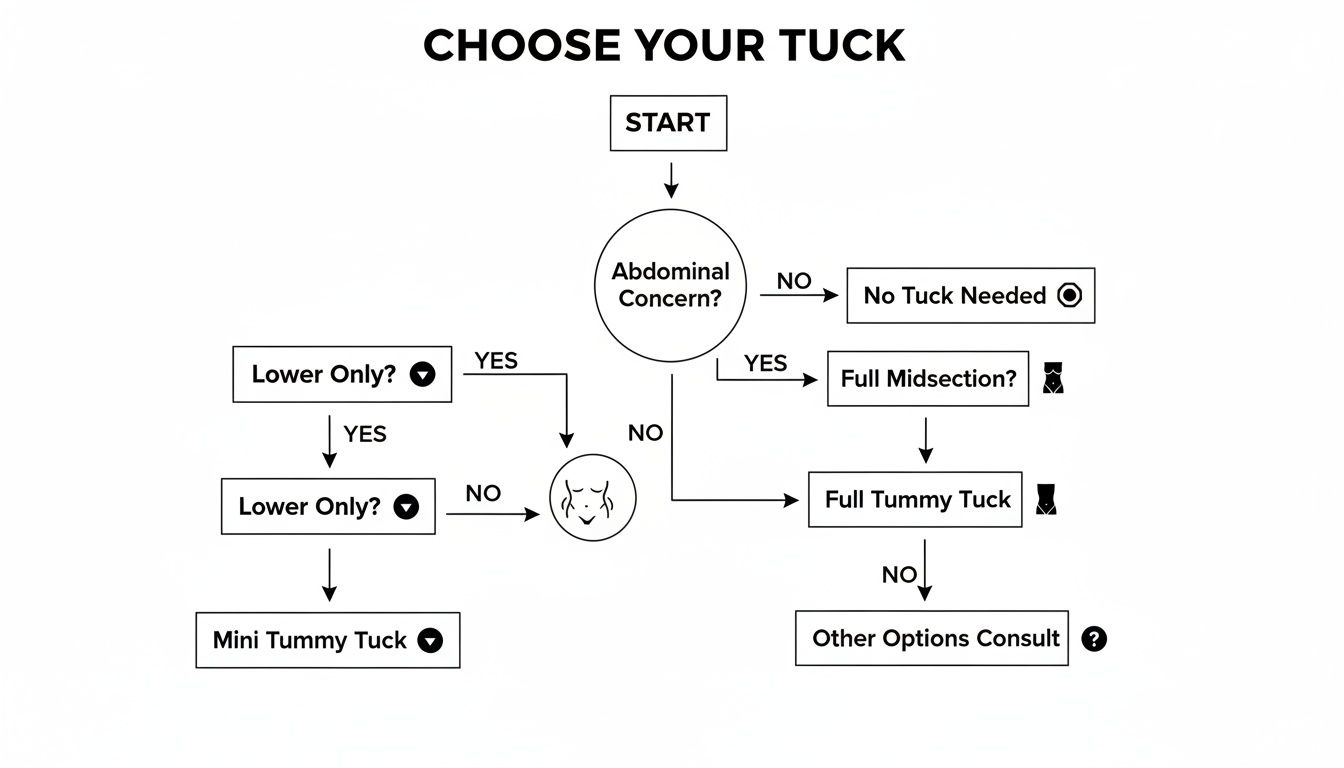
The flowchart helps simplify that initial self-assessment. It clearly shows how concerns isolated to the lower abdomen point toward a mini procedure, while issues affecting the full midsection almost always require a more comprehensive approach.
Picture someone who is already at or very close to their ideal body weight. They live a healthy lifestyle but are constantly bothered by a small, persistent "pooch" of skin and fat right below their belly button that just won't go away. This is the classic candidate for a mini abdominoplasty. Their concern is very specific and localized.
Here are the key traits of an ideal candidate for a mini tummy tuck:
A mini tuck is for the patient who looks in the mirror and thinks, "If I could just fix this one small area, I would be happy." It refines the lower abdomen, but it cannot and will not change the appearance of the upper stomach.
In my experience, only a "fairly small percentage" of patients who come in for a consultation are truly ideal candidates for a mini procedure. Many people discover during their exam that their concerns, especially muscle laxity, are more extensive than they first thought.
Now, let's consider a different person. Maybe a woman who has had a couple of children, or someone who has lost a significant amount of weight. They often have loose skin both above and below the navel, stretched abdominal muscles, and a belly button that might look distorted or hooded. This patient needs a full abdominal reconstruction, making them a perfect candidate for a traditional tummy tuck.
A full tummy tuck candidate typically has:
Being at a healthy, stable weight is crucial for the safety and success of either surgery. You can learn more about why this is so important by reading our guide on the ideal BMI for a tummy tuck.
While both procedures deliver high satisfaction, the sheer versatility of a full tummy tuck often makes it the more common recommendation. The numbers back this up—global statistics show an impressive overall patient satisfaction rate of 97% for abdominoplasty. In one study analyzing 55,596 patients, the complication rate was a low 2.1%, though full tucks naturally carry slightly higher risks simply because they are more invasive.
Once we move past the surgical details and who makes a good candidate, we get to what most patients really want to talk about: the recovery process and the scars left behind. Let’s be honest, this is the practical side of things. It’s what dictates how much time you need off work, who you’ll need to help you at home, and what you’ll see in the mirror long-term. The differences between a mini tummy tuck vs. a tummy tuck here are night and day.
A full tummy tuck is a major surgery, and the recovery reflects that. You should plan on taking two to three weeks completely off from work and your usual routine. That first week is all about resting, managing your comfort level, and dealing with surgical drains—a near-universal part of this procedure used to keep fluid from building up.
On the other hand, a mini tummy tuck gets you back on your feet much faster. Since it’s a less extensive operation, most people feel up to returning to a desk job and light activities in just one to two weeks. You’ll still need to take it easy, of course, but the overall downtime is significantly less.

For both procedures, you'll be living in a compression garment for a while. This isn't just for comfort; it's a critical tool that helps control swelling, supports your healing tissues, and helps shape your new abdominal contour. It’s especially vital after a full tummy tuck, where the swelling can be quite substantial due to the extensive muscle work.
No matter which surgery you have, sticking to your surgeon’s post-op plan is the single most important thing you can do. For a deeper dive, check out our guide with tummy tuck recovery tips to help you prepare for a smooth healing process.
The biggest difference in early recovery is your independence. A full tummy tuck patient will absolutely need a helper for that first week or so. A mini tummy tuck patient often feels capable of managing on their own much, much sooner.
To help with that post-op swelling, some patients find other therapies useful. For instance, once you get the green light from your surgeon, a gentle lymphatic drainage massage can do wonders to reduce fluid retention and make you feel more comfortable in the weeks after your surgery.
The scars are probably the most permanent and obvious difference between these two operations. The incision your surgeon makes is directly tied to the amount of correction you need, so the scar tells the story of the surgery itself.
A full tummy tuck will leave you with two scars:
In contrast, a mini tummy tuck leaves just one scar:
This table breaks down what you can expect from the healing process for each surgery.
At the end of the day, while a shorter recovery and a smaller scar are certainly appealing, the right choice always comes down to what it will take to give you the beautiful, natural-looking result you’re hoping for.
When you’re weighing a mini tummy tuck vs. a full tummy tuck, the financial side of things is naturally a huge factor. It’s easy to get fixated on the price tag, but the smarter way to look at it is to consider the total investment and what you're actually getting for your money. A lower upfront cost doesn't mean much if it doesn't deliver the result you're hoping for.
The biggest reason for the price difference comes down to surgical time and complexity. A full tummy tuck is simply a more involved, longer operation, and that time in the operating room trickles down to affect every part of the final bill.
The quote you get from a surgeon's office isn't just one arbitrary number; it’s a package of several distinct costs. Breaking it down helps you see exactly where your money goes and why the prices vary so much between the two procedures.
A typical all-inclusive quote will cover:
Always make sure your quote is comprehensive to avoid any surprise bills later. A transparent, detailed breakdown is a sign you're working with a reputable practice.
Costs can definitely shift depending on where you live and your surgeon's reputation, but we can talk in general ranges. The mini tummy tuck is always the less expensive option, but that discount directly reflects the difference in what the surgery can accomplish.
For example, most board-certified surgeons in the U.S. find that a mini tummy tuck is often 20-30% cheaper than a full one. You'll typically see a mini tummy tuck averaging between $6,000 and $8,000, while a full tummy tuck can range from $8,000 to $12,000 and sometimes more. This makes perfect sense when you remember a mini tuck might only take one or two hours, while a full abdominoplasty can keep you in the OR for three to five hours. To see more of these cost differences, it's often helpful to explore plastic surgery practice websites for more detailed insights.
The most important question isn't "Which procedure costs less?" but rather "Which procedure will deliver the result I want so I only have to do it once?" Investing in the correct surgery from the start is the most cost-effective decision you can make.
True value in plastic surgery is getting a result you love—one that makes you feel confident for years to come. Think about it this way: for someone with significant loose skin above their belly button and separated abdominal muscles, a mini tummy tuck would be a poor investment, regardless of its lower cost. It simply can't fix those issues, which would likely lead to disappointment and the need for a second, more expensive revision surgery down the road.
On the flip side, if you're an ideal candidate with just a small pooch below the navel, paying for a full tummy tuck would be overkill. The higher cost and longer recovery wouldn't give you any extra benefit because your anatomy just doesn't need that level of correction. The key is to match the surgical solution to the anatomical problem. That’s how you ensure your financial investment aligns perfectly with your aesthetic goals, giving you the best possible value in the long run.
Even after you've looked at the surgical techniques, recovery times, and cost estimates, it's completely normal to still have a few questions when comparing a mini tummy tuck vs. a full tummy tuck. This is a big decision, and getting clarity on every last detail is key.
We've put together some of the most common questions we hear from patients right here in our office. Getting these answers often helps solidify the real-world differences between a targeted touch-up and a complete abdominal overhaul.
This is one of the most critical questions, and it highlights a major difference between the two surgeries. The short answer is no; a mini tummy tuck is not designed to repair significant muscle separation (diastasis recti). The surgical field is limited to the lower abdomen, which means a surgeon can only tighten very minor looseness below the navel, if that.
A full tummy tuck, on the other hand, is the go-to procedure for repairing separated muscles along the entire abdominal wall. This is the part of the surgery that truly restores core strength, flattens the whole stomach, and brings in the waistline in a way a mini procedure just can't.
Surgical drains are there for a reason—they prevent fluid from building up (a seroma) and help you heal properly. Whether you'll need them really depends on how extensive the surgery is.
The presence of drains is a direct indicator of the surgery's scale. While managing them can be a temporary inconvenience, they are a critical tool for ensuring a smooth and safe recovery, especially after a comprehensive procedure like a full tummy tuck.
Absolutely. In fact, adding liposuction is incredibly common and takes the results of both procedures to the next level. We often call this a lipoabdominoplasty. It allows for much better shaping by removing stubborn fat pockets at the same time we're dealing with the loose skin.
With a full tummy tuck, we frequently use liposuction on the flanks, hips (the "love handles"), and back to create a more defined, hourglass-type figure. It allows us to treat the entire torso for a more balanced and impressive result.
When it comes to a mini tummy tuck, liposuction is great for fine-tuning the lower abdomen or targeting small, nearby fat deposits on the hips. It simply enhances the outcome of the smaller procedure, making sure the area we treat blends beautifully with your natural curves.
A consultation with a surgeon is the only way to know for sure, but there’s a simple "pinch test" you can do at home to get a general idea. Stand up, relax your stomach muscles, and gently pinch the roll of skin and fat above your belly button.
If you can easily pinch more than a couple of inches of loose skin there, you are almost certainly a better candidate for a full tummy tuck. This signals that you have significant skin laxity above the navel—a problem a mini tummy tuck is physically unable to fix. A mini's scope is strictly below the belly button, so it can't address any sagging or looseness higher up.
Of course, this is just a guide. A board-certified plastic surgeon will need to do a physical exam to properly assess your skin elasticity, muscle condition, and your overall concerns before making a definitive recommendation.
Ready to discover which procedure is the perfect fit for your aesthetic goals? The next step is a personalized consultation. At Cape Cod Plastic Surgery, Dr. Fater and our experienced team are here to provide the expert guidance you need to make a confident decision. Schedule your consultation today and begin your journey toward a more confident you.
October 5, 2026
Why Our On-Site Accredited Facility Matters for Your Safety

October 2, 2026
Beyond the Calendar: How to Know You’re Truly Ready for Plastic Surgery

October 2, 2026
Exploring Your Breast Augmentation Options: Implants, Shapes, and What to Expect

Cape Cod Plastic Surgery offers expert cosmetic and reconstructive procedures in a safe, accredited setting. Led by Dr. Marc Fater, we combine advanced techniques with personalized care to help you look and feel your best.
Monday: 9:00 AM – 5:00 PM
Tuesday: 9:00 AM – 5:00 PM
Wednesday: 9:00 AM – 5:00 PM
Thursday: 9:00 AM – 5:00 PM
Friday: 9:00 AM – 5:00 PM