

September 9, 2026
How to Care for Surgical Incisions Properly
Expert Guide to Proper Surgical Incision Care
Jun 17, 2026

You've done the work. You've healed from pregnancy, settled into life with your child, cleaned up your diet, and returned to exercise. Yet every time you pull on jeans or catch your reflection from the side, the same lower abdominal fullness is still there. Maybe it's loose skin that folds over leggings. Maybe it's a rounded “pooch” that makes you look a few months pregnant even though you aren't. Maybe your core just doesn't feel the way it used to.
That frustration is common, and it's valid. Pregnancy changes the abdomen in ways that discipline alone often can't reverse. Skin can stretch beyond its ability to tighten back down. Fat can collect in stubborn pockets. The abdominal wall itself can widen and weaken.
That's why many women start looking into a post pregnancy tummy tuck. This isn't about failing at fitness. It's about recognizing that some postpartum changes are structural, not behavioral. If you've also been looking for practical ways to understand loose skin after childbirth, this guide on how to get rid of loose skin after pregnancy is a helpful companion.
A tummy tuck, also called abdominoplasty, is designed for a very specific set of problems. It's not a weight-loss procedure, and it's not the right answer for every postpartum body. But for the right patient, it can address the exact combination of changes pregnancy often leaves behind.
What makes this confusing is that many women describe all of these issues with one word: “pooch.”
That one word can mean very different things:
If you don't separate those problems mentally, it's hard to understand what surgery can and can't do. That's where a good consultation matters. A surgeon doesn't just ask what bothers you visually. They also evaluate how your tissues feel, where the fullness sits, whether the muscle separation extends above the belly button, and whether your goals are mostly contour, core support, or both.
Many postpartum patients think they need “skin removal” when the main driver is muscle separation. Others think they need muscle repair when the real issue is lower abdominal skin laxity.
That distinction shapes everything else, especially whether a mini or full tummy tuck makes sense.
A post pregnancy tummy tuck is best understood as a repair of three separate layers. If you only think about the skin, you'll miss why the operation can improve shape so dramatically in some women and only modestly in others.
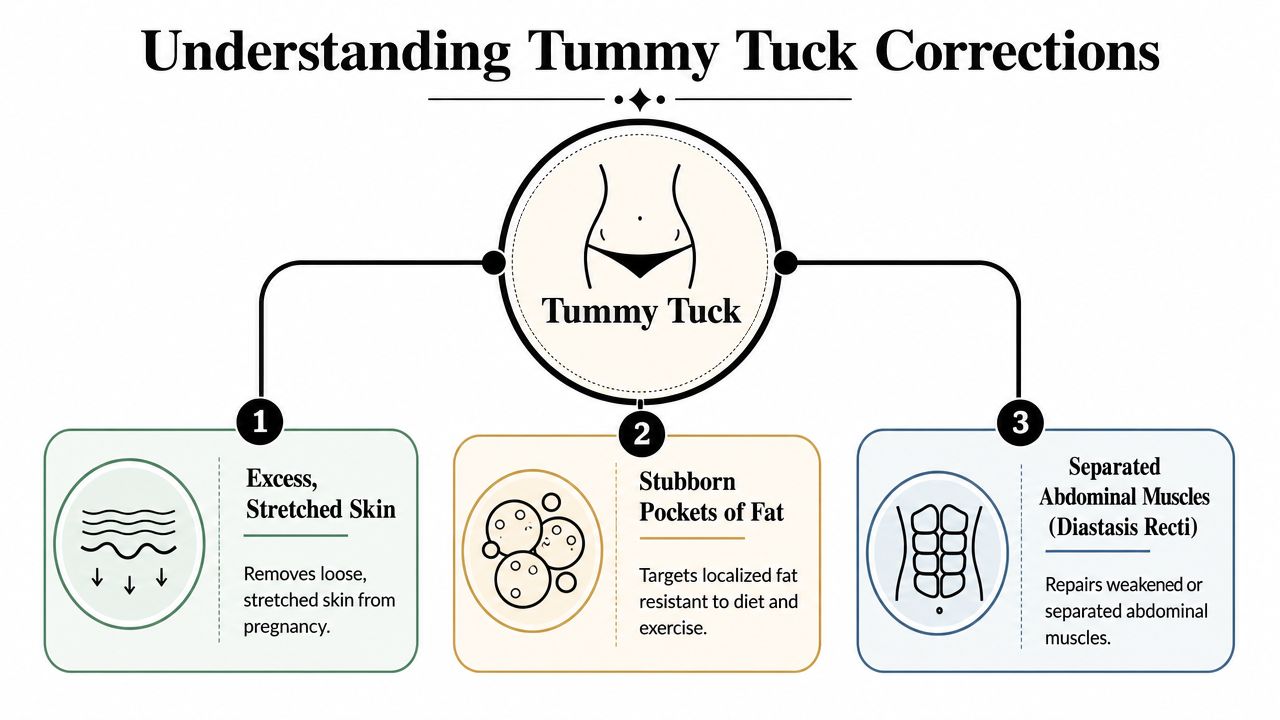
Pregnancy stretches the abdominal skin like the fabric on a well-used sweater. Sometimes it recoils well. Sometimes it doesn't. When the skin has lost elasticity, no amount of planking or clean eating will make excess skin disappear.
A tummy tuck removes that extra skin directly. This is why patients with folds, wrinkling, or skin overhang often see the most obvious visual change.
Some postpartum abdominal fullness comes from localized fat, not just stretched skin. A tummy tuck can remove skin and improve contour, and in some cases surgeons combine it with liposuction to smooth transitions and reduce stubborn pockets.
That matters because a flatter abdomen usually comes from treating the whole contour, not just pulling skin tight.
The most misunderstood issue is rectus diastasis, which is the separation of the vertical abdominal muscles after pregnancy. The procedure is specifically used to correct rectus diastasis by tightening the muscle layer and removing excess skin and fat, and experts advise waiting at least 6 months after delivery, often 6 to 12 months after a C-section, so tissues have healed and weight has stabilized, as explained by the American Society of Plastic Surgeons in its overview of mommy makeover timing and rectus diastasis repair.
Imagine the abdominal muscles as an internal corset that has loosened at the center seam. Exercise can strengthen the muscles themselves, but it can't always bring that stretched midline back together once it has widened significantly. During surgery, the muscle layer is tightened to restore support and improve abdominal contour.
If you're still sorting out whether your gap may improve on its own, this patient-friendly guide on how long diastasis recti takes to heal can help frame what healing may look like before surgery becomes part of the conversation.
Ask yourself these questions:
Practical rule: The more your concern involves both appearance and core support, the more important the muscle layer becomes in your surgical plan.
Most women know they don't want surgery too soon after childbirth. What they often don't know is how to tell when “soon” becomes “reasonable.” I suggest thinking about timing as a checklist, not a date on a calendar.
A helpful visual can make those milestones easier to grasp.
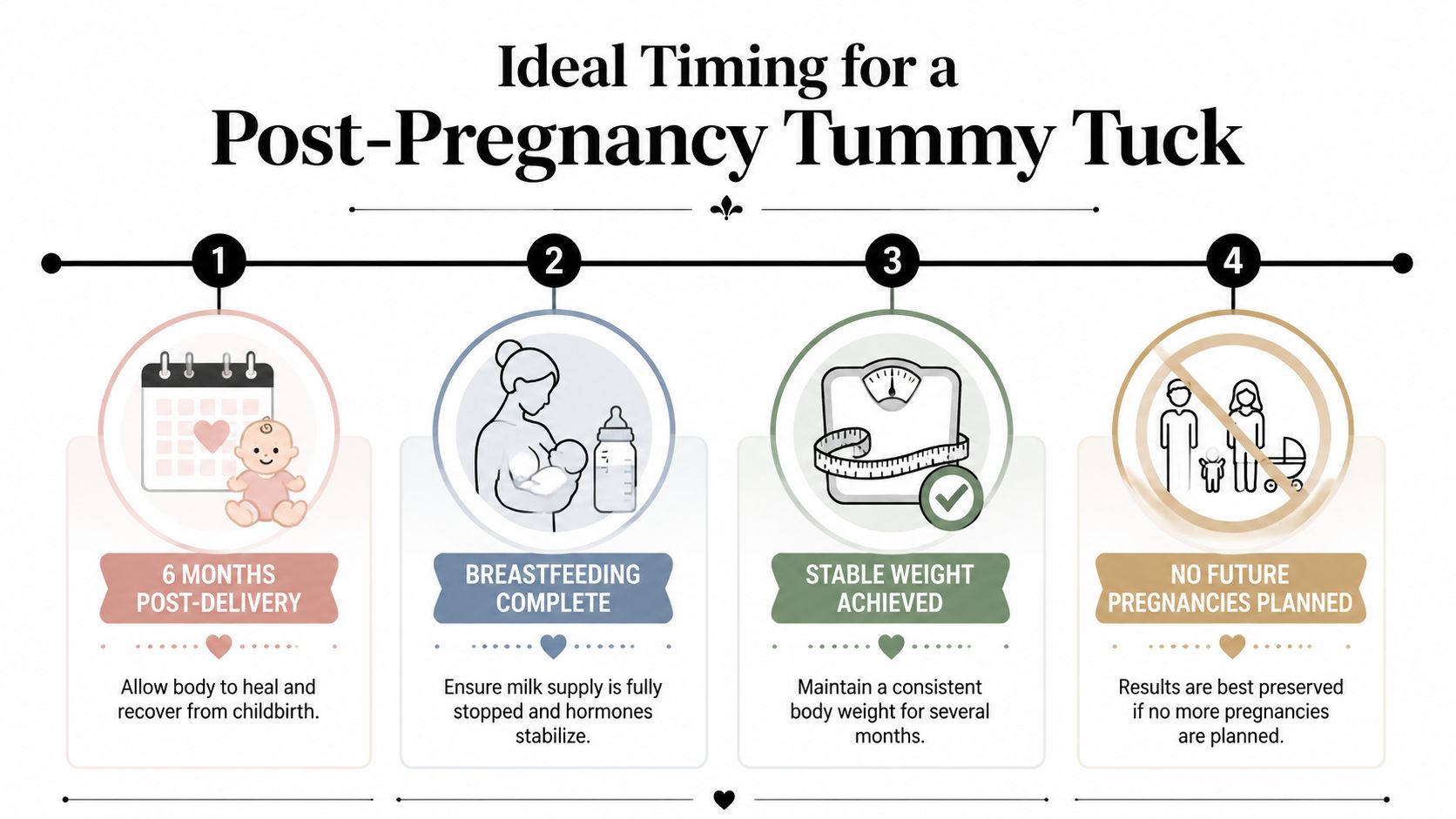
A widely used benchmark is to wait at least 6 months after delivery, and many surgeons want your weight to be stable for 2 to 3 months before surgery because pregnancy-related tissue changes, breastfeeding, and weight fluctuation can affect planning and results, as discussed in this review of timing after pregnancy for a tummy tuck.
That timeline isn't arbitrary. Right after pregnancy, your tissues are still changing. Skin is retracting as much as it can. Hormones are shifting. The uterus has only recently returned to baseline. If you operate during that moving-target stage, it becomes harder to judge how much correction is needed.
If you're breastfeeding, your body is still in a postpartum hormonal state. Many women also underestimate the practical side of recovery. You'll need help with childcare, especially if you have a baby or toddler who still wants to be carried.
Later in this section, I want you to hear directly from a surgeon discussing common timing questions after childbirth.
This is one of the most important questions in the whole process. A later pregnancy can stretch the skin and abdominal wall again, which may change your result.
More than that, there are obstetric considerations. A 2024 retrospective study found that pregnancy after abdominoplasty was associated with higher odds of preterm delivery, with an odds ratio of 2.13 and a 95% confidence interval of 1.48–3.13, after matching. The authors also noted a relative increase in cesarean delivery rates, while concluding that future pregnancy is not a contraindication to abdominoplasty. The abstract also references a 2023 case report showing that pregnancy can still lead to abdominal bulging after muscle repair. You can review that evidence in this study abstract on pregnancy after abdominoplasty.
That doesn't mean you must be absolutely certain you'll never become pregnant again. It means you should treat future pregnancy as a serious planning factor, not an afterthought.
You're usually closer to ready when these statements feel true:
The best time for a post pregnancy tummy tuck is when your anatomy, your schedule, and your family plans are all aligned.
Many online explanations fall short on this point. They reduce the choice to one idea: a mini tummy tuck is for a small problem, and a full tummy tuck is for a big problem. That's too simplistic.
The primary concern is not just how much skin you have. It's where the problem lives and whether you want muscle repair that improves core support as well as shape.
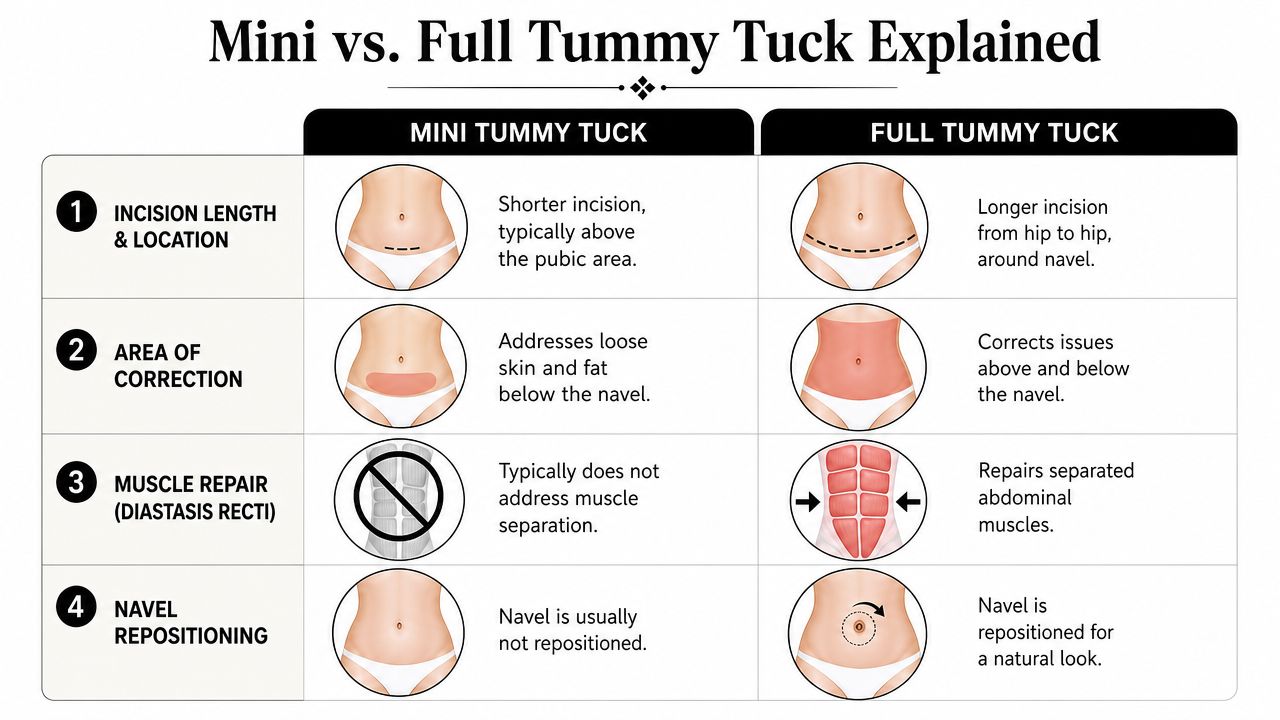
A mini tummy tuck is usually best for someone whose concerns are concentrated below the belly button. This often includes a small lower abdominal pouch, mild loose skin, or laxity near a prior C-section scar.
The incision is shorter, and the belly button usually isn't repositioned. For the right patient, that can be a very elegant operation. But it has limits. If your abdominal wall bulges above the navel, a mini procedure usually won't fully solve the problem.
A full tummy tuck addresses the abdomen more completely. It's generally the better fit when skin laxity and muscle separation involve both the upper and lower abdomen.
That matters functionally. The choice often hinges on the location and severity of diastasis recti. A mini tuck targets the lower abdomen with a smaller incision, while a full tummy tuck is necessary to repair muscles both above and below the navel, providing more complete core tightening, as explained in this patient guide on mini versus full tummy tuck decision-making.
| Question | Mini tummy tuck | Full tummy tuck |
|---|---|---|
| Where is the loose skin? | Mainly below the navel | Above and below the navel |
| Is the belly button repositioned? | Usually no | Usually yes |
| Can it address broad muscle separation? | Limited | Yes, more comprehensively |
| Who tends to benefit most? | Patients with isolated lower abdominal laxity | Patients with postpartum contour changes across the whole abdomen |
If your main complaint is, “I still look poochy,” ask one more question: “Do I also feel weak through the middle?” If the answer is yes, the operation has to be judged by more than the scar length.
A common example is the patient who looks relatively slim from the front but still has a rounded side profile and a sense that her core never reconnected after pregnancy. That patient may not need the “smallest” operation. She may need the operation that repairs the structure causing the bulge.
For a deeper look at candidacy differences, this comparison of mini tummy tuck vs tummy tuck walks through those distinctions in practical terms.
Liposuction and tummy tuck surgery solve different problems. Liposuction removes fat. It does not remove loose skin or repair muscle separation. That's why liposuction alone often disappoints postpartum patients whose real issue is tissue laxity or diastasis.
In contrast, some surgical plans combine liposuction with a mini or full tuck to refine the waist and smooth contour transitions. The right combination depends on your anatomy, not on choosing the least invasive label.
A shorter scar isn't automatically a better result if it leaves the main functional problem untreated.
Recovery is where good planning pays off. Most women don't struggle because recovery is mysterious. They struggle because they expect it to move faster than biology allows.
The Mayo Clinic notes that patients typically need 6 to 8 weeks of abdominal binder support, should avoid strenuous exercise for at least 8 weeks, swelling can persist for up to 3 months, and scars may continue to improve for up to 1 year. The same guidance notes that some patients may need about 2 to 4 weeks off work depending on job demands. You can review that timeline in the Mayo Clinic's overview of tummy tuck recovery and healing milestones.
Expect to walk carefully, rest often, and rely on help at home. You may feel tight through the abdomen, especially when standing upright. That tightness doesn't mean something is wrong. It often reflects the repaired muscle layer and the tension of closure.
This is not the time to test your independence. Arrange meals, childcare help, and a sleeping setup that doesn't force you to twist or sit straight up abruptly.
This is the stage where many patients feel “better” but aren't yet healed. You may be moving more comfortably and returning to desk-based work if your surgeon clears you, but swelling is still present and your internal repair is still vulnerable.
Useful priorities during this period include:
By the time you feel more like yourself, you may assume the result you see is the final one. It usually isn't. Swelling resolves gradually, and scar quality changes over many months.
That's why photos taken very early can be emotionally misleading. A patient may love the flatter shape but fixate on firmness, swelling, or a pink scar that hasn't had time to settle.
Recovery mindset: Judge progress in seasons, not days.
| Recovery window | What usually matters most |
|---|---|
| First several days | Rest, short walks, assistance at home, protecting the incision |
| Early weeks | Compression, posture, activity limits, follow-up visits |
| Later healing | Gradual return to exercise after clearance, swelling improvement, scar care |
Some patients also explore noninvasive comfort aids or skin-support products during healing. If you're curious about adjunctive recovery tools, you can explore MEDISTIK's healing advantages to understand how some people think about discomfort management and healing support. That doesn't replace your surgeon's instructions, but it can help you ask more informed questions.
Every surgery has risks, and a tummy tuck is no exception. These can include bleeding, infection, healing problems, fluid collection, anesthesia-related complications, scarring, contour irregularity, and dissatisfaction if expectations weren't realistic from the start.
The way you reduce those risks is not by pretending they don't exist. It's by choosing carefully, planning realistically, and following postoperative instructions closely. The safest path usually includes a board-certified plastic surgeon, a thorough medical review, and an accredited operating environment.
Some women focus entirely on the surgical event and forget to discuss future pregnancy. As noted earlier in the article, pregnancy after abdominoplasty isn't considered prohibited, but the 2024 study discussed above found a higher odds of preterm delivery, with an odds ratio of 2.13, which is why family planning belongs in the consultation conversation.
That issue sits alongside a simpler cosmetic truth. A future pregnancy can stretch repaired tissues again and change the result you paid for.
Non-surgical treatments absolutely have a role, but they don't do the same job.
A good rule is simple. If the problem is skin excess or significant muscle separation, non-surgical treatment may improve the edges of the issue, but it won't recreate what surgery physically repairs.
Choosing a surgeon for a post pregnancy tummy tuck shouldn't start with social media photos. It should start with credentials, judgment, and the environment where surgery happens.

Look for these basics first:
If you're comparing local options, this guide on finding a plastic surgeon gives a useful checklist for evaluating credentials and fit.
For readers on Cape Cod, Cape Cod Plastic Surgery is one local option for consultation. The practice information provided by the publisher states that Dr. Marc Fater is a board-certified plastic surgeon with over 30 years of experience, and the facility includes an on-site, AAAASF-accredited surgical suite.
Those details matter because a tummy tuck is not a commodity procedure. It requires a surgeon who can assess not just how to remove skin, but how to balance scar placement, contour, muscle repair, recovery planning, and your long-term goals.
Cost and insurance also come up often. In most cases, a cosmetic tummy tuck is treated as an elective procedure rather than an insurance-covered medical necessity. The most useful next step is a personalized consultation where you can discuss whether your concern is mostly skin, fat, muscle separation, or a combination.
If you're considering a Cape Cod Plastic Surgery consultation, use it as a chance to get a precise diagnosis of what's causing your postpartum abdominal changes and which treatment path matches your goals.
September 9, 2026
Expert Guide to Proper Surgical Incision Care

Master dermal fillers aftercare with do's and don'ts, swelling tips, activity limits and warning signs to protect your results and heal smoothly.

September 8, 2026
Ensuring Safety: Why Your Surgeon's Credentials Matter Most

Cape Cod Plastic Surgery offers expert cosmetic and reconstructive procedures in a safe, accredited setting. Led by Dr. Marc Fater, we combine advanced techniques with personalized care to help you look and feel your best.
Monday: 9:00 AM – 5:00 PM
Tuesday: 9:00 AM – 5:00 PM
Wednesday: 9:00 AM – 5:00 PM
Thursday: 9:00 AM – 5:00 PM
Friday: 9:00 AM – 5:00 PM