
September 9, 2026
How to Care for Surgical Incisions Properly
Expert Guide to Proper Surgical Incision Care
Mar 22, 2026
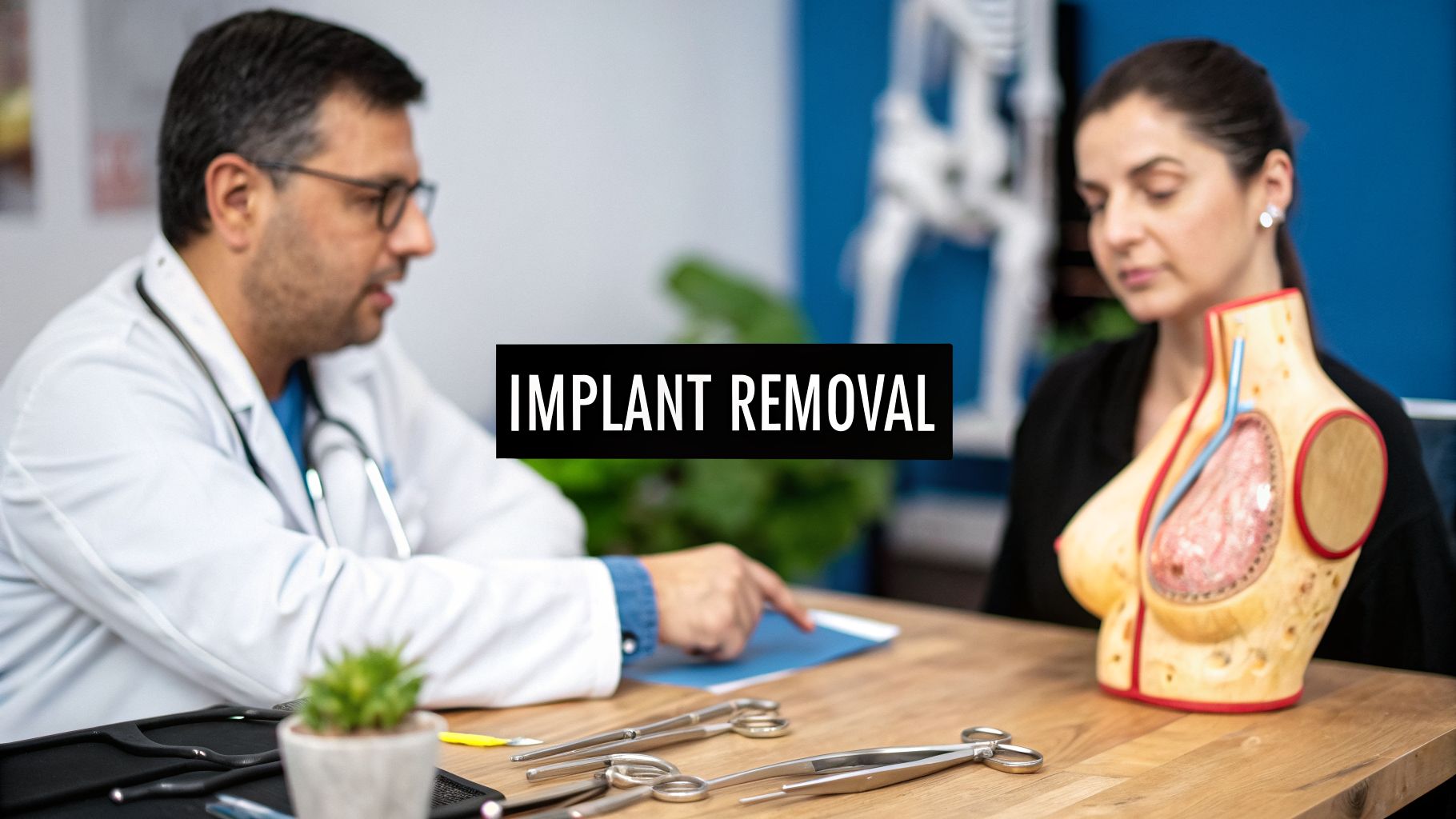
Considering breast implant removal is a significant decision, but it's a path more and more women are choosing every year. Whether it's for health reasons, a lifestyle change, or simply the desire for a more natural look, you're taking a step toward reclaiming a sense of comfort and confidence in your own body.
Making the choice to move on from breast implants is deeply personal, and it's a journey we understand well here at Cape Cod Plastic Surgery. Our goal is to give you clear, honest information, breaking down everything from your surgical options to what recovery really looks like.
We're here to help you feel informed and empowered as you explore what's next.

This isn't just a passing trend—it's a real shift in how women view their bodies and their health. The reasons for choosing explant surgery are as unique as the women themselves, ranging from medical concerns to a simple change in personal style.
The numbers tell a powerful story. In the U.S., we’ve seen an explosive 653% increase in breast implant removal surgeries between 2008 and 2021. Some women are responding to known health risks, while many others are embracing a more natural, athletic aesthetic.
In 2021 alone, nearly 219,000 women had their implants removed, and a full third of them decided against getting new ones. You can discover more insights about why women are removing their breast implants and see just how common this choice has become.
For many women, however, the process doesn't end with just removing the implants. The next step often involves a breast lift to restore shape and firmness to the breast.
Think of your skin and breast tissue like a balloon. After being stretched by an implant for years, simply removing the implant (like letting the air out) often leaves the "balloon" deflated and saggy. The skin doesn't just snap back to its original shape.
The goal of an explant with a lift is to not only remove the implant but to artfully reshape the remaining tissue, creating a youthful and natural contour that feels entirely your own.
This is why combining the explant with a mastopexy (the medical term for a breast lift) is such a popular and effective option. The lift removes excess, stretched-out skin, tightens the underlying tissue, and repositions the nipple for a perkier, more youthful look.
To make this clearer, here’s a quick comparison to help you understand the fundamental differences at a glance.
| Consideration | Breast Explant Only | Breast Explant with Lift (Mastopexy) |
|---|---|---|
| Primary Goal | Remove breast implants and scar tissue (capsule). | Remove implants and reshape the natural breast tissue. |
| Best For | Women with good skin elasticity and minimal sagging. | Women with stretched skin, sagging, or downward-pointing nipples. |
| Final Appearance | A smaller, often flatter and less projected breast shape. | A smaller, but lifted, firmer, and more youthful breast shape. |
| Incisions | Typically uses the original augmentation incision. | Requires additional incisions to remove skin and reposition the nipple. |
| Recovery | Generally shorter and less complex. | More involved recovery due to the additional tissue reshaping. |
Ultimately, choosing an explant with a lift addresses the volume loss and the changes to the breast shape, providing a more comprehensive and aesthetically pleasing result for most patients.
Deciding to remove your breast implants is a deeply personal journey. For most women I see here on Cape Cod, it’s not a conclusion they arrive at quickly. It’s a choice that comes after a lot of thought about their health, their lifestyle, and how they want to feel in their own skin.
The reasons are as unique as the women who make them, but they generally fall into two camps. Some women are driven by physical health concerns, while others are motivated by a desire to align their bodies with who they are today. Whatever the path, the destination is the same: feeling comfortable, confident, and authentically yourself.
For many women, the conversation about removing breast implants and lift starts with a health concern. The body is a complex system, and sometimes it can react to implants in ways that cause anything from nagging discomfort to more serious medical problems.
These health-related drivers are very real and often include:
Sometimes, vague health concerns may also point toward a hormonal imbalance, which can have overlapping symptoms with BII. Understanding your body's hormonal state can be an empowering piece of the puzzle. A good female hormone blood test guide can provide valuable insight as you explore your overall health.
Beyond purely medical issues, a growing number of women are choosing explant surgery simply because their implants no longer fit their life. What felt right ten or twenty years ago may not match their vision for themselves today.
This is often about moving toward a more natural look and feel that reflects a new chapter. It's a decision rooted in self-acceptance and personal freedom.
Some of the most common aesthetic and lifestyle reasons I hear include:
Whether your reasons are medical, aesthetic, or a mix of both, choosing to move forward with implant removal is a powerful and valid decision. It’s the first step toward a silhouette that makes you feel healthy, comfortable, and completely at home in your body.
Once you’ve decided to move on from your breast implants, the next step is figuring out the best surgical approach for you. This isn’t about a standard, one-size-fits-all procedure; it’s about creating a plan that matches your body, your goals, and your reasons for wanting the implants out. The path you choose will define both your recovery and your final, natural shape.
I often use this analogy: removing an implant is like taking a heavy piece of art off a delicate curtain. The art is gone, but the fabric is often left stretched and sagging. For most women, addressing that stretched fabric is just as important as removing the object that caused it.
The most straightforward option is a standard explant, which means we surgically remove the breast implant. This procedure focuses on one thing: getting the implant out. In many cases, we’ll also remove the scar tissue capsule your body naturally formed around it.
This approach can work well for women with great skin elasticity and very little sagging. But for most patients—especially if you’ve had larger implants or have had them for many years—an explant alone can leave behind a "deflated" or empty look. The skin pocket that once held the implant is now empty, and it may not have the ability to shrink back on its own.
This brings us to the most common and complete procedure: removing breast implants and lift, a surgery that combines the explant with a mastopexy. This two-in-one approach doesn't just remove the implant; it beautifully addresses the changes it leaves behind.
A mastopexy, or breast lift, is designed to reverse sagging (ptosis) by doing three key things:
By combining the explant and the lift, we can create a perkier, firmer breast shape using only your natural tissue. It’s often the secret to a truly satisfying and natural-looking result. You can learn more about how a breast lift without implants works in our detailed guide on the topic.
Your personal reasons for removal—whether they’re related to health, lifestyle, or simply aesthetics—will play a big role in this decision.
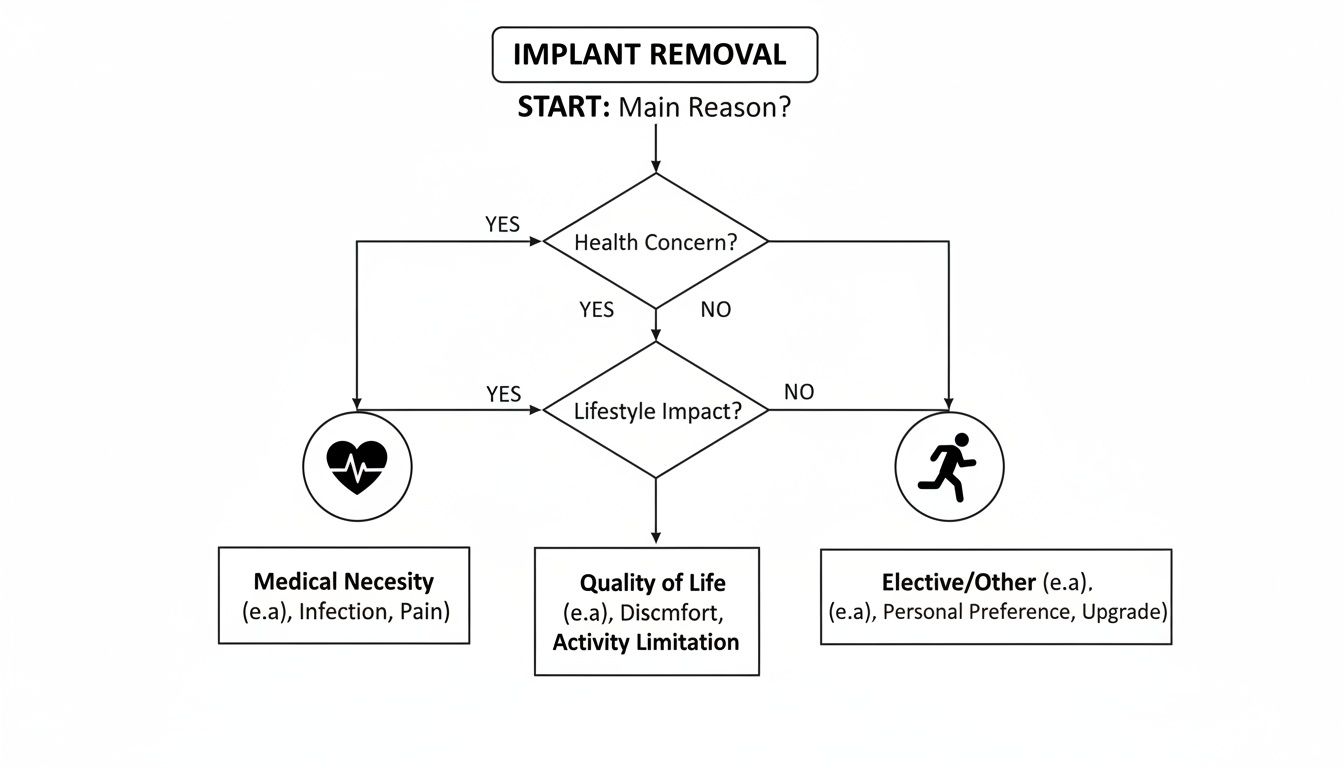
As you can see, the "why" behind your decision often points to the "how" of the surgery.
Whenever a foreign object like a breast implant is placed in the body, it’s completely normal for a layer of scar tissue, called a capsule, to form around it. What we do with this capsule during your explant surgery is a crucial part of the conversation.
A capsulectomy is the surgical term for removing this scar tissue. The technique I use will depend entirely on your specific situation and any health concerns you may have.
Deciding on the right capsulectomy technique is a key decision we’ll make together based on your anatomy, implant status, and overall health. During your consultation, we'll go over all these options to make sure your surgical plan is perfectly designed to give you the best and safest outcome.
Knowing what’s ahead can make all the difference in feeling prepared for your explant and lift surgery. Think of this as your roadmap, guiding you from your first conversations here at our Cape Cod practice all the way to feeling comfortable and confident in your final results. Let's walk through it step-by-step.
If you're considering this procedure, you’re certainly not alone. Explant surgery has become an increasingly common choice for women, whether for health reasons or simply because their aesthetic goals have changed. In the U.S., explant procedures surged to 219,000 in 2021—a 47% jump from the previous year. Worldwide, the number of women choosing to combine their explant with a lift doubled to over 320,000 by 2022 as more embraced a natural look. You can read more about these trends toward a natural aesthetic in our related article.
Everything starts with a conversation. During your private consultation, we’ll sit down together to really understand what you’re hoping to achieve. We'll go over your medical history, examine your breasts, and talk through all your options. This is your time to ask anything and everything on your mind so you can move forward with total confidence.
Once you’re ready, we'll schedule your pre-operative appointments. This is where we finalize the surgical plan, take your "before" photos, and give you a detailed set of instructions for the days leading up to surgery. Getting this preparation right is a key part of ensuring a smooth and safe procedure.
On surgery day, you’ll arrive at our accredited surgical facility in Hyannis. You'll have a chance to meet with your surgeon and anesthesiologist one more time to go over the plan. The surgery itself—combining the implant removal and breast lift—is done under general anesthesia, so you’ll be completely comfortable and asleep for the entire procedure.
Your surgeon will first carefully remove the implants and the scar tissue capsules around them. The next step is the "lift," where we artistically reshape your own breast tissue, remove any loose or excess skin, and reposition the nipple and areola to a higher, more youthful position. Afterwards, you’ll wake up in our recovery area, and once you're ready, a friend or family member can drive you home to begin your healing.
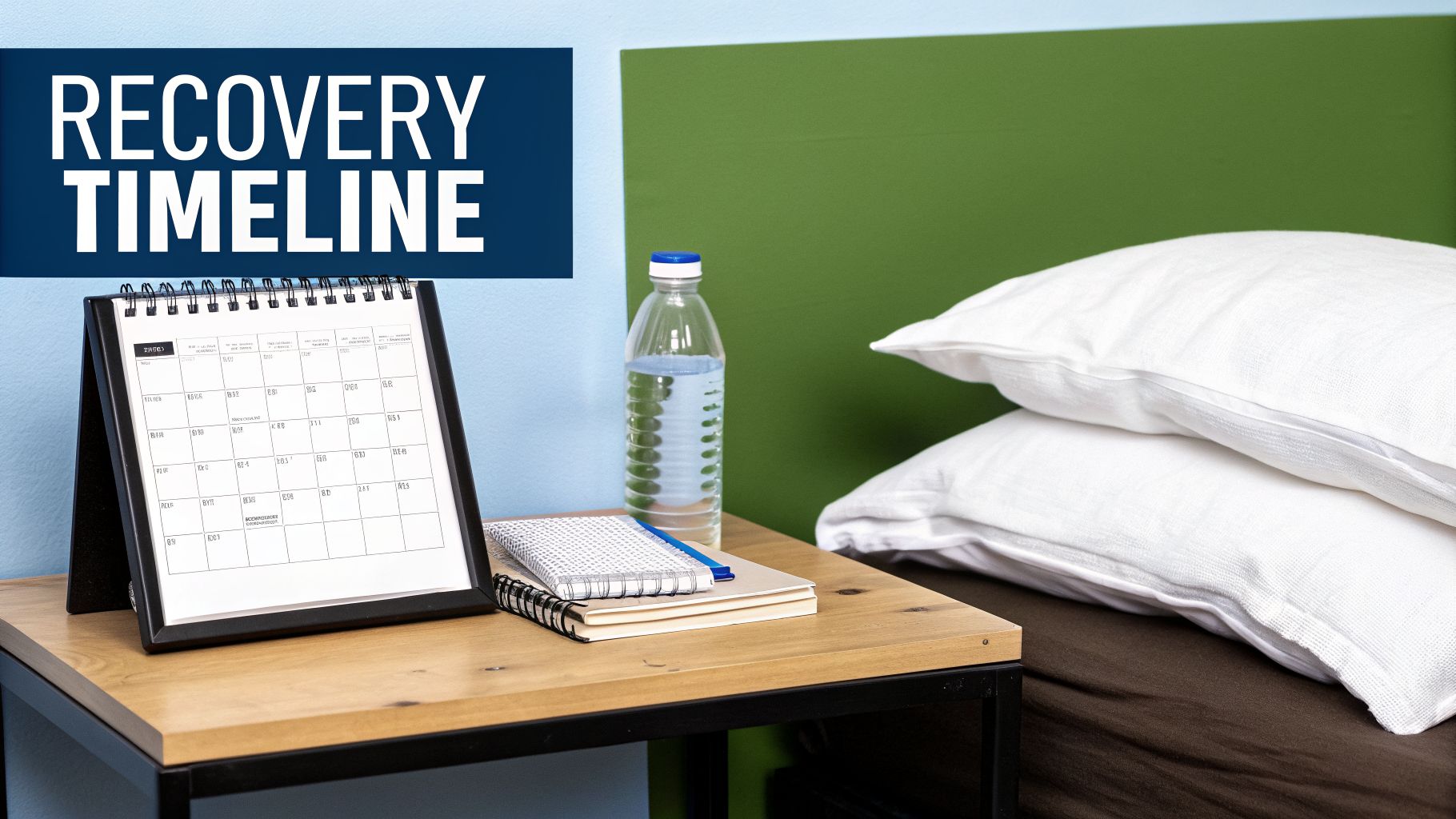
Your recovery is a journey, not a sprint. To help you plan, we've outlined the typical milestones you can expect. Keep in mind that everyone heals differently, but this timeline provides a great general framework.
This table breaks down the typical recovery journey week by week, helping you know what to expect and how to plan for your downtime.
| Timeframe | What to Expect | Activity Level |
|---|---|---|
| First 48 Hours | Swelling, bruising, and soreness are normal. Pain medication will keep you comfortable. Surgical drains may be in place. | Rest is your #1 job. Very limited movement. |
| Week 1 | Discomfort will lessen, but swelling remains. You’ll wear a supportive surgical bra around the clock. | Gentle walks around the house are good. No lifting, pushing, or pulling. |
| Weeks 2-4 | You’ll start to feel much more like yourself. Incisions are healing, and energy levels are returning. | Most people can return to desk jobs. Still no strenuous exercise or heavy lifting (nothing over 10 lbs). |
| Weeks 4-6 | Swelling continues to go down, and your new breast shape becomes more defined. | Light exercise (like longer walks) may be approved. Still avoiding heavy upper body workouts. |
| 6+ Weeks | You’re on the home stretch! Most residual swelling will resolve over the next few months. | Most patients are cleared to resume all normal activities, including full exercise. Ease back into it gradually. |
Following your surgeon's specific instructions is the most important thing you can do for a great outcome. For a more detailed look into this period, feel free to check out our complete guide on what to expect after breast implant removal.
By staying patient and sticking to the plan, you’ll navigate your recovery with confidence, getting closer each day to the beautiful, natural results you’ve been waiting for.
Once you start seriously considering explant surgery, two major questions almost always come to the forefront: "How much will this actually cost?" and "How on earth do I find the right surgeon for me?" These are perfectly normal—and incredibly important—questions. Let's walk through the answers so you can feel confident and prepared.
The price you're quoted for surgery isn’t just an arbitrary number. Think of it as a comprehensive package that brings together all the essential elements for a safe, high-quality procedure.
When we put together a surgical plan, the total cost is typically broken down into three key parts. Each one is non-negotiable for your safety and the success of your outcome.
A common question we get is about insurance coverage. For the most part, removing breast implants and a lift is considered a cosmetic choice, so insurance won't cover it. There are, however, rare exceptions. If you have a confirmed implant rupture or a severe case of capsular contracture, there's a medical reason for the removal, and your insurance provider might cover a portion of the cost. Our team is experienced in these situations and can help you figure out what's possible.
Of all the decisions you'll make, choosing your surgeon is by far the most important. This person isn't just performing an operation; they are your partner and guide through a deeply personal journey.
Finding a surgeon is about more than just credentials; it's about finding someone who listens, understands your vision, and has the proven skill to bring that vision to life safely. Your comfort and confidence in them are non-negotiable.
So, where do you start? Here are the absolute must-haves when vetting a potential surgeon:
Your surgeon should be your biggest advocate, working with you to create a plan that honors your body and achieves your goals. For a more detailed guide, take a look at our article on how to choose a surgeon for more practical tips.
It's completely understandable to have a few last-minute questions before deciding on a procedure as personal as removing breast implants and getting a lift. We've put together this section to answer the most common things we discuss with our patients right here in Cape Cod. The goal is to give you straightforward answers that clear up any remaining uncertainties.
Think of it as a final conversation to make sure you feel completely comfortable and confident before you even schedule your consultation.
This is, without a doubt, one of the most important questions women ask. When you have implants for years, the skin and breast tissue stretch to accommodate them. If you simply take the implant out, that stretched "pocket" of skin remains. For many, this leads to a look they describe as "deflated" or saggy.
What your breasts will look like really depends on your body—your skin's elasticity, how much natural breast tissue you have, and the size of the implants coming out. Often, the breast tissue will droop, and the nipples might point downward.
That’s why we so often recommend combining the explant with a breast lift. A lift is what allows us to reshape your own tissue, remove the extra skin, and create a firmer, higher, and more youthful breast shape.
When we meet for your private consultation, we'll do a careful assessment and give you a very honest, realistic idea of what you can expect with and without a lift.
Any surgery leaves a scar, but the art of plastic surgery is placing those incisions so they heal as discreetly as possible. When we combine an explant with a lift, the most common technique uses an anchor-shaped incision pattern.
This involves three fine lines that connect:
These scars are permanent, but they're the necessary trade-off for getting that lifted, reshaped contour you’re looking for. At first, they'll look red and a bit raised, but over the next year or so, they typically fade into thin, pale lines.
We're big believers in proactive healing. There are many effective scar management options available, and we’ll guide you through a detailed scar care plan to help you get the best possible result.
Many women come to us because they’re struggling with a cluster of symptoms—like chronic fatigue, joint pain, brain fog, or anxiety—that are often grouped together as Breast Implant Illness (BII). While BII isn't an official medical diagnosis yet, the stories we hear from patients are incredibly powerful.
A huge number of women tell us they feel remarkably better after removing their breast implants and lift, especially if a total capsulectomy is part of the surgery. One study found that an impressive 85% of women reported their overall health improved within just six months of their explant.
It’s important to have a realistic perspective, though. We can't promise a cure for everyone, as some of these symptoms might be from other health issues entirely. Having a thorough medical workup and an open conversation with your surgeon is the best way to understand what this surgery could realistically mean for your health.
Ready to take that next step? It’s easy. To talk about your goals for removing your implants and see if a lift is the right move for you, we invite you to book a private consultation.
Just give our Hyannis office a call or fill out the secure contact form on our website to set up a time. During your appointment, your surgeon will listen to your story, understand what you’re hoping for, and work with you to create a surgical plan that’s tailored to your body and your goals. We’re here to support you every step of the way.
At Cape Cod Plastic Surgery, Dr. Fater and our entire team are here to provide expert, compassionate care that puts you first. If you’re ready to explore what’s possible, we encourage you to schedule your personal consultation today.
September 9, 2026
Expert Guide to Proper Surgical Incision Care

Master dermal fillers aftercare with do's and don'ts, swelling tips, activity limits and warning signs to protect your results and heal smoothly.

September 8, 2026
Ensuring Safety: Why Your Surgeon's Credentials Matter Most
Cape Cod Plastic Surgery offers expert cosmetic and reconstructive procedures in a safe, accredited setting. Led by Dr. Marc Fater, we combine advanced techniques with personalized care to help you look and feel your best.
Monday: 9:00 AM – 5:00 PM
Tuesday: 9:00 AM – 5:00 PM
Wednesday: 9:00 AM – 5:00 PM
Thursday: 9:00 AM – 5:00 PM
Friday: 9:00 AM – 5:00 PM