
September 9, 2026
How to Care for Surgical Incisions Properly
Expert Guide to Proper Surgical Incision Care
Dec 30, 2025
You’ve made the exciting decision to have a rhinoplasty, and now the real journey begins. Knowing what to expect week by week is the key to a smooth and confident recovery. This process isn’t a single event; it's a gradual unfolding. Think of it like a sculptor slowly revealing a masterpiece—your new nose will emerge as the initial swelling gives way to subtle, beautiful definition over time.
Embarking on a rhinoplasty journey means preparing for a multi-stage healing process where patience is truly your greatest asset. The transformation doesn't happen overnight. Instead, it unfolds week by week, with each phase bringing you closer to your final, beautiful result. Understanding this timeline helps set realistic expectations and empowers you to handle your aftercare like a pro.
The first few days are the most intense, focused on resting and managing the immediate effects of surgery. As the days turn into weeks, you'll see a huge improvement as the bruising fades and swelling goes down. By the three-month mark, most of the major changes are visible, giving you a fantastic preview of the final outcome.
We can break down the healing process into a few key stages, each with its own set of milestones. Knowing what’s coming up makes the entire journey feel much more manageable.
The First Week: This is all about rest, managing discomfort, and looking forward to getting that splint off. That first look in the mirror post-splint is a big moment!
The First Month: You’ll notice a dramatic drop in swelling and bruising. You’ll feel much more comfortable returning to social situations and light daily activities.
Months Two to Six: This is the refinement stage. That last bit of stubborn swelling, especially at the tip of your nose, starts to finally go away, revealing much more definition.
One Year and Beyond: By the one-year mark, we consider the healing complete. All the tissues have settled into their new, permanent position, unveiling the stable, natural-looking result you’ve been waiting for.
This visual timeline gives a great overview of the key phases, from the initial swelling to the final reveal.
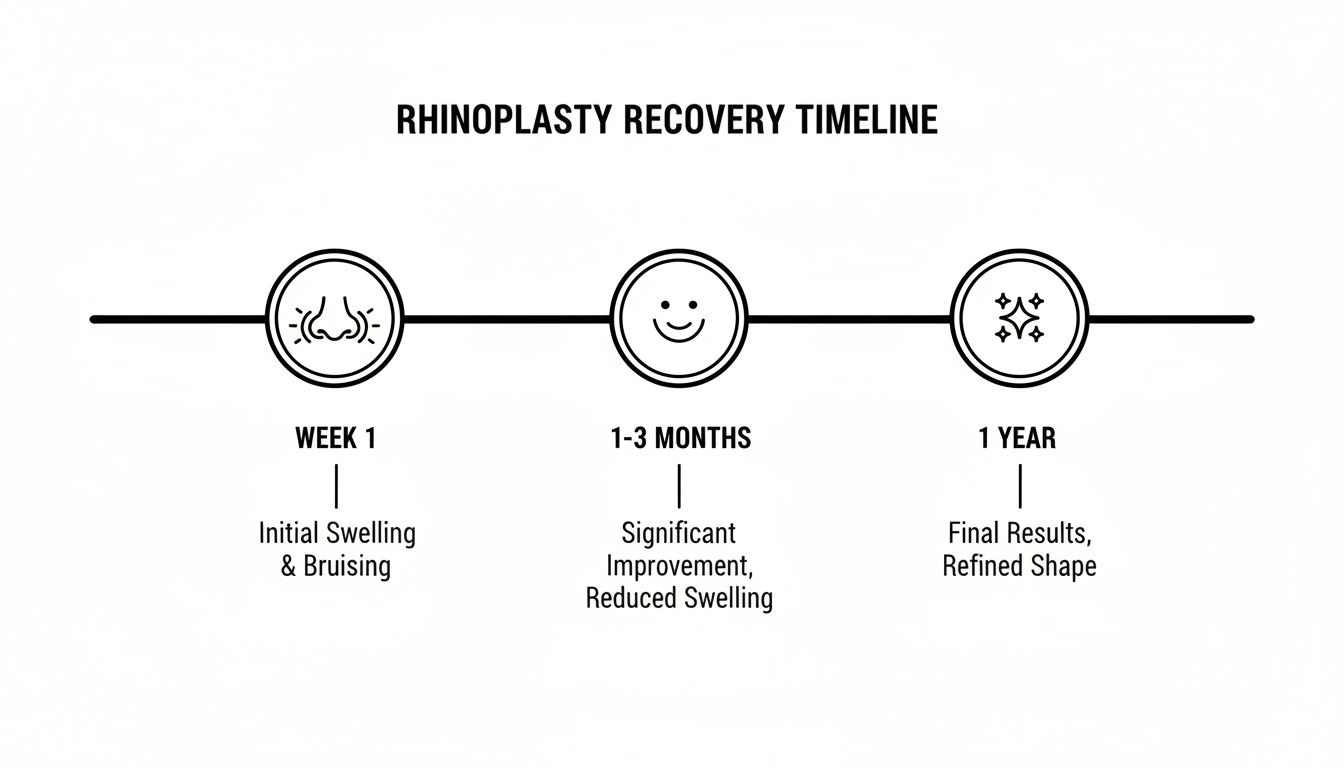
The image really shows that while the first week involves the most noticeable healing, the journey continues for up to a year as those last subtle refinements take place. One of the most crucial, and often overlooked, aspects of a great recovery is prioritizing sleep and rest during recovery. Giving your body that time allows it to heal as efficiently as possible.
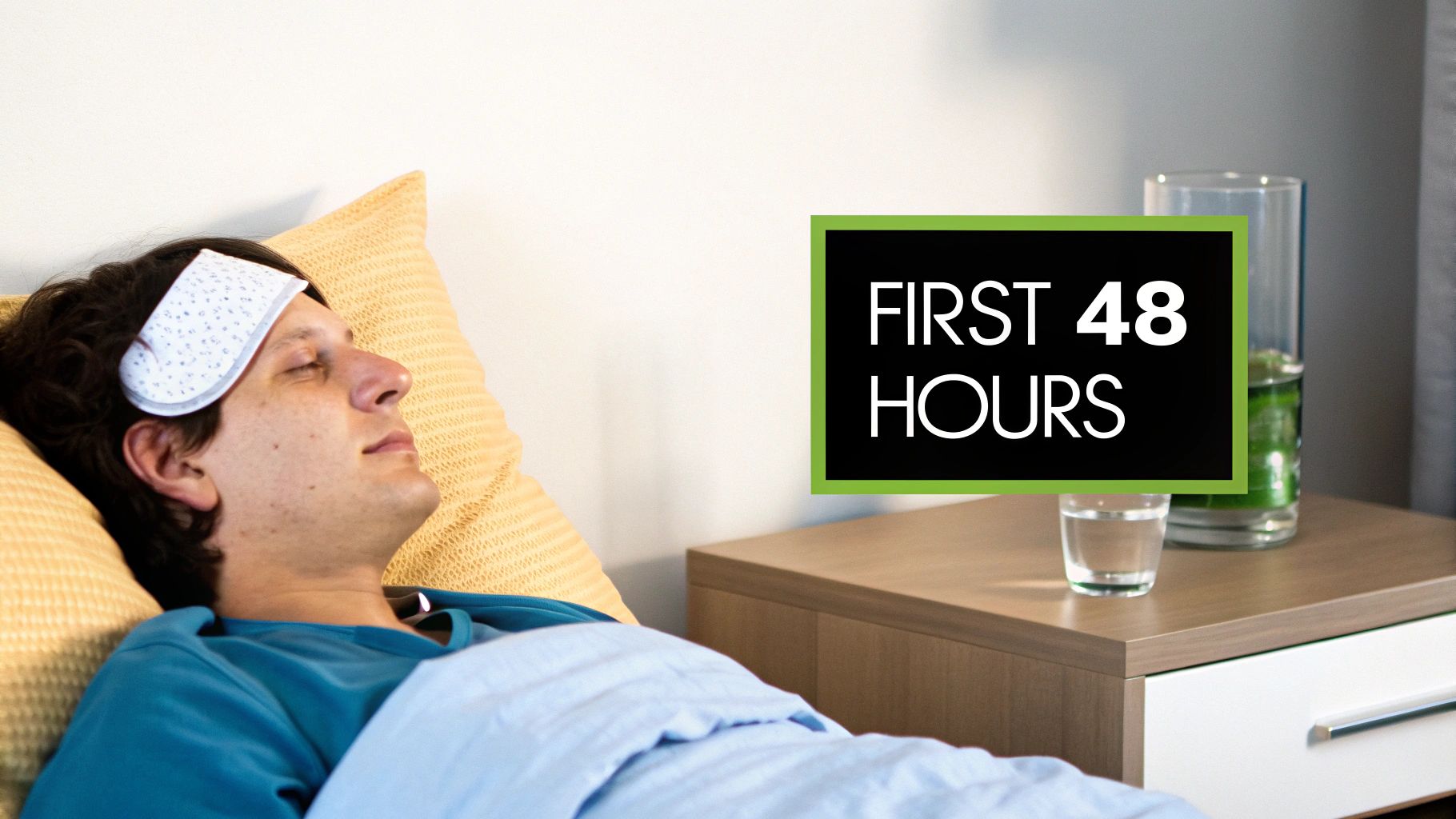
Once your rhinoplasty is complete and you’re back home, the first 48 hours are all about one thing: rest. This is the most intense part of your recovery, but also the most critical. Think of it as laying a strong foundation for the rest of your healing journey. What you do now really does impact the weeks to come.
You'll be sporting a splint or cast on the outside of your nose, which acts like a protective shield for the newly sculpted bone and cartilage. You may also have soft splints or packing inside your nose to help control bleeding and give your septum extra support.
Swelling and bruising are completely normal reactions to surgery. Don't be alarmed if you look in the mirror—bruising around the eyes is common, and the swelling will actually peak during these first two or three days. It’s all part of the process.
Your best defense against this is gravity. Keeping your head elevated above your heart is crucial. When you rest or sleep, prop yourself up with two or three pillows. This simple trick does wonders for reducing fluid buildup in your face.
The goal isn't to be entirely pain-free, but to keep your discomfort manageable. You’ll likely feel more congestion and pressure than sharp pain. The key is to stay on top of your prescribed medication schedule to keep things under control.
Gentle cold compresses will also become your friend. A bag of frozen peas or a soft gel pack wrapped in a cloth works perfectly. Apply it to your forehead or cheeks, but never place it directly on your nose or the splint. This helps shrink blood vessels, which in turn reduces both swelling and bruising.
For more detailed strategies on handling post-op discomfort, our guide on pain management after surgery is a fantastic resource.
Following your aftercare instructions to the letter is the single most important thing you can do for a smooth start. Here’s a quick rundown of your main priorities:
You'll also notice a bit of bloody drainage from your nostrils—this is expected. We’ll provide you with a small gauze pad (a "drip pad") to tape under your nose to catch it. We'll show you exactly how to change it as needed. These first two days are short, but they truly set the tone for your entire recovery.
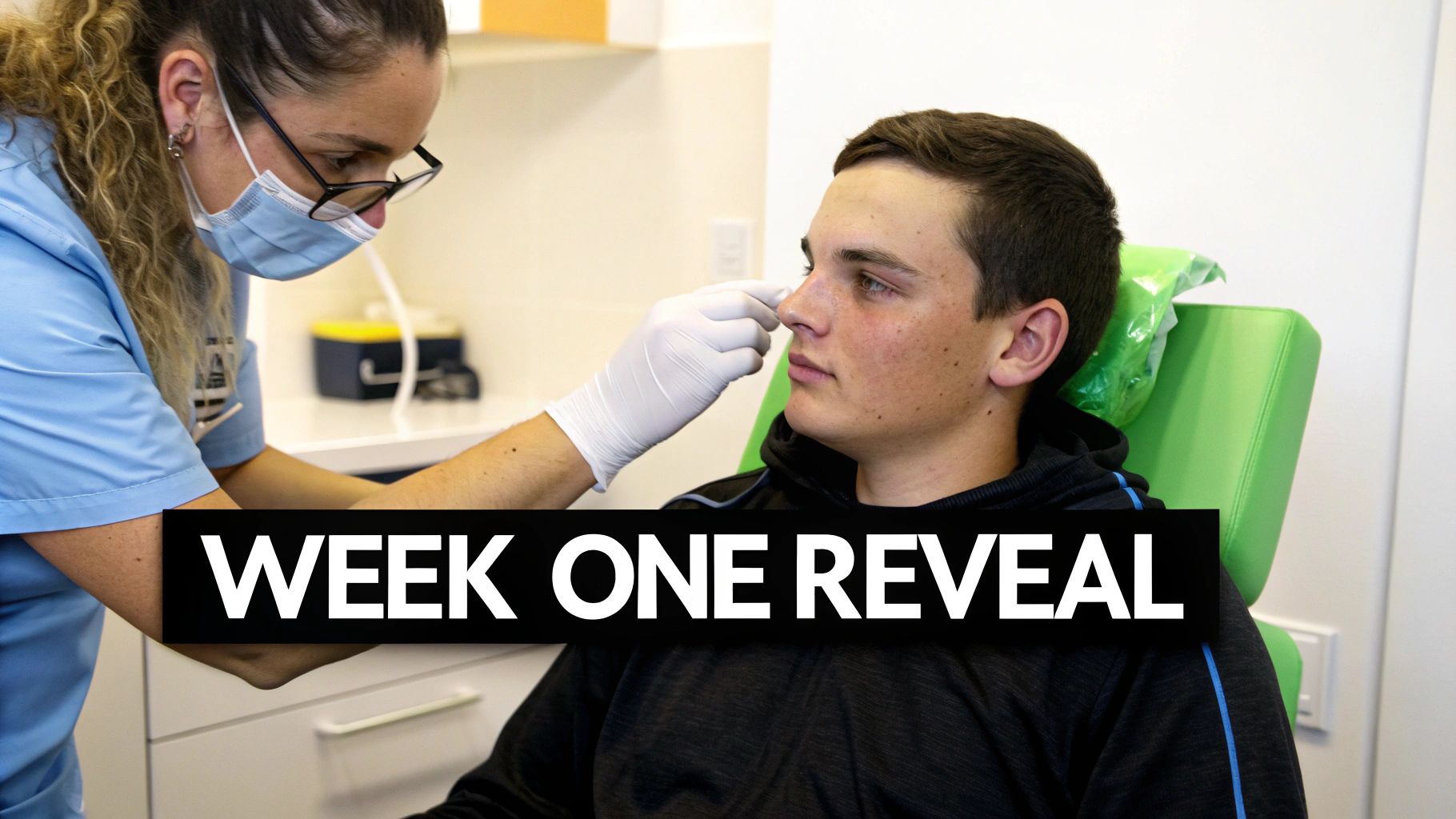
Let's be honest: the first week after rhinoplasty is the toughest part of the journey. But it's also where you'll see the most change from one day to the next. This week is all about patience and careful self-care, with a huge milestone waiting at the end—getting that splint off and seeing your new nose for the very first time.
After the initial 48 hours, you'll likely notice the swelling and bruising hit their peak, especially around your eyes and cheeks. This often happens around day three. While it can look dramatic in the mirror, it's a perfectly normal and expected part of the healing process. From this point on, you should see those symptoms start to fade a little more each day.
To help you navigate this critical first week, here's a quick overview of what to expect day by day.
This table is a general guide, but remember that everyone's healing journey is unique. The most important thing is to follow the specific instructions we provide.
Somewhere around day seven, you'll come back to see Dr. Fater for your first major follow-up. This is the moment you’ve been waiting for: the removal of the nasal splint. It’s completely normal to feel a mix of excitement and nerves. The process itself is surprisingly quick and doesn't hurt—it feels a bit like a sturdy band-aid being peeled off.
Now, it's so important to set your expectations for what you’ll see. Your nose will still be very swollen, particularly at the bridge and the tip. It might look a bit wider or more "upturned" than you expected. This is absolutely not your final result.
Managing Your Emotions: Seeing your nose for the first time can be an emotional experience. It's okay to feel a little overwhelmed. Remind yourself that what you see is a work in progress, and the true, refined shape is still hiding under that initial swelling.
Once the splint is off, we'll gently clean your nose and might apply some special tape to help control the swelling for a few more days. This is the perfect time to ask us any questions you have about what comes next.
Your main job this week is to protect your healing nose and give your body the rest it needs. Diligent aftercare is what sets the stage for a smooth recovery.
While this first week demands a lot of care, you might be surprised at how quickly you start to feel more like yourself. Studies show that many rhinoplasty patients are back to most of their routine activities in just 4.1 days on average, with 85-90% feeling much better by day ten.
When you look in the mirror after that splint comes off, try to focus on the positive changes you can already see, not just the temporary puffiness. You’ve made it through the most intensive phase of recovery. The journey isn't over, but you’ve hit a huge milestone. To get a better sense of how the healing process unfolds over time, take a look at our gallery of rhinoplasty before and after photos. It’s a great way to visualize the amazing transformations that happen as the weeks and months go by.
Once that splint is off, you’ve officially turned a major corner. You're past the most intense part of recovery and entering a phase that’s all about easing back into the rhythm of your life, bit by bit. From week two to week four, your nose is still healing in a big way, but you'll finally start to look and feel more like yourself again.
During this time, the most noticeable bruising and swelling will have faded dramatically. You’ll still have some puffiness—the tip of the nose is always the last to settle down—but it's usually subtle enough that you’ll notice it far more than anyone else. For most people, this is a huge moment and a real confidence booster as they get ready to face the world again.
I like to tell my patients to think about resuming their activities like a traffic light system. Some things are a go, some require you to slow down and be cautious, and a few are a hard stop. Following this simple guide is one of the best ways to protect your nose as it heals.
Green Light: Go Ahead!
Yellow Light: Proceed with Caution
Red Light: Full Stop!
Patience is the name of the game here. You’ll feel a lot better, but your nose is still incredibly fragile. The single best thing you can do for your final result is to resist the temptation to do too much, too soon.
Even though the worst of the puffiness is gone, you'll still have what we call "residual swelling." It can come and go, often feeling a bit more obvious in the mornings or after you’ve had a salty dinner. This is completely normal and expected. The tip of your nose, in particular, will hold onto swelling the longest and will probably feel firm and a little numb.
As these weeks go by, you'll notice sensation slowly starting to return. Don't be surprised if you feel some odd tingling or itching—those are actually good signs that the nerves are waking back up. The structure of your nose gets stronger every day, but it’s so important to remember that the healing isn’t truly complete for up to a year. Think of this phase as the bridge connecting the initial recovery to the final, subtle refinements that are still to come.
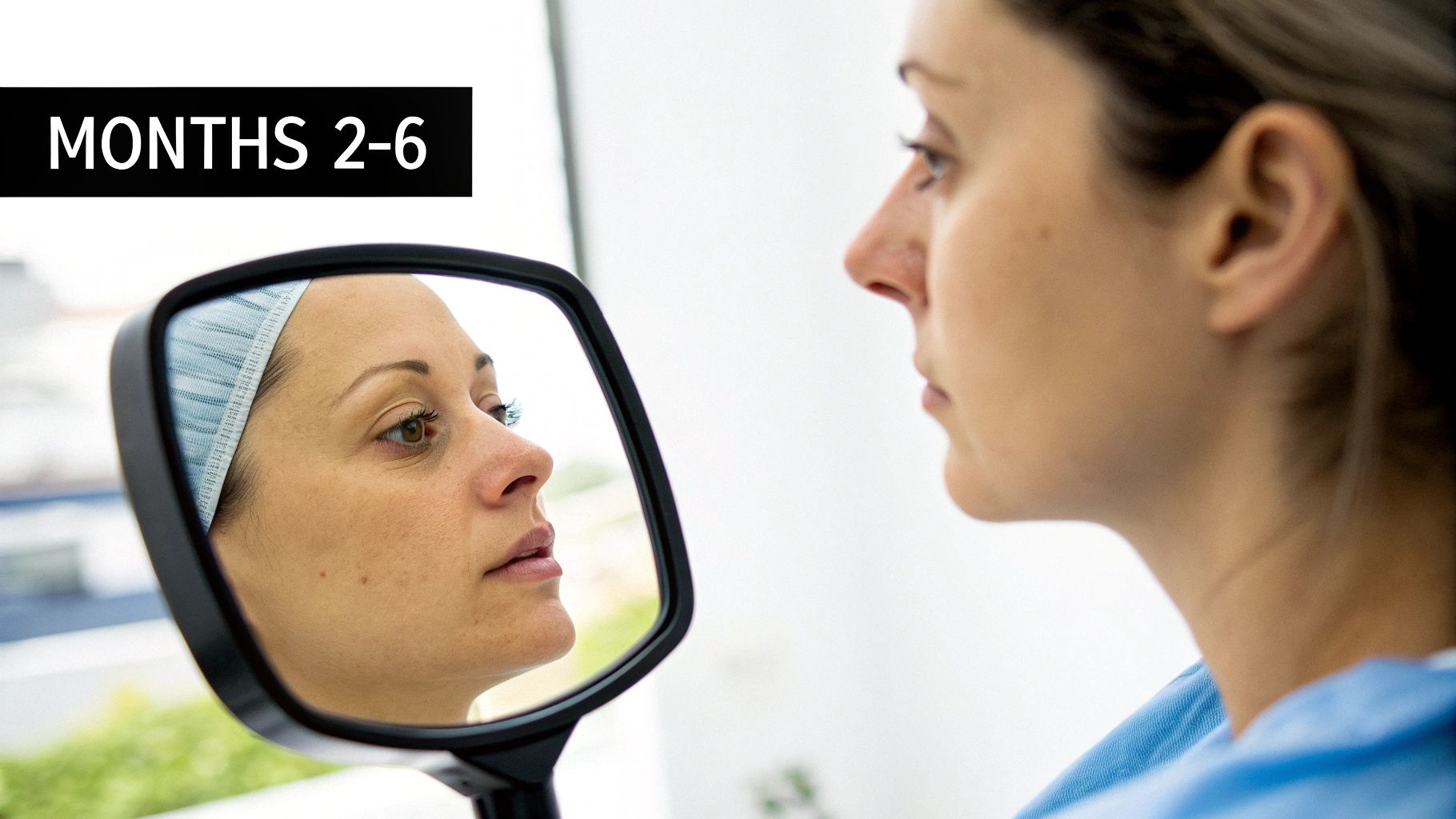
This next chapter in your recovery is all about patience. The most dramatic part is over—the major swelling and bruising are a distant memory, and you’re well back into your daily rhythm. Now, the healing process becomes much more subtle as your body works on the fine-tuning that truly defines your final result.
Think of it like a sculpture. The initial work chiseled out the main form, which you could see clearly after the first month. Now, the artist is sanding and polishing, bringing out the delicate contours and crisp lines that make the piece truly beautiful. This is when the last, most stubborn swelling finally starts to give way.
The nasal tip is always the last part of the nose to settle. This is purely down to anatomy—the skin is thicker there, and it's the area furthest from the body's main circulation, so it holds onto fluid the longest.
Don't be surprised if the tip still feels a bit firm or numb. This is completely normal. You might also notice the swelling changes a bit from day to day, maybe looking a little puffier in the morning or after you've had a salty dinner. This is all part of the process and will happen less and less as time goes on.
The changes between months two and six can be so gradual you might not notice them in the mirror each day. This is why I always tell my patients to compare photos month to month. That’s when you’ll really see and appreciate the beautiful, steady refinement that’s happening.
By the three-month mark, the finish line is clearly in sight. We find that about 80% of the swelling is gone by this point, giving you a very good idea of what your new nose will look like. While the last bit of refinement can take up to a year, this is the milestone where most people truly start to feel like their new nose is a part of them. Patient satisfaction studies often highlight this period as a major turning point, and you can read up on rhinoplasty recovery statistics to see the data for yourself.
One of the best parts of reaching this stage is feeling confident enough to resume all your normal activities. Your nose has healed significantly and regained most of its structural strength, which means you can get back to a more demanding physical routine.
Here’s what you can generally expect:
You’ll also notice sensation slowly returning to the tip of your nose. The nerves disrupted during surgery are busy regenerating, which can sometimes cause a little tingling or itching. It might feel strange, but it’s actually a great sign that your body is healing exactly as it should be.
We’ll have you come in for a few follow-up appointments during this period to make sure everything is on track. These check-ins are crucial for us to monitor your progress and for you to ask any questions that have popped up along the way.
At these appointments, we'll be looking at:
This period of quiet, steady refinement is what makes the difference between a good result and a great one. Your patience during these months will pay off beautifully as the final, elegant details of your new nose are revealed.
You’ve made it to the home stretch. This final stage of your recovery is where the magic really settles in. It’s a period of subtle refinement, where all your patience is rewarded as your nose finds its permanent, elegant shape.
Between six months and one year, your body is working to resolve that last little bit of lingering swelling—we're talking about the final 10-15%. It might not sound like much, but this is what brings out the ultimate definition and sharpness, especially in the nasal tip. Think of this as the phase where the skin fully shrink-wraps over the new framework Dr. Fater sculpted for you.
You've likely noticed the tip of your nose has been the most stubborn area to fully refine. There's a simple anatomical reason for this. The skin there is naturally thicker and has a less robust blood supply than the skin on the bridge, which means it holds onto swelling much longer.
It’s a bit like wringing out two different sponges. The bridge of your nose is a thin, fine sponge that dries out quickly. The tip, however, is a much thicker, denser sponge that takes its time releasing every last drop of fluid. As that last bit of puffiness finally subsides in these final months, the delicate, refined details of your new nose truly come into view.
This final phase is exactly why surgeons always say to wait a full year before assessing the final outcome. The changes might be subtle day-to-day, but they are what transform a "very good" result at six months into a "fantastic," permanent one at the one-year mark.
Your one-year appointment with Dr. Fater is more than just a check-up; it's a celebration of your journey's end. This visit is key for a few reasons:
At this point, you can officially put the recovery period behind you. There are no more activity restrictions or special precautions to worry about—just the full enjoyment of your results.
This journey has been so much more than a surgical procedure; it's an investment in your confidence and well-being. The patience you've shown through the healing process pays off with a natural, balanced result that complements your unique features. The beautiful nose you see in the mirror at your one-year appointment is the one you’ll carry with you for good.
Going through rhinoplasty recovery is a journey, and it's totally normal to have questions pop up along the way. Getting clear, honest answers is the best way to feel prepared and confident as you heal. Let's tackle some of the most common things patients ask about.
You'll definitely notice a big difference the moment your splint comes off, but the truly final, refined shape of your new nose can take up to a full year to reveal itself.
Think of it as a slow, gradual unveiling. The lion's share of the swelling disappears in the first three months, which gives you a great idea of the final outcome. That last little bit of puffiness, though, especially at the tip where the skin is thickest, takes its time. Patience is your best friend during this phase—it’s what allows the most delicate and natural-looking details to emerge.
Honestly, the first 48-72 hours are the toughest. This is when you'll want to stay on top of your prescribed pain medication. After those first couple of days, though, most people find they can switch to over-the-counter options and feel perfectly comfortable.
Most patients say it's less of a sharp "pain" and more of a dull ache, pressure, and a whole lot of stuffiness. To keep that discomfort to a minimum, focus on these simple things:
Your main job for the first few weeks is simple: protect your nose. That means steering clear of anything that could bump it or spike your blood pressure.
Avoid all strenuous exercise, lifting anything heavy, and obviously, any contact sports. You'll also need to resist the urge to blow your nose. And if you wear glasses, you'll have to wait until Dr. Fater gives you the green light to let them rest on your nose again, which is typically around the 4-6 week mark. Finally, keep your nose out of the sun for at least six months to prevent any potential skin discoloration.
Complications are rare, but it's crucial to know what to watch out for. Call us immediately if you experience any of the following:
The recovery process can also be an emotional one. If you find yourself struggling, you might find helpful resources on coping with anxiety during your recovery.
The absolute best thing you can do for a smooth, safe recovery is to follow all the post-op instructions Dr. Fater and our team give you. We’ve designed them to get you the best possible result.
Your comfort and confidence are what matter most to us. If you have more questions about what to expect after rhinoplasty or you’re ready to talk about your goals, please contact Cape Cod Plastic Surgery to set up a personal consultation with Dr. Fater. You can learn more about our approach at https://ccplasticsurgery.com.
September 9, 2026
Expert Guide to Proper Surgical Incision Care
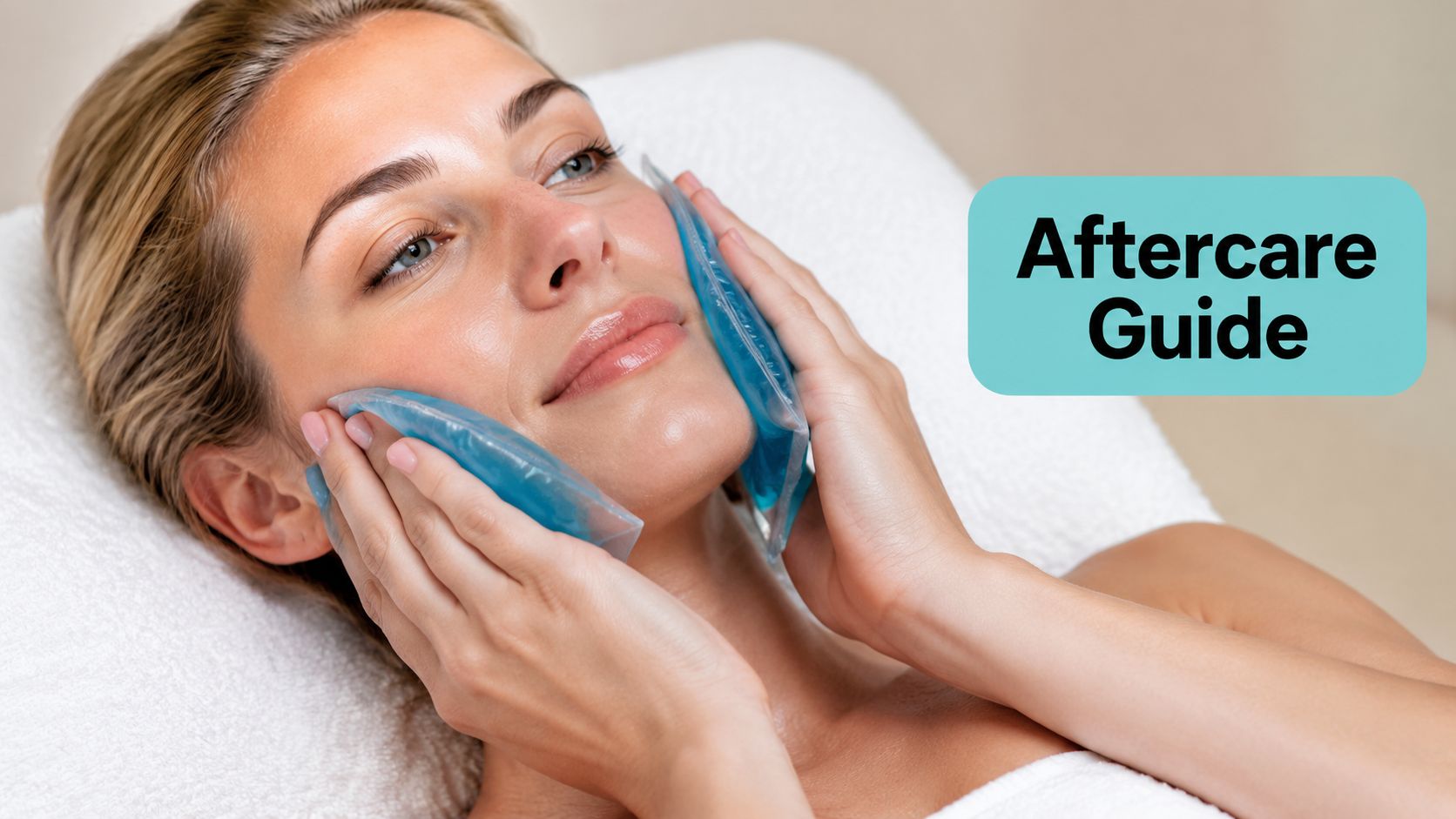
Master dermal fillers aftercare with do's and don'ts, swelling tips, activity limits and warning signs to protect your results and heal smoothly.

September 8, 2026
Ensuring Safety: Why Your Surgeon's Credentials Matter Most

Cape Cod Plastic Surgery offers expert cosmetic and reconstructive procedures in a safe, accredited setting. Led by Dr. Marc Fater, we combine advanced techniques with personalized care to help you look and feel your best.
Monday: 9:00 AM – 5:00 PM
Tuesday: 9:00 AM – 5:00 PM
Wednesday: 9:00 AM – 5:00 PM
Thursday: 9:00 AM – 5:00 PM
Friday: 9:00 AM – 5:00 PM