

October 7, 2026
What to Expect During Your Breast Surgery Recovery
A Practical Guide to Healing After Breast Surgery
Aug 30, 2026
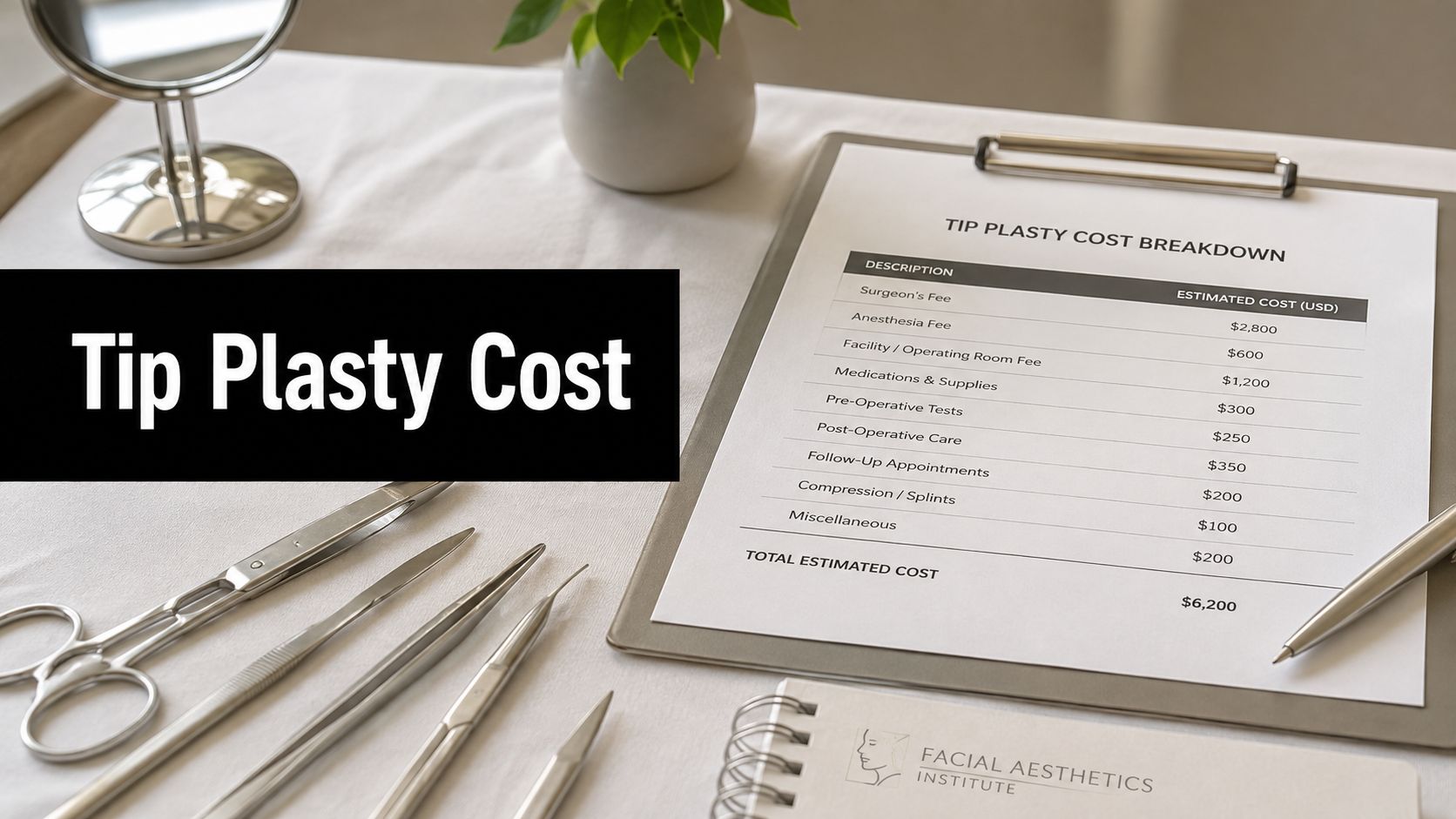
The 2025 U.S. national average tip plasty cost is $8,212, with a typical range of $4,750 to $14,225. Your final out-of-pocket total may be higher or lower because the headline figure often doesn't include anesthesia, facility charges, grafting, medications, or postoperative care.
That range is wide enough to make a cheap quote look attractive and an expensive quote look unreasonable, even when both estimates are accurate. The practical question isn't, “What does tip plasty cost?” It's, “What exactly does this quote pay for, and what could still be added?”
A responsible comparison separates the surgeon's fee from the operating-room bill, anesthesia, medical testing, recovery supplies, follow-up visits, and any structural work discovered during planning. It also distinguishes a true tip-only procedure from a rhinoplasty that includes bridge, septal, or breathing-related correction.
The best starting benchmark remains the 2025 U.S. national average of $8,212, with a broad range of $4,750 to $14,225, according to CareCredit's tip plasty cost guide. The source notes that geography and whether the procedure is combined with other cosmetic surgery can shift the price substantially.
Treat that figure as a planning benchmark, not a guaranteed invoice. Published averages commonly emphasize the surgeon's professional fee, while a patient's actual bill may also include anesthesia, the surgical facility, preoperative testing, prescriptions, splints, dressings, and follow-up appointments.
Ask the office to separate every charge before you pay a deposit. A credible estimate should show:
The amount can also change if the surgeon needs cartilage grafting, additional support, nostril reshaping, or functional correction. A quote that says only “tip plasty, $X” leaves too much uncertainty.
Practical rule: Compare complete treatment plans, not isolated surgeon fees.
Regional pricing is another reason national averages can mislead. Local surgeon demand, staffing costs, facility overhead, and anesthesia availability all influence the quote. The same procedure can therefore sit near the lower end of the national range in one market and approach the upper end in another.
The financial decision becomes clearer when you identify the procedure's scope first. If your concern is limited to the lower third of the nose, a tip-only operation may be appropriate. If you also want bridge changes, correction of a deviated septum, or improvement in airflow, the quote should be evaluated as a broader rhinoplasty or functional nasal procedure.
Tip plasty focuses on the cartilage and soft tissue in the lower third of the nose. It usually leaves the nasal bridge and nasal bones unchanged, so the operation covers less anatomy than a full rhinoplasty. That narrower scope can affect the headline price, but it does not guarantee a simple procedure or a low total bill.
The surgeon may refine the tip's fit, shape, projection, or rotation while keeping the bridge profile intact. The goal is targeted change, not a complete redesign of the nose.
Tip plasty may address:
A tip-only quote does not cover every concern patients connect with their nose. A prominent bridge hump, major deviation of the nasal pyramid, or breathing obstruction involving the septum or nasal valves may call for full rhinoplasty, septoplasty, or another functional procedure. Those operations can add surgical work, facility time, anesthesia needs, and revision considerations to the bill.
Tip plasty fits the discussion when the bridge already looks acceptable and the main complaint involves the tip. A broader rhinoplasty deserves evaluation when the goals include a straighter profile, a smaller bridge, correction of significant deviation, or meaningful improvement in nasal airflow.
The consultation should also test the tip's structural support. Thick skin, weak cartilage, prior trauma, or previous surgery can make a limited correction more technically demanding. A focused operation is not automatically a straightforward one, and grafting or reinforcement can move the quote beyond a basic tip-only fee.
For a visual overview of how surgeons tailor nasal reshaping to facial proportions, review this guide to nose reshaping and rhinoplasty options. Judge the proposed operation by its match to your anatomy and goals, not by the label “mini.”
A useful quote reads like a small financial ledger. It identifies who receives each payment, what service the charge covers, and which items remain conditional.
The surgeon's fee usually forms the core of the estimate. It reflects consultation time, operative planning, technical skill, and the surgical work. Anesthesia is separate in many practices, particularly when a dedicated anesthesia provider administers sedation or general anesthesia.
Facility charges cover the room, equipment, sterile supplies, staff, monitoring, and recovery area. An office-based suite may have a different fee structure from a hospital outpatient department, but the lower-cost setting isn't automatically the better choice. The facility must be appropriate for the planned anesthesia and the patient's medical needs.
Preoperative testing can include medical clearance, laboratory work, or imaging when clinically appropriate. Prescriptions, nasal care supplies, compression dressings, internal splints, and postoperative appointments may be bundled or billed separately.
The following example totals $9,400. It's an illustrative planning model, not a national average or a patient-specific quote.
| Cost Component | Average (USD) | % of Total |
|---|---|---|
| Surgeon's fee | $6,200 | 66.0% |
| Anesthesia provider | $1,000 | 10.6% |
| Facility or operating room | $1,400 | 14.9% |
| Testing and imaging | $200 | 2.1% |
| Medications and recovery supplies | $200 | 2.1% |
| Follow-up visits | $400 | 4.3% |
| Total | $9,400 | 100% |
The surgeon's fee in this model covers a straightforward tip operation. It doesn't assume ear or rib cartilage harvest, extensive scar-tissue dissection, dorsal camouflage, or combined septal work. Those additions can change both operative time and the facility and anesthesia charges.
Patients should also understand the distinction between a bundled package and an itemized invoice. Bundling can make payment easier, but the written agreement should still identify inclusions and exclusions. For broader context on health costs and planning around coverage, what you're healthy means for coverage can help explain why medical and cosmetic expenses are treated differently.
Common conditional items include:
A quote that excludes these possibilities isn't necessarily wrong. It's incomplete unless the surgeon explains when they could become relevant. Before signing, compare the estimate with the practice's broader cosmetic surgery cost guidance and ask for every likely charge in writing.
Scope, complexity, geography, and operating conditions drive the largest price changes. The key cost difference is whether the surgeon is refining the tip alone or correcting structural and functional problems. Reinforcing weak cartilage, harvesting a graft, or addressing breathing concerns can add more time, staff, and facility charges than a limited trim.
Geography affects every major fee. Surgeons, anesthesia professionals, operating facilities, and support staff price their services according to local overhead and demand. Major coastal cities often cost more than smaller metropolitan areas. That difference reflects the market, not necessarily a better result.
Surgeon experience matters most when the anatomy is difficult. Prior rhinoplasty, scar tissue, weak cartilage, trauma, and nasal valve concerns require more planning and technical dissection. Pay for experience that matches your case, not just a prestigious address. Review before-and-after results involving patients with similar starting anatomy.
Anesthesia can materially change the bill. Selected limited tip procedures may use local anesthesia with sedation. More extensive structural surgery may require general anesthesia. The anesthesia professional, monitoring, recovery area, and facility standards should appear clearly in the estimate.
Grafting creates another pricing tier. Septal cartilage may be available when septal surgery is already planned, while ear or rib cartilage requires a separate donor site and additional operative work. Thick skin, previous surgery, weak cartilage, and suspected valve collapse can turn a narrow refinement into structural reconstruction.
| Variable | Typical Price Impact |
|---|---|
| Higher-cost geographic market | Often increases surgeon, facility, and anesthesia charges |
| Experienced primary rhinoplasty specialist | May raise the professional fee |
| Revision or prior nasal surgery | Increases planning, dissection, and operative complexity |
| Local anesthesia with sedation | May cost less than general anesthesia when clinically appropriate |
| General anesthesia | Adds anesthesia and facility requirements |
| Office-based accredited suite | May differ from hospital outpatient pricing |
| Septal cartilage graft | Adds work when grafting is required |
| Ear or rib cartilage graft | Adds donor-site surgery and operative time |
| Thick skin or weak cartilage | May require additional structural support |
| Nasal valve or breathing correction | Expands the procedure beyond tip-only surgery |
A tip-only quote can therefore differ sharply from a rhinoplasty quote. The broader operation may include bridge work, grafting, or functional correction, along with longer anesthesia and facility use. Confirm whether the estimate covers the surgeon, anesthesia, facility, medications, follow-up visits, and possible revision-related charges.
The pricing guidance from Bookimed's rhinoplasty cost overview places U.S. tip rhinoplasty at about $7,000 to $15,000 and Turkey at roughly $2,700 to $5,000. Those figures illustrate how location and surgical extent influence a quote, but they do not replace a written, case-specific estimate.
Choose the quote that explains each expense. A longer operation, structural graft, qualified anesthesia team, and appropriate facility can justify a higher total. A vague premium with no itemized reason cannot.
International quotes can look far lower than U.S. pricing because clinics often bundle different services under “all-inclusive.” A low headline figure may leave out anesthesia, facility fees, medications, monitoring, or follow-up care after you return home. Compare the bill line by line, not the country name.
Available 2026 market guidance places tip plasty at roughly $1,500 to $3,200 in South Korea and about $40,000 to Rs. 1,00,000 in India. These figures are not standardized totals. South Korea tip plasty pricing guidance stresses checking exactly what each package includes before comparing it with a U.S. quote.
The U.S. benchmark is $8,212, with a range of $4,750 to $14,225, as reported earlier in CareCredit's national tip plasty guide. Use that figure as a reference, not as a promise that every international package covers equivalent care.
| Market | Typical All-In Range (USD) | Usually Included |
|---|---|---|
| United States | $4,750 to $14,225 | Varies by practice, often requires separate review of anesthesia and facility charges |
| South Korea | $1,500 to $3,200 | Package structure varies, so confirm surgery, anesthesia, facility, and aftercare |
| India | About $40,000 to Rs. 1,00,000 | Inclusion levels vary by provider and location |
| Turkey | Roughly $2,700 to $5,000 | May include coordinated travel services, but written medical inclusions must be verified |
No verified comparative figures are provided here for Mexico or Thailand, so do not treat unsourced ranges as reliable. Ask an overseas clinic to itemize the surgeon's fee, anesthesia, operating room, medications, hotel nights, airport transfers, garments, local follow-up, and emergency support.
Travel changes the risk calculation. If swelling, infection, bleeding, or an unexpected structural issue develops after you return, your surgeon may be hours away, and a local physician may not accept responsibility for an operation performed elsewhere. Revision language needs the same scrutiny. “Free revision” may still exclude anesthesia, facility charges, travel, or donor-site work.
A lower sticker price can be reasonable only when the care is comparable. If the package does not state what it covers, you do not know the procedure's true cost.
Price becomes meaningful only when tied to scope. A longer operation, structural graft, qualified anesthesia team, and appropriate facility create real expenses. A vague premium label does not. Choose a surgeon who can connect each charge to the work, monitoring, and follow-up your case requires.
Start with board certification in plastic surgery or facial plastic and reconstructive surgery, then verify it through the relevant certifying organization. Certification does not establish rhinoplasty expertise. Ask how much of the surgeon's practice involves nasal surgery and how often they perform tip-focused procedures.
A useful before-and-after gallery shows consistent views, realistic lighting, and patients with skin thickness, ethnicity, and starting anatomy similar to yours. Thick skin and weak cartilage require different planning from thin skin and strong cartilage. Galleries filled only with idealized cases leave out the evidence most relevant to your decision.
Computer morphing can clarify the aesthetic discussion, but it is not a promise. The surgeon should identify which changes are realistic and which image features cannot be guaranteed after healing.
Use the consultation to test clinical reasoning:
A tip-only quote should describe a limited change to the nasal tip. A rhinoplasty quote may include work on the bridge, septum, nasal bones, or breathing structures. If the surgeon cannot explain why your plan belongs in one category, the headline price is not enough for comparison. Ask whether anesthesia and facility fees are included, and how a revision would affect your total cost.
A surgeon who gives a final price by phone, without examining your nose, cannot reliably assess complexity. Be cautious if the office pressures you to book immediately, refuses to explain revision terms, or treats anesthesia as an afterthought.
For a broader framework on credentials and consultations, use this guide to choosing a qualified surgeon.
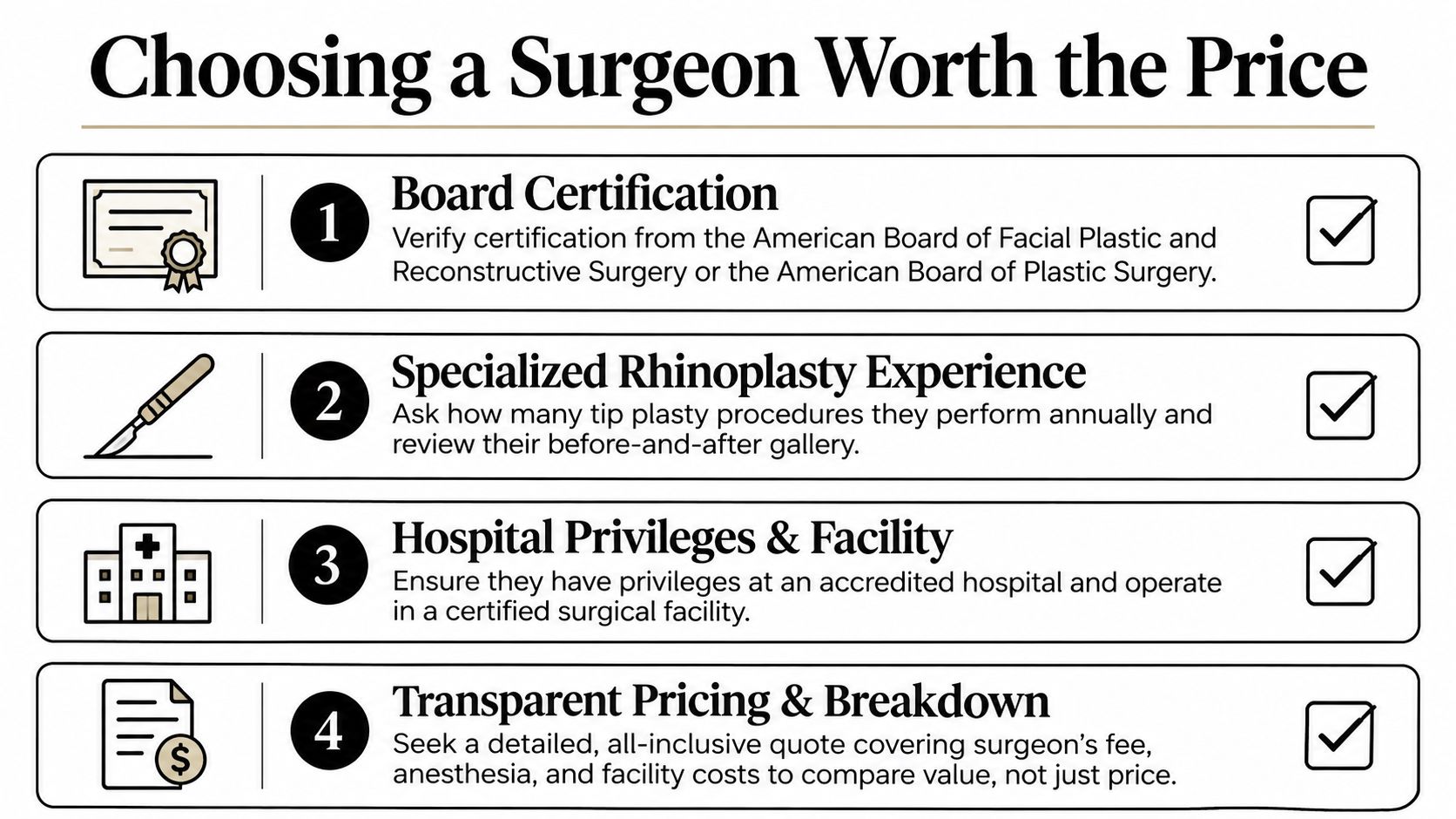
Leave the consultation knowing what will change, what will remain unchanged, which costs are fixed, and which may depend on intraoperative findings. That clarity is part of the price.
Purely cosmetic tip refinement is generally an out-of-pocket service. Insurance typically doesn't pay for changing the shape of the nasal tip when the purpose is aesthetic, even if the patient feels self-conscious about the appearance.
The situation changes when the operation includes a documented functional problem. Septal correction, nasal valve treatment, or another breathing-related component may qualify for coverage when the carrier's medical-necessity requirements are met. The cosmetic portion can remain self-pay even when the functional portion receives authorization.
Ask the surgeon's billing team to separate those components before scheduling. Confirm whether the practice will submit the functional claim, whether preauthorization is required, what documentation the carrier needs, and which deductibles, copayments, or facility balances remain your responsibility.
Common payment routes include an in-house practice plan, a medical lender such as CareCredit or Cherry, or personal funds. Promotional 0% APR offers can reduce interest during the promotional period, but you must understand the repayment deadline and what happens if the balance remains unpaid. Longer amortizing plans may lower the monthly payment while increasing total interest.
HSA and FSA funds may be relevant to an eligible functional component, but cosmetic expenses generally require separate treatment. Confirm eligibility with the plan administrator rather than assuming the entire operation qualifies.
Avoid financing a quote that hasn't been fully itemized. A low monthly payment can hide added facility charges, medications, revision exclusions, or interest that begins later.
Ask before signing: “What is the maximum amount I could owe if the operation takes longer or additional structural work becomes necessary?”
Warning signs include same-day discounts tied to immediate commitment, unclear refund policies, financed balances that include unexplained add-ons, and a revision promise that doesn't identify facility or anesthesia costs.
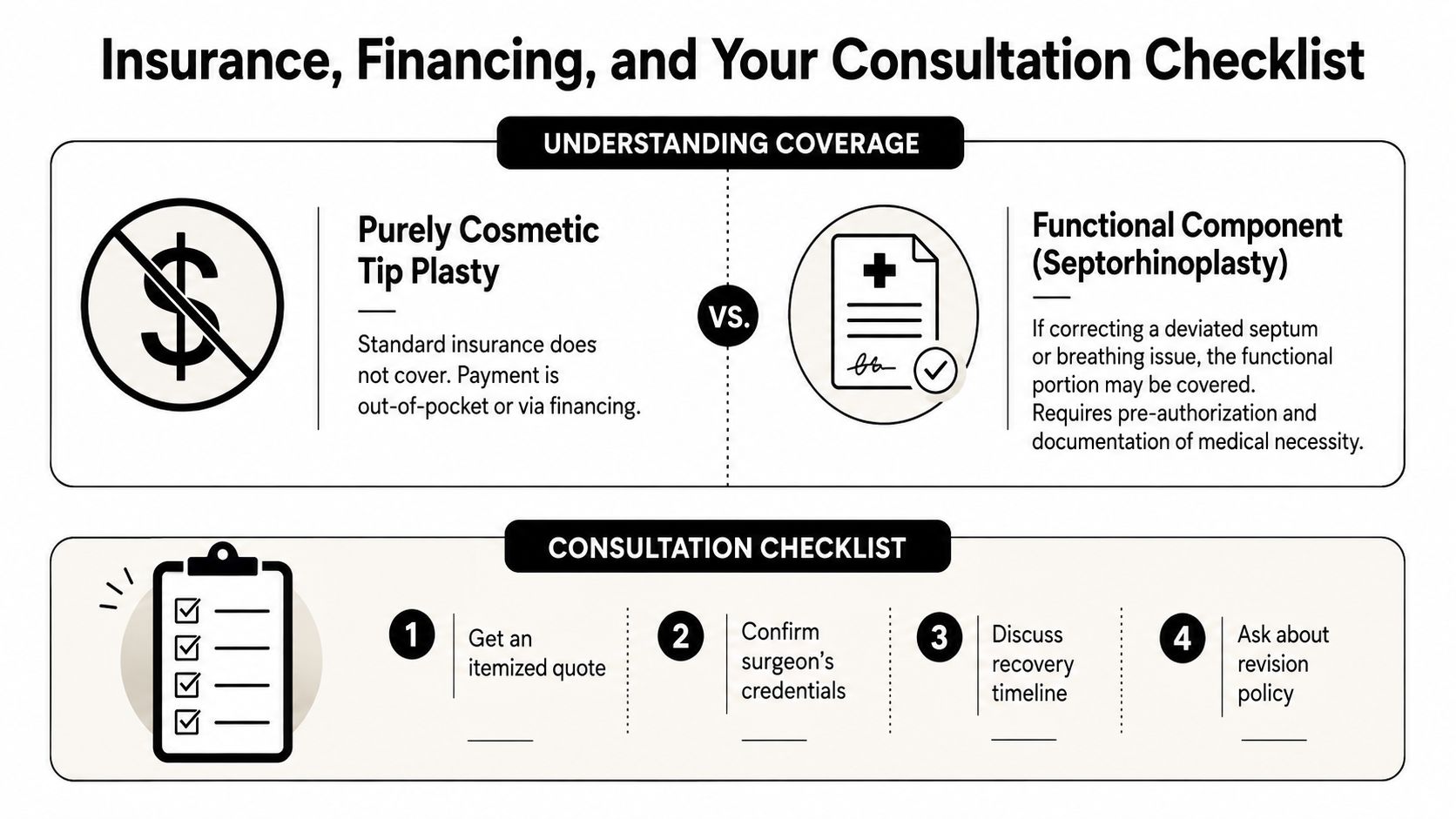
Cape Cod Plastic Surgery offers facial surgical consultations, personalized treatment planning, and an on-site AAAASF-accredited surgical suite, giving prospective patients a setting in which to discuss tip refinement, full rhinoplasty, facility charges, and financing questions in person. Visit Cape Cod Plastic Surgery to request a consultation and bring this checklist so your quote can be reviewed line by line.
October 7, 2026
A Practical Guide to Healing After Breast Surgery

October 6, 2026
Your Safety Guide: What to Look for When Choosing a Plastic Surgeon

October 5, 2026
Why Our On-Site Accredited Facility Matters for Your Safety
Cape Cod Plastic Surgery offers expert cosmetic and reconstructive procedures in a safe, accredited setting. Led by Dr. Marc Fater, we combine advanced techniques with personalized care to help you look and feel your best.
Monday: 9:00 AM – 5:00 PM
Tuesday: 9:00 AM – 5:00 PM
Wednesday: 9:00 AM – 5:00 PM
Thursday: 9:00 AM – 5:00 PM
Friday: 9:00 AM – 5:00 PM