

October 7, 2026
What to Expect During Your Breast Surgery Recovery
A Practical Guide to Healing After Breast Surgery
Mar 1, 2026
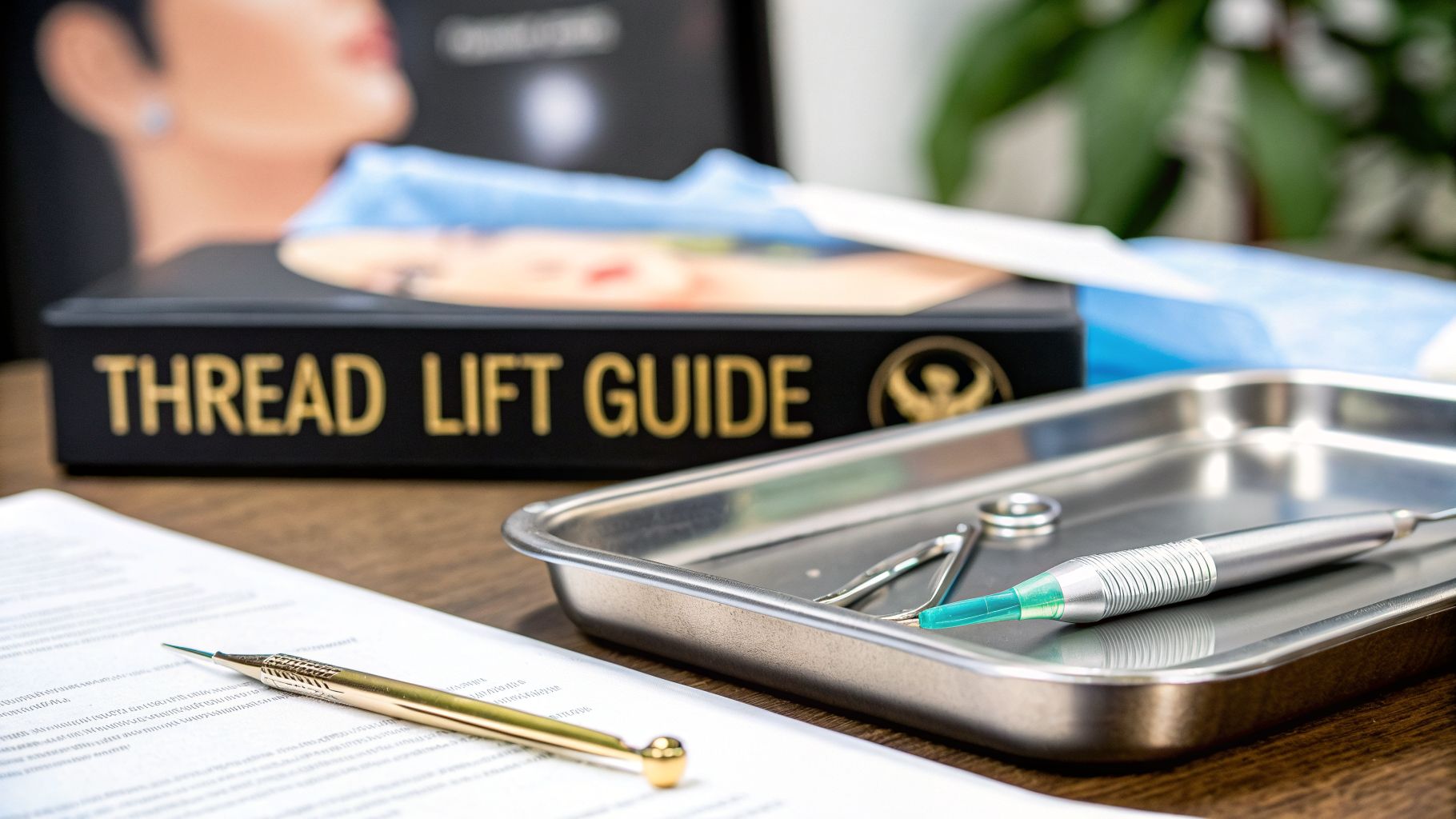
So, you've probably heard about thread lifts, but what exactly are they? Think of it less like a complex medical procedure and more like creating a subtle, supportive "hammock" right under your skin. We use special, temporary sutures to gently lift sagging tissue in areas like the cheeks, jowls, or neck, giving you a refreshed and more youthful contour.
While you'll see an initial lift right away, the real genius of a thread lift is what happens behind the scenes. It's a clever, two-part process that works with your body, not just on it.
First, there's the immediate mechanical lift. When a skilled practitioner places these threads, they act like a scaffold, carefully repositioning tissue that has started to droop due to gravity and age. It's a physical lift you can see the moment you look in the mirror after your appointment.
The second part of the process is where the long-term benefits kick in. Your body naturally perceives the threads as a foreign object and triggers a healing response. This is a good thing! It sends a signal to your skin to ramp up the production of new collagen.
Collagen is the key protein that provides the structure, strength, and bounce we associate with youthful skin. As we get older, our natural collagen production slows way down, which is a major cause of sagging and wrinkles. A thread lift essentially tells your skin to get back to work building that essential foundation.
This natural collagen-building process, called neocollagenesis, creates a new, stronger support system from within. Over the following weeks and months, you'll notice your skin becoming firmer and smoother. The threads themselves will safely dissolve, but they leave behind a matrix of your very own collagen, which continues to support the lift and improve your skin's overall quality for a natural, lasting result.
The demand for this kind of dual-action treatment has exploded. A massive multicenter review in Japan, which looked at an incredible 111,948 facial thread lifting procedures between 2020 and 2024, found a 44.7-fold increase in just five years. Procedures jumped from 981 in 2020 to 43,817 in 2024. This huge growth shows just how much people want meaningful results without the downtime of a full surgery. You can dig into the data behind this massive growth in thread lift popularity to see the trend for yourself.
To help you get a clear picture of the procedure, we've put together a quick summary table.
This combination of an instant lift and long-term skin improvement is what makes thread lifts such a compelling option in modern aesthetics. It perfectly bridges the gap between injectable fillers and a surgical facelift, offering real, visible results with minimal interruption to your life.
To really get what a thread lift is all about, we have to look at what’s happening just beneath the surface of your skin. This isn't just a simple procedure of pulling the skin tight. It's a clever combination of an immediate, physical lift and a long-term, natural rejuvenation process.
Think of your provider as both an architect and a gardener. First, they use the threads to create an immediate support structure, lifting and repositioning the skin. Then, those same threads act like a fertilizer, encouraging your body to grow its own new collagen. This two-part process is what makes a thread lift so effective.
Just like a skilled artist has a variety of brushes, a thread lift expert has a range of different threads to work with. The right choice depends entirely on your skin, your facial structure, and what you’re hoping to achieve. The three main types we use today are PDO, PLLA, and PCL.
PDO (Polydioxanone) Threads: These are the go-to for many procedures. They’re made from the same safe, dissolvable material used in surgical stitches for decades. PDO threads dissolve in about 4 to 6 months and are fantastic at kicking off collagen production. They come in different textures—smooth, twisted, or barbed—for different jobs.
PLLA (Poly-L-Lactic Acid) Threads: If you’ve heard of the dermal filler Sculptra, you already know PLLA. These threads last longer, dissolving over 12 to 18 months. They are real powerhouses for building collagen and restoring volume, making them a great choice for tackling deeper folds or hollow areas.
PCL (Polycaprolactone) Threads: As the most durable of the three, PCL threads can take up to 2 years or more to dissolve completely. They provide a strong, lasting support framework and stimulate collagen for the longest period, making them ideal for building a foundational lift that truly endures.
You can learn more about how we specifically use PDO threads in our practice for a non-surgical lift option.
It’s not just about the material; the texture of the thread is what creates the actual lift. This is where the engineering comes in.
Barbed or Cog Threads
These are the heavy lifters. Imagine a thread with tiny, almost invisible barbs or cones along its length. When we place these threads under the skin, those barbs act like a grappling hook, gently grabbing onto the tissue. We can then lift the skin into a higher, more youthful position, and the barbs anchor it right there.
Smooth or Mono Threads
These threads play a different role. They don't have barbs, so they aren't used for significant lifting. Instead, we place them in a cross-hatch or mesh-like pattern to create a supportive "net" underneath the skin. Their main job is to trigger a broad collagen response to improve skin texture, smooth fine lines, and firm up crepey areas.
This graphic breaks down how these elements work together to lift, anchor, and stimulate your skin from within.
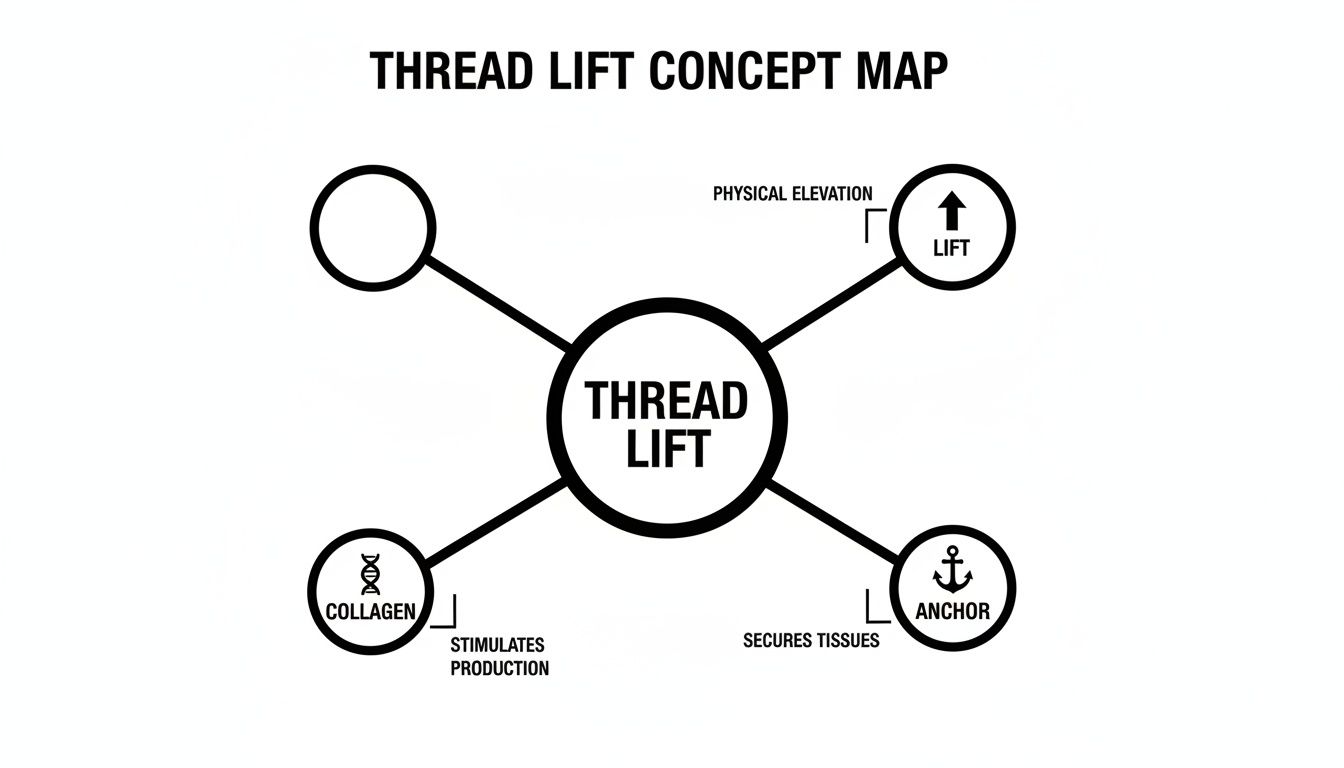
As you can see, it's a three-pronged approach working in harmony to give you a result that looks and feels completely natural.
The real magic behind a thread lift is a process called neocollagenesis. This is simply the medical term for your body’s natural ability to create new collagen. The threads act as a signal, triggering a controlled healing response that builds a new, strong network of collagen that stays in place long after the threads themselves are gone.
This new collagen matrix is what provides that lasting support, improving your skin’s elasticity, thickness, and overall firmness. So while you'll see an immediate lift the day of your procedure, the best results will continue to emerge over the next two to three months as your body builds its own internal scaffolding. It’s a beautiful partnership between our technique and your body's own biology.
Figuring out if a thread lift is the best way to reach your goals is the single most important part of this whole process. This isn't a one-size-fits-all procedure; it's specifically designed for a certain kind of person with very specific concerns. Knowing who makes a great candidate is the key to getting results you'll genuinely be happy with.
The sweet spot for a thread lift usually falls to people in their late 30s to early 50s. This is often when you start to see the first real, nagging signs of aging—your cheeks might not be as high as they used to be, jowls are just starting to form, or your jawline is losing some of its sharpness. You notice a change, but it’s not yet at a point where a full surgical facelift feels necessary.
The people who get the best results from a thread lift tend to have a few things in common. These factors are crucial because they allow the threads to do their job properly and create a lift that looks both beautiful and completely natural.
You're likely a great fit if you have:
Think of it this way:
The perfect candidate has good skin quality and is just starting to see signs of aging. They want a real, visible lift without the downtime or intensity of surgery. For them, a thread lift can be incredibly satisfying.
It’s just as important to know when a thread lift isn't the right move. While it's a fantastic tool, it has its limits. For many people, a different approach will deliver a much better, safer, and longer-lasting result.
Sometimes, a person is on the fence. They might have a bit more sagging than is ideal, or their skin quality might be a little compromised. In these cases, a skilled provider might suggest combining a thread lift with other treatments, like dermal fillers to restore volume or other non-invasive skin tightening techniques to improve texture.
However, some situations are a clear "no" for this procedure.
Who Should Look at Other Alternatives?
At the end of the day, the goal is to find the procedure that truly fits your anatomy and what you hope to achieve. A thread lift can be a wonderful "in-between" option, but it’s also important to know that it can create internal scar tissue that might make a future facelift more complex. The only way to know for sure is to have an honest conversation with an expert who can help you weigh the pros and cons and map out the best plan for you.
Knowing what to expect on the day of your procedure can make all the difference, turning any nervousness into quiet confidence. Let’s walk through the entire process together, from the moment you step into the clinic to the final reveal. When you understand the plan, you can relax and feel prepared.

Of course, the real journey starts with your consultation. This is our opportunity to get on the same page, discuss what you’d like to achieve, and confirm that a thread lift is the right fit for your goals and facial anatomy.
This initial phase is all about thoughtful, meticulous planning. We don't just place threads without a strategy; each one is part of a detailed architectural plan designed for your unique facial structure.
Facial Mapping: Your provider will begin by carefully studying your face, noting your skin quality and the specific areas where you've lost support. They’ll then mark the precise entry points and the pathways the threads will follow. This "map" is our guide to ensuring your lift is balanced, natural, and effective.
Cleansing and Preparation: Next, we’ll thoroughly cleanse the treatment area with an antiseptic solution. This is a crucial step to create a sterile environment and minimize any risk of infection.
Local Anesthesia: Your comfort is our top priority. We start with a topical numbing cream, followed by a few small injections of local anesthetic. You might feel a quick pinch, but the area will become numb almost immediately. Most patients say they only feel some light pressure during the procedure, not pain.
This careful preparation is what sets the stage for a smooth, predictable experience. It’s a calm and deliberate process designed to ensure both your safety and your peace of mind.
Once the area is fully numb and prepped, we move on to the main event. This is where a provider's skill and artistry really come into play. The whole process is precise, controlled, and usually completed in under an hour.
Using a very fine, specialized tool—either a thin needle or a blunt-tipped cannula—we gently insert the threads into the planned tissue layer just beneath the skin. The choice of tool often depends on the thread type and treatment area; cannulas, for instance, are great for minimizing potential bruising.
You'll likely feel some mild pressure or a slight pulling sensation as the threads are guided into position. Once a thread is in place, the provider uses it to gently lift and secure the skin and underlying tissue.
Think of it like a master tailor making a subtle adjustment to a piece of fine fabric. Your provider will carefully maneuver the skin into its new, lifted position, making sure the contours are smooth and perfectly symmetrical. The goal is a refreshed and rested look, not an overtly "pulled" one.
We repeat this step for each thread, gradually building the lift until we achieve the desired result. The number of threads can range from just a few to over a dozen, depending on the area we're treating and how much lift is needed.
With all the threads perfectly positioned and the lift established, we're on the home stretch. The external ends of the threads are trimmed so they disappear completely beneath the skin's surface. Your provider will then make final, subtle adjustments to ensure a flawless, natural-looking contour.
After one last check, you're all done. There are no stitches that need removing and no bandages to worry about. We’ll go over your aftercare instructions in detail, and then you can head home to start your recovery with a refreshed new look.
Once your thread lift is complete, the journey shifts to healing and enjoying your newly refreshed look. Knowing what to expect during recovery helps you feel at ease and ensures your results settle in beautifully. The great news is that the downtime is remarkably short, but closely following your aftercare instructions is the secret to a fantastic outcome.

You’ll see an immediate lift right after the procedure, but it's totally normal to have some minor, temporary side effects as your skin starts the healing process.
The first week is really the most critical phase of your recovery. While you can get back to most of your usual routine almost immediately, your body still needs a little time to adapt. Here’s a general idea of what that looks like.
While the immediate recovery is pretty straightforward, it's crucial to give your body the support it needs. Simple things like sleeping on your back with your head elevated and avoiding big, exaggerated facial expressions for the first week or two can make a huge difference in how quickly your final results take shape.
Like any medical procedure, a thread lift does come with potential risks. The good news is that they are rare, especially when you're in the hands of an experienced, board-certified plastic surgeon. We believe in being completely transparent, so it’s important to know about the possibilities, however unlikely.
A comprehensive review of 26 different studies gives us a clear picture of the procedure's safety. The analysis found that the most common issue was temporary swelling, seen in about 35% of patients. Other, less common side effects included skin dimpling (10%), a temporary feeling of numbness (6%), and the thread being slightly visible under the skin (4%). More serious problems like infection or a thread breaking through the skin (extrusion) were even rarer, each happening in just 2% of cases. The high patient satisfaction rates really highlight that, in expert hands, a thread lift is a low-risk and effective option. You can learn more about the comprehensive findings on thread lift safety and its outcomes.
In our practice, we take every precaution to minimize these risks through a commitment to the highest standards.
One of the most exciting things about a thread lift is that the results arrive in two distinct phases.
First, you get an immediate, visible improvement. You'll walk out of your appointment with your skin physically lifted and repositioned, restoring a more defined, youthful contour to your cheeks, jowls, or neck. It’s an instant gratification moment.
But that initial lift is really just the beginning. The second phase is what delivers the truly lasting, natural-looking rejuvenation. Over the next 2 to 3 months, your body gets to work building a network of new collagen around the threads. This process, called neocollagenesis, gradually improves your skin's texture, firmness, and elasticity from the inside out.
Your final, optimal results will emerge during this time. Your skin will look and feel smoother and more resilient because your own collagen has created a brand-new support structure. While the threads themselves will dissolve safely over time, this new collagen matrix remains, extending the benefits long after the threads are gone. Most patients enjoy their refreshed appearance for 1 to 2 years, making it a fantastic choice for meaningful, non-surgical rejuvenation.
Once you’ve explored what a thread lift involves, the next step is easily the most critical one you'll take: choosing who will perform your procedure. The quality of your results, your safety, and your overall experience truly come down to the skill of the person holding the threads. This isn't just a casual recommendation—it's the most important factor for a successful outcome.
Think of it this way: you wouldn’t hire an architect to design a major part of your home without seeing their past work and confirming their credentials. A thread lift is no different. It demands a deep, nuanced understanding of facial anatomy to create a lift that looks natural and beautiful, all while avoiding potential problems.
When you start researching providers, there are a few things that are absolutely non-negotiable. Think of this as your essential checklist for finding someone you can trust completely.
A provider’s credentials aren't just letters after their name; they're your assurance of safety and skill. A board-certified plastic surgeon has the training to not only get the aesthetics right but also to expertly manage any complications, should they ever occur.
The surgeon’s expertise is paramount, but where they perform the procedure is a crucial part of the safety equation, too. You should always confirm that your thread lift will be done in an accredited surgical facility.
Here at Cape Cod Plastic Surgery, for example, our on-site surgical suite is fully accredited by the American Association for Accreditation of Ambulatory Surgery Facilities (AAAASF). This means we are held to the exact same high standards for safety, cleanliness, and emergency preparedness as a hospital operating room. It’s about giving you complete peace of mind.
This powerful combination—an expert surgeon working in a top-tier environment—is what you should be looking for. A provider like Dr. Marc Fater, who brings over 30 years of experience as a board-certified plastic surgeon, embodies the level of expertise needed for predictable, beautiful results. The final piece is a one-on-one consultation, where you can feel confident that you and your surgeon are on the same page.
Taking the time to choose wisely is the single best investment you can make in your final result. For more in-depth advice, you can read our detailed guide on how to choose the right plastic surgeon for any procedure. Getting this decision right makes all the difference in having a safe and satisfying journey.
It's completely normal to have questions swirling around in your head, even after learning the basics of a procedure. Let's walk through some of the most common things people ask about thread lifts, so you can feel confident and clear on what to expect.
This is almost always the first question, and the answer is usually a pleasant surprise. While the idea of threads being placed under the skin might sound uncomfortable, the procedure itself is very manageable. We make sure you're comfortable from start to finish.
First, we apply a strong topical numbing cream to the area. Then, we use a local anesthetic, injected right where the threads will go. You might feel a tiny pinch from the injection, but after that, the skin becomes numb. Most people say they feel a bit of pressure or a slight pulling sensation during the treatment, but no real pain. Any soreness afterward is typically minor and can be handled with standard over-the-counter pain relievers.
Pinning down an exact price for a thread lift is tricky because it’s not a one-size-fits-all procedure. The final cost really depends on your specific needs. Several key factors come into play:
As a general ballpark, you can expect the cost to range from $1,500 to $4,500. While it's a smaller initial investment than a surgical facelift, it's important to remember the results are not permanent.
A key thing to consider is the long-term cost. Getting thread lifts repeatedly over several years could eventually add up to the cost of a surgical facelift, which offers much longer-lasting results. A good, honest consultation will help you weigh the true value of each option.
Absolutely! In fact, combining a thread lift with other treatments is often the best way to get a complete and beautifully balanced result. Think of it as a team effort. Threads are fantastic for lifting sagging tissue, but they don't add volume or treat wrinkles caused by muscle movement.
For instance, we can use dermal fillers to restore youthful volume to hollowed cheeks, and then use the thread lift to gently elevate that newly plumped skin. At the same time, a neurotoxin like Botox can smooth out crow's feet or forehead lines. This kind of layered approach allows us to tackle different signs of aging all at once, creating a powerful, synergistic effect for a natural-looking rejuvenation.
Ready to explore what’s possible with an expert who can help you find the right solution for your unique goals? Cape Cod Plastic Surgery, led by board-certified plastic surgeon Dr. Marc Fater, is here to guide you. Schedule your personalized consultation with us today.
October 7, 2026
A Practical Guide to Healing After Breast Surgery

October 6, 2026
Your Safety Guide: What to Look for When Choosing a Plastic Surgeon
October 5, 2026
Why Our On-Site Accredited Facility Matters for Your Safety

Cape Cod Plastic Surgery offers expert cosmetic and reconstructive procedures in a safe, accredited setting. Led by Dr. Marc Fater, we combine advanced techniques with personalized care to help you look and feel your best.
Monday: 9:00 AM – 5:00 PM
Tuesday: 9:00 AM – 5:00 PM
Wednesday: 9:00 AM – 5:00 PM
Thursday: 9:00 AM – 5:00 PM
Friday: 9:00 AM – 5:00 PM