

October 7, 2026
What to Expect During Your Breast Surgery Recovery
A Practical Guide to Healing After Breast Surgery
Aug 28, 2026
“Wear your compression garment as much as possible” is common postoperative advice. But more compression isn't automatically better. The right garment, pressure, and schedule depend on the operation, the tissues being treated, your circulation, and how your body is healing.
Compression wear after surgery can help control swelling, bruising, discomfort, and movement in selected patients. It can also feel too tight, irritate healing skin, or create problems when it's used without adjustment. Your surgeon's instructions should always take priority over a general recovery guide.
Compression garments are often treated as a universal part of recovery, especially after liposuction, abdominoplasty, breast surgery, and other body-contouring procedures. The clinical evidence is more limited than that widespread practice might suggest. A 2024 systematic review of post-abdominoplasty compression garments identified only 5 trials involving 130 patients, and concluded that the evidence for benefit remains limited and weak. The review found a non-significant trend toward less seroma formation and subcutaneous edema, but it also raised a concern that compression may increase intra-abdominal pressure. The systematic review in Plastic and Reconstructive Surgery Global Open describes compression as a trade-off, not a proven advantage for every patient.
That distinction matters. A garment may reduce the feeling of movement or help redistribute superficial fluid, yet that doesn't mean it improves every wound outcome. Symptom support and surgical healing are related, but they aren't identical goals. A patient may feel more comfortable in a binder while another patient experiences pressure, heat, restricted breathing, or increased swelling in a different area.
Compression became established in surgery partly through research on venous-thrombosis prevention, not specifically through cosmetic contouring research. A major evidence review summarized 9 randomized trials involving 1,344 participants and reported that graduated compression stockings reduced the risk of deep vein thrombosis by 51% after surgery. That finding comes from a different clinical question than whether an abdominal garment improves contour or prevents a seroma. The review of graduated compression stockings and postoperative deep vein thrombosis also describes later evidence questioning the value of stockings in some settings when patients already receive heparin.
The practical lesson is simple: compression should be prescribed for a reason. That reason might be edema control, comfort, tissue support, or circulation support in a specific context. It shouldn't be “tight is good” or “longer is always better.”
A useful rule: The garment should support recovery without becoming another source of pain, impaired circulation, or restricted breathing.
Compression is most defensible when it matches the treated area and the recovery goal. A facial procedure may need light, localized support. Liposuction may require a garment that distributes pressure evenly across treated zones. An abdominal procedure may need careful adjustment as swelling changes. Your surgical team can decide whether compression is appropriate, how much pressure is reasonable, and when to reduce it.
A compression garment applies controlled external pressure to tissues affected by surgery. Think of a soft sponge containing water. Gentle, even pressure can encourage fluid to move away from the most swollen area. Uneven or excessive pressure, however, can press fluid toward another region or interfere with normal circulation.
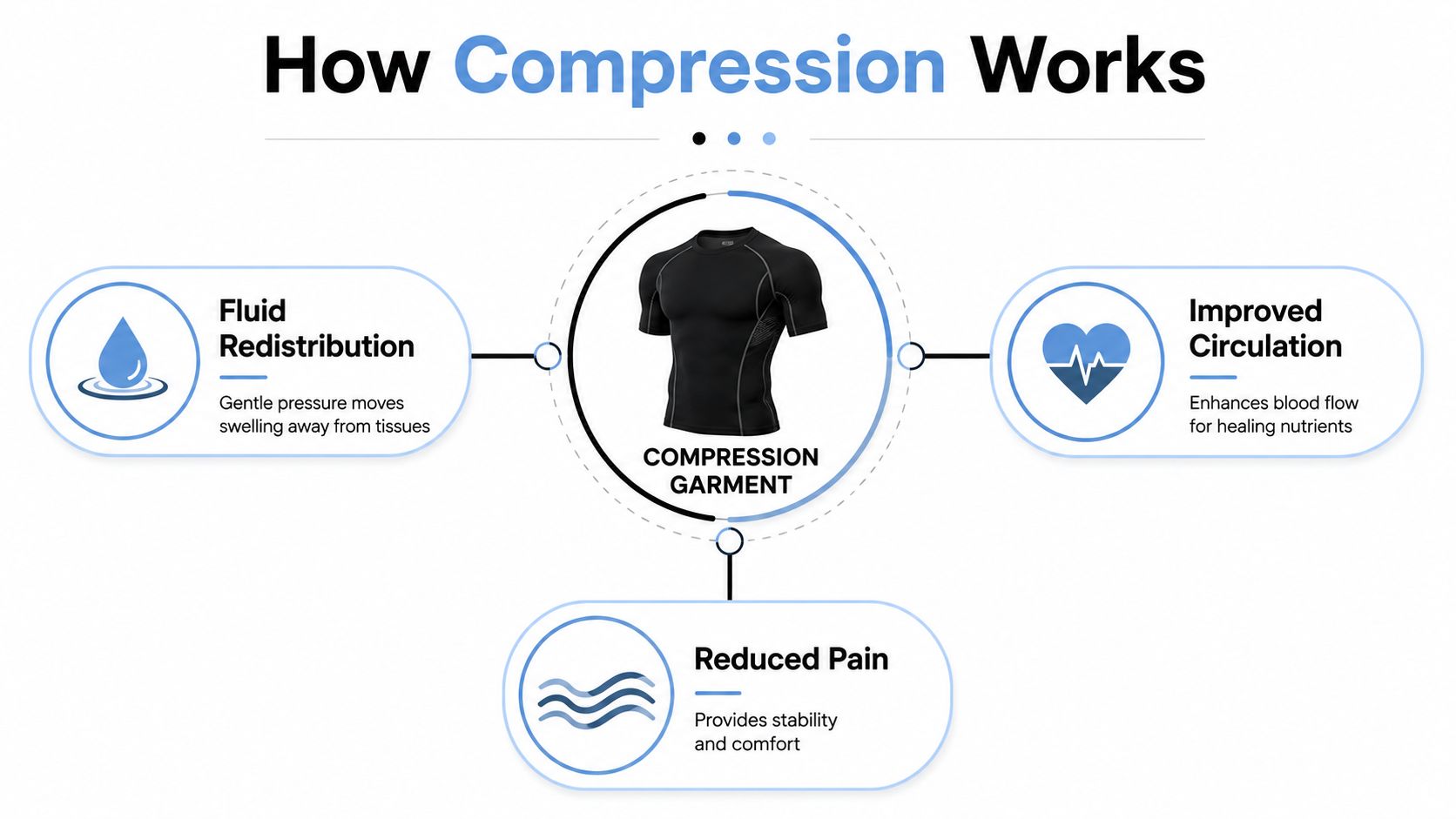
After surgery, the body sends fluid and inflammatory cells to the treated area. That response supports healing, but it also produces swelling, tightness, and bruising. Even pressure can limit excessive tissue movement and encourage superficial fluid redistribution, which may make the area feel less heavy or tense.
A 2023 practical review found the strongest support for postoperative compression in reducing edema and ecchymosis after rhinoplasty, and for reducing pain after breast and abdominal procedures. The same review found no clear seroma benefit overall. The practical review of postoperative compression garments supports using compression primarily for fluid management and symptom control, rather than promising that it will prevent every complication.
A garment can provide gentle support when you stand, walk, or change position. That stability may reduce pulling sensations around treated tissue and make movement feel more controlled. It doesn't replace wound care, prescribed medication, walking instructions, or follow-up examinations.
Patients sometimes assume that a garment directly heals an incision. It doesn't. Healing depends on factors such as blood supply, surgical technique, nutrition, infection prevention, and your body's response. Compression may create a more supportive environment, but it isn't a substitute for the broader recovery plan.
After liposuction or body contouring, swelling can temporarily obscure the shape created during surgery. An appropriately fitted garment can help hold the skin and superficial tissues evenly against the underlying contours while swelling settles. That may improve comfort and help the treated area feel more secure.
For new parents recovering from abdominal changes, an abdominal binder for new moms can provide general background on binder design and practical use. Postoperative patients should still follow their own surgeon's instructions, because a binder used for everyday support may not be appropriate over fresh incisions.
Some patients also choose lymphatic massage or related techniques, but those should be cleared by the surgical team. Cape Cod Plastic Surgery provides additional educational information about lymphatic drainage after surgery, including why timing and technique matter.
A breast support bra, a liposuction bodysuit, and an abdominal binder don't perform the same job. They apply pressure to different tissues and can affect movement, breathing, and incision comfort in different ways. The schedule below is a planning framework, not a replacement for your personalized postoperative instructions.
| Procedure | Garment Type | Initial Wearing Schedule | Key Considerations |
|---|---|---|---|
| Breast augmentation, reduction, or lift | Surgeon-approved postoperative bra or soft support bra | Follow the practice's prescribed schedule | Avoid pressure that irritates incisions or forces the breasts into an unwanted position |
| Liposuction | Targeted compression garment, bodysuit, or stage-appropriate support | Cape Cod Plastic Surgery's liposuction guidance states garments are typically worn for 3 weeks to minimize bruising and swelling | The garment should apply even pressure across treated zones without folds or tight bands |
| Abdominoplasty | Abdominal binder or full-torso garment selected by the surgical team | Use the schedule prescribed after incision and muscle repair assessment | Breathing, intra-abdominal pressure, mobility, and lower-extremity circulation require attention |
| Arm or thigh procedures | Sleeve, shorts, or targeted compression garment | Adjust as swelling and incision sensitivity change | Check the garment's edges for rolling, pinching, and color changes in the hands or feet |
| Facial surgery | Light facial wrap or localized support, when prescribed | Usually limited to the surgeon's specific instructions | Pressure must not obstruct breathing, vision, swallowing, or wound access |
After augmentation, reduction, or lift surgery, the priority is usually support without unnecessary pressure on the incisions or breast shape. A surgical bra may hold dressings in place and reduce movement, but an underwire bra can rub sensitive areas if your surgeon hasn't cleared it. The ideal fit should feel steady, not crushing.
Patients often ask whether a tighter bra will prevent displacement. It won't correct an incorrectly positioned implant or substitute for surgical assessment. If one breast suddenly becomes much firmer, larger, hotter, or more painful, contact the practice rather than tightening the garment.
Liposuction garments are designed to cover the treated zones and distribute pressure evenly. A garment with seams crossing a tender area, a rolled edge, or a tight opening can create localized pressure points. A garment that fits well on the first day may need adjustment as swelling changes.
Cape Cod Plastic Surgery's tummy tuck recovery tips provide procedure-specific education for abdominal recovery. After abdominoplasty, don't assume that a liposuction garment or generic shapewear offers the right support. Muscle repair, incision location, drains, posture, and breathing comfort all influence the choice.
Facial compression is more delicate because the garment sits near the airway, eyes, ears, and mouth. Use only the wrap and tension prescribed by your surgeon. For arm and leg procedures, monitor the areas beyond the garment. Swelling, tingling, coldness, or color changes in the hand or foot can indicate that pressure needs immediate review.
The safest schedule is the one that changes with your healing. Your surgeon may recommend continuous use early on, then shorter daytime periods, lighter support, or discontinuation. A calendar can guide you, but your incision and symptoms determine whether the plan remains appropriate.
The best garment is not the smallest one you can tolerate. It's the one that delivers the intended support across the correct area without cutting into skin, bunching over an incision, or interfering with breathing and movement.
Use the sizing method supplied by the garment manufacturer or your surgical practice. Measurements taken before surgery may not match your postoperative size because swelling changes the body's dimensions. Ask whether the practice will supply the garment, arrange a fitting, or recommend a specific model.
Check these points before purchasing:
Wash your hands first. If the garment is difficult to apply, sit or lie down and work it gradually over the body instead of pulling sharply from one edge. Keep zippers, hooks, seams, and closures away from fresh incisions unless your surgeon has specifically positioned them there.
Smooth the fabric with your palms. Wrinkles create narrow pressure bands, which can be more irritating than broad, even compression. Check that the garment hasn't rolled at the waist, groin, shoulder, knee, or ankle.
To remove it, release closures slowly and support the treated area as needed. Ask for help if weakness, pain, or limited range of motion makes dressing unsafe.
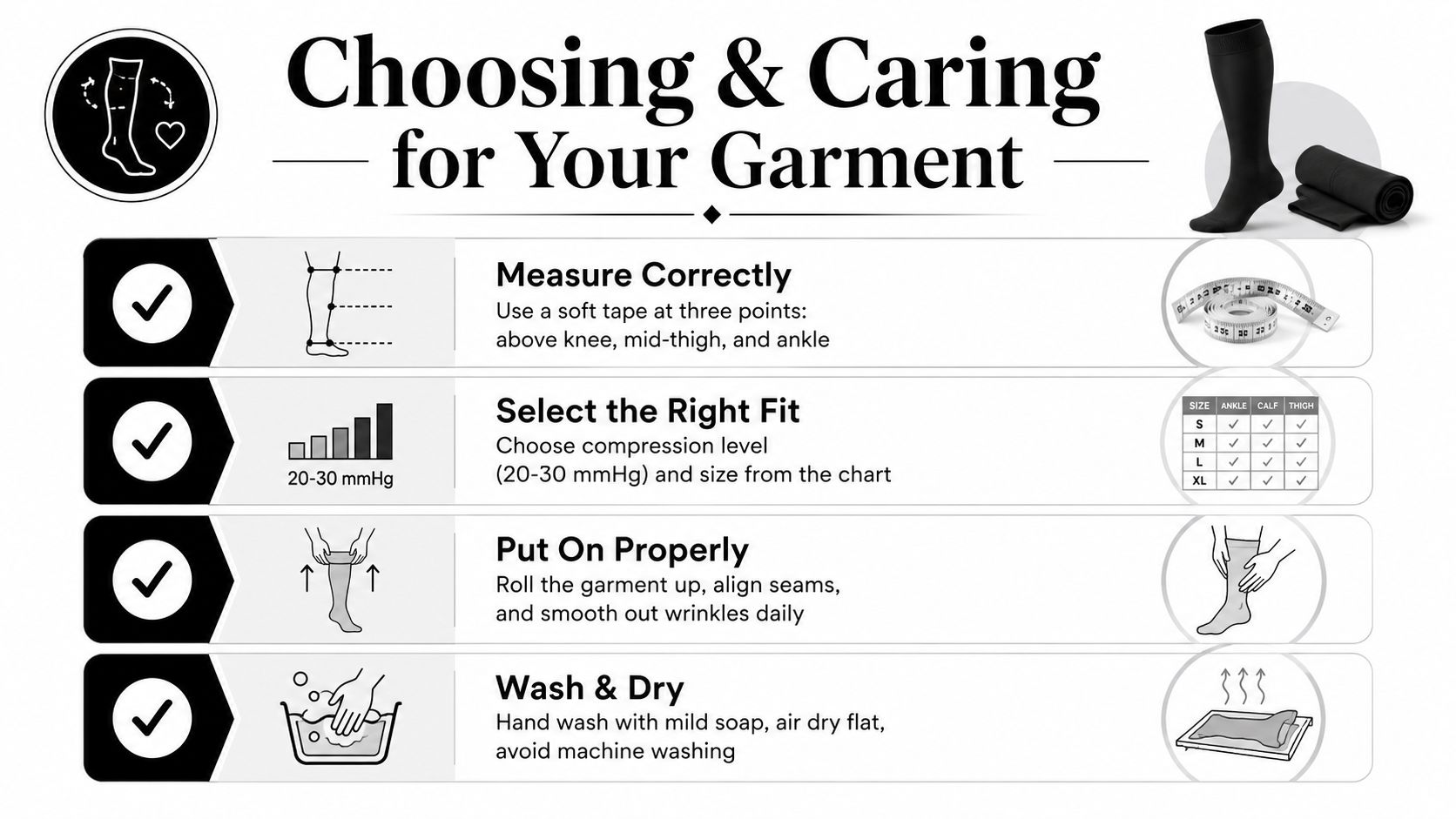
Follow the garment's care label and your practice's instructions. Mild soap and careful rinsing help remove sweat, skin oils, and drainage. Avoid bleach and harsh products that can damage elastic fibers, and allow the garment to air-dry as directed rather than applying uncontrolled heat.
Inspect it during washing. Replace it when elastic loses its support, seams separate, fabric tears, or the garment no longer lies smoothly. A damaged garment can create uneven pressure.
For a visual demonstration of postoperative support garments, watch this fitting and care resource:
Patients recovering from breast procedures can also review guidance on selecting a post-op bra, while remembering that the surgeon's preferred bra style and timing should control the decision.
Compression can be helpful, but tightness isn't proof that a garment is working. A garment that causes numbness, burning, increasing pain, or visible skin changes may be applying pressure in the wrong place or at the wrong intensity.
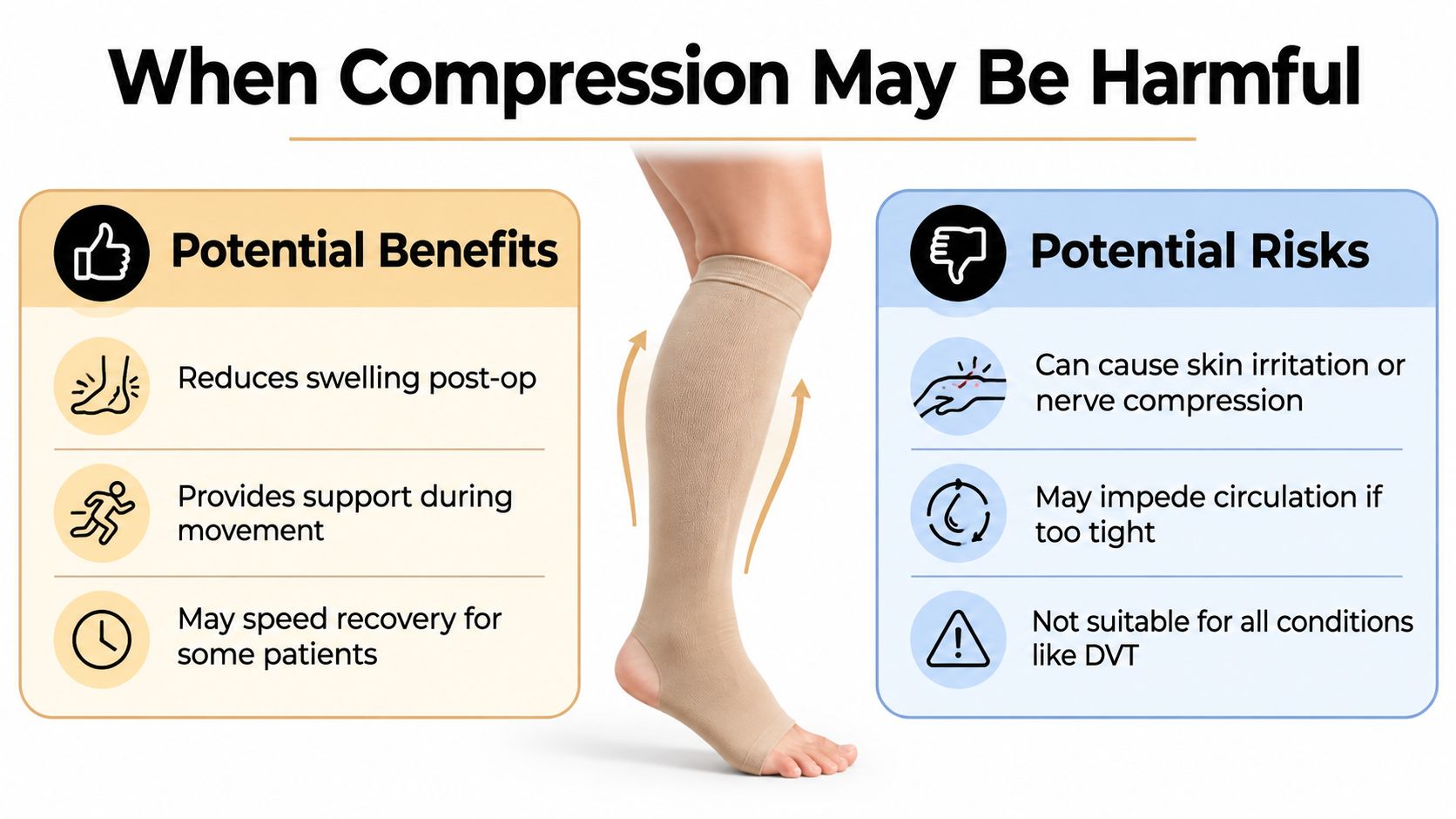
A 2023 clinical study found that patients who didn't wear a compression garment after abdominoplasty had less subcutaneous edema later in recovery than patients who wore one. That result conflicts with the assumption that compression always reduces swelling. The abdominoplasty study indexed by PubMed is one reason surgeons should evaluate the individual patient rather than prescribe maximum pressure by default.
The same evidence discussion raises concerns about abdominal binders and garments increasing intra-abdominal pressure and lower-extremity venous stasis. These concerns don't mean every binder is unsafe. They mean that fit, pressure, mobility, and risk factors matter, particularly for patients with circulation problems, clot risk, or prolonged immobility.
Call your surgical practice promptly if you notice:
Don't wait for a scheduled appointment if symptoms are severe or rapidly worsening. Sudden shortness of breath, chest pain, fainting, or symptoms suggesting a serious clot require emergency medical care. Never use a tight garment to manage suspected deep vein thrombosis.
Safety comes before schedule. If the garment is causing concerning symptoms, contact your surgeon rather than trying to “push through” the discomfort.
Patients with known vascular disease, clotting concerns, significant swelling in one limb, breathing disorders, or limited ability to walk should discuss compression before using it. Your surgeon may change the garment, reduce the schedule, prescribe a different form of support, or advise against compression in a particular area.
At Cape Cod Plastic Surgery in Hyannis, Massachusetts, compression recommendations are tied to the operation and the patient's examination. Dr. Marc Fater has over 30 years of experience, and that experience informs a practice style in which garment choice, pressure, and timing are not treated as identical for every body or procedure.

A patient recovering from liposuction may receive different instructions from someone recovering from a tummy tuck, breast surgery, or facial procedure. The practice's liposuction service information states that compression garments are typically worn for 3 weeks after surgery to minimize bruising and swelling. That timeline shouldn't be transferred automatically to another operation.
During postoperative visits, the team can assess incision healing, swelling patterns, garment position, comfort, and whether the current level of support remains appropriate. Bring the garment with you if you're unsure whether it fits correctly. A visual check can reveal rolling, bunching, pressure points, or coverage problems that are difficult to judge alone.
Contact the practice if you're unsure whether a symptom is expected, if the garment suddenly feels different, or if you can't wear it as instructed. Early communication gives the team an opportunity to adjust the plan before discomfort becomes a larger recovery barrier.
The practice offers facial surgery, breast surgery, body contouring, and reconstructive care, with an on-site AAAASF-accredited surgical suite. That setting supports coordinated surgical and postoperative care, but your daily observations still matter. Tell the team what happens when you stand, walk, sleep, wash the garment, and remove it.
There isn't one universal duration. The answer depends on your procedure, swelling, incision status, mobility, and surgeon's findings. Some patients transition from more consistent support to daytime or activity-based use, while others can stop earlier. Follow the schedule given by your surgical team rather than copying another patient's timeline.
Only if your surgeon has instructed you to do so. Sleeping in compression may be appropriate for some early recovery plans, but it isn't safe when the garment causes breathing difficulty, numbness, skin changes, or escalating pain. Check the fit before bed and report concerning symptoms.
Change stages when your surgeon recommends it, not just because the garment feels looser or because you want stronger pressure. Swelling may fluctuate during the day, and a smaller garment can become restrictive even if it fits comfortably at another time.
Remove or loosen it according to your postoperative instructions, inspect your skin, and contact the practice for guidance. Don't cut the garment, add padding over an incision, or replace it with tight shapewear without approval.
Compression doesn't cancel activity restrictions. Walk and exercise only as cleared by your surgeon, and ask specifically about travel, prolonged sitting, and physical therapy. The garment must never prevent you from breathing comfortably or moving safely.
Cape Cod Plastic Surgery can provide procedure-specific postoperative instructions, garment fitting guidance, and follow-up assessment for patients recovering from breast, facial, and body-contouring procedures. Visit Cape Cod Plastic Surgery to learn about consultation options and discuss a compression plan suited to your operation and healing progress.
October 7, 2026
A Practical Guide to Healing After Breast Surgery

October 6, 2026
Your Safety Guide: What to Look for When Choosing a Plastic Surgeon

October 5, 2026
Why Our On-Site Accredited Facility Matters for Your Safety

Cape Cod Plastic Surgery offers expert cosmetic and reconstructive procedures in a safe, accredited setting. Led by Dr. Marc Fater, we combine advanced techniques with personalized care to help you look and feel your best.
Monday: 9:00 AM – 5:00 PM
Tuesday: 9:00 AM – 5:00 PM
Wednesday: 9:00 AM – 5:00 PM
Thursday: 9:00 AM – 5:00 PM
Friday: 9:00 AM – 5:00 PM