

October 7, 2026
What to Expect During Your Breast Surgery Recovery
A Practical Guide to Healing After Breast Surgery
May 25, 2026

The first day or two after surgery can feel oddly confusing. You may be relieved the procedure is over, but then you notice how stiff everything feels. Reaching for a water glass seems bigger than it should. Standing up straight may pull in places you didn't expect. Even a small movement can make you wonder, “Am I helping myself heal, or am I going to mess something up?”
That hesitation is common after cosmetic and reconstructive surgery. People are often careful around incisions, drains, swelling, tight skin, or the feeling that everything is “held together” and shouldn't be disturbed. But complete stillness usually isn't the goal. In many recoveries, your surgeon wants you moving in a very specific, protected way.
That's where active assisted range of motion comes in. It gives you a middle ground between doing too much and doing nothing at all. Instead of forcing movement, you use gentle help from your other arm, a stick, a tabletop, a towel, or a therapist to guide the motion. For many patients, that's the first way movement starts to feel safe again.
A very typical recovery moment looks like this. A patient sits at the edge of the bed after surgery, shoulders a little rounded, moving cautiously because the chest feels tight or the abdomen feels protective. She wants to sit up straighter, maybe wash her face, maybe reach for a shirt sleeve, but every motion feels uncertain.
This is especially true after procedures that change how your skin, soft tissue, and posture feel. Breast surgery can make the front of the chest feel guarded. An arm lift can make overhead reaching feel intimidating. Tummy tuck patients often feel like standing tall will pull too much. Reconstructive patients may be balancing healing tissue with tenderness, swelling, and understandable anxiety about scars.
A lot of people think the problem is only pain. Often it's more than that:
That's why the first steps after surgery usually aren't strength exercises. They're controlled motion exercises. If you've looked at broader rehab resources like BionicGym for knee replacement recovery, you've probably seen the same theme: early recovery is often about safe motion before it's about hard work.
Practical rule: The right early exercise should feel guided and controlled, not brave or aggressive.
For plastic surgery patients, this matters in a very specific way. You're not just recovering function. You're also protecting incisions, respecting tissue healing, and trying to support the best aesthetic outcome possible. Good movement can help you return to daily tasks without adding unnecessary strain or compensation.
Your own post-op instructions always come first. General recovery guidance can help you understand the process, but it should fit around your surgeon's plan. If you need a broader overview of healing basics, these post-operative care tips for a smooth recovery can help connect movement with the rest of your aftercare.
Active assisted range of motion means you move a joint yourself, but you get a little help to complete the motion. That help might come from your other hand, a therapist, a cane, a towel, a tabletop, or another simple tool.
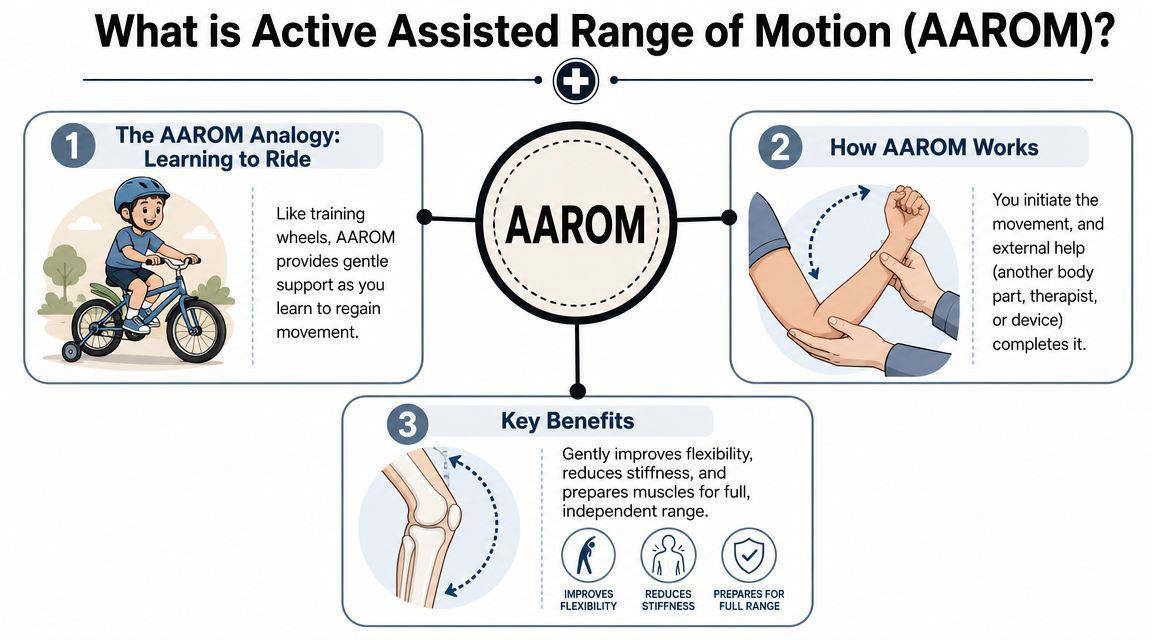
The clearest way to think about it is a bike with training wheels. You're still pedaling. The bike is still moving because of your effort. But the support keeps you from tipping too far while you learn or recover.
According to Physiopedia's overview of range of motion, AAROM sits between fully active motion and fully passive motion. The patient moves the joint with partial external help from a therapist, device, or the opposite limb. That's why it's such a useful bridge between immobility and full independent movement.
Active assisted range of motion is movement you start, with just enough help to finish safely.
The active part means your muscles are still involved. You're not limp while someone else does all the work. You're participating.
That's important because many patients assume “assisted” means they should stay completely relaxed. In AAROM, you're doing what you can. If you can lift your arm halfway comfortably but not all the way, the assist helps with the remaining part. Your body is still learning and practicing the movement.
The assisted part means you don't have to force the full motion on your own. This is often where people feel relief. You're not failing if you need help. You're using the amount of support that matches your current stage of healing.
For cosmetic and reconstructive surgery patients, that support can be very reassuring because tissue tightness often feels different from weakness. You may have the intention to move, but the area may feel restricted by swelling, dressings, tenderness, or protective guarding. Assistance lets you move without turning the exercise into a struggle.
A few simple examples make it easier to picture:
If you remember one idea, make it this one: active assisted ROM is not “doing less.” It's doing the right amount.
The three common motion terms can sound similar, which is why patients often mix them up. The fastest way to understand them is to ask one question: Who is doing the work?
If someone else moves the joint for you, that's passive. If you do all of it by yourself, that's active. If you start the motion and get some help to finish it, that's active-assisted.
AAROM is often the sweet spot after surgery because you're involved in the motion without asking healing tissue to handle the whole load. A clinical explanation from Kemtai's discussion of the three types of ROM notes that AAROM is appropriate when a patient can move but can't complete the full arc because of pain, weakness, or post-operative limitation. It also notes that AAROM preserves neuromuscular recruitment and joint proprioceptive input while reducing mechanical load compared with purely passive motion.
| Characteristic | Passive ROM (PROM) | Active-Assisted ROM (AAROM) | Active ROM (AROM) |
|---|---|---|---|
| Who moves the joint | A therapist, helper, or device | You start the motion and receive partial help | You do the whole motion yourself |
| Muscle effort from you | Minimal or none | Partial | Full |
| Main goal | Maintain mobility when you can't move well on your own | Bridge the gap between passive movement and independent movement | Build control of full independent motion |
| How it feels | More like being guided | More like supported practice | More like self-directed movement |
| Common recovery use | Very early or when movement is highly limited | When you can move some, but not the whole way | Later, when tissues and pain allow full participation |
Let's say you've had surgery involving the chest, breast, arm, or upper body.
That middle category is where many people get stuck mentally. They think if they need help, they shouldn't move at all. Or they think if they can move a little, they should do the entire motion independently. Usually, neither extreme is ideal.
The middle ground often protects healing better than either extreme. Too little motion can feed stiffness. Too much independent effort can irritate healing tissue.
Plastic surgery recovery has extra layers that general rehab articles often skip. A shoulder motion after breast surgery doesn't just involve the shoulder. It may also involve skin tension, chest wall sensitivity, scar awareness, drains, or implant-related precautions. An abdominal procedure may limit how freely you reach because your trunk position changes how everything feels.
That's why your exercise plan isn't just about “can the joint move?” It's also about whether the movement is calm, symmetrical, and controlled.
Patients usually want a direct answer here. Why not just rest until everything heals more? Because healing tissue still needs thoughtful movement.
AAROM gives your body a way to move without asking it to do too much too soon. That matters after cosmetic and reconstructive surgery because stiffness can build in nearby joints and soft tissues even when the surgical area itself is healing normally.
Here are the practical reasons surgeons and therapists often like this approach:
For plastic surgery patients, this can show up in everyday ways. A breast surgery patient may feel more comfortable washing her hair or putting on a shirt once shoulder motion returns gradually. An abdominoplasty patient may move more naturally through bed mobility and posture once guarded movement decreases. A reconstructive patient may feel less intimidated by using the involved area once supported motion becomes familiar.
In an eight-week active-assisted stretching program, the intervention group showed significant increases in range of motion and improved functional performance at p < 0.05, while the control group showed no improvement. That doesn't mean every surgery patient should do the same program. It does show that assisted motion is more than a placeholder. It can produce measurable changes in mobility and function.
That's one reason AAROM is often introduced early in rehab. The goal isn't to chase intensity. The goal is to restore motion in a way your tissues can tolerate.
Early recovery works best when movement is dosed like medicine. Enough to help. Not so much that it creates a setback.
For patients worried about appearance, this is reassuring. Safe movement isn't the enemy of a good result. Poorly chosen or poorly timed movement can be a problem, but well-guided motion is often part of protecting your recovery rather than threatening it.
Not every exercise fits every procedure. A patient recovering from an arm lift, breast procedure, or reconstruction may need a different motion plan than someone recovering from abdominal surgery. Still, a few AAROM patterns show up often because they're simple, controlled, and easy to adjust.

One useful detail from the shoulder rehab literature is that exercise choice matters. A summary at Hand Surgery Resource notes that table-slide and forward-bow exercises produced more range of motion with less pain than some other methods, including rope-and-pulley, which is a good reminder that the most familiar tool isn't always the best starting point.
This is one of the friendliest early options for many upper-body recoveries because the table supports the arm.
This often feels smoother than lifting the arm against gravity. For many patients, that makes it less threatening.
A broom handle, cane, or wooden dowel can let your stronger arm guide the healing one.
If you're recovering from an upper-body procedure, this can be a good way to practice symmetry. If you're recovering from an arm-focused procedure, follow your specific precautions closely.
This is often used when rotation feels stiff, but it should be done very gently.
This is a good example of why details matter. A small change in elbow position can change the stress on healing tissues.
A quick demo can make these patterns easier to picture:
This closed-chain option uses body position to create gentle motion.
Some patients tolerate this better than traditional pulley work because it feels less forced.
If you're looking at rehab examples for other joints, it helps to compare how simple support tools are used. This guide to safe hip replacement exercises is a good example of how recovery exercise should match healing stage, not just body part.
Patients recovering from upper-arm contouring may also want procedure-specific context, since shoulder motion and incision comfort can overlap. This overview of arm lift surgery recovery can help you understand how motion fits into the bigger healing picture.
One of the biggest mistakes after surgery is treating rehab like a toughness test. That idea causes problems. No pain, no gain does not belong in early post-op movement.
The best early exercise is the one you can repeat with good form, low guarding, and no symptom spike afterward. A 2021 study discussed in the shoulder rehab literature found that certain closed-chain ROM exercises allowed greater motion with lower pain than others, which supports a very practical idea: the smartest exercise early on is the one that improves motion while limiting pain and compensation.
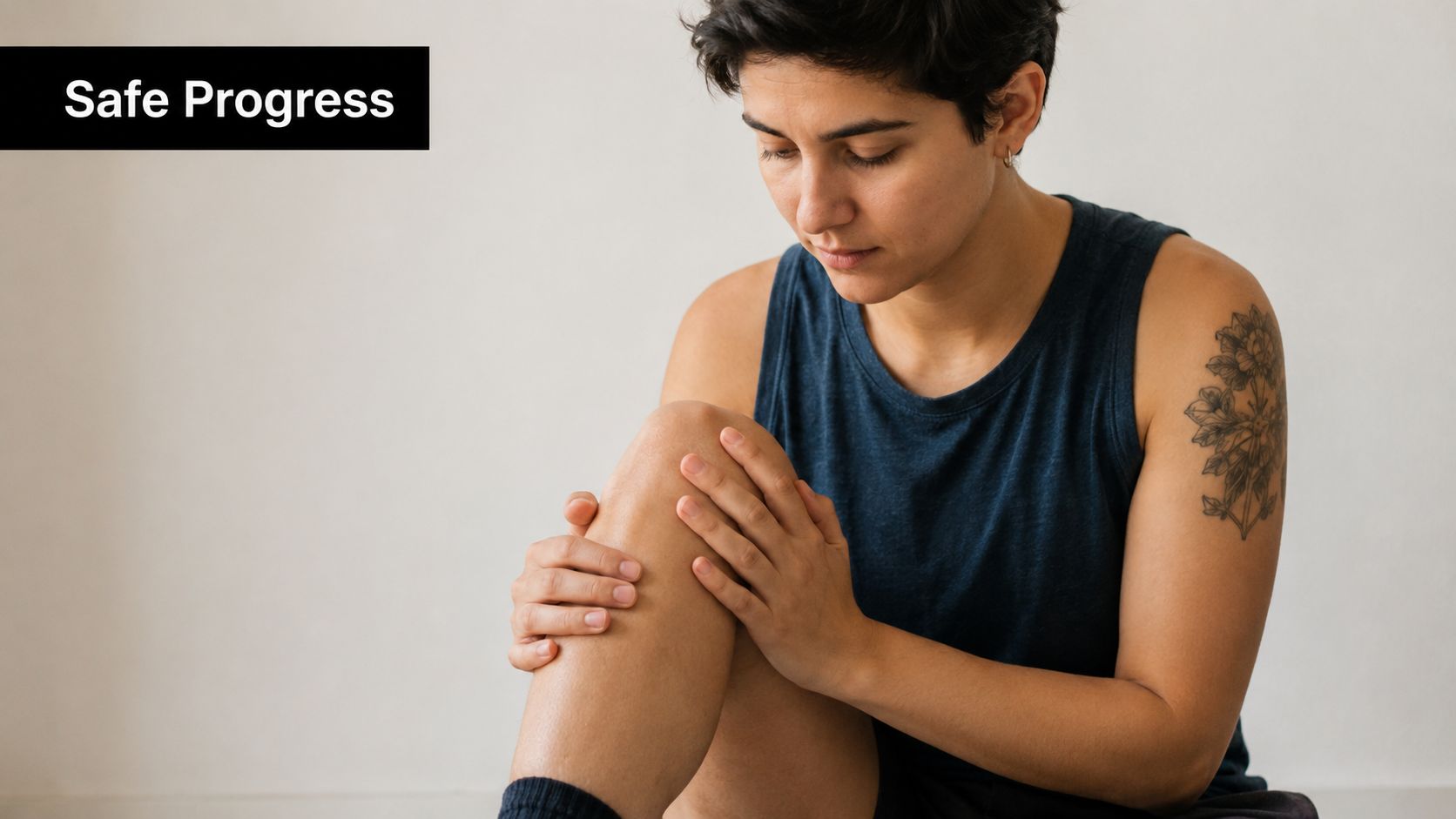
Recovery usually moves in a sequence, not a leap:
That progression matters because tissues don't care how motivated you are. They respond to load, position, and timing. If your movement becomes jerky, compensatory, or painful, your body is telling you the dose is wrong.
A useful checkpoint is how you feel later the same day and the next morning. If soreness escalates, swelling jumps, or motion feels worse instead of looser, the exercise may be too much or too soon.
Stop the exercise and contact your medical team if you notice:
These warnings matter even more in cosmetic and reconstructive recovery because the issue isn't only discomfort. Excessive strain can change how you move around healing tissue, and poor movement patterns can linger if you practice them over and over.
If you're also trying to sort out normal soreness versus a problem, guidance on pain management after surgery can help you understand what deserves a call.
It can if you do the wrong movement at the wrong time or push past your restrictions. But properly selected AAROM is meant to be gentle and controlled. The goal is to move within a protected range, not stretch the incision aggressively. If an exercise creates a strong pulling feeling directly at the incision, stop and ask your surgeon or therapist to modify it.
Not always. Many patients can safely perform simple assisted motions at home if their surgeon has clearly explained what's allowed. A therapist becomes especially helpful when motion is very limited, pain makes you guard heavily, or you aren't sure whether you're compensating with your neck, back, or opposite side.
Not necessarily. Many people assume pulleys are the default answer, but simpler options like table slides or a dowel may feel better early on. For some patients, they also make it easier to avoid jerking, shrugging, or forcing overhead motion.
That fear makes sense. Cosmetic patients often worry that any discomfort means they're damaging their result. In reality, carefully chosen motion is often part of a polished recovery. The key is that the motion has to match your procedure, your healing phase, and your surgeon's rules.
No. The principle is similar, but the exercise choice and timing can differ a lot. A tummy tuck patient may need more attention to trunk position and posture. A breast surgery patient may need more guidance with shoulder motion. A reconstructive patient may have tissue-specific precautions that make generic internet exercise advice a poor fit.
Only when your surgeon says it's time. That approval matters because two patients can have similar-looking procedures and very different tissue considerations. Don't start a movement program because it seems gentle or because someone else online did it earlier. Your healing timeline is your timeline.
If you're planning a cosmetic or reconstructive procedure and want guidance that respects both healing and appearance, Cape Cod Plastic Surgery offers personalized care designed around safe recovery, thoughtful follow-up, and natural-looking results.
October 7, 2026
A Practical Guide to Healing After Breast Surgery

October 6, 2026
Your Safety Guide: What to Look for When Choosing a Plastic Surgeon
October 5, 2026
Why Our On-Site Accredited Facility Matters for Your Safety

Cape Cod Plastic Surgery offers expert cosmetic and reconstructive procedures in a safe, accredited setting. Led by Dr. Marc Fater, we combine advanced techniques with personalized care to help you look and feel your best.
Monday: 9:00 AM – 5:00 PM
Tuesday: 9:00 AM – 5:00 PM
Wednesday: 9:00 AM – 5:00 PM
Thursday: 9:00 AM – 5:00 PM
Friday: 9:00 AM – 5:00 PM