

October 7, 2026
What to Expect During Your Breast Surgery Recovery
A Practical Guide to Healing After Breast Surgery
Apr 25, 2026

You’re probably here after a familiar moment. You catch your reflection in a mirror, on a video call, or in a photo taken from an angle you didn’t choose, and your eyes look heavier, more tired, or more hooded than you feel. At first, the primary focus is on the procedure itself. Upper lids or lower lids. Cosmetic or functional. Recovery. Scars.
Then the main question surfaces. Who should perform surgery this close to your eyes?
That’s the decision that matters most. Blepharoplasty has an overall success rate of 85 to 90%, and more than 93% of patients report high satisfaction after upper blepharoplasty, with complications in less than 10% of cases when the procedure is performed well, according to reported blepharoplasty outcome data. Those numbers are reassuring, but they also point to the central truth patients often miss. Good outcomes don’t happen because blepharoplasty is simple. They happen because the surgeon’s judgment, technical control, and restraint are sound.
A well-chosen surgeon can make you look rested without making you look different. A poorly chosen one can remove too much skin, change the shape of the eye, create asymmetry, or leave you chasing revisions you never expected to need.
If you’re searching for the blepharoplasty best surgeon, a generic top-ten list won’t help enough. You need a way to judge credentials, specialty fit, photo galleries, reviews, facility safety, and local follow-up care. You also need to know what trade-offs are real. Some surgeons are stronger with cosmetic finesse. Others are better with functional complexity. Some practices present polished marketing but weak surgical depth. Others are quieter online and far stronger in the operating room.
The right choice usually becomes clear when you evaluate the whole picture, not just a name, a social feed, or a star rating.
Patients often assume eyelid surgery is a small procedure because the incisions are small. That’s a mistake. The eyelids are delicate structures with almost no room for overcorrection, casual planning, or one-size-fits-all technique.
A good blepharoplasty result depends on more than removing extra skin or under-eye fullness. The surgeon has to understand eyelid support, brow position, facial balance, healing patterns, and how much change your face can tolerate without losing its character. That’s why surgeon choice outweighs almost every other factor.
The best results in eyelid surgery don’t announce themselves. Friends may say you look less tired or ask whether you changed your skincare routine. They shouldn’t immediately say you had surgery.
That kind of outcome requires judgment. In practice, the surgeon has to decide not only what to remove, but also what to preserve. Aggressive surgery can create a hollow upper lid, a pulled lower lid, or an eye that no longer closes comfortably. Conservative surgery can leave too much heaviness behind. The right plan sits in the middle and is individualized.
Practical rule: If a surgeon talks about eyelid surgery as if it’s routine skin trimming, keep looking.
What works is a surgeon who studies your face, your brow position, your skin quality, and the way your eyelids function before discussing technique. What doesn’t work is a rushed consultation that jumps straight to scheduling.
A strong candidate-surgeon match usually includes:
Don’t ask only, “Is this surgeon qualified?” Ask, “Is this surgeon right for my eyes, my anatomy, and my goals?”
That shift changes everything. It moves you away from marketing and toward decision-making. It helps you compare specialists more intelligently, ask sharper questions, and recognize whether a surgeon is guiding you or selling to you.
The patients who do best usually aren’t the ones who found the flashiest practice. They’re the ones who chose carefully.
Credentials can look impressive on a website and still tell you very little unless you know what they mean. For blepharoplasty, qualifications are not a cosmetic detail. They are your first filter.
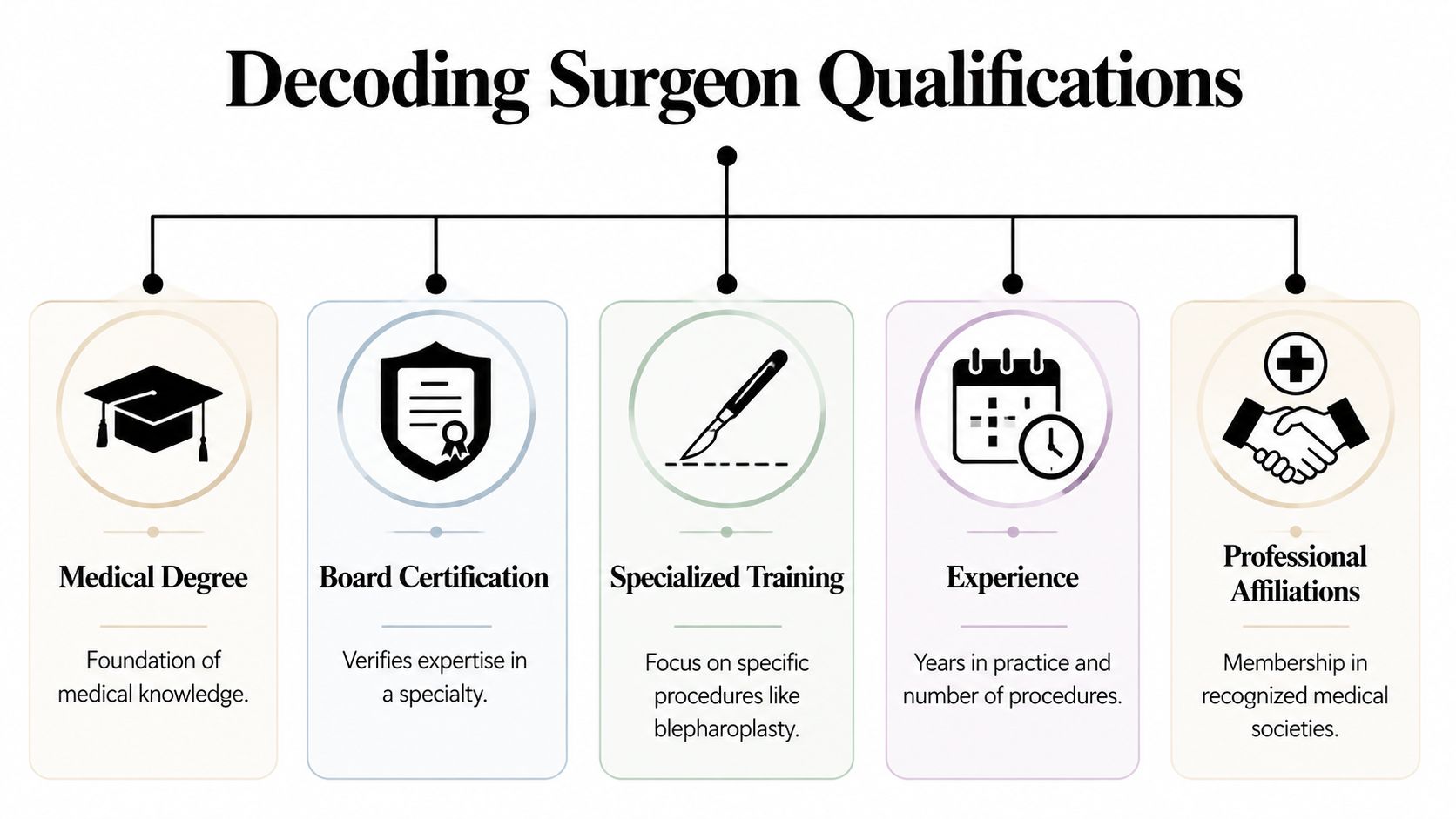
For facial surgery, and especially eyelid surgery, I’d treat board certification as the baseline. It tells you the surgeon completed recognized specialty training and met formal standards in that field. It also helps separate real surgical training from vague cosmetic branding.
Patients often get confused by titles. “Cosmetic surgeon” can sound polished, but it doesn’t tell you the same thing as board-certified plastic surgeon or board-certified ophthalmologist with oculoplastic training. If you want a useful explanation of how credential language can mislead patients, board-eligible vs board-certified is worth reviewing before you book consultations.
This is one of the most important distinctions in a blepharoplasty best surgeon search, and it’s rarely explained well.
An oculoplastic surgeon is an eye specialist who completed additional surgical training focused on the eyelids and surrounding structures. A board-certified plastic surgeon brings broader training in facial aesthetics, tissue handling, symmetry, and surgical planning across the face. Both can be excellent choices. The better fit depends on your anatomy and your goals.
According to reported ASOPRS comparison data, oculoplastic blepharoplasty has 1 to 2% major complication rates versus 5 to 10% for general plastics, which is one reason patients with functional concerns, revision cases, lid asymmetry, or dry-eye history often benefit from eye-focused expertise. On the other hand, a highly experienced board-certified plastic surgeon with a strong facial practice may be an excellent fit for patients whose goals are primarily cosmetic and whose anatomy is straightforward.
The key is nuance. “Who is better?” isn’t the right question. “Who is better for my case?” is.
Patients also mix up optometrists, ophthalmologists, and oculoplastic surgeons. That confusion can affect how they interpret referrals and recommendations. If you want a clear, patient-friendly primer on the distinction between an optometrist vs ophthalmologist, read that before your consults. It helps you understand who diagnoses vision issues, who performs surgery, and where oculoplastic subspecialty training fits.
Years in practice matter, but only if those years include regular eyelid surgery. A surgeon may be excellent at body contouring and still not be the right choice for your lower lids. Facial anatomy rewards repetition and judgment built from many similar cases.
Ask directly:
A qualified surgeon usually sounds measured, not theatrical. They can explain why one technique fits you and another does not. They don’t promise perfection. They don’t imply that every patient needs the same operation.
Here’s a practical way to compare what you hear in consultation:
| What you hear | What it usually means |
|---|---|
| “You’re a good candidate, but I need to examine brow position and lid support first.” | Thoughtful planning |
| “Upper lids are easy. We do these all the time.” | Overconfidence or oversimplification |
| “Your lower lids may need a conservative approach to avoid a pulled look.” | Respect for anatomy |
| “We can fix everything in one quick procedure.” | Sales language, not surgical reasoning |
A surgeon who can explain why they would not do part of a procedure is often safer than one who says yes to everything.
A before-and-after gallery should answer one question: can this surgeon produce results you’d want on your own face?
Most patients look at portfolios passively. They scroll, react, and move on. A better approach is to evaluate photos the way a surgeon does. You’re not just looking for improvement. You’re looking for consistency, restraint, and signs that the result fits the person.

The best eyelid surgery doesn’t erase individuality. It restores openness and smoothness while preserving expression.
When you review a gallery, slow down and compare more than one patient. Look for patterns:
Many people make poor decisions. They choose a surgeon based on attractive results in faces that look nothing like theirs.
If you have thick skin, hereditary puffiness, asymmetry, deep-set eyes, or a heavy brow, you should see cases that resemble those features. If you’re considering lower blepharoplasty, don’t rely on upper-lid photos. If you’re older and care about a subtle result, don’t let a gallery full of younger patients guide the decision.
A useful reference for learning how to think through image selection is before-and-after photos in plastic surgery. It helps patients move past the emotional reaction of “that looks good” and into a more disciplined review.
Photo galleries can be honest and still be misleading. Cropping, makeup, lighting, camera tilt, and timing all affect what you think you’re seeing. In some cases, digital changes are obvious. In others, the issue is inconsistent presentation that flatters the after image.
If you’ve never thought about this before, a practical primer on detecting image manipulation can sharpen your eye. You don’t need to become a forensic analyst. You just need to notice when the evidence is too polished to be trusted.
If the after photos use softer lighting, heavier makeup, different head tilt, or a more flattering lens distance, the gallery tells you less than it appears to.
Star ratings are blunt instruments. Detailed reviews are much more useful.
A meaningful review often describes the entire patient experience. It mentions whether the surgeon listened, whether risks were explained, whether swelling and recovery matched expectations, and whether the patient felt supported afterward. Those details matter more than enthusiastic one-line praise.
Look for signals such as:
Specificity about the consultation
A helpful review says what was discussed, not just that the visit was “great.”
Comments on postoperative care
Eyelid surgery follow-up matters. Strong practices stay engaged after the operation.
Balanced tone
Reviews that mention minor inconveniences but still express confidence often feel more reliable than perfect, generic praise.
Repeated themes across platforms
If multiple patients describe the same strengths or the same frustrations, pay attention.
Some review patterns deserve caution, even if the overall rating looks strong.
The right portfolio and the right reviews should reinforce each other. When they do, confidence grows. When they don’t, keep looking.
A consultation is not a formality. It’s an interview, and you are doing the hiring.
That mindset changes the tone of the visit. You stop trying to impress the surgeon or prove you’re a good candidate. Instead, you begin evaluating whether this person can operate safely, communicate clearly, and make sound decisions under pressure.

Before the surgeon talks about technique, they should talk about you. Your symptoms, your goals, your past eye history, dry-eye symptoms, contact lens use, prior facial procedures, healing concerns, and what bothers you most.
If the conversation jumps straight to price or scheduling, that’s not efficient care. It’s incomplete care.
The strongest consultations usually feel calm, specific, and transparent. These questions help you get there.
The answers should sound individualized. If two different patients would receive the exact same explanation, the planning may not be specific enough.
Facility safety often gets far less attention than it deserves. It shouldn’t.
According to reported guidance on surgeon vetting and facility accreditation, AAAASF accreditation can reduce infection risks by as much as 40% compared with non-accredited facilities. That matters because a polished office is not the same thing as a rigorously accredited surgical environment.
Ask directly:
Safety check: Ask where your surgery will physically take place before you commit. The answer should be immediate and precise.
A surgeon who performs blepharoplasty well should also prepare you well. Recovery guidance should be clear, not improvised.
Ask about:
These questions reveal how the practice functions after the operation, when patients are most vulnerable and most likely to need reassurance.
For patients who want a broader framework before the appointment, what to expect during your plastic surgery consultation is a useful checklist to review before you walk in.
Some warnings are obvious. Others are subtle.
Be cautious if you notice any of the following:
A helpful video can make these consult dynamics easier to visualize:
Good surgeons don’t create false urgency. They explain trade-offs. They acknowledge uncertainty where uncertainty exists. They don’t oversell lower lid surgery to someone who may be better served by a conservative approach, and they don’t recommend upper lid skin removal without thinking about brow position and lid function.
That kind of consultation leaves you informed, not dazzled.
When patients say they “just had a good feeling,” that feeling usually comes from something concrete. The surgeon was careful with details, direct about limits, and attentive to safety. That’s the confidence you want.
A Cape Cod patient sees her new eyelid contour in the mirror a week after surgery and notices one side looks a little more swollen. In many cases, that is a normal part of healing. It is far easier to sort out quickly when the surgeon is nearby, knows the operative details, and can examine the lids in person.
That is why local access carries real weight in blepharoplasty. Eyelid surgery is not a one-day transaction. It involves preoperative planning, postoperative checks, and a surgeon who can assess healing directly if swelling, dryness, tightness, or asymmetry creates concern.
Patients who search broadly for the blepharoplasty best surgeon sometimes give too much weight to online visibility and too little to practical follow-up. A nationally known name may be appropriate for a complex revision or a highly specialized problem. For straightforward cosmetic eyelid surgery, distance can create avoidable friction at the exact point where reassurance and direct examination matter most.
Cape Cod patients should expect the same standards they would demand in Boston, New York, or any other major market. Geography does not lower the bar.
A strong local blepharoplasty practice should show the following:
| Standard | What it should look like |
|---|---|
| Credentials | Board certification and regular experience with eyelid surgery |
| Surgical judgment | Plans tailored to brow position, lid anatomy, skin quality, and eye shape |
| Portfolio quality | Consistent, natural outcomes across many patients, not a few dramatic examples |
| Facility safety | An accredited operating environment such as AAAASF, with clear safety protocols |
| Follow-up care | Reliable access to the surgeon and staff during recovery |
That framework matters because blepharoplasty is a small operation in size, but not in consequence. A few millimeters can change the result.
Dr. Marc Fater is a reasonable local example of how to apply that framework. He is a board-certified plastic surgeon with decades of experience, and the practice includes an on-site AAAASF-accredited surgical suite. For a discerning patient, those points are relevant because they address two common concerns at once: surgeon training and facility oversight.
Those facts do not answer every question. They should not.
The more useful question is whether the practice combines technical experience with restraint and sound judgment. In eyelid surgery, experience matters most when it leads to appropriate patient selection, conservative tissue handling, and a clear explanation of what surgery can and cannot improve. A surgeon may have an impressive résumé and still be the wrong fit if the aesthetic style is too aggressive or the consultation does not address your anatomy carefully.

Patients often appreciate proximity most after surgery, not before it.
Routine healing still raises questions. Lower lid swelling can linger. Upper lid creases can look uneven early on. Dryness can feel worse for a short period. Most of these issues settle with time and proper guidance, but they are easier to manage when your surgeon is available for direct follow-up instead of remote reassurance based on phone photos.
That is one reason I advise patients to treat locality as a quality factor once the other standards are met. Local care does not make a surgeon better. It does make good care easier to deliver consistently.
For patients comparing providers in this area, Cape Cod Plastic Surgery in Hyannis is one practice that fits the local framework outlined above, including an AAAASF-accredited surgical suite and in-person follow-up close to home. That makes it a useful comparison point as you assess other options on Cape Cod.
Use the same standard for every consultation. Do not let familiarity, advertising, or convenience decide for you.
Ask:
The right local choice is the practice that holds up under close examination, both in the operating room and after it.
Start with the concern that bothers you most. If the issue is hooding, heaviness, or upper eyelid skin that crowds the lash line, upper blepharoplasty may be the relevant discussion. If the concern is puffiness, bags, crepey lower lid skin, or a tired appearance beneath the eyes, lower blepharoplasty may be the better focus.
Some patients need both. Others think they do, but their real issue is brow descent, cheek changes, or skin quality rather than lid tissue alone. That’s why a good exam matters more than self-diagnosis.
Not always. The better choice depends on the case.
If you have revision surgery, functional eyelid concerns, significant asymmetry, or a history of eye surface problems, oculoplastic training may be especially valuable. If your case is primarily cosmetic and the surgeon has strong facial experience, excellent judgment, and a natural portfolio, a board-certified plastic surgeon may be an excellent fit. The right question is not which title sounds more specialized. It’s which surgeon is best equipped for your anatomy and goals.
Bring a short list of what bothers you most, your medical history, prior facial or eyelid procedures, and any eye-related symptoms such as dryness or irritation. It also helps to bring old photos of yourself if your goal is restoration rather than change.
You should also bring questions. Patients who write them down usually leave with much better clarity.
Trust the consultation.
Photos matter, but surgery is not a gallery purchase. You’re choosing a person and a process. If you feel rushed, dismissed, pressured, or unclear about the plan, that is not a minor issue. Technical skill and patient communication are not separate. Judgment shows up in both places.
No. Healing varies, aging continues, and some patients begin with anatomy that makes perfect symmetry impossible. That said, some revisions do stem from poor planning, overcorrection, undercorrection, or weak technique.
The important point is that revision surgery is usually harder than primary surgery. If you’re considering a surgeon, ask how they think about preventing the common problems that lead to revisions. The answer often tells you more than a polished photo gallery.
Usually more than one is helpful, especially if your case is nuanced or if you’re deciding between specialist types. Two consultations often give patients a much clearer sense of what is standard, what is personalized, and what feels right.
You are not being difficult by comparing surgeons. You are being careful.
You need both.
A skilled surgeon in a poorly run environment is not enough. A beautiful office with weak surgical judgment is not enough either. The best decisions happen when credentials, planning, facility safety, anesthesia standards, and follow-up systems all align.
Most patients know when the decision stops feeling like a gamble.
You understand the plan. You understand the trade-offs. The surgeon answered your questions directly, didn’t oversell the procedure, and showed results that match your goals. The facility standards were clear. The follow-up process made sense. You felt informed rather than persuaded.
That’s usually the moment the search ends.
If you’re considering eyelid surgery and want a careful, in-person evaluation on Cape Cod, Cape Cod Plastic Surgery offers consultations designed to help you assess candidacy, understand your options, and decide with confidence whether blepharoplasty is the right next step.
October 7, 2026
A Practical Guide to Healing After Breast Surgery

October 6, 2026
Your Safety Guide: What to Look for When Choosing a Plastic Surgeon

October 5, 2026
Why Our On-Site Accredited Facility Matters for Your Safety

Cape Cod Plastic Surgery offers expert cosmetic and reconstructive procedures in a safe, accredited setting. Led by Dr. Marc Fater, we combine advanced techniques with personalized care to help you look and feel your best.
Monday: 9:00 AM – 5:00 PM
Tuesday: 9:00 AM – 5:00 PM
Wednesday: 9:00 AM – 5:00 PM
Thursday: 9:00 AM – 5:00 PM
Friday: 9:00 AM – 5:00 PM