
September 9, 2026
How to Care for Surgical Incisions Properly
Expert Guide to Proper Surgical Incision Care
Jul 31, 2026

Breast augmentation in Mexico commonly runs $3,000 to $7,200 USD in 2025 and 2026, with a typical center around $4,000 to $4,725, while comparable U.S. quotes are often $8,000 to $12,000+. If someone gives you a single Mexico price without telling you what's inside it, that quote is incomplete.
The most popular advice on this topic is also the laziest: compare the headline price and book the lower one. That is bad medicine and worse planning. A $3,500 package and an $8,000 package are not automatically the same surgery, because one may leave out anesthesia, facility time, implants, post-op care, or even the follow-up you'll need once you're home.
A low quote can be honest, but it can also be narrow. The problem is that many Mexico listings sell a package, not a procedure, and packages vary in what they cover. If one quote includes only the surgeon and basic facility time, while another includes implants, anesthesia, medications, and follow-up, those prices are not comparable.
The better way to think about breast augmentation cost Mexico is to separate the surgery into pieces. That means surgeon fee, implant cost, anesthesia, operating room, recovery support, and a reserve for revision risk. Until those are defined, you do not really know what you're paying for.

Practical rule: If a clinic won't itemize the quote, assume you're missing something important.
Mexico's price advantage is real, but it's often discussed too loosely. A 2021 Statista comparison put average breast implant surgery at about $4.2 thousand in Mexico versus $6.4 thousand in the United States, about 34% lower in Mexico, and more recent quote aggregations place many Mexico procedures in the $3,000 to $7,200 band with a typical center around $4,000 to $4,725 (Renew Bariatrics, Med Traveling).
That sounds straightforward until you look at the bundle. Mexico's lower headline number often reflects an all-inclusive structure, which can make the apparent savings larger than a surgeon-fee comparison suggests. In plain English, a cheap quote may just be a thin quote.
You want the surgeon's fee separated from the implant, and the implant separated from the anesthesiologist. If the facility fee is bundled, ask what kind of operating room it is and how much monitored recovery is included. If follow-up visits are included, ask how many, and whether they happen in person or by photo review.
The most useful question is simple. Ask, “What is the total out-of-pocket cost if everything goes as planned, and what does it cost if I need an extra day, an extra visit, or revision support?” That question cuts through sales language fast.
Mexico is not one price point. It is a pricing band that shifts with city, facility type, surgeon reputation, and how complete the package is. If you want a budget that holds up, start with a range, not a fantasy number.
A 2021 benchmark placed Mexico at about $4.2 thousand compared with $6.4 thousand in the United States, which anchors the historic gap at roughly 34% lower for Mexico (Renew Bariatrics). More current quote aggregations show common Mexico pricing between $3,000 and $7,200, with a center around $4,000 to $4,725 (Med Traveling). Mexico City averages about $5,375 with a published range of $4,250 to $6,500 (Bookimed).
| Market | Typical Range (USD) | Approx. Average |
|---|---|---|
| Mexico overall | $3,000 to $7,200 | $4,000 to $4,725 |
| Mexico City | $4,250 to $6,500 | $5,375 |
| United States | $8,000 to $12,000+ | Higher than Mexico |
The U.S. comparison matters because it shows why patients travel in the first place. But the more important point is that a quote near the top of Mexico's range may reflect a stronger facility, better anesthesia coverage, or more complete monitoring, not overpriced marketing. A lower price can mean a thinner package, not the same operation at a discount.
Bottom line: Budget for the range first. Choose the surgeon and facility second. That sequence is safer and more honest.
The word “all-inclusive” sounds reassuring until you ask what, exactly, is included. In Mexico, package pricing often compresses several real costs into one number, which is convenient for marketing and confusing for patients. If you want to compare apples to apples, you have to pull that package apart.
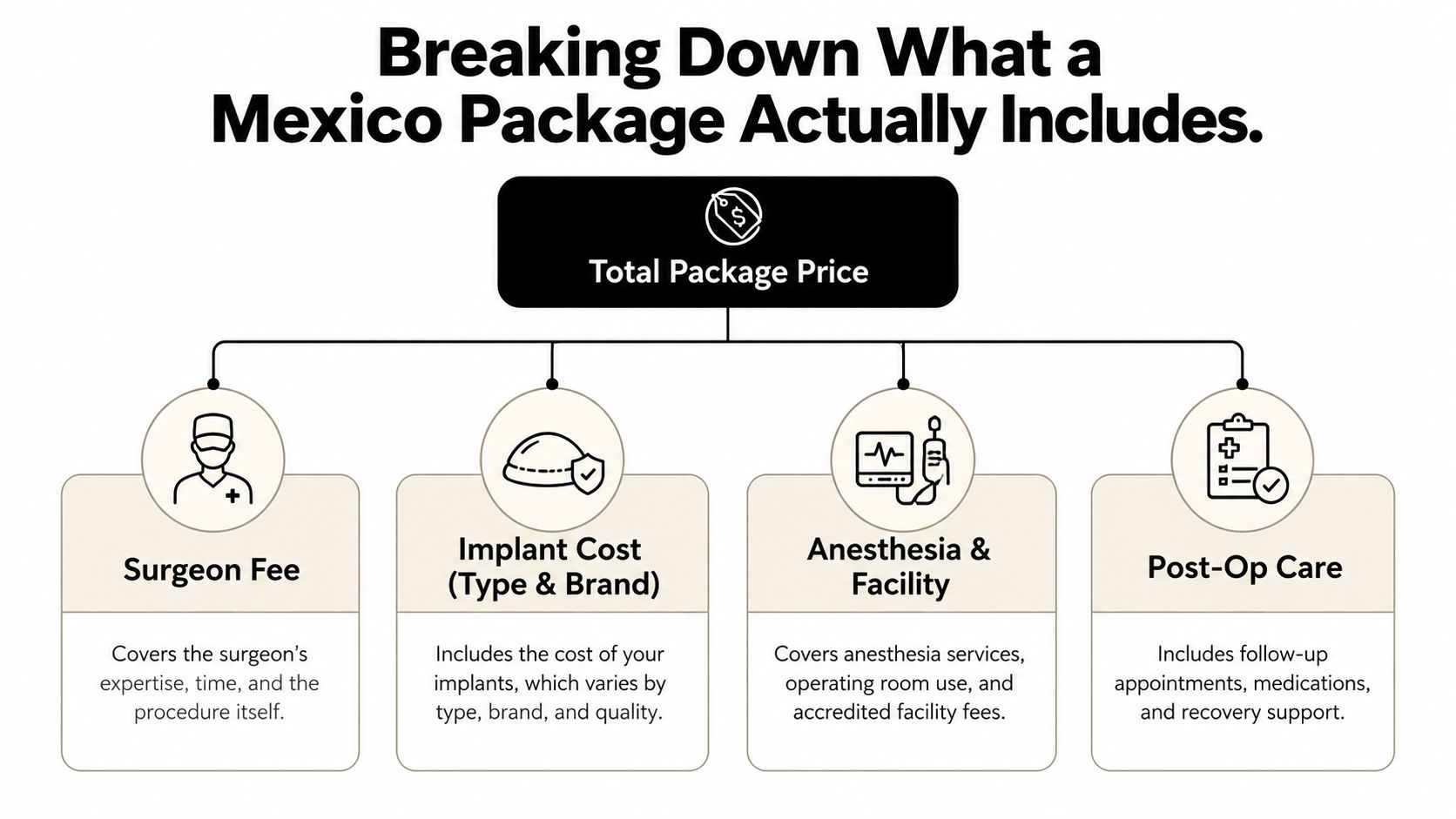
A real package usually starts with the surgeon fee. That is the actual professional charge for operating, planning, and managing your case. It should not be hidden inside a vague “surgical services” line if the clinic is serious about transparency.
Then comes the implant cost, which depends on type and brand. Silicone, saline, and other implant choices affect price, and brand quality matters because you're not buying a decorative object, you're buying a medical device. The package should say what implant is being used, not just that “implants are included.”
The next cost is anesthesia and facility use. That includes the anesthesiology team, OR time, monitoring, and the infrastructure needed if something changes during surgery. A lower number that omits this detail is not a better price, it's a narrower disclosure.
Post-op care also belongs in the quote. Medications, compression garments, follow-up visits, and short recovery support are often bundled, but they can also be trimmed out. That's where a cheap package gets expensive, because you end up paying later for the parts that should have been spelled out upfront.
For a useful breakdown of how surgeons typically present implant pricing, review the separate implant cost discussion in the Cape Cod Plastic Surgery breast implants price range guide. Use that kind of line-item thinking when you read a Mexico quote.
Ask for each of these in writing.
If the clinic gives you one lump sum and resists details, that's not simplicity. That's risk transferred to you.
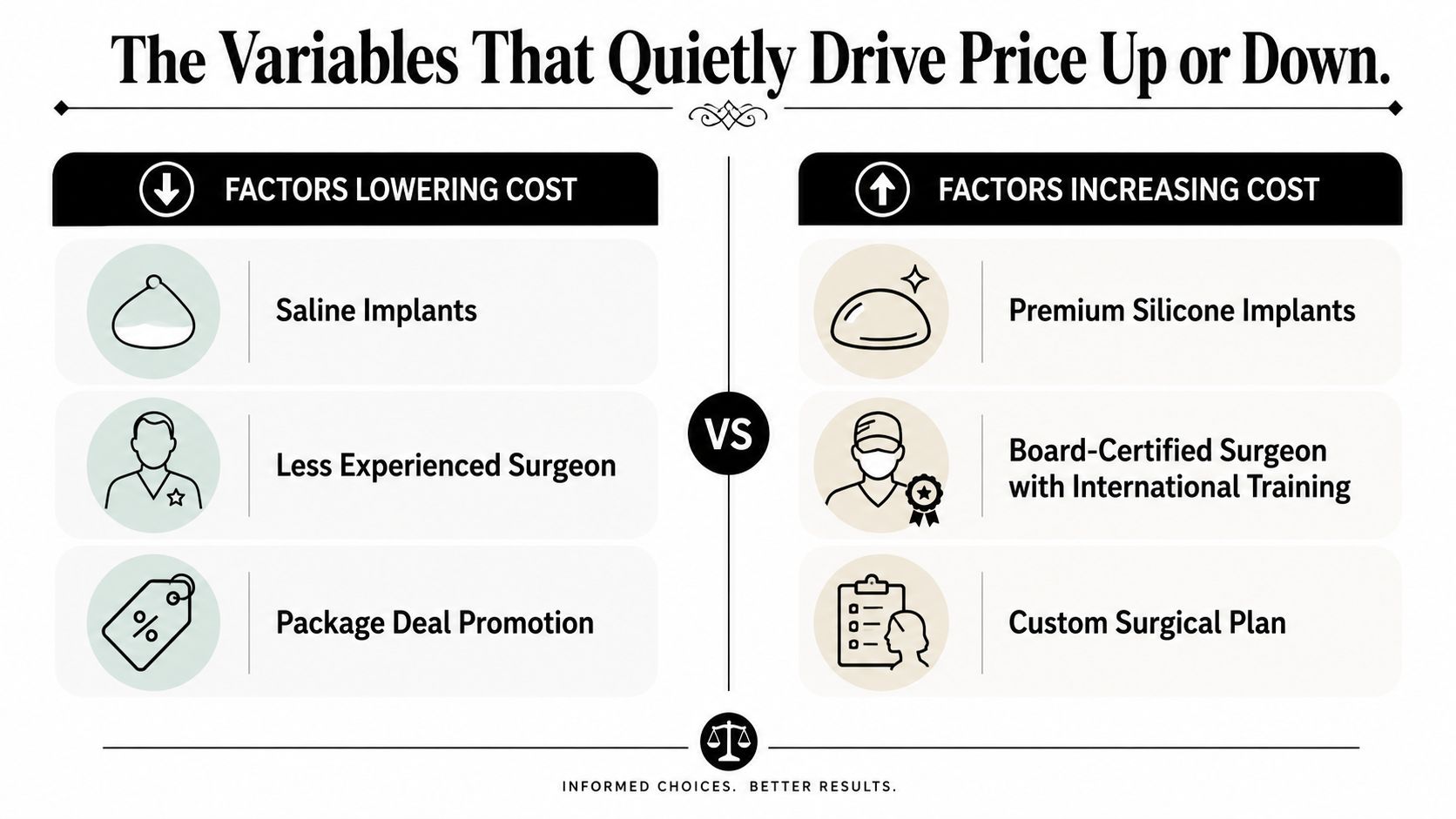
Some price differences are obvious, but the biggest swings usually come from choices patients don't fully understand at the start. Surgeon reputation, implant selection, city, and anesthesia model all push the quote in different directions. If you miss those levers, you'll misread the budget.
Mexico City sits at the higher end, with an average around $5,375 and a published range of $4,250 to $6,500 (Bookimed). That is not a random markup. Major urban centers usually price in stronger infrastructure, more formal hospital settings, and higher staffing overhead.
By contrast, some Cancun and broader Mexico packages are quoted closer to the lower-middle of the market, sometimes around $3,500 to $4,900 in the published ranges tracked by quote aggregators (Bookimed). That may be perfectly reasonable, but you should know what kind of setting you're buying into.
A silicone implant usually costs more than a basic saline option, and a fat transfer approach is a different operation entirely, not just a different price tag. Surgeon experience also changes the fee, because a highly sought-after operator is pricing skill, judgment, and safety protocols, not just time in the room.
The anesthesia model matters too. Local with sedation is not the same thing as a full anesthesiology team under general anesthesia. If the quote is lower because the anesthesia support is thinner, the savings are cosmetic.
Some packages are discounted because they are open about efficiencies. Others are discounted because they leave out the parts that are hardest for the patient to evaluate before travel. Those are not the same.
A smart buyer asks which pieces are fixed and which are flexible. If the clinic can explain why the price changed, fine. If they can't, the quote probably isn't built to protect you.
Price means nothing if the surgical setting is sloppy. A lower quote is never a reason to lower your standards, and medical tourism gets risky when patients hand over judgment to a coordinator and call that research. You need the same seriousness you'd want from a local accredited practice.
Ask for the surgeon's formal certification and verify it independently. In Mexico, that means checking the surgeon's specialty status, asking for their cédula de especialidad, and confirming hospital privileges at a legitimate facility. If they claim qualifications but won't let you verify them, stop there.
You should also ask who administers anesthesia, where the surgery takes place, and whether the operating room is part of a real medical center or a standalone storefront. A good surgeon answers directly and doesn't act offended by due diligence.
For a practical checklist on background research, use the how to research plastic surgeons guide from Cape Cod Plastic Surgery. The exact country changes, but the discipline does not.
A proper facility should be able to show you the recovery area, explain emergency protocols, and tell you how post-op monitoring works. That's where a benchmark like an AAAASF-accredited OR, such as the one at Cape Cod Plastic Surgery, matters, because accreditation signals that the surgery environment itself has been built for safety.
If you're evaluating a Mexico clinic, ask whether it has comparable oversight, who is on site if a problem develops, and how complications are handled after business hours. Travel patients often focus on aesthetics and forget the recovery environment. That's a mistake.
Red flag: If the clinic pushes cash payment, refuses to name the anesthesia provider, or has no clear follow-up plan, walk away.
If you're traveling alone, pay attention to practical support, not just surgery marketing. A useful resource is solo travel tips from Explore Effortlessly, especially if you're trying to evaluate whether you'll have enough help after surgery. Good planning is not paranoia, it's risk control.
The safest quote is the one that tells you who is responsible before, during, and after surgery. Anything less is incomplete.
The savings story is incomplete if it ignores revision risk. No surgeon can promise you'll never need more care, and medical tourism makes follow-up more complicated because the original operating team may be thousands of miles away when you need help. That distance has a price.
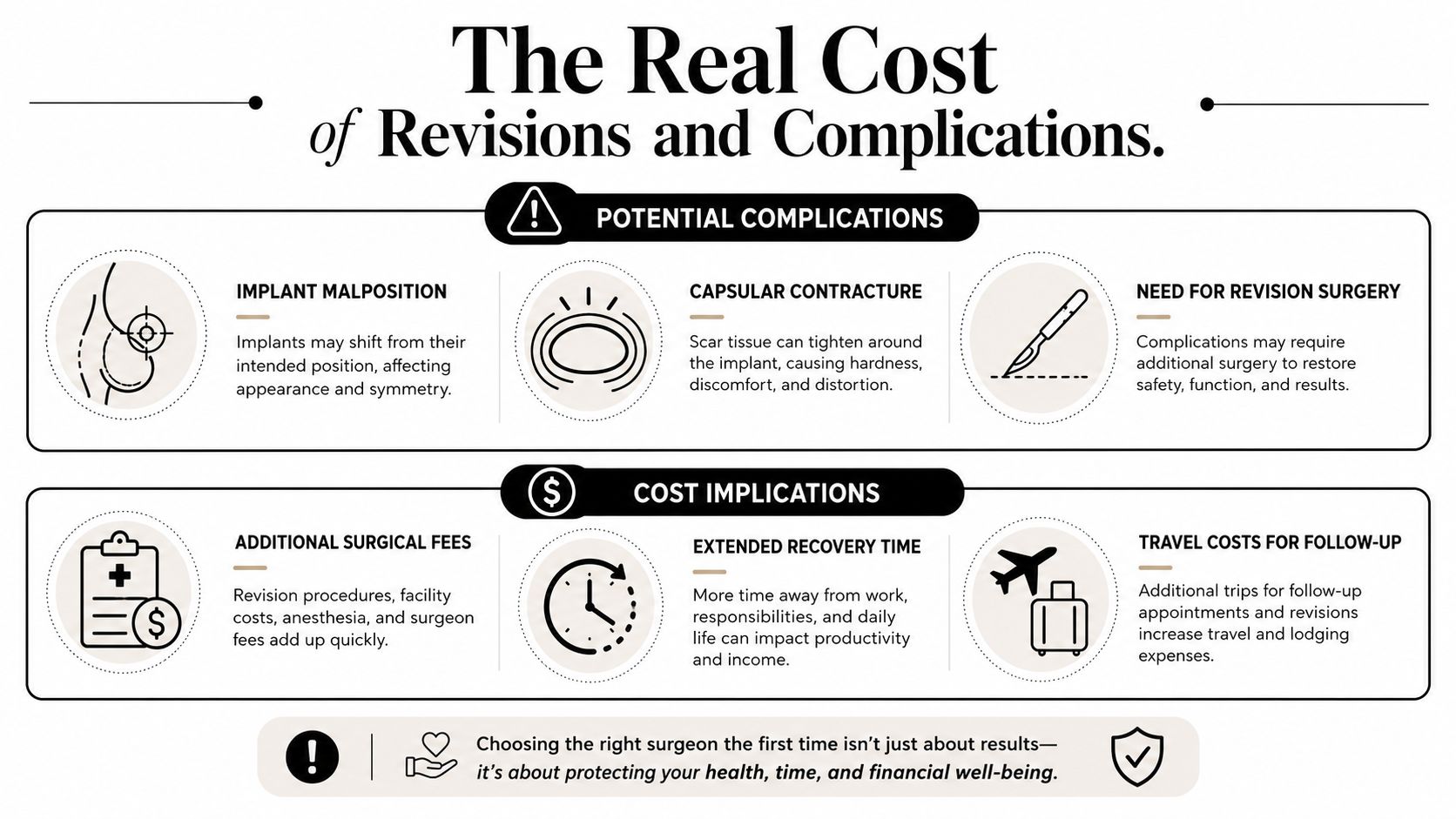
Complications after breast augmentation can include implant malposition, capsular contracture, asymmetry, rupture, or the need for revision surgery. Those aren't abstract possibilities. They are the kinds of issues that turn a cheap trip into a second surgical budget.
Medical tourism pages love to sell savings of 40% to 70%, but they rarely show what happens when additional care is needed. A neutral review from the brief notes that complication care after returning home can involve hospitalization or surgery, and the practical cost rises fast once you add flights, companion travel, and lost work time (ClinicadelRey).
If you have to return for care, you pay again for travel and time. If you need a U.S. surgeon to take over, that doctor may be starting from scratch because they didn't do the original operation. If the implant itself needs replacement, the surgery becomes a second event, not a tweak.
For patients researching implant-related harm and downstream legal issues, injuries from defective medical devices is a useful reminder that device problems can extend beyond the operating room. Medical care and legal recovery are different topics, but the financial impact lands on the patient either way.
I'd rather see a patient choose a slightly higher quote from a better-documented team than gamble on the lowest sticker price and hope for the best. That's not fear. That's a realistic reserve for the possibility that healing is imperfect.
If a Mexico package is dramatically cheaper but offers no meaningful follow-up structure, the price gap may evaporate once you factor in the second round of care. The question is not “What do I save today?” It's “What does this cost if I need help later?”
Mexico can be a smart choice for the right patient and the right clinic. A U.S. accredited local practice can be the better choice for patients who want easier follow-up and no travel burden. The point is not to crown a winner, it's to match the model to the patient.
A Mexico package usually wins on the quote sheet. A U.S. board-certified, accredited practice wins on continuity, easier revision access, and simpler recovery logistics. If you want to compare those trade-offs in another U.S. market, the breast augmentation cost New York guide shows how local pricing reflects a different structure of care.
A local practice also removes the travel variable. There's no flight home while you're swollen, no border timing issue, and no scramble to find a doctor willing to manage someone else's surgery. That convenience is worth money.
Mexico still makes sense for patients who do their homework, understand the package, and choose a surgeon and facility with real oversight. If you're looking only at the lowest number, though, you're not making a medical decision. You're making a coupon decision.
Before you book, get the quote in writing and make sure it lists the surgeon fee, implant type, anesthesia provider, facility, medications, and follow-up. If anything is vague, assume it will cost more later. Also budget for travel, companion support, and the possibility that your stay will need to be longer than planned.
If you're crossing borders, the logistics matter as much as the operation itself. The Approved Experiences Traveler guide is useful background if you're planning a driving route, because recovery trips get more complicated when transportation is not straightforward.
Plan recovery around actual healing, not optimistic marketing. You should know who will see you after you return home, how to reach the surgical team if something looks off, and which symptoms trigger an immediate call. If your local surgeon won't take over post-op care, find that out before you pay.
The right decision is the one that balances price, continuity, and safety. If Mexico gives you a complete package from a vetted surgeon and a facility you trust, it can be a solid choice. If the quote looks cheap because it leaves out the parts that protect you, it isn't a bargain.
If you want a candid, surgeon-led conversation about breast augmentation, Cape Cod Plastic Surgery offers board-certified expertise, an on-site AAAASF-accredited surgical suite, and a straightforward approach to safety, planning, and follow-up. Visit Cape Cod Plastic Surgery to discuss your options and compare the value of local care against travel-based surgery before you make a decision.
September 9, 2026
Expert Guide to Proper Surgical Incision Care

Master dermal fillers aftercare with do's and don'ts, swelling tips, activity limits and warning signs to protect your results and heal smoothly.

September 8, 2026
Ensuring Safety: Why Your Surgeon's Credentials Matter Most

Cape Cod Plastic Surgery offers expert cosmetic and reconstructive procedures in a safe, accredited setting. Led by Dr. Marc Fater, we combine advanced techniques with personalized care to help you look and feel your best.
Monday: 9:00 AM – 5:00 PM
Tuesday: 9:00 AM – 5:00 PM
Wednesday: 9:00 AM – 5:00 PM
Thursday: 9:00 AM – 5:00 PM
Friday: 9:00 AM – 5:00 PM