

October 2, 2026
When Is the Right Time for Plastic Surgery
Beyond the Calendar: How to Know You’re Truly Ready for Plastic Surgery
Jul 4, 2026

Most visible signs after a brow lift, like bruising and major swelling, usually settle down in about 10 to 14 days, but the full brow lift recovery time, including your final result settling into place, takes 3 to 6 months. That gap between “I look presentable again” and “I'm fully healed” is the part that surprises many patients.
If you're reading this after a consultation, you may be feeling two things at once. You're excited to look more refreshed, and you're also wondering what the next few days will be like. Will you look alarming? Will it hurt? Will your brows look too high at first? Will you know what's normal?
Those questions are completely reasonable. Recovery feels much easier when you know what to expect, what's temporary, and what deserves a call to your surgeon's office. A brow lift isn't a one-day event followed by instant results. It's a healing process with clear stages, and each stage has its own look, its own sensations, and its own care priorities.
A patient often leaves her consultation feeling relieved that she finally has a plan. She's spent months noticing that her upper face looks tired, heavy, or tense even when she feels perfectly rested. Then the practical thoughts kick in on the drive home. “How long will I be swollen?” “Can I be seen in public?” “What will recovery really look like day by day?”
That's where a personalized guide matters.
A brow lift recovery isn't just about waiting for bruising to fade. It's about understanding the rhythm of healing so you don't panic when swelling peaks, you don't judge your result too early, and you give your body the best chance to recover smoothly. Patients often do better emotionally when they stop thinking of recovery as one long blur and start thinking of it as a series of short, manageable phases.

For anyone still learning about the procedure itself, this overview of brow lift surgery and how it brightens the eyes helps connect the surgical plan with the changes you'll later see in recovery.
The biggest misunderstanding is this. People often think recovery ends when they can go back to work or meet a friend for coffee. In reality, that's only the early part of healing.
Your body first deals with inflammation, swelling, and bruising. After that, it shifts into a quieter phase where tissues settle, tiny nerves wake up, and the brow position refines. That second phase is less dramatic, but it matters just as much for your final appearance.
Practical rule: Don't judge your outcome by what you see in the mirror during the first couple of weeks.
Patients tend to feel most confident when they focus on a few simple goals:
That combination of patience and good aftercare makes the whole experience feel far more manageable.
Healing after a brow lift is a bit like planting a garden. At first, everything looks unsettled. The soil is disturbed, the structure is new, and nothing looks fully “done.” Then, gradually, things calm down, soften, and take their final shape.
According to this day-by-day brow lift recovery guide, most patients achieve initial recovery within 10 to 14 days, with peak swelling around days 2 to 3 and a return to normal activities around 7 to 10 days. The same guide notes that complete healing and final aesthetic stabilization take 3 to 6 months, and that endoscopic brow lifts recover faster, averaging about 1 week, compared with several weeks for traditional lifts.
The earliest part of brow lift recovery time is the most visible. This is when the body sends fluid and healing cells to the area. That response is normal, but it also creates puffiness, tightness, and discoloration.
During this stretch, many patients are surprised that they look a little more swollen before they look better. That doesn't mean anything is wrong. It means the body is doing exactly what healing tissue does.
| Recovery phase | What patients commonly notice |
|---|---|
| First 48 hours | Swelling, pressure, fatigue, and a very “fresh from surgery” look |
| Days 3 to 7 | Bruising becomes more noticeable, then slowly starts easing |
| Weeks 2 to 4 | Most obvious swelling fades, daily life feels easier |
| Months 1 to 3 | Tissues continue to soften and settle |
| Months 3 to 6 | Brow position and overall appearance become more stable |
Early recovery and final healing are not the same thing. By the time you feel socially comfortable, your deeper tissues are still remodeling. Small areas of firmness, mild numbness, and subtle asymmetry can improve gradually as healing continues.
Healing happens in layers. The outside improves first. The deeper settling takes longer.
That's especially important with brow position. Early on, the brows can look a bit too high or slightly stiff. With time, the tissues relax and the result becomes more natural.
Technique matters. A less invasive approach usually causes less tissue trauma, which often means a shorter initial recovery. Aftercare matters too. Head elevation, cold compresses, and avoiding anything that raises blood pressure too much can all help reduce swelling during the early healing window.
If you remember one thing, make it this. Looking better in two weeks is common. Looking final takes months.
The first three days are the part most patients worry about most. They're also the part that usually feels most manageable once you know what's normal.
On the day of surgery, patients often are tired, puffy, and more aware of pressure than pain. The forehead and scalp may feel tight, heavy, or oddly numb. That combination can be unsettling if you weren't expecting it, but it's a common early sensation after this type of procedure.
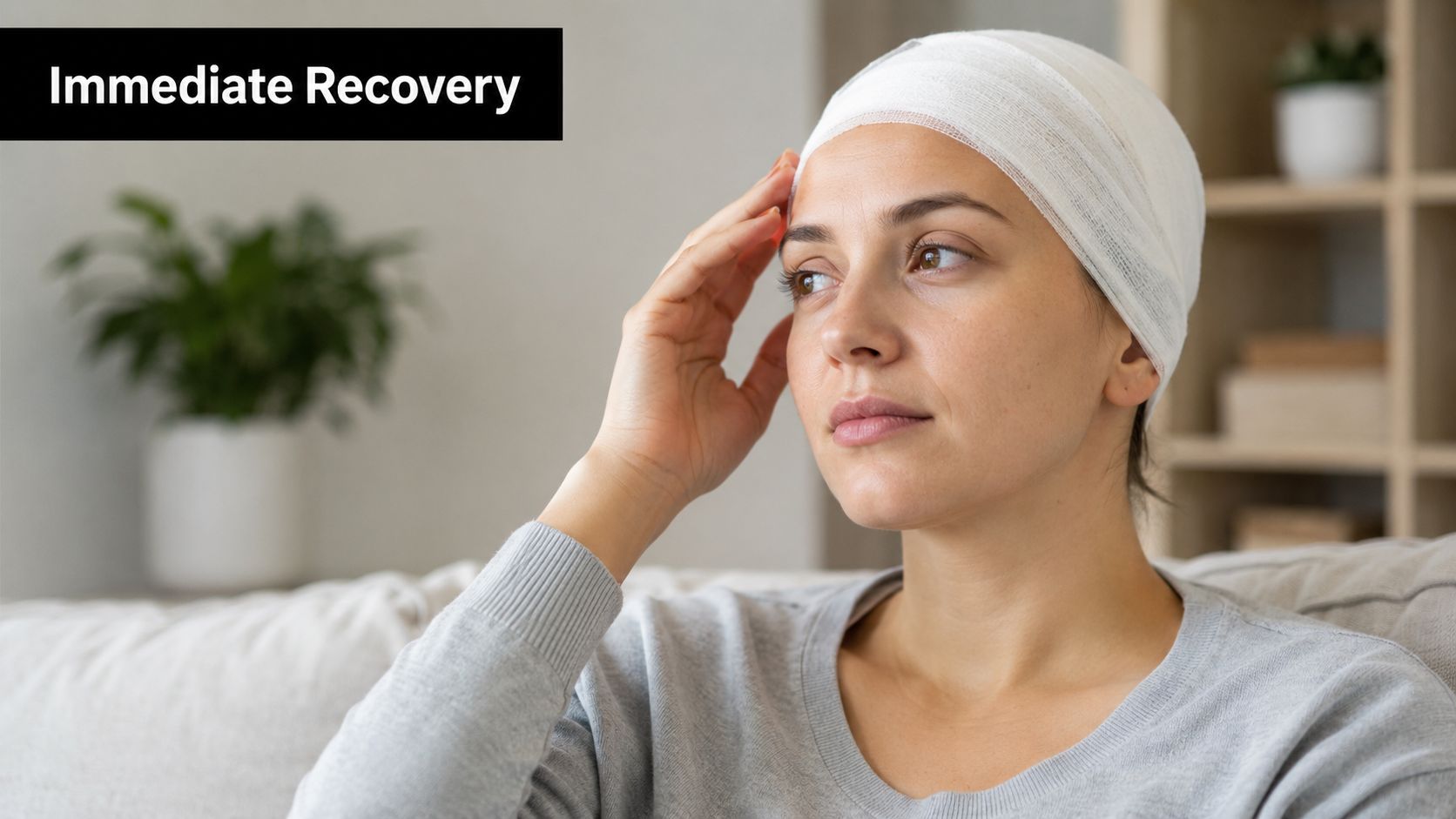
Most patients describe the first day as a “lay low” day. You'll likely spend more time resting than doing much else. Your head may feel wrapped, supported, or tight. If you're someone who's very visual, the mirror can be a little jarring at first.
That's why I often tell patients not to inspect every detail on day one. Focus on rest, hydration, and keeping your head raised. Your body has just started the inflammatory phase of healing.
According to these post-operative instructions after endoscopic brow lift, days 2 to 3 show maximum swelling, bruising, and forehead or scalp tightness. The same guidance notes that by day 4, wound cleaning begins, and the brows may appear excessively raised, which is a temporary effect that improves as tissues settle.
This is the point where some patients get nervous and think they've taken a step backward. They haven't. Swelling often peaks after the first day, not during it.
A common pattern looks like this:
Later in recovery, that same source notes that staples are often removed around day 21, numbness can improve between days 14 and 35, and some people feel prickly or electric sensations as nerves recover. It also states that strenuous activity should wait at least 4 weeks, while full activity normalization occurs within 2 to 3 weeks for endoscopic procedures, with traditional lifts requiring longer.
Here's a helpful visual walkthrough for patients who like to see recovery discussed in plain language before surgery or during those first home days.
Keep your world small for the first few days. Rest, cool the area as instructed, and don't try to “bounce back” too fast.
A simple first-72-hour checklist usually helps:
The first 72 hours are rarely glamorous, but they are predictable. That predictability helps.
Two patients can have the same procedure and still have different brow lift recovery time. That doesn't automatically mean one is healing “better” than the other. It usually means their bodies, surgical plans, and daily habits aren't identical.
The biggest driver is often the type of brow lift performed. A less invasive approach generally causes less disruption to the tissues, so swelling and bruising may calm down faster. A more extensive lift can create a longer initial recovery because the body has more healing work to do.
That's why some patients feel ready for normal daily routines sooner, while others need a more patient pace. The procedure itself sets the starting point.
General health, skin quality, circulation, and how your body tends to scar or swell all shape recovery. Some people bruise easily. Some hold onto puffiness longer. Some are very sensitive to temporary numbness and tingling, while others barely notice it.
A few everyday factors can slow healing too:
Patients sometimes think aftercare is about comfort only. It isn't. The little things directly affect how the early recovery phase feels.
Cold therapy is a good example. If your surgeon approves it, cooling can help manage early swelling and discomfort. For readers who want a broader look at the physiology behind this, this article on science-backed cold water benefits gives useful context on how cold exposure affects the body. In post-surgical care, the key is moderation and surgeon guidance, not aggressive icing.
Your healing timeline is shaped partly in the operating room and partly at home.
It's tempting to compare yourself with a friend or an online photo. That usually creates unnecessary worry. One patient may have more bruising and less tightness. Another may have almost no discoloration but more numbness. Both can still be healing normally.
A better question is this: “Am I improving in the expected direction?” If the answer is yes, even gradually, that's usually reassuring.
Good aftercare doesn't have to be complicated. It has to be consistent. Patients who do well usually aren't doing anything fancy. They're following a calm routine and not giving swelling a reason to flare up.
For anyone preparing a recovery space in advance, this guide to essential gear for healing at home can help you think through pillows, support items, and comfort supplies that make the first days easier.
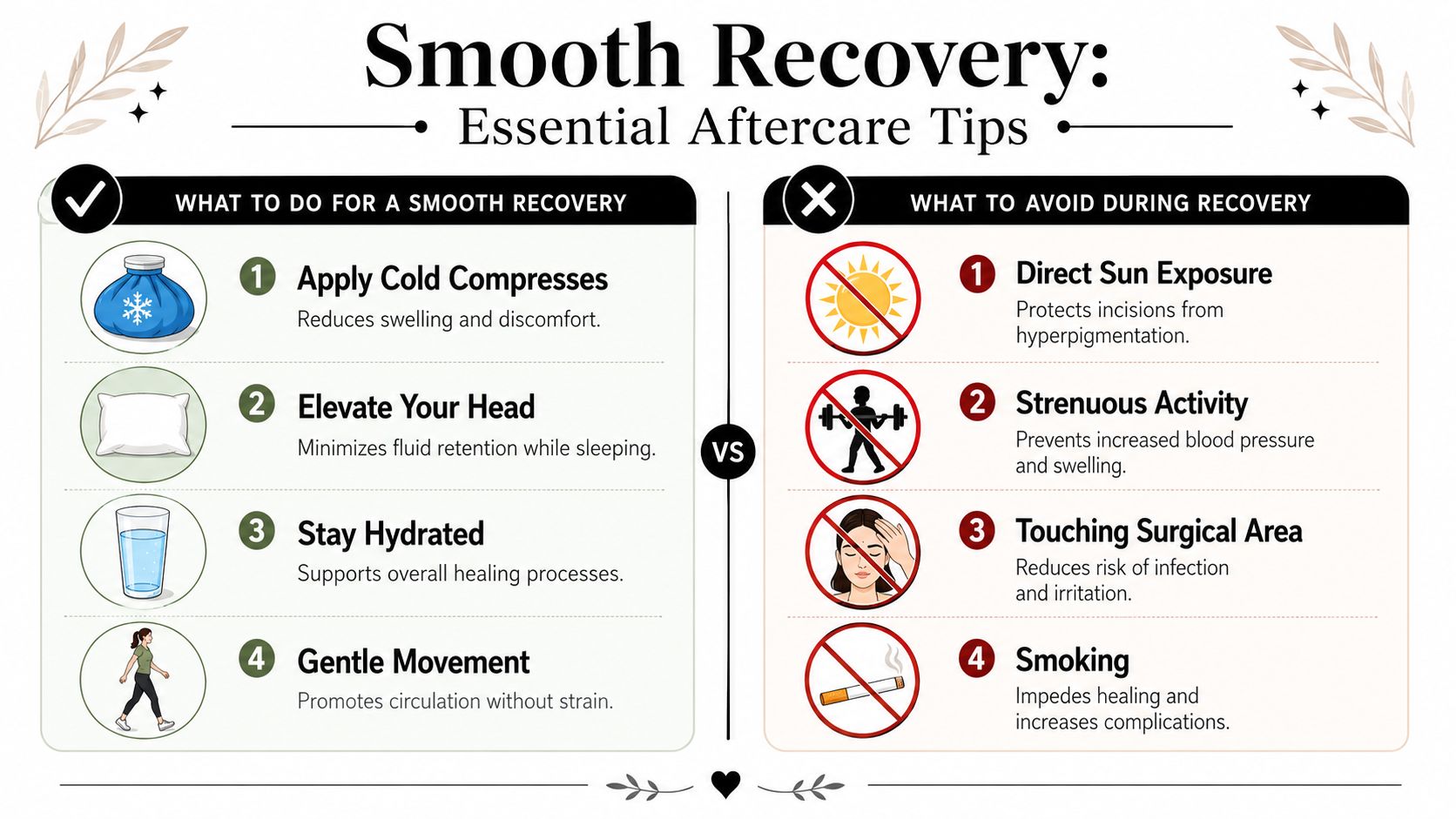
These are the habits that tend to make recovery smoother:
A detailed list of expert tips for effective post-surgery recovery and care is also useful if you want to build a practical home routine before surgery day.
Feeling better can trick patients into doing too much, which often leads to many setbacks.
Avoid these common mistakes:
| Do | Avoid |
|---|---|
| Rest with your head up | Sleeping flat on your face or side if not cleared |
| Use prescribed medication as directed | Skipping doses, then chasing discomfort later |
| Take short, easy walks | Gym workouts, straining, or high-intensity activity |
| Follow washing and incision instructions exactly | Using random creams, oils, or home remedies |
Hair washing, makeup, and routine grooming should follow the exact instructions from your surgical team, because those details depend on incision placement and how your early healing looks. If you're unsure, ask before doing it rather than guessing.
Recovery goes better when you protect the result you already paid for.
The best aftercare mindset is simple. Be gentle, be consistent, and don't rush your body to satisfy the calendar.
Most of what patients notice after a brow lift falls into the “expected and temporary” category. The challenge is that expected symptoms can still feel dramatic when they're happening on your own face.
A calm way to think about it is to sort things into two buckets. What's normal and when to call us.
These symptoms often happen during routine healing:
That last point causes a lot of unnecessary stress. A brow lift result can look “unfinished” before it looks refined.
Contact your surgeon promptly if you notice:
Those aren't symptoms to monitor casually. They deserve direct guidance from your surgical team.
| Likely normal | Needs a call |
|---|---|
| Gradual improvement, even if slow | Sudden worsening |
| Mild asymmetry in swelling | Rapid, dramatic one-sided swelling |
| Numbness or tingling | Vision problems |
| Tightness and bruising | Signs of infection |
If you're also thinking about general post-surgical safety beyond the brow area, this article on preventing blood clots after surgery is worth reading.
One more reassurance. Calling your surgeon's office doesn't mean you're overreacting. Good recovery care includes asking questions early.
Usually not in the first couple of weeks. Early on, the brows can look higher, firmer, or more “set” than expected. That doesn't mean the result is permanent in that position. Tissues soften and settle gradually, which is why patience matters so much with brow lift recovery time.
If you keep checking the mirror daily, you'll notice tiny changes and may overinterpret them. Weekly comparisons are often more useful than daily ones.
Yes, it can be. Many patients notice numbness, altered sensation, itching, or brief zinging feelings as healing progresses. Those sensations are often more strange than painful.
That said, normal doesn't mean you should suffer in silence. If a sensation worries you, call your surgeon's office and describe it clearly. Reassurance is part of good care.
This depends on where your incisions are, whether the skin is fully closed, and how much bruising remains. The safest rule is not to apply makeup near healing areas until your surgeon says it's okay.
Patients often want makeup for social reasons before the tissues are ready. Waiting a little longer is frustrating, but it's better than irritating the skin and slowing healing.
Hair coloring should also wait until your surgeon clears you. Chemicals, rubbing, heat, and salon manipulation can all irritate healing incisions or nearby tissues if you return too soon.
When patients ask this question, what they're really asking is, “When can I go back to feeling like myself?” That's a very normal feeling. Most of the return-to-normal steps happen one by one. First you feel better. Then you look less swollen. Then your result starts to feel like your own face again.
Slow doesn't always mean wrong. Some patients move through recovery quickly, while others carry swelling or sensory changes longer. What matters more than speed is steady progress and good follow-up.
If you're ever unsure, ask. You should never have to guess your way through recovery.
If you're considering a brow lift and want guidance that feels personal, careful, and experienced, Cape Cod Plastic Surgery offers consultations designed to answer key questions patients ask before surgery and during recovery. A thoughtful plan, clear aftercare, and close follow-up can make the entire process feel far less intimidating.
October 2, 2026
Beyond the Calendar: How to Know You’re Truly Ready for Plastic Surgery

October 2, 2026
Exploring Your Breast Augmentation Options: Implants, Shapes, and What to Expect
October 1, 2026
Reshaping Your Silhouette: A Guide to Body Contouring

Cape Cod Plastic Surgery offers expert cosmetic and reconstructive procedures in a safe, accredited setting. Led by Dr. Marc Fater, we combine advanced techniques with personalized care to help you look and feel your best.
Monday: 9:00 AM – 5:00 PM
Tuesday: 9:00 AM – 5:00 PM
Wednesday: 9:00 AM – 5:00 PM
Thursday: 9:00 AM – 5:00 PM
Friday: 9:00 AM – 5:00 PM