

September 9, 2026
How to Care for Surgical Incisions Properly
Expert Guide to Proper Surgical Incision Care
May 10, 2026

Butt implants in 2026 typically cost $8,000 to $20,000 for the full procedure, and the average surgeon's fee alone sits around $7,964 to $7,992. The problem is that the price you see advertised is usually only one slice of the total investment.
If you're reading this, you're probably doing what most patients do. You've opened six tabs, seen wildly different prices, and started wondering whether anyone is giving you a straight answer. Some offices quote a surgeon's fee. Some quote a starting price. Some bundle more of the recovery costs. Very few explain the financial risk if something goes wrong later.
That's where patients make expensive mistakes. They focus on the entry price and ignore the total cost of ownership. In cosmetic surgery, that means your consultation, surgery, anesthesia, facility, implants, recovery supplies, time away from work, and the possibility of revision surgery. If you only compare the upfront number, you're not comparing the actual cost.
As a surgeon, my advice is simple. Don't shop for butt implant surgery the way you'd shop for a couch. This is not a commodity. A cheaper operation can become the most expensive decision you make if it leads to malposition, asymmetry, infection, or a revision.
A patient comes in after collecting three quotes for butt implants. One office advertises a low starting price. Another gives a much higher number with no explanation. A third avoids specifics altogether. That kind of pricing confusion pushes patients to compare the wrong thing, and that mistake gets expensive fast.
Here is the reality. Butt implant pricing only makes sense if you look at the total cost of ownership. The number that catches your eye online is rarely the number you will pay by the end of surgery, recovery, and follow-up care. If a poor result leads to another operation, the cheapest quote can become the costliest decision.

Practices do not build quotes the same way. Some list only the surgeon's fee. Others include anesthesia, the operating facility, implants, and routine follow-up visits. Some quote a range because the final plan depends on implant size, anatomy, operative difficulty, and whether additional contouring is needed.
You see the same problem in other medical price searches. If you've ever tried to compare oxygen therapy costs for 2026, you've seen how often the advertised price leaves out the full treatment path.
My advice is simple. Ignore the teaser number and ask for the out-the-door estimate.
Ask for a written quote that shows every expected charge, including:
One more point matters more than patients realize. Surgeon expertise is part of the price, but it also protects you from future costs. A well-planned operation by an experienced, board-certified plastic surgeon usually costs more upfront and less over time. That is the better deal.
Patients who ask detailed financial questions early make better decisions. They are not looking for the lowest entry price. They are choosing the option with the lowest risk of paying twice.
Butt implants are solid silicone implants placed to increase projection, structure, and shape in the buttocks. Think of them like architectural support. If the body doesn't have enough natural volume to build the shape you want, an implant adds the framework that soft tissue alone can't provide.
That distinction matters. Some patients want more fullness, but they're lean and don't have enough excess fat for transfer. In that setting, an implant can make sense because it creates volume directly rather than borrowing it from another area.

A well-performed implant procedure is best at creating:
This is why implants appeal to patients with a naturally straight silhouette. Exercise can improve muscle tone, but it can't reliably create the specific contour many patients want.
The right candidate is generally healthy, at a stable weight, and realistic about recovery. They also understand what implants are for. This procedure is a structural solution, not a subtle tweak.
Patients often fit into one of these groups:
Butt implants are not the “easy version” of gluteal enhancement. They're a specific operation for a specific anatomy.
A Brazilian Butt Lift uses your own fat. Butt implants use silicone devices to add shape directly. The practical difference is straightforward. A BBL needs donor fat. Implants don't.
That makes implants the more logical option when a patient is slim or wants predictable projection that doesn't rely on fat transfer survival. It also means the operation has a different feel, recovery pattern, and long-term maintenance profile. Those differences matter just as much as the initial quote.
A patient sits in my office with a low online quote on her phone and assumes she has found the price of surgery. She has not. She has found the opening number in a much larger bill.
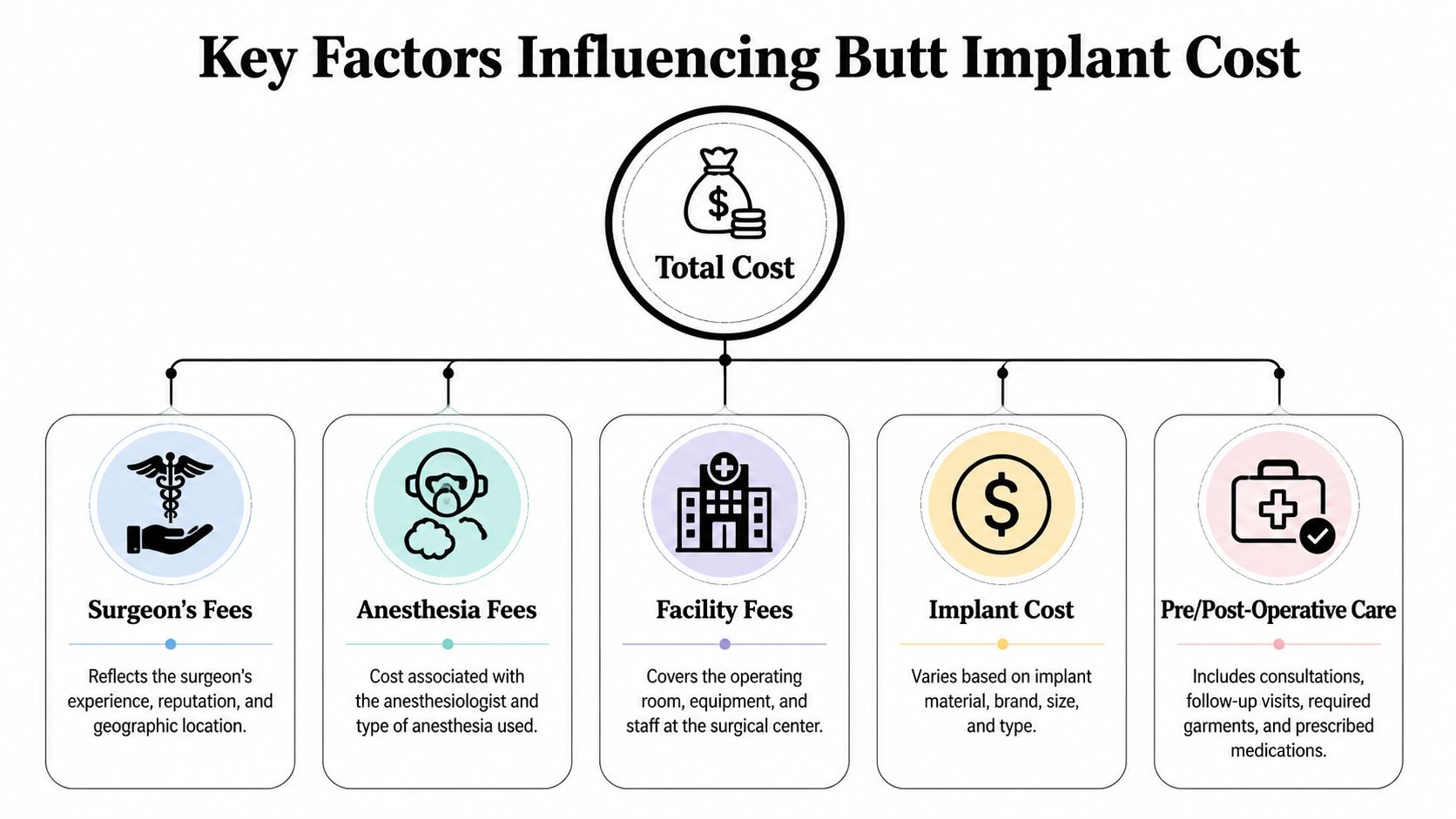
Butt implant cost only makes sense when you look at the full ownership cost of the procedure. The surgical fee is just one part. Your real budget has to account for anesthesia, the operating facility, implants, recovery supplies, follow-up care, time away from work, and the possibility of revision surgery if the first operation is poorly planned or poorly executed. That last category is where cheap surgery gets expensive fast.
The surgeon's fee pays for more than time in the operating room. It covers your evaluation, surgical plan, implant selection, pocket design, technical execution, and post-operative judgment. That is the part of the bill where experience matters most.
Anesthesia is a separate safety cost. Facility fees cover the accredited surgical suite, nursing staff, monitoring, sterile processing, equipment, and emergency readiness. The implant itself is another line item. Then come the practical expenses patients often miss until late in the process, such as prescriptions, compression garments, drain supplies if used, and scheduled follow-up visits.
Some practices bundle these items. Some do not. You need a written breakdown before you commit.
| Cost Component | Typical Price Range (USD) | What It Covers |
|---|---|---|
| Surgeon's fee | Varies by surgeon and case complexity | Surgical planning, implant placement, operative skill, and follow-up oversight |
| Anesthesia and facility fees | Varies by surgery length and setting | Anesthesia care, operating room time, nursing staff, monitoring, and safety infrastructure |
| Implants and recovery-related costs | Varies by implant choice and practice policies | Silicone implants, garments, prescriptions, supplies, and post-op care |
| Total procedure cost | Often much higher than the surgeon's fee alone | The combined cost of the full surgical episode, not just one line item |
Public pricing summaries are broad. Your quote should be specific.
Do not accept a verbal estimate. Get a written quote and read it line by line.
Use this checklist:
If you want to see the level of detail a practice should provide, review a cosmetic surgery pricing page with clear line-item expectations and compare it with the estimate you receive.
A vague cheap quote is not a bargain. It is often the first warning sign that you may pay twice.
You get one quote for $12,000 and another for $24,000. Same procedure name. Completely different financial risk.
That gap usually comes down to three things. Geography, case difficulty, and surgeon skill. If you want the lowest total cost of ownership, not just the cheapest invoice, you need to judge all three correctly.
Surgery in a major metro area usually costs more. Rent is higher. Staffing costs more. Insurance and operating overhead cost more. Those expenses show up in your quote.
Do not assume a lower regional price is the better deal. A cheap out-of-town operation can become very expensive once you add flights, lodging, time away from work, and follow-up care. The bigger problem is what happens if something goes wrong. Revision surgery close to home after bargain surgery elsewhere is one of the most expensive patterns I see.
Travel only makes sense if you are traveling for a surgeon with clear expertise, sound judgment, and a track record of consistent results.
Patients often get confused by the pricing process. They compare costs as if every butt implant procedure requires the identical level of preparation and surgical expertise. It does not.
A straightforward primary augmentation costs less than a case involving asymmetry, scar tissue, thin soft-tissue coverage, implant malposition, or a prior poor result. Add liposuction or other contouring, and the total rises again. Revision surgery is especially expensive because correcting a problem is harder than doing the original operation well.
That is why pricing ranges can be so wide. RealSelf's butt implant cost overview notes both broad national price variation and the fact that highly experienced surgeons often charge more than average. Both points reflect the same reality. More difficult surgery and better surgical judgment cost more up front.
They also lower the odds that you will pay for a second operation.
This is the line item patients try to negotiate. It is also the one most likely to save them money over time.
A surgeon with deep gluteal augmentation experience is not selling prestige. You are paying for planning, restraint, technical precision, and complication avoidance. That includes choosing the right implant size, protecting soft tissue coverage, placing the implant correctly, and telling you when implants are a poor choice. In some patients, another approach makes more sense, especially after a careful review of Brazilian Butt Lift risks and safety concerns.
Cheap surgery can carry a very high downstream price:
That is the math patients miss. Paying more for the right surgeon often lowers your total spend because it reduces the chance that you will need to fix a preventable problem later.
Board certification, an accredited operating facility, and real experience with gluteal surgery are not marketing details. They are cost-control decisions.
Patients usually arrive comparing two options. Butt implants or a Brazilian Butt Lift. That's the right comparison, but the comparisons themselves are often flawed. They focus on popularity or social media language instead of body type, durability, and financial fit.
More than 50,000 gluteal augmentation procedures are performed annually in the U.S., and one market source places the average price for butt implants in 2026 at $11,000, while hybrid procedures that combine implants with fat transfer range from $12,000 to $25,000, based on this gluteal augmentation cost market guide.
Implants fit the patient who lacks enough donor fat or wants stronger structural projection. A BBL fits the patient who has enough harvestable fat and wants shaping that uses their own tissue.
Neither option is universally better. They solve different problems.
| Question | Butt Implants | BBL |
|---|---|---|
| Best for | Lean patients or those wanting stronger projection | Patients with enough donor fat |
| Volume source | Silicone implant | Your own transferred fat |
| Shape style | Structured, projection-focused | Softer contouring effect |
| Cost pattern | More direct implant-based pricing | Can rise with extensive liposuction |
| Long-term issue to watch | Implant-related complications or revision | Fat reabsorption |
Patients often assume implants are always more expensive. Not necessarily. A BBL can become costly when large-volume liposuction and body contouring are needed to harvest and process enough fat. On the other hand, hybrid augmentation can push pricing even higher because it combines structural implant work with fat transfer.
If you're weighing these procedures, this discussion of Brazilian Butt Lift risks is worth reading before you decide.
A video explanation can also help clarify how surgeons think about these choices in practice.
Choose the operation that matches your anatomy, not the one that sounds trendier. If you don't have enough donor fat, stop trying to force yourself into a BBL plan that won't deliver. If you do have good donor fat and want a softer, more natural contour, implants may be unnecessary.
The best result usually comes from the procedure your body can support predictably.
Most online cost articles fail patients because they talk about surgery day and ignore everything that happens after surgery day. That's a mistake.
Recovery has a price even when everything goes well. You may need time away from work, extra help at home, support pillows, garments, prescriptions, and temporary limits on sitting or activity. None of that is glamorous, but all of it affects your budget.
The bigger issue is revision surgery. One source focused on butt implants versus BBL reports that revision rates can reach 20 to 35 percent within 5 years, and that a single revision can add $5,000 to $15,000 to your total cost, according to this analysis of butt implant long-term costs and revisions.
That is the heart of the total-cost argument. A low upfront quote means very little if you end up paying for correction later.
Common financial drivers after surgery include:
Patients preparing for body recovery often benefit from practical movement guidance, especially if they already have hip pain or mobility issues. Resources like avoiding painful FAI hip exercises can help you understand what kinds of movement may aggravate symptoms while you're already managing post-operative limitations.
If you can barely afford the primary surgery, you probably can't afford the revision risk. That matters.
Spend more upfront on the surgeon if that surgeon has the training, judgment, and operative environment to reduce preventable complications. Patients hate hearing that because everyone wants a deal. But surgery is one of the worst places to be price-driven.
The cheapest path is the one that heals well the first time.
Most butt implant procedures are elective, which means insurance usually won't cover them. Patients generally pay through savings, medical financing, or a structured payment plan offered through the practice.
That's normal. Plenty of people finance cosmetic surgery. What matters is that you finance the right procedure with the right surgeon, not that you stretch your budget to chase a fast booking date.
Use financing to manage cash flow, not to justify a poor decision. If you need a framework for comparing medical coverage in another field, it can help to look at guides that explain how benefits are evaluated, such as find chiropractic care insurance options. Cosmetic surgery usually works differently, but the principle is the same. You need to know what is and isn't paid for before you commit.
For practical planning, review options for financing cosmetic surgery and ask every lender or practice the same questions about terms, fees, and timing.
Don't ask, “What's the cheapest butt implant cost?” Ask, “What gives me the best chance of a safe operation and a result I won't need to redo?”
That question leads you toward the right surgeon, the right facility, and a more honest financial decision.
If you want a personalized quote from a board-certified plastic surgeon with decades of experience, schedule a consultation with Cape Cod Plastic Surgery. You'll get a clear discussion of candidacy, a realistic cost breakdown, and direct guidance on whether implants, fat transfer, or a different plan makes the most sense for your body and your budget.
September 9, 2026
Expert Guide to Proper Surgical Incision Care

Master dermal fillers aftercare with do's and don'ts, swelling tips, activity limits and warning signs to protect your results and heal smoothly.

September 8, 2026
Ensuring Safety: Why Your Surgeon's Credentials Matter Most

Cape Cod Plastic Surgery offers expert cosmetic and reconstructive procedures in a safe, accredited setting. Led by Dr. Marc Fater, we combine advanced techniques with personalized care to help you look and feel your best.
Monday: 9:00 AM – 5:00 PM
Tuesday: 9:00 AM – 5:00 PM
Wednesday: 9:00 AM – 5:00 PM
Thursday: 9:00 AM – 5:00 PM
Friday: 9:00 AM – 5:00 PM