

October 7, 2026
What to Expect During Your Breast Surgery Recovery
A Practical Guide to Healing After Breast Surgery
Apr 16, 2026
TL;DR: While there is no direct antidote to instantly reverse Botox, its effects are temporary and usually fade naturally over 3 to 4 months as nerve endings recover. Some unwanted effects can be managed while you wait, and results typically peak at 7 to 14 days before gradually softening.
You may be reading this after glancing in the mirror for the fifth time today. Maybe your forehead feels heavier than expected. Maybe one brow looks different from the other. Maybe you were aiming for “rested” and got “this doesn’t feel like me.”
That moment can feel much bigger than a cosmetic issue. When a treatment affects your face, even temporarily, it can shake your confidence fast. The good news is that Botox does not create a permanent change. The harder truth is that there usually isn’t an immediate undo button.
If you’ve been searching can botox be reversed, you deserve a straight answer, a real explanation, and practical advice for what to do next. You also deserve acknowledgment that waiting can be emotionally difficult. Most articles stop at “be patient.” Patients need more than that.
A common pattern goes like this. Someone has Botox, feels fine leaving the office, then checks again a few days later and notices something unfamiliar. The result may not even be “bad” in a medical sense. It may feel wrong to the person wearing it.
That’s when the searching starts. Can Botox be dissolved? Can it be flushed out? Can massage remove it? Can another injector fix it today?
What people usually want is the same kind of answer they’ve heard about filler. If a filler can be dissolved, surely Botox can too. That assumption is understandable, but it’s where a lot of confusion begins.
For current real-world treatment, the answer is no. Botox does not have a standard, commercially available reversal agent that your injector can use the way they might use hyaluronidase for a hyaluronic acid filler.
Practical rule: If you’re unhappy in the first few days, don’t assume the result is final. Botox effects usually develop over time, and the appearance can change before it settles.
There is legitimate research worth knowing about. A study published on January 6, 2021 in Science Translational Medicine showed that Botox reversal was feasible within hours in mice, which offers real scientific hope for the future, though human trials were still pending as of 2026 according to this summary of the Botox reversal study.
That matters because it tells us the field isn’t standing still. Researchers understand the problem. They’re working on it.
Today’s practical reality is simpler. If you dislike the result, your next move isn’t to hunt for an antidote online. It’s to talk to the injector who treated you, confirm whether you’re still in the settling phase, and figure out whether the issue needs observation, a small balancing adjustment, or supportive care while the treatment wears off.
Panic makes everything feel urgent. Most Botox concerns improve with time, and some can be made less noticeable while you wait.
Botox works because it interrupts communication between a nerve and a muscle. If that sounds abstract, use this picture instead.
Think of the nerve as a light switch and the muscle as the lamp. Normally, the switch flips on, the signal travels, and the lamp lights up. With Botox, the switch is still there, but the signal can’t reach the lamp the way it normally would. The muscle stays relaxed.
A lot of patients understand it best this way. Botox acts a bit like a key that enters the system and then disables the normal signaling process. Once that molecular step happens, you can’t pull it back out with a dissolving medication.
That is why Botox feels very different from other injectables. It is not sitting there as a blob that can be melted away. It has already done its job at the nerve ending.
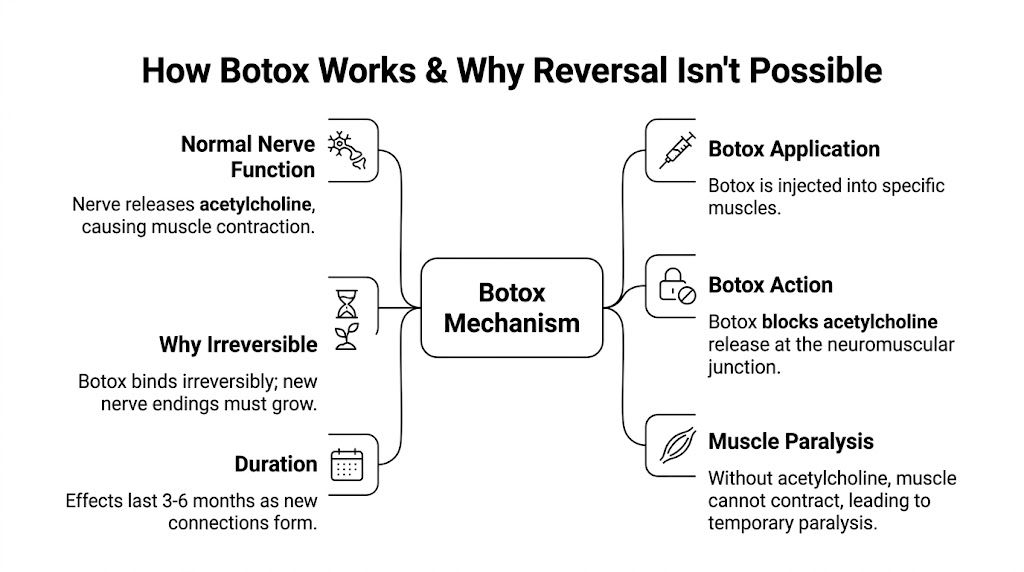
Botox functions by irreversibly binding to SNARE proteins at the nerve ending, which blocks the release of acetylcholine, the neurotransmitter that tells a muscle to contract. Because of that permanent molecular attachment, there is no commercial antidote that can chemically unbind it, and the effect lasts until the body regenerates new nerve terminals over about 3 to 4 months, as explained in this review of why Botox can’t be reversed.
That’s the scientific reason behind the plain-English answer. It isn’t that doctors are withholding an antidote. It’s that the biology doesn’t give us one in routine practice.
Recovery depends on your body building new connections. That takes time. It’s a repair-and-regrow process, not a rinse-out process.
For patients, this has two practical implications:
If you’re comparing options or trying to understand where neuromodulators fit among other aesthetic treatments, this overview of Botox treatments gives useful background on how they’re generally used. If your main question is how long the effects tend to last in practice, this guide on how long Botox lasts is a helpful companion read.
The short version is simple. Botox can’t be “dissolved” because it doesn’t behave like a filler. Your body has to outgrow the effect.
Patients often group Botox and filler together because both involve a syringe, a quick office visit, and cosmetic improvement without surgery. Medically, they are very different tools.
Botox relaxes muscle activity. Most common fillers add volume or structure. That difference changes everything about reversal.
Most common fillers people ask about are hyaluronic acid fillers. Hyaluronic acid can be dissolved with hyaluronidase. That’s a real reversal tool. If the filler is misplaced, overdone, or causing a problem, an injector may be able to dissolve it directly.
With Botox, there isn’t an equivalent product sitting in the treatment room that can instantly switch the muscle back on.
| Attribute | Botox (Neurotoxin) | Hyaluronic Acid Fillers (e.g., Juvéderm, Restylane) |
|---|---|---|
| Main purpose | Relaxes muscle movement | Adds volume and shape |
| How it works | Blocks the nerve signal that triggers muscle contraction | Places hyaluronic acid gel under the skin |
| Reversal agent | No standard commercial antidote | Hyaluronidase can dissolve it |
| What happens if you dislike it | You usually wait for it to wear off, with limited management options | It may be dissolved relatively quickly |
| Best way to avoid regret | Careful dosing and placement | Careful product choice, placement, and access to dissolving if needed |
This difference changes informed consent. When someone says, “Let’s just try Botox and see,” I always think that sentence needs context. You can absolutely “try” Botox, but trying it still means living with the result until your body moves through it.
That doesn’t make Botox unsafe or unwise. It just means the commitment is different.
If you’re weighing the two categories side by side, this comparison of Botox vs dermal fillers is useful because it frames them as separate tools, not interchangeable ones.
A cautious patient often does better when they know this before treatment, not after. The more clearly you understand the difference, the less likely you are to feel blindsided if the result isn’t exactly what you expected.
If Botox can’t be reversed, what can you do? More than many patients think.
The first step is to stop guessing and identify the exact problem. “I hate it” is a real feeling, but it can describe several different situations. A result may still be developing. It may be asymmetrical. It may be too strong in one area. Or it may feel unfamiliar even though it looks subtle to everyone else.

Botox effects peak at 7 to 14 days and then gradually fade over 3 to 6 months as nerve connections regenerate. Unwanted forehead effects such as brow drooping often improve naturally within 4 to 8 weeks, according to this explanation of whether Botox can be reversed.
If you’re only a few days out, the best move may be observation. Botox often needs time to declare itself.
If you’re closer to the peak window and still concerned, that’s when a targeted plan matters more.
This is one of the most upsetting outcomes because it changes expression and can even affect how open the eyes look.
What helps depends on whether the issue is true eyelid ptosis or a heavy brow pattern. In some cases, prescription eye drops may temporarily improve lid position while you wait. In others, the best strategy is to monitor and let the effect soften naturally.
This usually happens when one set of forehead or brow-pulling muscles remains stronger than another. The good news is that a skilled injector can sometimes improve symmetry with a small, strategic touch-up in an opposing muscle.
This is not reversal. It’s rebalancing.
Sometimes the treatment technically “worked,” but it looks stronger than you wanted. In that case, there may be nothing to add or remove. The plan becomes patience, follow-up, and better dose planning next time.
Don’t let anyone promise to “flush out” Botox with massage, creams, or home remedies. Those don’t undo the molecular effect.
Use a short checklist rather than reacting day by day.
A good follow-up is specific. Bring these questions:
Patients often feel calmer once the issue has a name. “This is temporary brow heaviness” is easier to handle than “something is wrong with my face.”
A visual explanation can also help if you’re trying to understand what may be happening with placement and muscle response:
Cosmetic dissatisfaction is one thing. Safety is another.
Seek prompt medical care if you develop symptoms such as trouble breathing, trouble swallowing, or unusual weakness beyond the treated area. Those are not routine cosmetic concerns.
Most unwanted aesthetic outcomes are temporary and manageable. Having a plan makes the waiting period feel less passive and much less frightening.
This is the part many articles skip. A temporary result can still feel emotionally intense.
If your face looks unfamiliar to you, it can affect work, social plans, dating, photos, and the simple act of making eye contact. You may know intellectually that it will fade, but that doesn’t always make you feel better today.
A real gap exists in patient education here. Most medical advice focuses on waiting for Botox to wear off, but mainstream resources rarely address how patients cope with altered appearance or confidence during that period, as noted in this discussion of the emotional gap in Botox and filler reversal guidance.
Patients commonly describe some mix of these reactions:
None of that means you’re being dramatic. Cosmetic treatments sit close to identity. When the result doesn’t match your expectation, the distress is real.
Constant checking rarely reassures. It usually amplifies anxiety.
Pick one time each day to assess the area, preferably with the same lighting and expression. Outside of that, stop auditing your face every time you pass a mirror.
A hairstyle change, brow styling, glasses, or eye makeup can shift attention away from the exact area bothering you. This isn’t denial. It’s a reasonable way to feel more like yourself while things improve.
If a big event feels stressful, give yourself permission to simplify your calendar. You don’t need to force confidence on demand.
At the same time, don’t isolate completely. A low-pressure dinner with someone supportive is often better for your mood than staying home and spiraling online.
If you’re distressed by the result, the goal isn’t to “just stop caring.” The goal is to reduce the amount of attention and meaning you give it each day.
Silence makes patients feel abandoned. Reassurance from a qualified injector can help because it replaces vague fear with a timeline, an explanation, and a plan.
A good provider should be willing to look, listen, and tell you plainly whether the issue is settling, manageable, or temporary.
One disappointing result can trigger harsher self-criticism than the treatment itself. If you notice yourself falling into appearance obsession, it may help to step back from beauty content and algorithm-driven “fix everything” advice. The cultural pressure behind that mindset is real, and this piece on the hidden dangers of looksmaxxing is a thoughtful reminder that self-improvement can become self-surveillance if you’re not careful.
You don’t have to love the waiting period. You do need tools that make it livable.
The current answer to can botox be reversed is still no in everyday practice. But that may not always be true.
One of the most interesting developments is ReViVox, an investigational agent developed by DelNova. It is designed as a local anticholinesterase treatment for affected muscle areas rather than a dissolver in the filler sense.
ReViVox has shown muscle movement restoration within 5 minutes in proof-of-concept human trials. That makes it one of the most promising breakthroughs discussed so far, according to this overview of ReViVox and rapid neuromuscular recovery.
That speed is striking because it suggests a practical intervention for selected unwanted effects rather than a long wait for spontaneous recovery.
There’s an important limit here. ReViVox remains investigational and is not commercially available for patient use.
That distinction matters. A lot of aesthetic misinformation starts with early scientific hope and gets translated into “there’s a cure now.” There isn’t, not in standard clinical practice.
A future Botox antidote would change several things:
But a future tool won’t eliminate the need for judgment. Even if reversal becomes possible, proper diagnosis would still matter. A heavy brow, lid ptosis, and asymmetry are not the same problem.
For now, the smart takeaway is balanced optimism. Research is moving. Science is trying to solve the exact problem patients worry about. But until a proven product is available in regular practice, prevention and good follow-up remain the most reliable safeguards.
The best reversal strategy is not needing reversal in the first place.
That doesn’t mean perfection is guaranteed. It means you dramatically improve your odds when you choose the right injector, set the right goals, and start conservatively.

Don’t choose an injector because the office is trendy or the treatment is on sale. Botox is anatomy, diagnosis, and judgment.
Look for a provider with board certification in a core aesthetic specialty, a strong understanding of facial balance, and a consultation style that feels careful rather than rushed.
A thoughtful injector rarely talks as if more is always better. For first-time treatment especially, a conservative plan is often the wisest one.
That matters because you can always add a bit more later. You usually can’t subtract what’s already acting on the muscle.
Two foreheads with the same wrinkle pattern can need different plans. Brow shape, eyelid position, muscle strength, and facial habits all affect treatment design.
Be cautious if you feel like you’re being placed into a package rather than assessed as an individual.
Good Botox often looks easy. It is not easy. It looks easy because an experienced injector made dozens of careful decisions before the needle touched your skin.
Some regret begins before treatment, not after it. A patient asks for a completely smooth forehead or a dramatic lift because that’s what looked good on someone else’s face in a filtered photo.
The better approach is to define what you want in plain language. Softer lines. More relaxed expression. A rested look. Brow shape that still feels like you.
That is also why emotional readiness matters. If you’re pursuing treatment from a place of intense self-scrutiny, pause and ask whether the plan is serving you or whether you’re getting pulled into a cycle of endless correction. The broader psychology of appearance pressure is worth paying attention to, especially online.
Research into reversal may become a real part of aesthetic medicine later. Right now, the most dependable protection is a careful injector, realistic expectations, conservative dosing, and strong follow-up.
That may not sound as exciting as an antidote. It is far more useful.
If you’re considering Botox or dealing with a result that doesn’t feel quite right, Cape Cod Plastic Surgery offers experienced, personalized guidance with Dr. Marc Fater, a board-certified plastic surgeon with over 30 years of experience. A thoughtful consultation can help you understand your options, set realistic expectations, and create a treatment plan built around natural results.
October 7, 2026
A Practical Guide to Healing After Breast Surgery

October 6, 2026
Your Safety Guide: What to Look for When Choosing a Plastic Surgeon

October 5, 2026
Why Our On-Site Accredited Facility Matters for Your Safety

Cape Cod Plastic Surgery offers expert cosmetic and reconstructive procedures in a safe, accredited setting. Led by Dr. Marc Fater, we combine advanced techniques with personalized care to help you look and feel your best.
Monday: 9:00 AM – 5:00 PM
Tuesday: 9:00 AM – 5:00 PM
Wednesday: 9:00 AM – 5:00 PM
Thursday: 9:00 AM – 5:00 PM
Friday: 9:00 AM – 5:00 PM