

October 7, 2026
What to Expect During Your Breast Surgery Recovery
A Practical Guide to Healing After Breast Surgery
Jun 1, 2026
Chin augmentation usually starts around $3,500 and can run to over $11,000 in the United States, depending on the quote structure and where you have surgery. The number many patients see first is often only the starting point, because the all-in price can also include anesthesia, operating room or facility charges, the implant itself, medications, and recovery-related expenses.
If you're researching chin implant cost right now, you've probably already seen why this topic feels confusing. One website quotes a national average. Another gives a much wider range. A local practice may advertise a lower entry price, but the consultation reveals separate fees that weren't included in the headline number.
That doesn't mean anyone is necessarily being deceptive. It usually means you're comparing different versions of the same purchase. Some quotes describe only the surgeon's fee. Others bundle the surgeon, anesthesia, and facility. A few include post-op visits and routine supplies. Many don't.
A chin implant is not like buying a single product off a shelf. It's a medical procedure with several moving parts, and the final bill reflects those parts. Patients make better decisions when they understand the total cost of ownership, not just the advertised base fee.
Most patients don't want a national average. They want to know what they'll spend from start to finish, and whether the result is worth it.
That's the right question.
Individuals inquiring about chin implant cost often find one number and assume it represents the full price. In practice, that figure may only represent the surgeon's professional fee. The total amount paid usually reflects a package of services tied to safety, planning, the operating environment, and recovery.
The first reason is simple. Not everyone is describing the same thing.
One listing may refer to the procedure fee alone. Another may describe the patient-facing total. A third may reflect a specific city where rent, staffing, and surgical overhead are much higher. Those aren't small details. They change the quote in a meaningful way.
The second reason is that chin augmentation isn't one identical operation for every patient. Some patients do well with a standard implant placed in a straightforward outpatient setting. Others need a more individualized implant choice, more involved planning, or a different anesthesia approach.
Practical rule: If a price sounds surprisingly low, ask what is excluded before you compare it with another practice's quote.
A useful financial conversation should separate the major categories so you can see what you're paying for. In most practices, that means understanding:
That kind of itemization matters because the lowest sticker price doesn't always represent the lowest real cost. A quote that looks higher at first may be more complete and easier to budget for. A quote that looks lower may leave out several necessary charges.
Patients usually feel more comfortable once the numbers are organized this way. Instead of trying to decode marketing language, they can weigh trade-offs of safety, convenience, implant choice, and permanence.
A common scenario plays out in consultation. A patient sees an online figure in the mid-$3,000 range, then receives a surgical quote that is several thousand dollars higher and wonders whether the practice is overpriced. In many cases, the gap comes from comparing a surgeon's fee with the full cost of surgery.
The clearest national benchmark comes from the American Society of Plastic Surgeons. It lists an average surgeon's fee of $3,641 for chin augmentation, and it specifically notes that this figure does not include anesthesia, operating room, or facility charges, as outlined on the American Society of Plastic Surgeons chin augmentation cost page.
Consumer financing companies often publish broader patient-facing ranges, and those estimates are usually higher because they reflect more of the actual bill a patient encounters. The practical takeaway is simple. The national average gives you a starting point, not a personal quote.
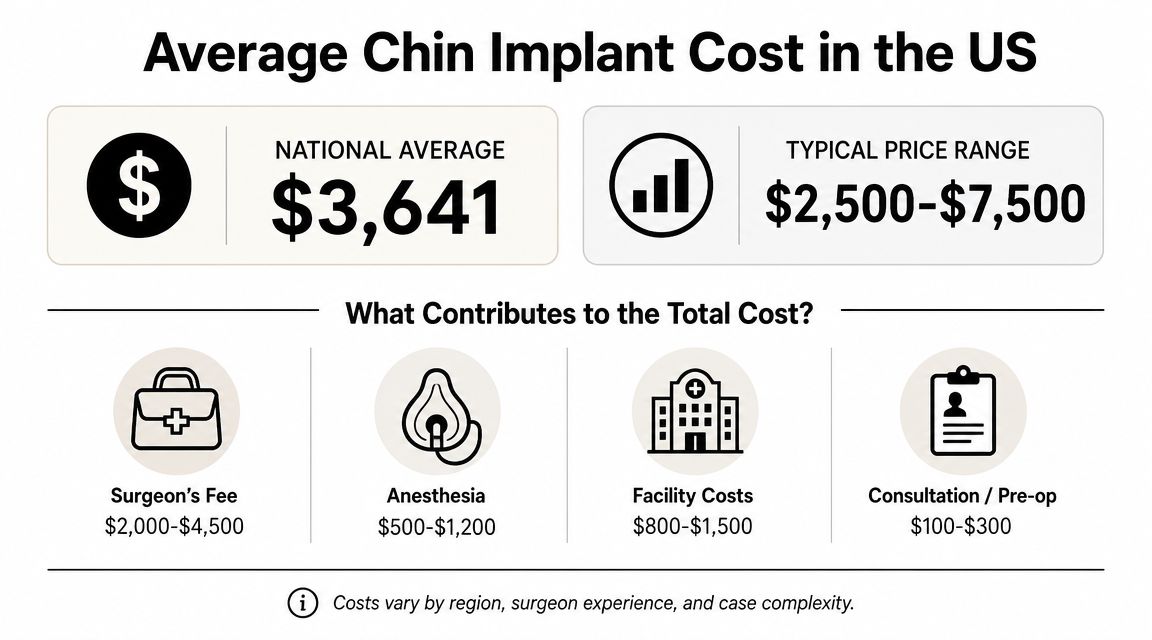
Average pricing is useful for orientation. It helps you judge whether chin augmentation is generally a few thousand dollars or much more than that. It does not tell you what your surgery will cost once the procedure is planned around your anatomy, implant choice, operating setting, and recovery needs.
That distinction matters because patients pay the total bill, not the average professional fee reported in a national survey.
I advise patients to use national averages as a rough range check. Then shift quickly to the total cost of ownership. That means asking what the quote includes during surgery and what it will realistically cost you afterward, including prescriptions, time away from work, transportation, and other recovery expenses that many online price summaries ignore.
A short visual summary helps clarify the distinction:
The safest way to compare prices is to compare complete quotes on the same basis. A lower number is only meaningful if it covers the same services, the same level of facility and anesthesia support, and the same follow-up care.
Use questions like these:
| Cost question | Why it matters |
|---|---|
| Is this only the surgeon's fee? | A low number may leave out most of the surgical bill |
| Is anesthesia included? | Separate anesthesia billing can change the final total |
| Is the facility or operating room included? | Office, ambulatory center, and hospital pricing differ |
| Is the implant included? | Implant type can affect cost |
| Are routine follow-ups included? | This changes your out-of-pocket total |
Patients who ask these questions early usually make better comparisons and have fewer surprises later.
A fair comparison is one complete quote versus another complete quote.
This approach also helps when weighing surgery against fillers. A filler treatment may cost less upfront, but repeated maintenance can change the long-term math. Surgery usually carries a higher initial bill, yet the value can be stronger for patients who want a permanent structural change rather than an ongoing treatment plan.
The easiest way to think about a chin augmentation quote is to compare it to buying a car. If someone tells you the cost of the engine alone, you still don't know what the actual car costs. You need the rest of the components, the assembly, and the delivery of the finished product.
Surgical pricing works the same way.
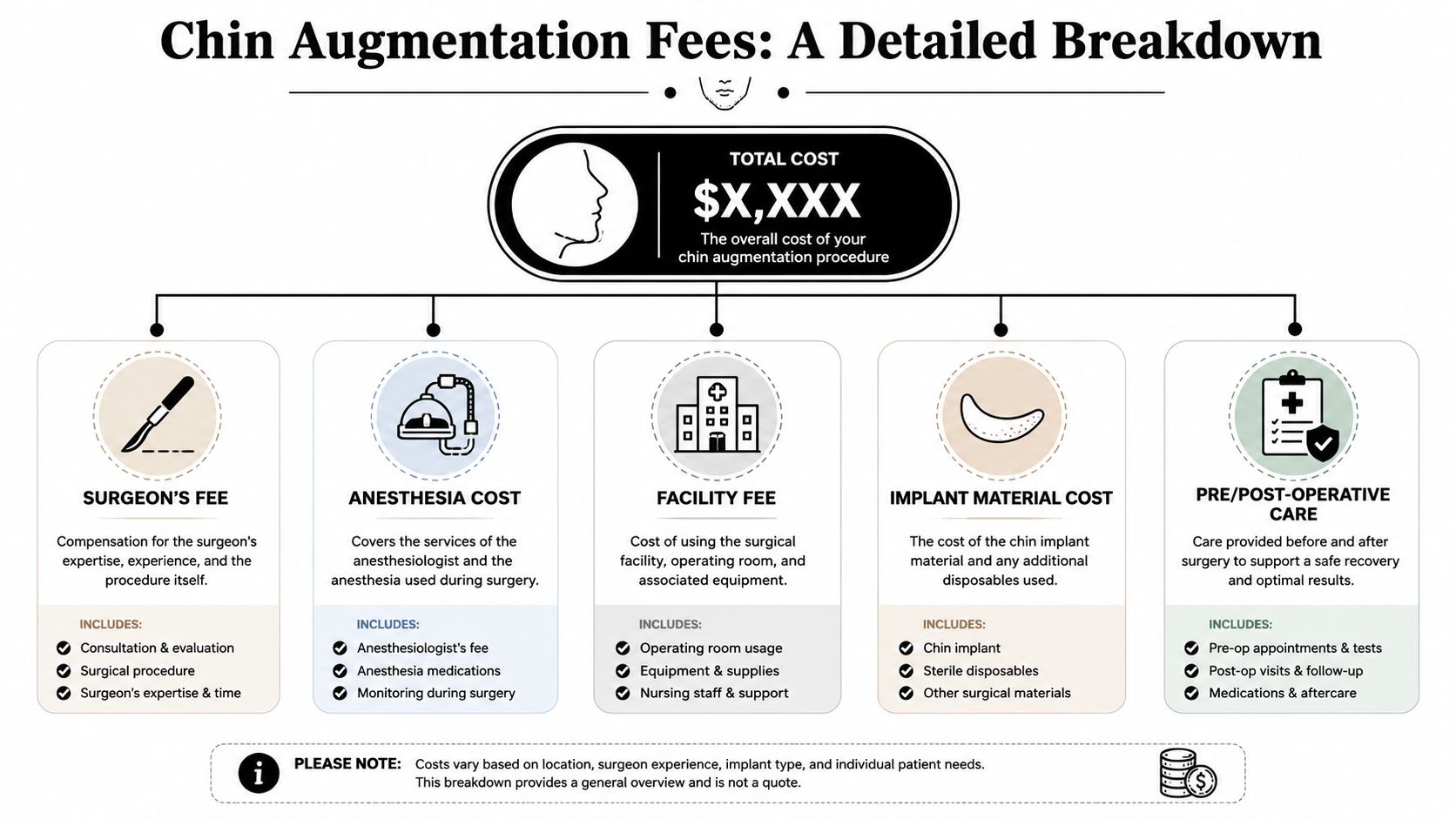
The surgeon's fee pays for the doctor's evaluation, operative planning, technical execution, judgment during surgery, and routine post-operative oversight. It's the professional component of the case.
This is the number patients often find first in national reporting. It matters, but it doesn't capture the entire financial picture. A surgeon with substantial facial surgery experience may charge more than a less experienced operator, and that difference isn't arbitrary. You're paying for planning, precision, and decision-making, not just time in the room.
Anesthesia and facility fees are common reasons a final quote rises above the advertised average.
Anesthesia pricing reflects the type of anesthesia used and who provides it. A shorter office-based case may be structured differently from a case performed with general anesthesia in an ambulatory surgical setting. Facility charges cover the operating room, nursing staff, sterile processing, monitoring equipment, and the overhead required to run a safe operative environment.
Those categories are easy to overlook when you're reading internet summaries, but they aren't optional if your procedure is performed in a setting built for surgical safety.
The implant device is usually a smaller part of total chin implant cost than many patients expect. Standard off-the-shelf implants are reported at about $175 to $500, while custom 3-D printed chin implants can add roughly $4,000 in materials alone before CT imaging and surgical fees, according to this clinical chin implant cost breakdown.
That difference matters because standard and custom implants solve different problems. A standard implant is often appropriate for a straightforward enhancement in someone with relatively symmetric anatomy. A custom implant may make sense when the chin shape is more complex, asymmetry is significant, or the planned change is more structural.
The implant isn't usually the main cost driver. The operating environment and the expertise around the implant are what shape most quotes.
A complete quote may also include or exclude several practical items:
That last category is where total cost of ownership becomes useful. The true cost isn't just what happens on surgery day. It's what you need before surgery, what you need after surgery, and what you might have to pay separately if the original quote wasn't fully itemized.
When patients ask smart financial questions early, the conversation gets much simpler. They can compare quotes on equal terms and decide based on value rather than confusion.
The same operation doesn't cost the same amount in every setting or for every patient. Chin implant cost moves up or down for reasons that are usually understandable once you break them apart.

Location is one of the clearest pricing variables. In current market reporting, a chin augmentation in New York City is cited at an average of about $7,000, Seattle is reported at $9,221, and Miami is reported between $2,000 and $3,500, showing how overhead and local demand influence pricing, according to this regional chin implant pricing review.
That doesn't mean one city is automatically better or worse. It means rent, staffing, facility expenses, and market demand all affect the quote before the first incision is made.
A board-certified plastic surgeon with a long track record in facial surgery may charge more than a newer or less specialized provider. That premium usually reflects judgment, consistency, and the ability to tailor the operation to the patient's anatomy.
Price shopping without accounting for experience is where patients sometimes make expensive mistakes. Revision surgery, prolonged recovery, or a result that doesn't match the face well can cost more than choosing carefully the first time.
A standard implant works well in many cases. A custom implant may be worth considering when the chin is asymmetric, the desired change is unusual, or the surgeon wants a more exact fit.
This isn't just a device decision. It changes planning, materials, and sometimes imaging requirements as well. That's why two quotes for "chin augmentation" can look very different even when both are reasonable.
Anesthesia affects comfort, workflow, and cost. Some cases can be performed in a simpler setting, while others are better suited to deeper anesthesia and a more formal operating environment.
Patients sometimes focus only on saving money here. That's rarely the right starting point. The better question is which approach matches the complexity of the case and the safety standards of the surgeon and facility.
Lower cost isn't a bargain if the setting isn't appropriate for the operation you're having.
An office procedure room, a private accredited surgical suite, an ambulatory surgery center, and a hospital all carry different overhead structures. The facility fee reflects staffing, equipment, monitoring, sterilization, and recovery capabilities.
A polished quote should tell you where the surgery will happen. If it doesn't, ask.
A straightforward primary chin implant is different from a revision, a combined facial procedure, or a case where anatomy requires more planning. Complexity affects operative decision-making, setup, and sometimes the type of implant chosen.
Here is a simple way to frame value when comparing offers:
| Factor | Usually lowers price | Usually raises price |
|---|---|---|
| Location | Lower-overhead region | Major urban market |
| Implant type | Standard implant | Custom implant |
| Case type | Primary, straightforward case | Revision or more tailored case |
| Facility | Simpler outpatient setting | More resource-intensive operative setting |
The cheapest quote may be appropriate. It may also be incomplete, poorly matched to your anatomy, or built around compromises you wouldn't knowingly choose.
Many patients considering a stronger chin profile are deciding between surgery and filler, not between surgery and doing nothing. That's a reasonable comparison because both can improve projection. They just do it in very different ways.
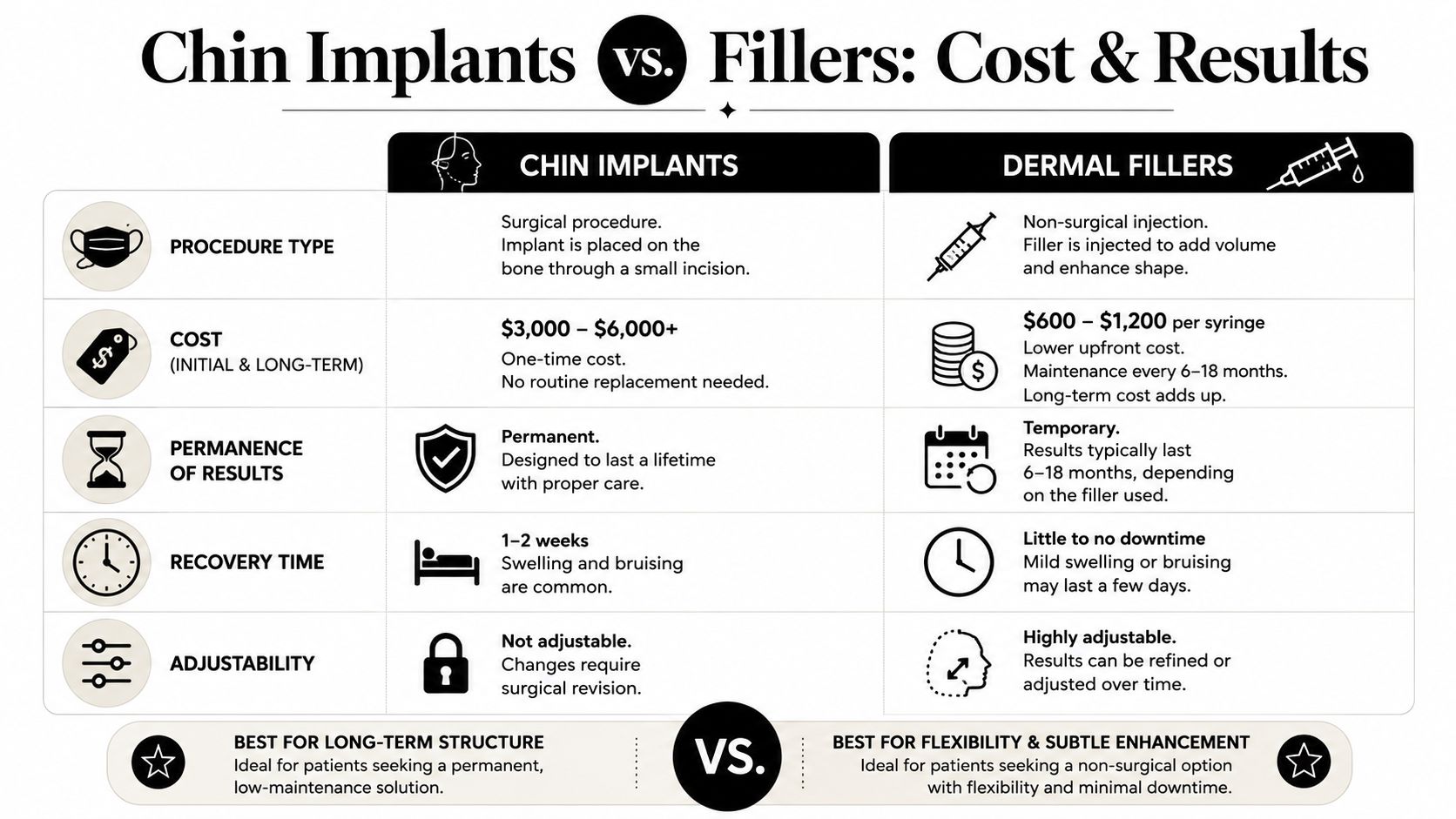
A chin implant is a surgical solution aimed at a lasting structural change. For the right candidate, it creates defined projection in a way that doesn't depend on repeat maintenance visits.
That permanence is the main economic argument in favor of surgery. The up-front cost is higher, but the result is designed to be durable rather than temporary. Patients who want a stable change and don't want the cycle of ongoing touch-ups often find that surgery aligns better with both their aesthetic goals and their long-term budgeting.
Fillers are useful when someone wants a preview, a subtle adjustment, or a non-surgical option with less downtime. They can also help patients who aren't ready to commit to an operation.
The trade-off is that filler is maintenance-based. The result fades. That means the financial decision isn't just the initial treatment price. It's the ongoing pattern of repeated treatment if you want to keep the effect.
A fuller discussion of that decision appears in this guide to chin implant vs filler, which is worth reading if you're choosing between a temporary and a surgical approach.
| Consideration | Chin implant | Chin filler |
|---|---|---|
| Goal | More structural, lasting enhancement | Temporary contour change |
| Cost pattern | Higher up-front investment | Lower entry cost but repeat spending |
| Recovery | Surgical recovery | Minimal downtime in many cases |
| Precision | Stronger option for defined projection | Better for modest adjustment |
| Commitment | Best for patients wanting permanence | Best for patients wanting flexibility |
If you're treating filler as a long-term substitute for an implant, compare the repeat expense over time, not just the first visit.
What doesn't work well is choosing fillers only because the first invoice is lower, when a permanent chin change is desired. That usually leads to repeated spending on a treatment strategy that wasn't built for the goal in the first place.
What does work is matching the tool to the objective. If you want flexibility and a softer test run, filler can be sensible. If you want a stable structural change, implants are usually the more coherent long-term solution.
Cosmetic chin augmentation usually isn't covered by health insurance, so most patients plan for it as an out-of-pocket procedure. That makes the payment structure almost as important as the quoted fee.
Financing can be helpful when it makes a well-considered procedure easier to budget without pushing you into a rushed decision. Some patients use medical financing programs. Others prefer to pay in stages or use a card-based installment option. If you're comparing payment methods, this overview of Suby on Splitit functionality gives a useful plain-English explanation of how one installment model works.
The smart approach is to budget beyond the operating day itself. Patients commonly forget to account for:
A good financial conversation should leave very little unclear. Ask whether the quote includes anesthesia, facility charges, implant cost, standard follow-ups, and routine post-op care. Ask what circumstances would create additional charges.
For a broader look at payment planning, this cosmetic surgery financing guide is a practical place to start. The right financing plan should make the procedure manageable, not obscure what you're paying for.
A consultation should do more than confirm that you're a candidate. It should tell you what procedure fits your face, what trade-offs come with each option, and what the financial commitment looks like in real terms.
That matters because chin surgery is rarely a one-size-fits-all purchase. Implant size, shape, projection, incision choice, anesthesia plan, and surgical setting all influence the experience and the quote. A useful consultation puts those pieces in one place so you can make a calm decision.
A thorough consultation usually includes a facial analysis, discussion of your profile goals, review of relevant medical history, and a practical conversation about what surgery can and can't achieve. It should also address whether a chin implant or a non-surgical approach makes more sense for your anatomy and expectations.
Patients often benefit from understanding the process in advance. If you haven't had cosmetic surgery before, this overview of what happens during a plastic surgery consultation can help you prepare for the questions and decisions that come up.
Dr. Marc Fater is a board-certified plastic surgeon with more than three decades of experience, and the practice operates with an on-site AAAASF-accredited surgical suite. Those details matter because surgical pricing should always be interpreted alongside the environment in which care is delivered.
Patients are not just paying for an implant. They're paying for clinical judgment, an operative plan designed for the face, anesthesia and safety protocols appropriate to the case, and follow-through during recovery. That's what turns a procedure quote into a meaningful value discussion.
One practical advantage of an individualized consultation is clarity. Instead of relying on broad internet averages, patients can leave with a quote tied to their own anatomy, goals, and surgical plan. That tends to reduce the biggest source of frustration in cosmetic surgery pricing, which is discovering too late that the number you used for budgeting wasn't the actual total.
If you're comparing options, that's the standard to use. Ask whether the recommendation fits your face. Ask whether the quote is complete. Ask where the procedure will be performed and who will be involved in your care.
Then decide based on value, safety, and fit, not just the lowest number on the page.
If you're considering chin augmentation and want a personalized, itemized quote based on your anatomy and goals, schedule a consultation with Cape Cod Plastic Surgery. A direct evaluation can clarify whether an implant or a non-surgical option makes more sense, and it gives you a realistic cost picture before you commit.
October 7, 2026
A Practical Guide to Healing After Breast Surgery

October 6, 2026
Your Safety Guide: What to Look for When Choosing a Plastic Surgeon

October 5, 2026
Why Our On-Site Accredited Facility Matters for Your Safety

Cape Cod Plastic Surgery offers expert cosmetic and reconstructive procedures in a safe, accredited setting. Led by Dr. Marc Fater, we combine advanced techniques with personalized care to help you look and feel your best.
Monday: 9:00 AM – 5:00 PM
Tuesday: 9:00 AM – 5:00 PM
Wednesday: 9:00 AM – 5:00 PM
Thursday: 9:00 AM – 5:00 PM
Friday: 9:00 AM – 5:00 PM