

October 7, 2026
What to Expect During Your Breast Surgery Recovery
A Practical Guide to Healing After Breast Surgery
Jun 7, 2026

For the cost of a facial on Cape Cod, you're probably not looking for a generic national list. You're likely standing in front of a mirror, noticing dullness, breakouts, rough texture, sun damage, or just skin that doesn't look as rested as you feel. Then you start comparing spa menus, medispa offers, and medical office treatments, and the prices seem to have nothing in common.
That confusion is reasonable. A facial can mean a basic cleansing appointment, a customized acne treatment, a peel-based corrective service, or a device-driven procedure that belongs more in a medical setting than a spa. Those are not the same purchase, and they shouldn't cost the same.
On Cape Cod, that matters even more. Local patients often want two things at once. They want healthy, refreshed skin, and they want to spend wisely. The right question usually isn't “What does a facial cost?” It's “What am I paying for, what result should I expect, and is this the right treatment for my skin?”
A common Cape Cod scenario goes like this. Someone in Falmouth, Chatham, or Hyannis books a facial before an event, a vacation, or family photos. They expect a little glow and some relaxation. Then they realize their real concern isn't pampering at all. It's persistent congestion, uneven pigment, acne flare-ups, or skin that feels older than it did a few years ago.
At that point, the menu gets confusing fast. One place offers a basic facial. Another offers a “signature” treatment. A medical office may suggest a peel, resurfacing plan, or a more targeted protocol. The prices can look unrelated, but the treatments are serving different purposes.
That bigger context matters because aesthetics is not a small niche purchase. In the U.S., patients spent upwards of $26 billion on minimally invasive and surgical cosmetic procedures combined in 2022, and Generation X accounted for 45% while Baby Boomers accounted for 30% of procedures, according to CareCredit's cosmetic cost guide. That tells you something important. Facial aesthetics isn't just a trend for younger patients. It's a major category of health, appearance, and confidence spending for adults in midlife and beyond.
When patients ask about the cost of facial treatments, they often expect one number. In practice, there isn't one honest number.
A facial in Provincetown designed for relaxation is a different service from a corrective treatment in Hyannis aimed at acne, pigment, or resurfacing. One may focus on cleansing, exfoliation, massage, and hydration. Another may involve stronger active ingredients, clinical judgment, stricter safety protocols, and a plan that extends beyond a single visit.
Practical rule: If the skin concern is specific, the treatment should be specific too. Generic facials rarely solve stubborn acne, sun damage, or textural change on their own.
For patients dealing with breakouts, it's often useful to pair in-office care with sound home care. A practical resource on a science-based approach to clear acne can help frame what professional treatment can do, and what daily skin management still needs to happen at home.
Individuals aren't just comparing sticker prices. They're trying to answer three very practical questions:
That's the value equation. It matters more than the lowest advertised number.
The easiest way to understand the cost of facial services is to compare them to car care. A basic exterior wash and a professional detail both involve cleaning a car, but nobody expects them to cost the same. One is routine maintenance. The other is labor-intensive, targeted, and built around a more visible result.
Facials work the same way. A standard spa facial may focus on cleansing, light exfoliation, steam, mask application, and relaxation. A medical facial or corrective skin treatment usually aims at a specific problem and may involve stronger actives, more customization, and tighter oversight.

A facial fee reflects more than the appointment length. It often includes assessment, treatment selection, product quality, sanitation standards, and the provider's ability to adjust the plan based on your skin's response.
That helps explain why regional pricing can look inconsistent. According to patient-reported data summarized by RealSelf's facial cost guide, the average facial cost in the U.S. is $247, with reported state averages ranging from $106 in Ohio to $332 in New York. The same source notes that in Massachusetts, some sources place the state average around $81, while customized facials in the Northeast often range from $120 to $250 depending on complexity.
For Cape Cod patients, that means a low posted price isn't necessarily a bargain, and a higher fee isn't automatically inflated. Coastal overhead, seasonal demand, staffing, and whether the service is delivered in a spa or medical setting all affect the final number.
A lower-cost facial can be a smart purchase when your goal is maintenance, hydration, or a refreshed look before an event. It becomes a poor-value purchase if you're expecting it to correct pigment, active acne, or meaningful textural change.
Here is a simple comparison:
| Treatment style | Primary goal | Typical setting | Why pricing differs |
|---|---|---|---|
| Basic spa facial | Cleansing and relaxation | Spa or salon | Fewer clinical inputs |
| Customized facial | Maintenance plus targeted concerns | Spa or medispa | More treatment planning |
| Medical-grade facial | Corrective care | Medical office or supervised clinic | Stronger actives, more expertise |
| Device-based facial treatment | Resurfacing or rejuvenation | Medical setting | Equipment, safety, operator skill |
A facial that feels wonderful and a facial that changes the skin are sometimes the same appointment, but often they are not.
That distinction is where many patients either waste money or spend wisely.
When patients look at a treatment menu, the names often sound polished but vague. “Glow facial,” “signature facial,” and “custom corrective treatment” may all be legitimate services, but the name alone doesn't tell you what the treatment is designed to do. The useful question is simpler. What method is being used, and what result is realistic?
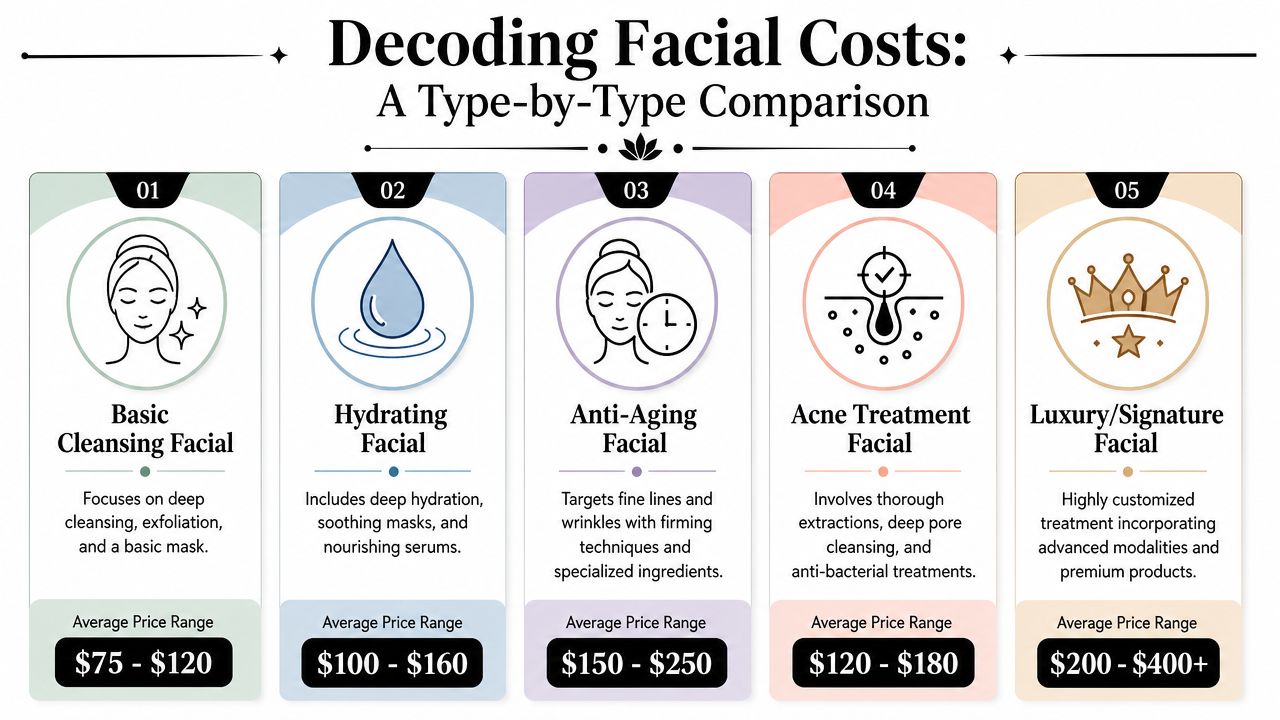
A basic facial is usually the entry point. It tends to include cleansing, exfoliation, mask application, and sometimes extractions or light massage. Nationally, a basic facial averages about $63 according to StyleSeat's facial pricing guide.
That kind of treatment often works well for:
It usually doesn't do enough for deeper pigment, scarring, or significant textural change.
Once you move into corrective territory, the method matters more than the label.
Microdermabrasion generally falls in a moderate price band. The same StyleSeat source lists microdermabrasion at $55 to $250. That range makes sense because technique, equipment quality, and whether the treatment is stand-alone or part of a customized service can change the fee.
Chemical peels span a broad clinical spectrum. CareCredit's cosmetic pricing guide lists light chemical peels at $249, medium peels at $656, and deep peels at $2,708 in its national pricing overview for cosmetic care. A light peel may fit maintenance or mild discoloration concerns. A deeper peel involves more intensity, more downtime, and a different risk-benefit conversation.
For patients comparing resurfacing styles, it can also help to understand where newer options fit. A neutral educational overview of SAHPRA-compliant carbon laser facials shows how some laser-based treatments are positioned as higher-tech alternatives to traditional facials, especially for oiliness, texture, and pore-focused concerns.
Costs often jump sharply, and for good reason. Equipment cost, staff training, safety protocols, and treatment goals all change.
StyleSeat reports that photo facials range from $100 to $800 and laser facials can range from $1,000 to $3,500. Those aren't just upgraded facials. They represent a move from spa-style maintenance into technology-based skin treatment.
Before choosing between a routine facial and a device-based option, many patients find it useful to compare treatment intent, not just price. A closer look at HydraFacial vs. regular facial can help clarify where a more advanced service may offer a better fit.
A quick video overview can also help patients visualize how professional facial treatments differ in intensity and purpose:
When you review a price list, read it this way:
That one habit can save patients from buying the wrong service.
Two facials can look similar on paper and feel very different in practice. The final cost usually reflects a bundle of decisions, not one factor. Who performs the treatment, where it's performed, what tools are used, and how customized the plan is all affect both price and outcome.

An esthetician, a nurse in a medical aesthetic setting, and a board-certified plastic surgeon are not interchangeable roles. That doesn't mean every patient needs physician-level treatment for a facial. It does mean the proper provider should match the complexity of the concern.
If the issue is simple maintenance, a skilled esthetician may be the right fit. If the concern involves acne that scars, significant pigment change, rosacea-prone skin, or a treatment that can trigger complications if used poorly, medical oversight starts to matter much more.
Clinical judgment changes value. A less expensive treatment becomes costly when it irritates the skin, delays the right diagnosis, or has to be undone.
A day spa and a medical office have different overhead for a reason. Infection control, emergency readiness, equipment maintenance, and professional staffing all change what it costs to operate.
That doesn't make every medical setting the right answer for every patient. It does explain why a lower-cost offer may leave out the very safeguards that become important once you move past a basic facial.
For patients weighing facial treatments against broader aesthetic spending, a more complete look at cosmetic surgery cost considerations can help frame how provider training, facility standards, and procedural complexity affect pricing across the board.
A surprisingly large part of the cost of facial services comes from how customized the appointment is. A standard protocol is simpler to price. A customized treatment for active acne, reactive skin, or sun damage usually requires more judgment and more adjustment during the visit.
Common cost drivers include:
Some patients do well with a simple, repeatable maintenance facial. Others need a treatment plan, not a menu item. The second group usually spends more, but they also avoid the cycle of trying one-off treatments that never address the underlying issue.
One of the most useful questions a patient can ask is, “What exactly is included in this price?” That question often reveals more than the number itself.
In many offices, the listed facial fee covers the appointment, the provider's time, cleansing and preparation, the treatment itself, and immediate post-treatment products used in the room. If the service is straightforward, that may be the full expense for that visit.
With more advanced or corrective care, the listed price may only describe the in-office portion.
In most legitimate settings, a facial fee commonly includes:
That said, “consultation included” doesn't always mean a full medical skin evaluation. It may mean treatment selection for that appointment.
Patients are often surprised by the add-on costs that make the total investment higher than expected.
These may include:
Ask whether the quoted fee covers one appointment or a skin strategy. Those are different purchases.
A short checklist can prevent most pricing surprises:
| Question | Why it matters |
|---|---|
| Is this a maintenance facial or a corrective treatment? | Sets result expectations |
| Are extractions, peel layers, or device use included? | Clarifies the true service |
| Will I need products before or after treatment? | Helps budget accurately |
| Is a series recommended? | Changes the real cost over time |
| Who performs the treatment? | Affects safety and appropriateness |
When a practice answers those questions clearly, patients usually make better decisions and feel better about the spend.
The best skin budget is not the lowest one. It's the one aligned with your goals, your skin biology, and what you can maintain without frustration.
A patient who wants relaxation and routine upkeep doesn't need the same plan as someone trying to improve acne, brown spots, or sun-damaged texture. Those goals live in different price categories because they require different tools and different expectations.
According to Beauty World NYC's guide to facial costs, basic facials can start around $50 to $95 for maintenance, while medical skin rejuvenation averages $697 for laser treatments. That jump reflects a shift in purpose. You're not just paying for a nicer version of the same visit. You're paying for a move from maintenance toward clinical result-seeking care.
A useful way to think about facial spending is to separate goals into categories:
Maintenance can often live in a recurring but moderate budget. Corrective care usually comes in larger, less frequent steps and may require home products that protect the investment.
Patients often overspend on extras and underspend on fundamentals. The treatment itself matters, but so does what supports healing and consistency afterward.
For example, if you're doing a more active treatment, skin recovery becomes part of the value equation. Guidance on which vitamins support skin healing can be useful for understanding how nutrition fits into recovery, especially when skin barrier support matters after exfoliating or resurfacing procedures.
The same principle applies financially. If a treatment plan is appropriate but hard to pay all at once, structured financing may make it easier to choose the right care rather than the cheapest care. Information on payment plans for aesthetic treatment can help patients think in terms of sustainability, not impulse spending.
The most expensive facial is the one that doesn't address your concern. The second most expensive is the one you can't maintain.
What tends to work:
What usually doesn't:
A worthwhile investment isn't defined by the highest price. It's defined by fit.
A low advertised price can get attention fast. It can also hide the reason a treatment ends up costing more later, whether that means irritation, poor results, or paying again to correct a bad recommendation.

On Cape Cod, many patients are deciding between a spa facial, a medical aesthetic treatment, and a surgical consultation without a clear sense of which category fits their concern. Price matters, but provider judgment matters just as much. A treatment is only a good value if it is appropriate for your skin and performed safely.
Pause if you notice any of the following:
A trustworthy provider explains what a facial can improve, what it cannot improve, and why.
Some concerns start deeper than the skin surface. If the main issue is facial volume loss, deeper folds, skin laxity, jowling, or fullness in the neck, a facial may help the skin look brighter or smoother without changing the feature that bothers you.
That is when a surgeon's evaluation becomes useful. A board-certified plastic surgeon can separate surface concerns from structural ones and explain whether skincare, peels, lasers, neuromodulators, fillers, or surgery make the most sense. In Hyannis, patients may seek that kind of evaluation from a practice such as Cape Cod Plastic Surgery, where both nonsurgical and surgical options can be discussed in one setting.
The goal is not to push every patient toward a procedure. The goal is to match the treatment to the problem. That protects your budget and your skin.
October 7, 2026
A Practical Guide to Healing After Breast Surgery

October 6, 2026
Your Safety Guide: What to Look for When Choosing a Plastic Surgeon
October 5, 2026
Why Our On-Site Accredited Facility Matters for Your Safety

Cape Cod Plastic Surgery offers expert cosmetic and reconstructive procedures in a safe, accredited setting. Led by Dr. Marc Fater, we combine advanced techniques with personalized care to help you look and feel your best.
Monday: 9:00 AM – 5:00 PM
Tuesday: 9:00 AM – 5:00 PM
Wednesday: 9:00 AM – 5:00 PM
Thursday: 9:00 AM – 5:00 PM
Friday: 9:00 AM – 5:00 PM