

October 7, 2026
What to Expect During Your Breast Surgery Recovery
A Practical Guide to Healing After Breast Surgery
Jul 21, 2026
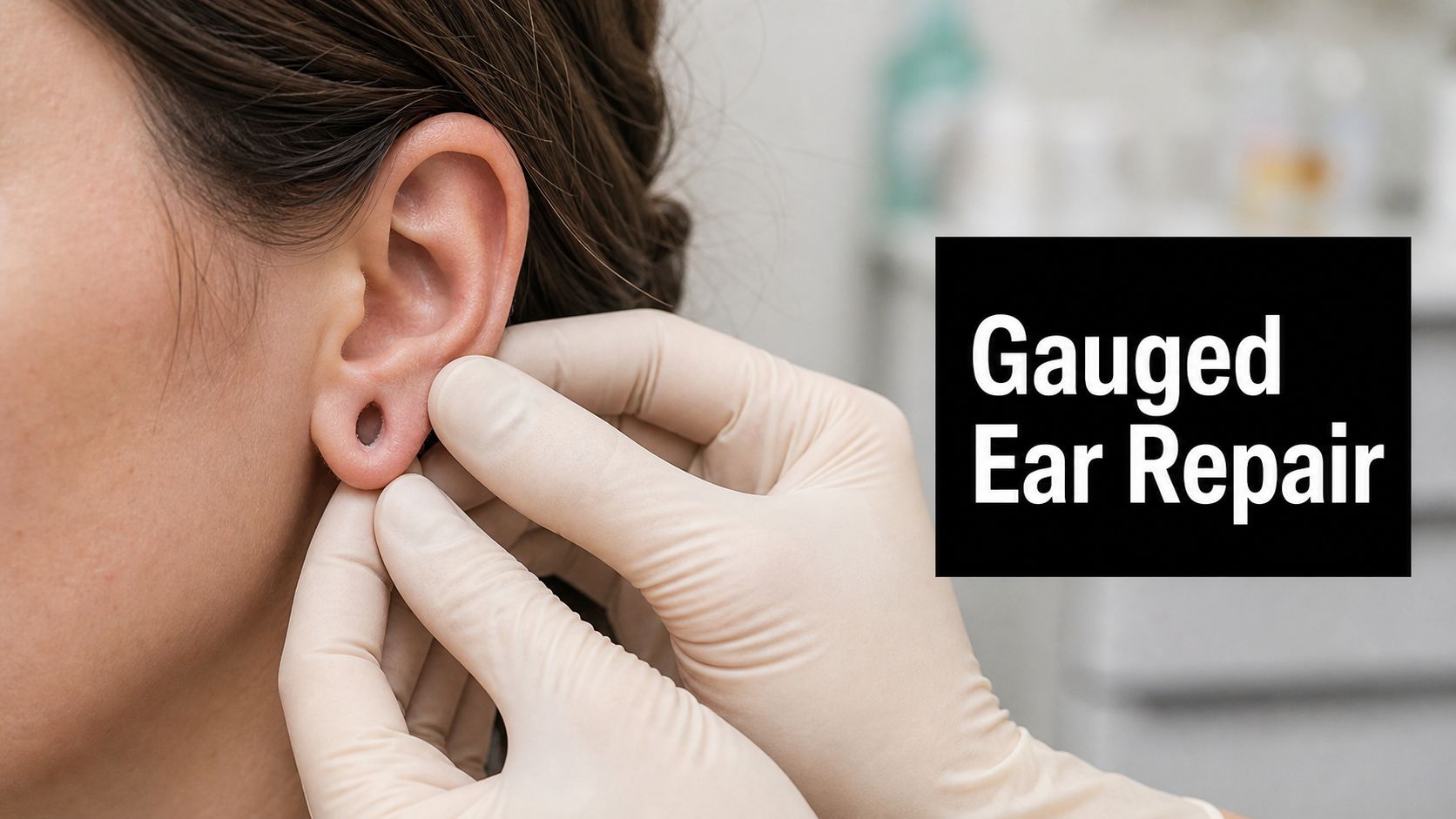
You may be reading this with plugs sitting on your bathroom counter, or with stretched lobes you stopped noticing until a job interview, a wedding photo, or a simple pair of studs made you think, “I'm ready for something different.”
That feeling is common. People change. Style changes. Priorities change. Wanting your ears to match who you are now doesn't mean you regret who you were before. It means you're making a new choice for yourself.
Gauged ear repair is the procedure that restores a stretched earlobe to a more natural shape. For many patients, the primary relief isn't only cosmetic. It's the sense that their appearance feels aligned again.
A patient story often begins with a personal realization. Someone stretched their ears years ago, loved the look, and wore it confidently through a different chapter of life. Then work became more client-facing. Or their taste shifted toward a cleaner, simpler look. Or they missed wearing traditional earrings and realized the old piercing no longer functioned the way they wanted.
None of that is vanity. It's identity catching up with the present.
I've seen people arrive with mixed emotions. Some feel excited. Others feel embarrassed for even asking. A few worry they'll be judged for having stretched their ears in the first place. They shouldn't be. Earlobe repair is not about erasing a mistake. It's about restoring options.
Sometimes the decision starts with a smaller step. A person removes their jewelry, tries to downsize, and spends time learning more about ear and body piercing practices through resources like ear and body piercing. That exploration often helps people understand the difference between healthy piercing care and the separate question of whether stretched tissue can return to its former shape.
Many patients don't want to look “perfect.” They want to look natural, balanced, and comfortable in their own skin again.
For local patients, choosing a board-certified plastic surgeon matters because earlobe repair is small surgery with visible consequences. The earlobe is a tiny structure, but even slight asymmetry or contour irregularity can stand out. Dr. Fater's role in that process is to examine the tissue carefully, understand what kind of result fits your goals, and rebuild the lobe with shape in mind, not just closure.
What matters most is simple. If your stretched lobes no longer feel like you, repair is a reasonable next step.
Many people hope their earlobes will “just shrink back” once the jewelry comes out. Sometimes there is a little tightening. But once a lobe has been stretched past a certain point, the tissue usually doesn't return to its original shape.
The easiest way to understand this is to think of a rubber band. Stretch it gently and it snaps back. Stretch it too far, keep it under tension, and it loses recoil. Earlobe tissue behaves in a similar way. The skin and soft connective tissue stop acting like springy tissue and start behaving like tissue that has remodeled around the opening.
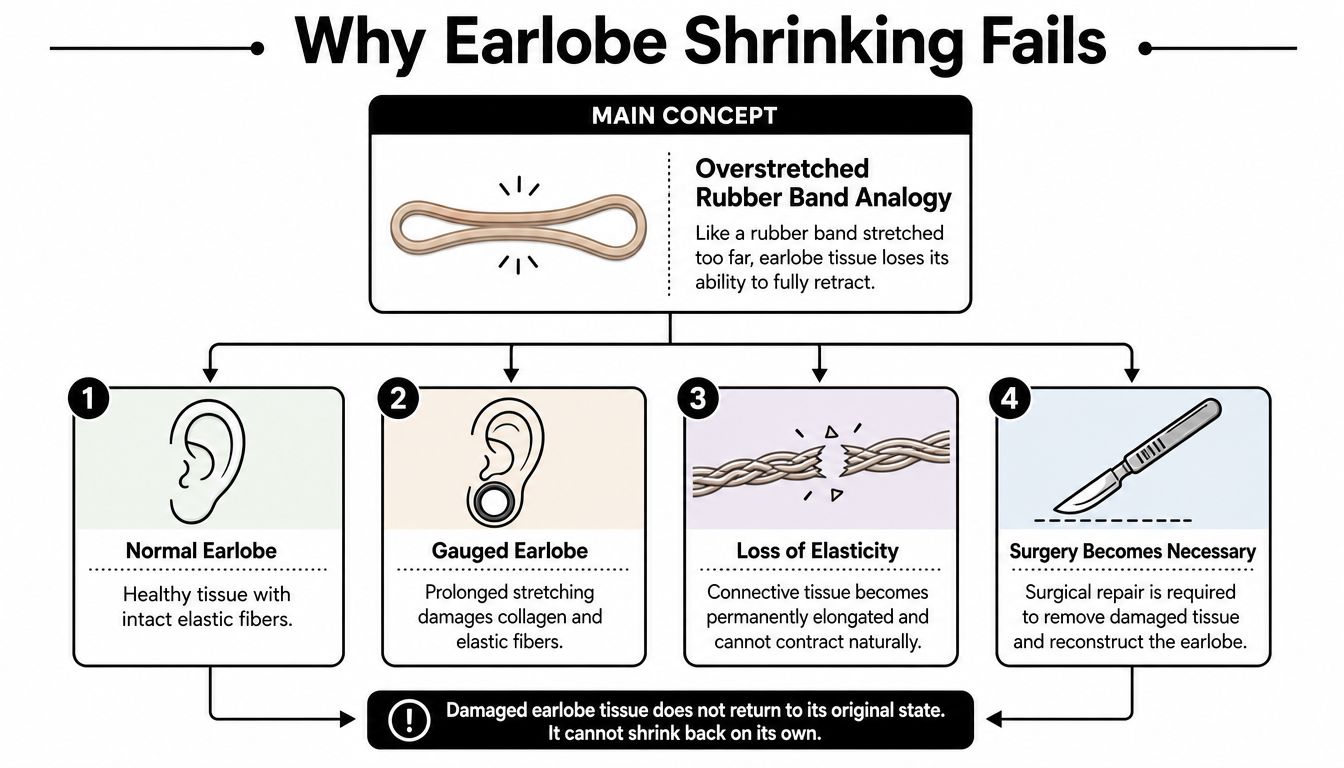
With progressive stretching, the hole doesn't remain a simple piercing. It becomes a lined tunnel of skin, called epithelial tissue. That lining matters. Once the body has created a stable skin-lined opening, the two sides of the hole don't naturally fuse back together.
The tissue also loses elasticity. Collagen and elastic fibers become permanently elongated. The result is a lobe that may hang, thin out, or keep a visible opening even after jewelry is removed.
Practical rule: If a hole has become a stable, skin-lined opening, your body usually won't close it on its own. A surgeon has to remove that lining before the lobe can be repaired.
There is a threshold beyond which spontaneous shrinking becomes unlikely. The point of no return is described as the range between 0g (about 8 mm) and 4g (about 5 mm) for the majority of individuals, after which permanent tissue damage requiring repair is expected, according to this discussion of ear shrinking thresholds on can you shrink your ears naturally.
That same source also notes that once patients reach or exceed that range, the lobe may be left with a permanent hole, and sizes larger than 00g (about 10 mm) typically won't shrink back to a standard piercing size without surgical repair.
Surgery works because it does what waiting cannot. It removes the epithelial lining, trims damaged tissue where needed, and brings healthy tissue edges together in a controlled way. That allows the lobe to heal as a closed structure rather than remain an open tunnel.
A patient often gets confused here and asks, “If my hole got a little smaller, doesn't that mean it will keep going?” Not necessarily. Smaller is not the same as closed. Many lobes tighten somewhat but stop at a small circular opening or a stretched slit.
That's the moment when gauged ear repair shifts from a cosmetic idea to a reconstructive solution.
Not every stretched earlobe is repaired the same way. The technique depends on the size of the defect, the quality of the remaining tissue, and whether the lobe still has a good natural shape or has become thin and droopy.
The key question isn't only, “Can we close the hole?” A better question is, “How do we close it while recreating a natural lower earlobe contour?”
A clinically important threshold is 15 mm. In a published discussion of stretched earlobe repair techniques, defects smaller than 15 mm in nonptotic lobules can be repaired with de-epithelialization and primary closure, while defects larger than 15 mm with ptotic lobules often require excision and rotation flap reconstruction to restore contour, as described in this review of gauged earlobe repair.
That sounds technical, so let's translate it into patient language.
| Technique | Best For | Procedure Overview | Resulting Scar |
|---|---|---|---|
| De-epithelialization and primary closure | Smaller defects with good tissue support | The inner lining of the hole is removed, and the healthy edges are closed together | Usually follows the repair line and is designed to blend into the earlobe contour |
| Excision with rotation flap reconstruction | Larger defects or sagging lobes | Damaged tissue is removed and nearby earlobe tissue is rotated to rebuild a rounded shape | More extensive than a simple closure, but planned to preserve contour and avoid deformity |
Primary closure is often easier for patients to picture. The surgeon converts the stretched tunnel into fresh edges, then closes those edges so the tissue can heal as a solid lobe. This works best when the tissue hasn't become too thin or droopy.
Rotation flap reconstruction is more architectural. The surgeon isn't merely closing a circle. The surgeon is shaping a new lobe from the remaining tissue. This is often the better choice when a straightforward closure would leave a visible notch or an unnaturally pointed bottom edge.
The best technique is the one that gives the earlobe a believable shape after healing, not the one that sounds simplest on paper.
People sometimes assume gauged ear repair is like mending fabric. It isn't. Earlobes are soft, curved, and visible from the front and side. If the surgeon focuses only on closing the hole, the final lobe can look tight, uneven, or indented.
That is why consultation matters so much. A thoughtful repair plan considers:
Smaller repairs can look beautifully subtle. Larger repairs can also look natural, but they usually require more deliberate contouring. The point isn't to use the most complex technique. It's to use the right one for your anatomy.
Most adults who are in good general health and want a more natural earlobe shape can consider repair. The consultation is where that broad possibility becomes a personal plan.
Early in the visit, the conversation is usually simple. What bothers you most? Is it the size of the opening, the way the lobe hangs, your inability to wear standard earrings, or the feeling that your ears no longer fit your style? Those details matter because the procedure should solve your specific problem, not a generic one.

A strong candidate usually has realistic expectations and understands that surgery can restore a more natural look, but not erase every trace of prior stretching. Healing quality also matters. If you smoke, scar heavily, or have had wound-healing problems before, bring that up directly.
During a consultation with Dr. Fater, the earlobes are examined for tissue thickness, contour, symmetry, and the condition of the skin. He'll also want to know whether you plan to re-pierce later, because that affects long-term planning. If you're new to cosmetic consultations in general, this overview of what to expect during your first plastic surgery consultation can help you arrive better prepared.
Patients often feel calmer once they realize the consultation isn't a test. It's a planning session.
A short video can also make the process feel more familiar before you walk in:
Come in ready to be honest. If your goal is “I want no one to notice I ever had gauges,” say that. If your goal is “I just want the holes closed and the lobes to look balanced,” say that too. Clarity helps your surgeon match technique to your expectations.
The day of surgery is usually far less dramatic than patients fear. Patients walk in feeling nervous, then quickly realize the process is controlled, focused, and straightforward. Earlobe repair is small-area surgery, but it requires careful hands and precise planning.
The first priority is comfort. The earlobe is numbed with local anesthesia, and once that takes effect, patients generally feel pressure or motion rather than pain. After that, the surgeon removes the stretched tract, shapes the tissue, and closes the lobe in a way designed to support both healing and contour.

One technique used in reconstruction is the S-curve tailor tacking approach. In a surgical demonstration discussing this method, the repair uses 5-0 or 6-0 Vicryl sutures internally for support, with attention to matching the natural curves of the lobe rather than creating a straight-line closure, as shown in this video on S-curve tailor tacking.
That same source notes that sutures typically remain in place for about 6 days, followed by M-Odol and Steri-Strips for 2 weeks, and re-piercing after 3 months to allow full healing.
Most patients leave relieved. The anticipation was worse than the procedure. The ears usually feel tight rather than severely painful. Mild swelling, tenderness, and awareness of the stitches are all normal parts of early healing.
A helpful mindset is to treat the earlobes as fresh surgical repairs, not as tough little flaps of skin that can handle anything. Sleep carefully. Avoid snagging clothing over the ears. Follow every wound-care instruction exactly. General incision guidance from how to care for surgical incisions can help patients understand why clean handling and consistent aftercare matter so much.
Healing usually goes smoothly when patients protect the repair from small daily accidents. The most common problems come from tugging, sleeping pressure, or trying to “check” the area too often.
Surgery day
You arrive, discuss the plan, get numbed, and have the repair performed. You go home the same day.
Early recovery
The area may look a little swollen or feel firm. That's expected. The lobe is settling into its new shape.
Suture removal phase
Depending on the exact method used, the external stitches are removed according to your surgeon's timeline. For the S-curve technique above, that is about 6 days.
Support phase
After suture removal, supportive dressings such as Steri-Strips may remain part of the plan to protect the contour and support scar maturation.
Longer healing
The scar continues to soften and mature over time. The lobe looks more “yours” as swelling resolves and the repair blends in.
Many patients study the ear too closely in the mirror during the first week. That's understandable, but early healing never reflects the final result well. Fresh repairs often look tight, slightly red, or more noticeable than they will later.
Try to judge progress by trends, not by hour-to-hour changes. Is the lobe staying closed? Does it look clean? Is tenderness gradually easing? Those are the signs that matter most.
Cost is one of the first questions patients want answered, and that's reasonable. Gauged ear repair is usually treated as a cosmetic or elective reconstructive procedure, so patients should be prepared for an out-of-pocket discussion during consultation.
The final fee depends on complexity, not just on whether a hole is present. A small repair with strong tissue is different from a larger, more sculptural reconstruction in a sagging lobe. The best way to think about cost is not as “price per stitch,” but as the combined value of surgical judgment, technique, follow-up care, and the quality of the final contour.

A consultation usually clarifies several variables:
If you're trying to understand how cosmetic procedure pricing is generally structured, this overview of cosmetic surgery cost is a useful starting point.
Every procedure carries some risk, even one that seems small. With earlobe repair, the practical concerns usually include infection, delayed healing, asymmetry, visible scarring, contour irregularity, and recurrence if the ear is stressed before it has healed fully.
None of those possibilities mean something is likely to go wrong. They mean you should choose a qualified surgeon, follow instructions carefully, and keep expectations realistic. A repaired earlobe can look natural and balanced, but it won't be untouched tissue. There will be a scar, even if it becomes subtle over time.
A good result doesn't mean “no scar at all.” It means the earlobe looks proportionate, healed, and natural enough that the scar doesn't dominate what you see.
The best outcomes are usually the ones that don't call attention to themselves. The hole is gone. The bottom border of the lobe looks rounded again. The ear no longer reads as stretched from across the room.
Some patients want re-piercing later. Others decide they like the clean, unpierced look. Either can be a good endpoint. What matters is that the repaired ear suits your face, your style, and your daily life.
During the procedure, the goal is numbness, not endurance. Patients usually feel the injection of local anesthetic first, then pressure or movement rather than sharp pain. Afterward, soreness is typically mild and feels more like tenderness or tightness than severe pain.
There will be a scar because this is a surgical repair. The aim is to place and shape that scar so it follows the earlobe contour and becomes less noticeable as healing progresses. Scar quality depends on both technique and your own healing pattern.
Often, yes, but only after full healing and only if your surgeon says the tissue is ready. In the surgical technique referenced earlier, re-piercing is permitted after 3 months. The new piercing is typically planned thoughtfully rather than placed directly through a fresh scar.
Yes, that is commonly done when both lobes need correction. Whether they should be repaired together depends on your anatomy, your goals, and your surgeon's recommendation.
That deserves an honest conversation before surgery. A repaired lobe contains scar tissue, and future stretching places different demands on that tissue. If you want information about tattoo and body-modification removal questions more broadly, EradiTatt general information is a useful non-surgical FAQ-style resource.
Call if the area becomes increasingly painful, looks more inflamed instead of less, develops drainage, or seems to be separating. Patients are sometimes afraid of being “overly cautious.” Don't be. Early questions are easier to manage than late problems.
If you're considering Cape Cod Plastic Surgery, scheduling a consultation is the best next step. Dr. Marc Fater can examine your earlobes, explain the repair options that fit your anatomy, and help you decide whether gauged ear repair is the right choice for you now.
October 7, 2026
A Practical Guide to Healing After Breast Surgery

October 6, 2026
Your Safety Guide: What to Look for When Choosing a Plastic Surgeon

October 5, 2026
Why Our On-Site Accredited Facility Matters for Your Safety

Cape Cod Plastic Surgery offers expert cosmetic and reconstructive procedures in a safe, accredited setting. Led by Dr. Marc Fater, we combine advanced techniques with personalized care to help you look and feel your best.
Monday: 9:00 AM – 5:00 PM
Tuesday: 9:00 AM – 5:00 PM
Wednesday: 9:00 AM – 5:00 PM
Thursday: 9:00 AM – 5:00 PM
Friday: 9:00 AM – 5:00 PM