

October 7, 2026
What to Expect During Your Breast Surgery Recovery
A Practical Guide to Healing After Breast Surgery
Aug 31, 2026
You're sitting in the emergency department with a towel pressed to your child's cheek, watching the bleeding slow and then start up again when they cry. A family dog snapped during play, and now you're trying to answer questions you never expected to hear, whether the wound needs stitches, whether the scar will last, and whether this is something that can still be fixed later.
Facial dog bites are frightening because they land at the intersection of urgent wound care and long-term appearance. The first repair and any later scar revision are separate decisions, and the right plan depends on timing, wound depth, tissue loss, and how the scar settles over months.
A parent walks into the ER holding gauze to a child's cheek, trying not to look panicked while the child cries, bleeds, and asks if the dog is going to be taken away. In that moment, the priority isn't the scar yet. It's stopping contamination, preserving tissue, and making sure the face gets assessed by someone who understands its anatomy.
Apply firm direct pressure with clean gauze or a clean cloth. If the wound is deep, edges gape, bleeding won't slow, or the bite involves the lip, eyelid, nose, or eye area, go to the emergency department instead of waiting for a routine appointment. If there's any doubt about the dog's vaccination status, that question belongs in urgent medical care, not a delayed office visit.
Don't pour peroxide, alcohol, or ointment into a fresh wound. If a small piece of tissue has been avulsed, wrap it in saline-soaked gauze and bring it with you. For a broader overview of what comes after the emergency visit, families often also need legal guidance, and a resource like dog bite attack compensation can help explain how medical documentation and visible facial injury may matter later.
The face bleeds a lot because it has a rich blood supply, but that same blood supply also helps healing. That's one reason facial wounds are often repaired early when the tissue can be approximated cleanly. The face also contains functional structures that are easy to miss in a rushed exam, including the facial nerve branches, parotid duct, lacrimal system, eyelid margin, and vermilion border.
Practical rule: a facial bite that looks “small” can still hide a deeper problem. If the wound crosses a natural border, or if the shape of the cheek, lip, or eyelid looks distorted, it deserves careful evaluation.
If you're managing the wound at home before the appointment, this guide to surgical incision care is a useful reference for the kind of gentle cleansing and observation that helps fresh repairs stay protected.
The standard approach starts with copious irrigation with normal saline, because dog bites carry bacteria and often drive debris deeper than the skin opening suggests. After that, the wound is explored for foreign material, devitalized tissue, and any sign that a deeper structure was injured.
A facial bite isn't just “stitches on skin.” The repair often needs layered closure so the muscle, dermis, and skin line up without tension, especially around the vermilion border, nostril rim, brow, or eyelid margin. Those landmarks matter because even a tiny mismatch becomes visible every time someone speaks or smiles.
Many facial bites also warrant prophylactic antibiotics, most commonly when the wound is contaminated, deep, or closed primarily. Tetanus status should be reviewed at the first visit, and rabies post-exposure decisions depend on the dog's vaccination status and local public health guidance. If the bite threatens the eye, eyelid, or oral lining, ophthalmology or oral surgery may need to join the first assessment.
A bite with major tissue loss or a heavily contaminated wound may need delayed closure or staged reconstruction, but that's the exception on the face, not the default. The classic reconstructive principle is simple, primary closure first when feasible, then grafts or flaps when tissue loss prevents a tension-free repair. A trauma-center review found that the earliest direct repair produced good outcomes with low complication rates, and the broader literature on facial dog bite repair keeps pointing to the same practical truth, the first closure often sets the stage for the final scar. Suture removal timing and aftercare also matter because early follow-up helps protect a precise facial repair.
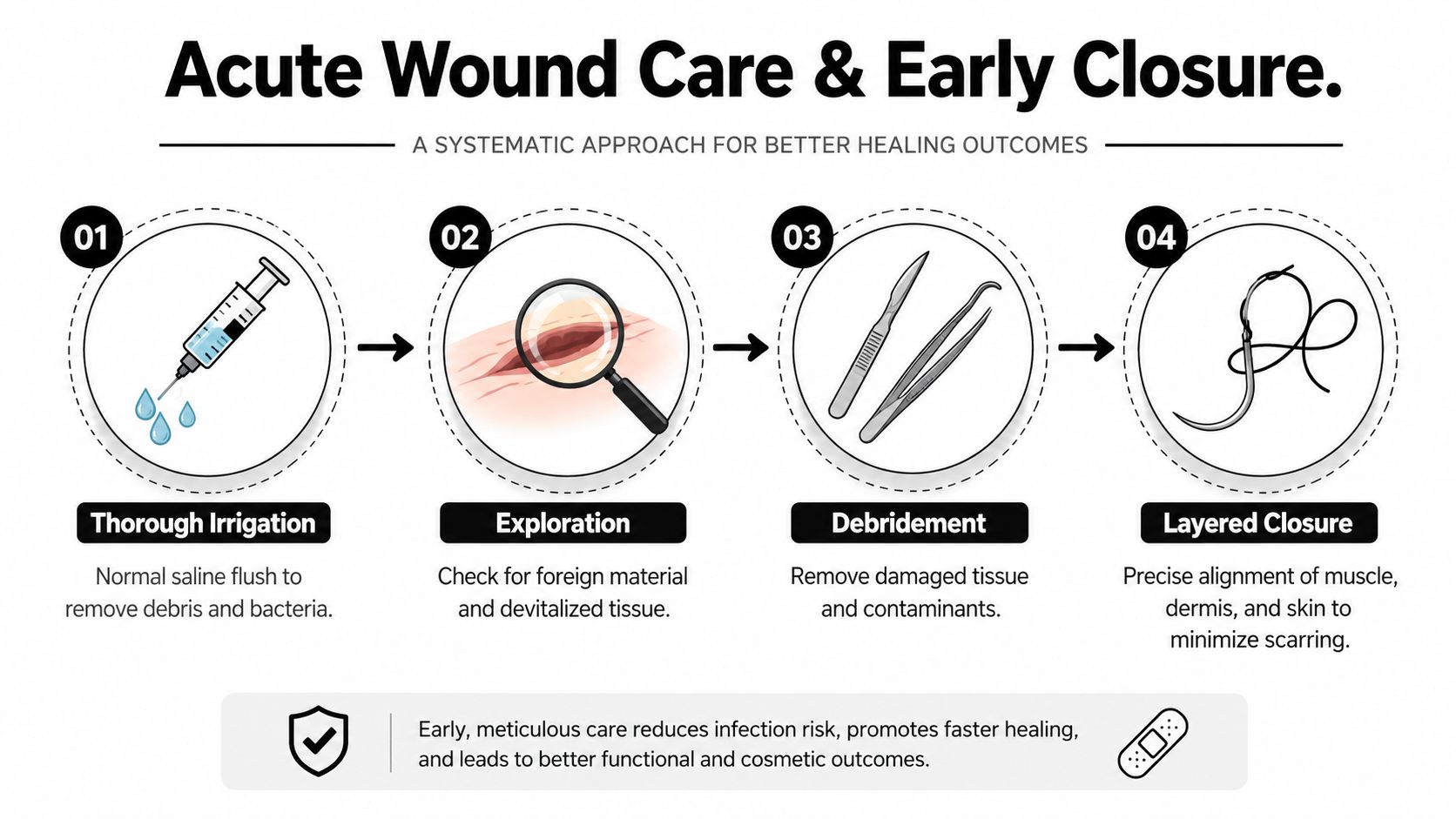
Early facial closure isn't about rushing. It's about cleaning the wound thoroughly, checking what's underneath, and aligning the anatomy before swelling and scar maturation make the job harder.
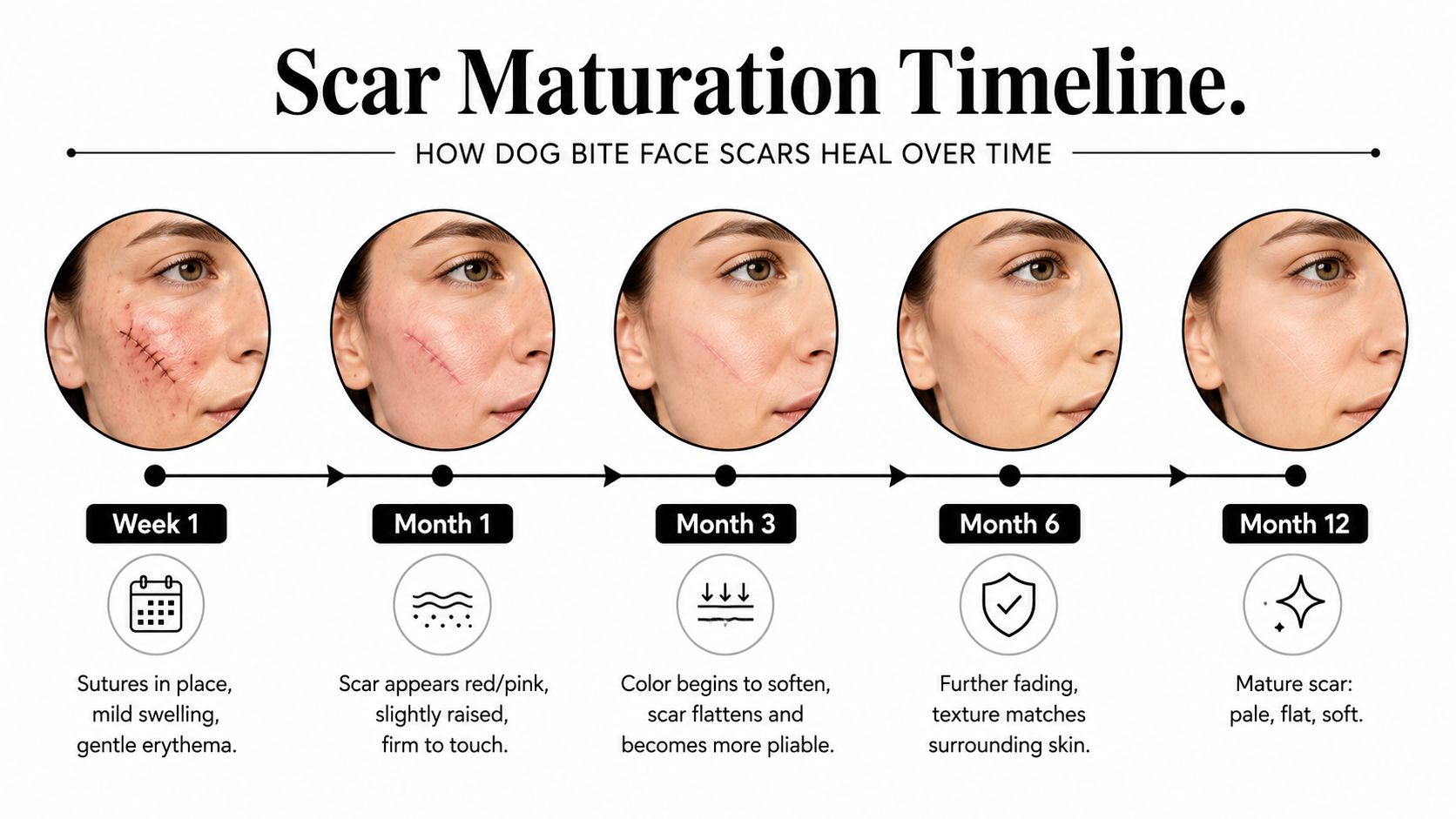
The first week often looks worse than the final result. Swelling, bruising, and redness are normal, and sutures are usually still in place while the skin edges begin to knit together. Gentle cleansing and the ointment regimen your surgeon recommends matter more than trying multiple over-the-counter products.
By the time stitches come out, often within the first week on the face, the scar may still look pink, firm, and a little raised. That doesn't mean the repair failed. It means collagen is being laid down and remodeled, and the skin is still in an active healing phase.
Around months 2 to 3, many facial scars look their worst. They can be red, slightly raised, itchy, or firm, and that is exactly when patients panic because the line seems more obvious than the original bite. In reality, this is often the midpoint of healing, not the endpoint.
By months 6 to 12, the scar usually softens, flattens, and fades in color. Most facial dog bite scars settle into a more stable appearance by about 9 to 12 months, even though subtle change can continue after that. A scar that looks dramatic at three months can still calm down substantially later, so early appearance is a poor predictor of the final result.
The day-to-day pattern is usually easy to recognize:
Short version: don't judge a facial bite scar too early. The skin is still remodeling long after the wound has closed.
The timing of that remodeling also explains why surgeons are cautious about making cosmetic judgments too soon. A scar that's still inflamed is not the same thing as a mature scar.
Once the wound is fully closed and stable, usually after the early healing phase has passed, nonsurgical scar care becomes the main toolset. These options don't erase a scar, but they can improve color, thickness, itch, and texture while the scar matures.
Silicone sheeting or silicone gel is a common first-line option for immature scars. It helps keep the scar hydrated and can reduce the tendency toward raised, thick healing. Sun protection matters just as much, because new facial scars can darken or stay visibly pink longer if they're exposed without adequate protection, so broad-spectrum sunscreen is part of real scar care, not a cosmetic extra.
Scar massage and desensitization can help when the scar feels tight or hypersensitive. That's especially useful around the cheek, lip, or jawline, where movement pulls on healing tissue every time you talk or eat. If the scar becomes firm or raised despite conservative care, intralesional triamcinolone or 5-fluorouracil injections may be used to calm hypertrophic behavior.
Laser treatment is most useful when the scar's problem is color or surface texture. Pulsed dye laser is often used for persistent redness, while fractional or ablative lasers may help with contour and roughness after the wound is fully stable. These devices can improve the look of a scar, but they don't make the scar disappear, and they work best when matched to the specific scar pattern rather than sold as a universal fix.
| Treatment | Mechanism | Best For | Typical Timing |
|---|---|---|---|
| Silicone sheeting or gel | Hydrates and supports scar maturation | Early raised or firm scars | After closure is stable |
| Sunscreen | Helps limit visible color change | New facial scars exposed to sun | Ongoing after healing |
| Scar massage | Softens tethering and reduces sensitivity | Tight, itchy scars | After the wound is fully closed |
| Steroid or 5-FU injections | Reduces hypertrophic thickening | Raised, firm scars | When a scar starts to overbuild |
| Laser treatment | Targets redness or texture | Persistent color or contour issues | After stable closure |
Cape Cod Plastic Surgery also offers scar revision surgery and publishes material on laser-based scar treatment, which are relevant options for facial scars that need procedural refinement rather than just ointment and patience.
The right surgery depends on what the scar is doing, not just where it sits. A thin linear scar that's slightly off a skin crease needs a very different operation from a through-and-through lip injury, a widened cheek scar, or a contracture that tugs on movement.
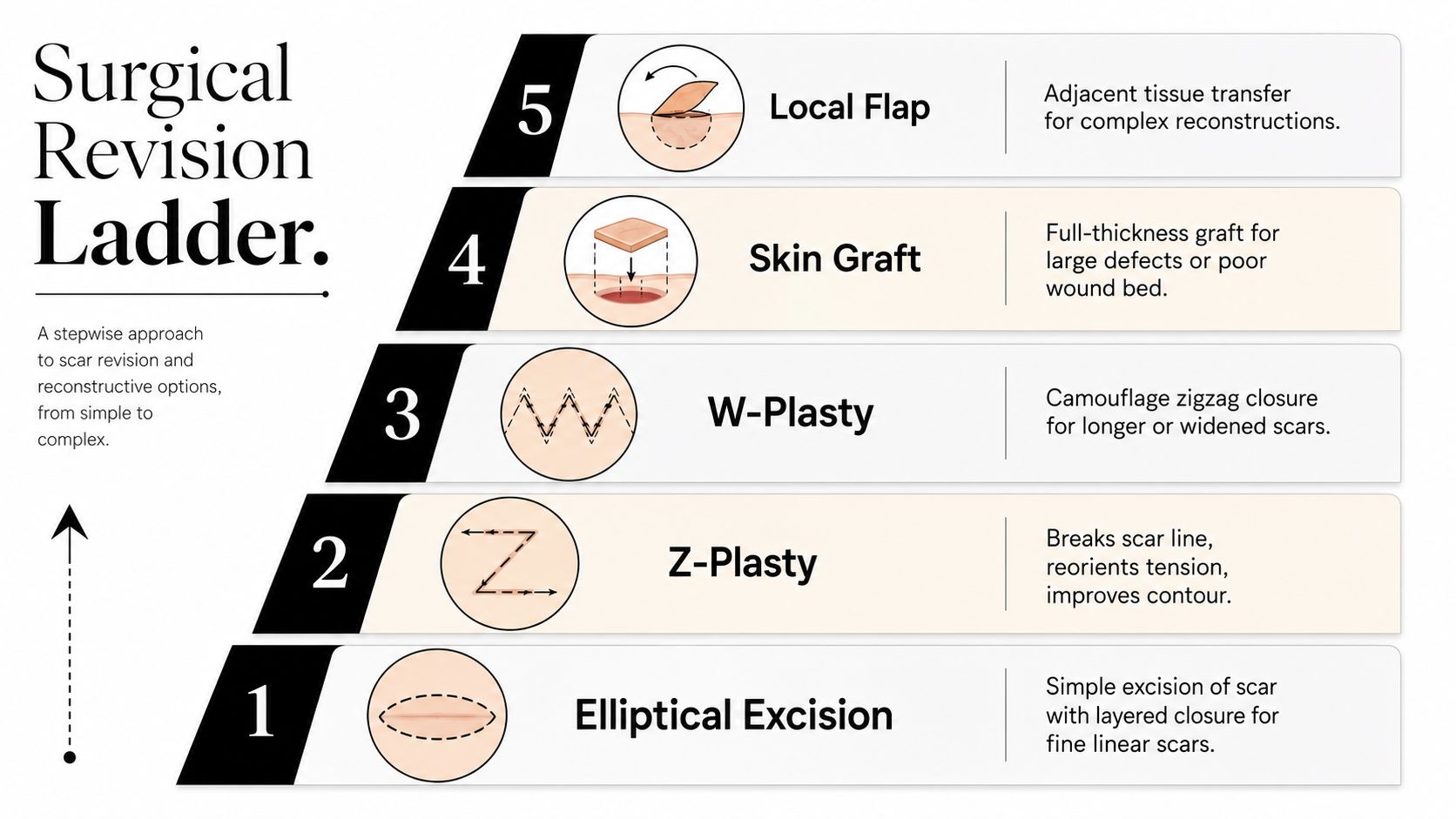
A simple elliptical excision works best when the scar is narrow and can be removed, then re-closed in a cleaner line. If the issue is distortion, Z-plasty can redirect tension and break up a scar line so it blends better with surrounding contours. W-plasty is useful for longer or irregular scars that benefit from camouflage rather than a single straight incision.
When there's missing tissue or contour loss, local flaps usually beat a skin graft because they bring in neighboring tissue with a better color and texture match. Advancement, rotation, bilobed, and nasolabial flaps all fit into that logic. Full-thickness skin grafts are usually a fallback when local tissue can't solve the defect cleanly.
The principle is simple, replace like with like whenever you can, and choose the least disruptive method that restores both shape and function.
The scar revision case literature on upper lip repair shows why detail matters. In one published example, the surgeon excised the scar, created a 2.1 cm × 1.5 cm V-shaped defect, and used advancement flaps in the mucosa and muscle to protect the vermilion border and keep the mouth corner from distorting. That kind of layered planning is the difference between a repair that merely closes and one that restores facial balance.
For people comparing procedural options in a practical way, scar revision surgery and confidence through care gives a broader sense of how revision is approached when scars stay visible after healing.
Not every facial dog bite ends the same way. A small puncture or superficial scrape may fade into a faint line, while a crush injury, avulsion, or through-and-through lip and cheek bite often leaves a visible mark even after excellent repair. The difference is partly the depth of injury and partly the amount of tissue that was lost at the start.
A secondary procedure is usually done after the wound has stabilized, especially if the scar is hypertrophic, malaligned, or prone to contracture. That may mean scar excision, re-closure, laser refinement, or a more structural operation if the first repair was only the beginning of staged reconstruction. It's also important to separate a planned revision from a true complication, because those are not the same thing.
The broader facial dog bite literature shows that later procedures are common enough that patients should be told about them early, not after the fact. A contemporary review found hypertrophic scarring was the most common complication after surgical management, at 4.3%, and revision operations were reported in 23 cases; the same review noted that secondary procedures ranged from 0% to 81% across the literature. Those numbers don't predict any one person's outcome, but they do show how wide the range is when counseling is vague or inconsistent.
A scar doesn't need to be invisible to be a success. For many families, success means the child can smile, eat, speak, and go back to ordinary life without a tightening band, an obvious step-off, or a sharp red line pulling attention every time they walk into a room. The best conversations focus on photographs, scar behavior, and objective landmarks, not impossible promises.
That's also why the revision timeline matters. Some scars are given 9 to 18 months to mature before anyone decides whether a second operation is worth it. If the scar is stable but still unacceptable, revision becomes part of the long-term plan rather than an admission that the first surgeon “failed.”
The first closure may happen in the ER, urgent care, or an operating room. The later revision is the point where you should be selective, because experience with facial subunits, scar behavior, and reconstructive technique really matters.
Start with board certification in plastic surgery, not just cosmetic surgery. Then ask how often the surgeon performs facial scar revisions, whether they have examples of dog bite cases similar to yours, and how comfortable they are with the specific area involved, such as the lip, cheek, nose, eyelid, or brow. A surgeon who can talk clearly about scar mapping, tension lines, and layered closure usually has a more grounded plan than someone who jumps straight to promises.
Look for a consultation that includes these basics:
Red flags are just as useful. Be cautious if someone guarantees an exact outcome, pressures you to combine procedures you didn't ask for, or can't explain how they'd handle the anatomy beneath the scar. Good revision care feels measured, not sales-driven.
For families trying to understand how visible injury fits into the broader recovery picture, the legal side can matter too. A practical overview like dog bite settlement factors in California can help you think about how treatment burden, scar visibility, and future care costs are often discussed in claims.
A good scar consultation should leave you with a plan, a timeline, and a clear sense of what improvement looks like. It should not leave you with pressure.
Cape Cod Plastic Surgery can evaluate facial scars, discuss revision options, and help map out the difference between early wound care and later refinement. If you're dealing with a facial dog bite scar and want a careful, in-person assessment, visit Cape Cod Plastic Surgery to schedule a consultation and talk through your options.
October 7, 2026
A Practical Guide to Healing After Breast Surgery

October 6, 2026
Your Safety Guide: What to Look for When Choosing a Plastic Surgeon

October 5, 2026
Why Our On-Site Accredited Facility Matters for Your Safety

Cape Cod Plastic Surgery offers expert cosmetic and reconstructive procedures in a safe, accredited setting. Led by Dr. Marc Fater, we combine advanced techniques with personalized care to help you look and feel your best.
Monday: 9:00 AM – 5:00 PM
Tuesday: 9:00 AM – 5:00 PM
Wednesday: 9:00 AM – 5:00 PM
Thursday: 9:00 AM – 5:00 PM
Friday: 9:00 AM – 5:00 PM