

October 7, 2026
What to Expect During Your Breast Surgery Recovery
A Practical Guide to Healing After Breast Surgery
Jun 2, 2026

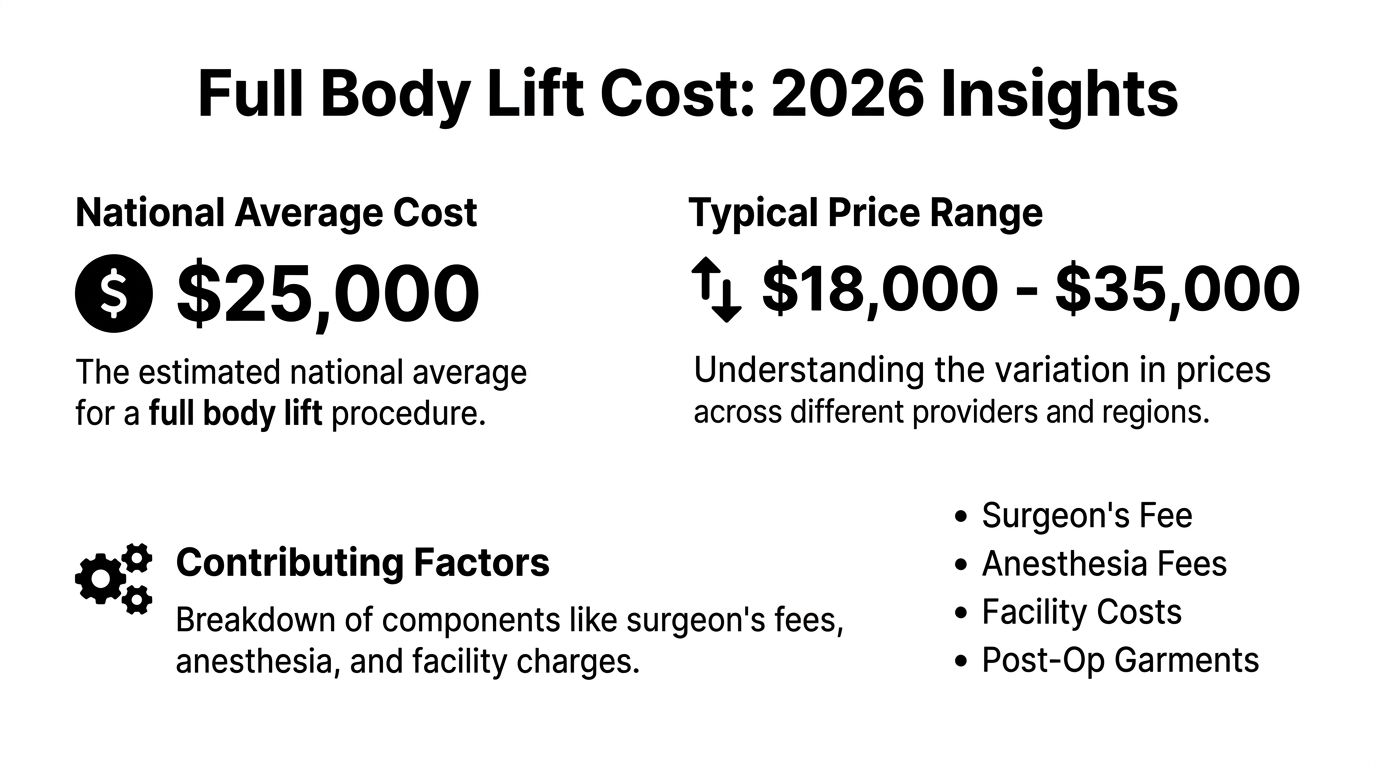
Most patients looking at a full body lift should expect an all-in price somewhere between $20,000 and $45,000 or more, depending on how extensive the surgery is and what the quote includes. A lower published average can be misleading because one common benchmark is only $11,397 for the surgeon's fee, while patient-reported pricing averages $22,484 and runs as high as $45,000 when anesthesia, facility, and related costs are included.
If you're reading this now, you're probably in the same place many body lift patients reach after major weight loss. You've done the hard part. The scale changed, your health improved, and your life may look very different. But loose skin across the abdomen, flanks, thighs, buttocks, or lower back can leave you feeling like the transformation isn't finished.
That's where cost becomes confusing fast. One website shows a number in the low five figures. Another shows something much higher. A consultation may sound affordable until the “all-in” quote arrives. The problem usually isn't dishonesty. It's that people are often comparing very different things under the same phrase, full body lift cost.
This guide breaks down what that price usually includes, why estimates vary so much, and what questions help you get a real number before you commit.
For many patients, body contouring starts as a practical decision, not a vanity project. Clothing still doesn't fit well. Exercise feels uncomfortable. The mirror shows progress, but also excess skin that won't respond to diet, strength training, or time.
A body lift often becomes the final stage of a long process. Patients who have gone through significant weight loss, whether through lifestyle change or surgery, are usually not looking for perfection. They want proportion, comfort, and a body shape that matches the effort they've already made. If you're still exploring the weight-loss side of that journey, this overview of Bariatric surgery options in Tupelo gives useful context on how some patients reach the point where contouring surgery becomes relevant.

Most consultations begin with a few familiar frustrations:
Those concerns are real. They also matter when pricing surgery, because the cost depends on how many areas need to be corrected and how much work is required to create a balanced result.
A body lift isn't just “skin removal.” It's a reshaping operation, and reshaping takes planning, operating time, and careful trade-offs.
The financial side can be jarring. A patient may come in expecting one procedure and learn that their goals require a combined plan. Another may have seen a surgeon-fee number online and assume that's the full price. It usually isn't.
What works is starting with honest expectations. If your concerns involve the abdomen, outer thighs, flanks, lower back, and buttocks, the all-in cost is usually substantial because the operation is substantial. What doesn't work is shopping by headline price alone. The lowest number often leaves out major line items, or it describes a smaller operation than the one you need.
A consultation for a “full body lift” often starts with a simple question: “What exactly is included?” The honest answer is that the name is broader than the operation. There is no single standard version. The plan depends on where the laxity sits, whether it wraps around the torso, and how much lifting versus contouring is needed to create a balanced result.
For many patients, the foundation is a lower body lift. That usually addresses the abdomen, flanks, lower back, and outer thigh region through a circumferential excision pattern. Depending on the anatomy, it may also improve buttock position, remove excess skin after major weight loss, and include liposuction in selected areas. A clear overview of the anatomy and goals is outlined in this explanation of what a lower body lift is.
That distinction matters because patients often compare quotes using the same label for very different operations.
One quote may cover skin removal around the waist only. Another may include abdominal muscle repair, liposuction of the flanks, reshaping of the mons area, lateral thigh lifting, drain management, and overnight recovery. Both may be called a body lift in casual conversation, but they are not the same surgery and should not cost the same.
During consultation, I look at four practical points that determine what belongs in the plan:
How far the excess skin extends
Some patients have laxity limited to the front abdomen. Others have tissue redundancy that continues around the hips and lower back, which changes incision length, operating time, and recovery.
Whether the thighs and buttocks need structural improvement
If the outer thighs need elevation or the buttocks need repositioning, the operation becomes more complex than skin excision alone.
Whether contouring is needed in addition to lifting
Liposuction can improve shape, but it also adds time, cost, and limits based on blood supply and safety.
Whether one operation is appropriate
Combining procedures can be efficient. It is not always the safest choice. In some patients, staging produces a better result with a lower overall risk profile.
This is why quotes vary so widely. The biggest mistake is focusing on the surgeon's fee before confirming what the operation includes. Ask for the anatomy being treated, the planned add-on procedures, and whether the quote reflects one operative session or a staged approach.
A useful rule is simple. Compare the plan, not the label.
If you want a true all-in understanding of cost later in the process, make sure your estimate identifies which areas are being lifted, whether liposuction or muscle repair is included, and what is excluded from the quoted number. That is how you avoid comparing a limited waistline procedure to a much broader body-contouring operation.
The biggest source of confusion around full body lift cost is that patients often see one “average” and assume it reflects the total they'll pay. It often doesn't.
A major benchmark from the American Society of Plastic Surgeons lists the average for lower body lift surgery at $11,397, but that figure reflects the surgeon's fee only, not the whole bill, as noted on the ASPS page covering body lift cost. The same source makes clear that anesthesia, operating-room, and other related expenses are separate.
That's why patient-reported platforms often look much higher. The same ASPS source cites RealSelf's patient-review-based average at $22,484, with reported prices ranging from $11,689 to $45,000. Those numbers are much closer to what patients usually mean when they ask, “What does a body lift cost me?”
Here's a visual summary of the pricing variations.
This distinction matters more for body lift surgery than for many smaller procedures.
A low number isn't necessarily wrong. It may merely be incomplete.
They're often measuring different things.
One source may report the physician's portion only. Another may reflect actual patient payments. A third may show a “starting at” number for a limited body lift rather than a broad circumferential plan. This is why a patient can see an average around the low five figures and still receive a quote that lands much higher.
Here's a short explanation from the patient perspective.
If you only remember one thing, remember this: a headline average is not the same as your real financial commitment.
When a quote comes in at the low end, ask whether it includes general anesthesia, operating-room charges, post-op garments, and follow-up care. If it doesn't, you're not looking at the full body lift cost. You're looking at one slice of it.
The cheapest quote on paper can become the more expensive choice once every excluded item gets added back in.
A strong quote should read like a line-item financial plan, not a vague promise. If you can't tell what is and isn't included, you can't compare surgeons fairly.
Most body lift quotes include some version of these components:
| Cost Component | Description | Typical % of Total Cost |
|---|---|---|
| Surgeon's fee | The surgeon's professional fee for planning and performing the operation | Varies |
| Anesthesia fee | Payment for the anesthesia professional and the anesthesia service itself | Varies |
| Facility fee | Use of the operating room, equipment, nursing staff, and recovery area | Varies |
| Pre-op testing | Medical clearance, labs, or other required evaluations before surgery | Varies |
| Post-op garments | Compression garments and similar recovery supplies | Varies |
| Medications | Prescriptions used during the recovery period | Varies |
| Follow-up visits | Postoperative assessments and wound checks, if not already bundled | Varies |
No fixed percentage belongs to every practice, because quote structures differ. Some surgeons bundle almost everything. Others separate each line item.
Bring a checklist to your consultation. Ask:
Is this quote surgeon fee only, or total price
This is the first question. If the answer is “surgeon fee only,” you need the rest of the numbers.
Who provides anesthesia and how is that billed
Some practices bundle it. Some bill by time. For a long contouring case, that matters.
Where is surgery performed
Hospital pricing can differ from office-based accredited surgery centers or private suites.
Are garments, medications, and follow-up visits included
These are easy to overlook and frustrating to discover later.
What triggers added cost
Extra operative time, overnight care, or staged revisions may change the final bill.
Patients do best when they compare estimates side by side and insist on the same categories from each office. Ask every practice for the same format.
Ask for an “all included except” list. That wording forces clarity faster than asking what's included.
What doesn't work is comparing a bundled quote from one surgeon to a surgeon-fee-only number from another. That's not a real comparison. It's the most common reason patients think pricing is “all over the place” when the underlying issue is that the estimates are built differently.
Two patients can both ask for a “full body lift” and receive quotes that are nowhere near each other. That usually reflects real differences in the surgical plan, the setting, and the amount of aftercare built into the price. It does not always mean one office is expensive and another is reasonable.
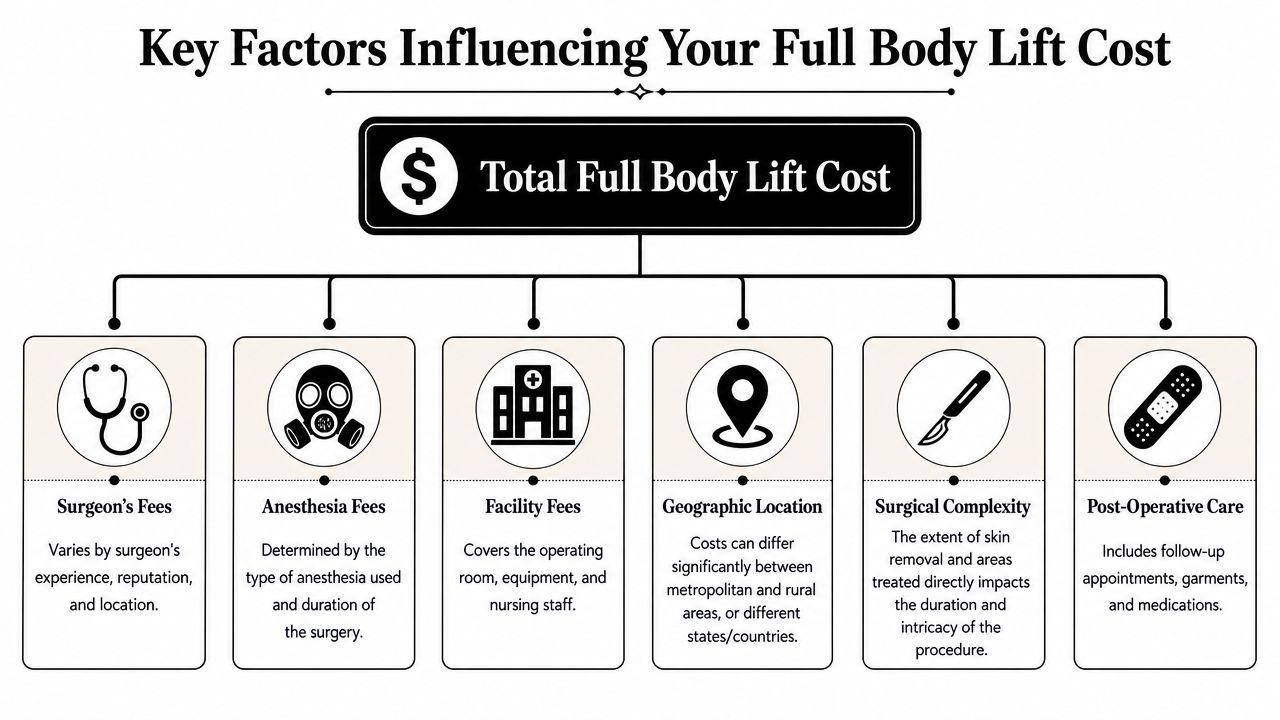
Geography sets the baseline, but it is only the starting point. RealSelf's body lift cost data shows meaningful variation by state and metro area, which matches what surgeons see every day. Practices in higher-cost urban markets usually face higher staffing, facility, and overhead costs, and those expenses show up in the final quote.
The bigger driver is the operation itself.
A longer case costs more because several parts of the bill rise at the same time. Facility time increases. Anesthesia time increases. In some patients, safety planning also changes. A surgeon may recommend staging the procedure instead of combining everything in one session if the contouring goals are broad, the tissue quality is poor, or the medical history raises concern about wound healing and recovery. Staging can improve safety, but it can also raise the total cost because you are paying for two operative days instead of one.
Surgeon experience also affects price. Body lift surgery is technically demanding, especially after major weight loss. These cases involve long incisions, tension management, drain planning, scar placement, and a recovery period that needs close follow-up. A board-certified plastic surgeon who performs body contouring regularly may charge more, but patients are paying for judgment as much as operating skill.
Facility choice matters for the same reason. An accredited office-based suite, ambulatory surgery center, and hospital do not bill the same way or provide the same level of support. Cape Cod Plastic Surgery notes that it operates with an AAAASF-accredited surgical suite. That is not a pricing claim. It is a useful detail to ask about when comparing where your surgery will take place, who monitors you during recovery, and whether an overnight stay could add cost.
Here are the cost variables that change quotes most often:
Number of areas treated
A lower body lift alone is different from adding upper body contouring, arm lift, breast reshaping, or liposuction.
Extent of tissue removal and contouring
More skin laxity, more scar revision, and more reshaping usually mean more operative time.
Medical history and safety planning
Prior abdominal surgery, smoking history, diabetes, clotting risk, or a high BMI can change the plan and the setting.
Recovery support
Compression garments, drains, overnight monitoring, lymphatic massage recommendations, and extra visits are not handled the same way by every practice.
Revision risk and staging strategy
A lower up-front quote may not reflect the likelihood that a second stage or later touch-up will be needed.
Patients who want a clearer picture of the financial side should ask for cosmetic surgery financing options and payment planning details before choosing a date. The same consumer logic shows up in other high-ticket purchases too. Reviewing examples like concierge-style mattress financing options can help patients understand how installment decisions are framed around large discretionary expenses.
The practical question is simple. What are you buying for the number on the page?
A low quote may exclude overnight care, garments, prescriptions, or revision planning. A higher quote may include more than the surgeon's fee and may reflect a safer setting for a long operation. That is why I advise patients to compare the full treatment plan, not just the headline number.
Most patients should assume a body lift is self-pay. In the vast majority of cases, the contouring portion is treated as cosmetic, not medically covered. That can feel discouraging, but it also means you should focus early on how you want to structure payment rather than waiting for insurance to rescue the plan.
Several options are common:
Medical financing programs
Many plastic surgery practices work with healthcare lenders. These are built specifically for elective care and can be more familiar with surgical billing timelines.
Personal loans from a bank or credit union
Some patients prefer a conventional loan because the terms may feel easier to track alongside other household finances.
Practice payment plans
Some offices allow phased prepayment before surgery, which can reduce stress if you're planning ahead.
If you're trying to understand how providers structure elective financing in a consumer-friendly way, even outside medicine, this guide to concierge-style mattress financing options is a surprisingly useful example of how installment decisions get framed around large discretionary purchases.
Don't just ask, “Can I finance it?” Ask better questions.
What amount am I financing
Make sure it's the all-in amount, not only the deposit or surgeon fee.
What happens if the surgical plan changes
If staging or added time becomes necessary, ask how billing is handled.
Are there penalties or deferred-interest structures
You need to know what happens if the balance isn't paid within the initial term.
For patients reviewing the mechanics of elective surgery payment, this article on how to finance cosmetic surgery covers the financing conversation in a practical way.
Financing should make the surgery manageable. It shouldn't make the decision careless.
The worst strategy is stretching into a surgery you can't comfortably support while also underestimating recovery costs. Time away from work, home help, travel, and recovery supplies can affect the total burden even when they aren't part of the official quote. A safe financial plan leaves room for those realities.
Two patients can receive quotes that are far apart, even when both are asking about a full body lift. Sometimes the difference reflects surgeon experience, facility standards, and a more realistic operative plan. Sometimes it reflects a quote that leaves out major pieces of the bill.
A lower number is only useful if it represents the true total.
Look for a surgeon who is board-certified by the American Board of Plastic Surgery, operates in an accredited facility, and regularly performs post-weight-loss body contouring. Full body lift surgery places real demands on judgment. The surgeon has to decide what can be done safely in one stage, what should be delayed, and when a lower-risk plan is better than a more aggressive one.
Ask direct questions. How often do you perform this type of surgery? Who provides anesthesia? Where will the procedure take place? Ask to see before-and-after photos of patients with a body shape, skin quality, and weight-loss history similar to yours.

A strong consultation does more than present a price. It explains what is included, what is optional, what may change in the operating room, and what would trigger added cost later. That level of detail matters because body lift quotes vary widely, and the surgeon's fee is only one part of the financial picture.
Patients should leave the visit understanding the scar pattern, expected recovery, likely need for drains or compression garments, and the limits of combining procedures safely. They should also know whether the quote includes anesthesia, facility fees, pathology if needed, garments, medications, follow-up care, and the surgeon's policy on revisions. Those details are where "all-in" pricing and partial pricing separate.
For a practical overview of how to evaluate training, judgment, and consultation quality, review this guide on finding a plastic surgeon.
The best value is rarely the lowest quote. It is the plan that matches your anatomy, your goals, and your safety profile, with a clear explanation of what you are paying for and why.
If you're considering body contouring after weight loss and want a detailed, realistic consultation, Cape Cod Plastic Surgery offers evaluations focused on surgical planning, safety, and transparent cost discussions so you can understand exactly what your quote includes before making a decision.
October 7, 2026
A Practical Guide to Healing After Breast Surgery

October 6, 2026
Your Safety Guide: What to Look for When Choosing a Plastic Surgeon

October 5, 2026
Why Our On-Site Accredited Facility Matters for Your Safety

Cape Cod Plastic Surgery offers expert cosmetic and reconstructive procedures in a safe, accredited setting. Led by Dr. Marc Fater, we combine advanced techniques with personalized care to help you look and feel your best.
Monday: 9:00 AM – 5:00 PM
Tuesday: 9:00 AM – 5:00 PM
Wednesday: 9:00 AM – 5:00 PM
Thursday: 9:00 AM – 5:00 PM
Friday: 9:00 AM – 5:00 PM