

October 7, 2026
What to Expect During Your Breast Surgery Recovery
A Practical Guide to Healing After Breast Surgery
Jan 18, 2026
Let's be direct: any surgery comes with risks. But when it comes to rhinoplasty, modern techniques and standards have made it an overwhelmingly safe procedure. It's less of a roll of the dice and more like a carefully navigated flight—the route is well-known, the pilot is an expert, and safety checks are everywhere.
When patients ask me if rhinoplasty is dangerous, what they're truly asking is, "What are the real-world chances of something going wrong?" It's the most important question you can ask, and thankfully, the answer is very reassuring. The first step is to distinguish between the normal, expected parts of healing (like swelling and bruising) and an actual, serious complication.
Sure, every surgery has an element of unpredictability. But nose surgery has been refined over many decades. It's one of the most studied and understood cosmetic procedures out there. The potential risks are well-documented, manageable, and—most importantly—very rare when you're in the right hands.
Vague fears tend to disappear when you look at hard numbers. The statistics from major studies paint a very clear picture of just how safe rhinoplasty is.
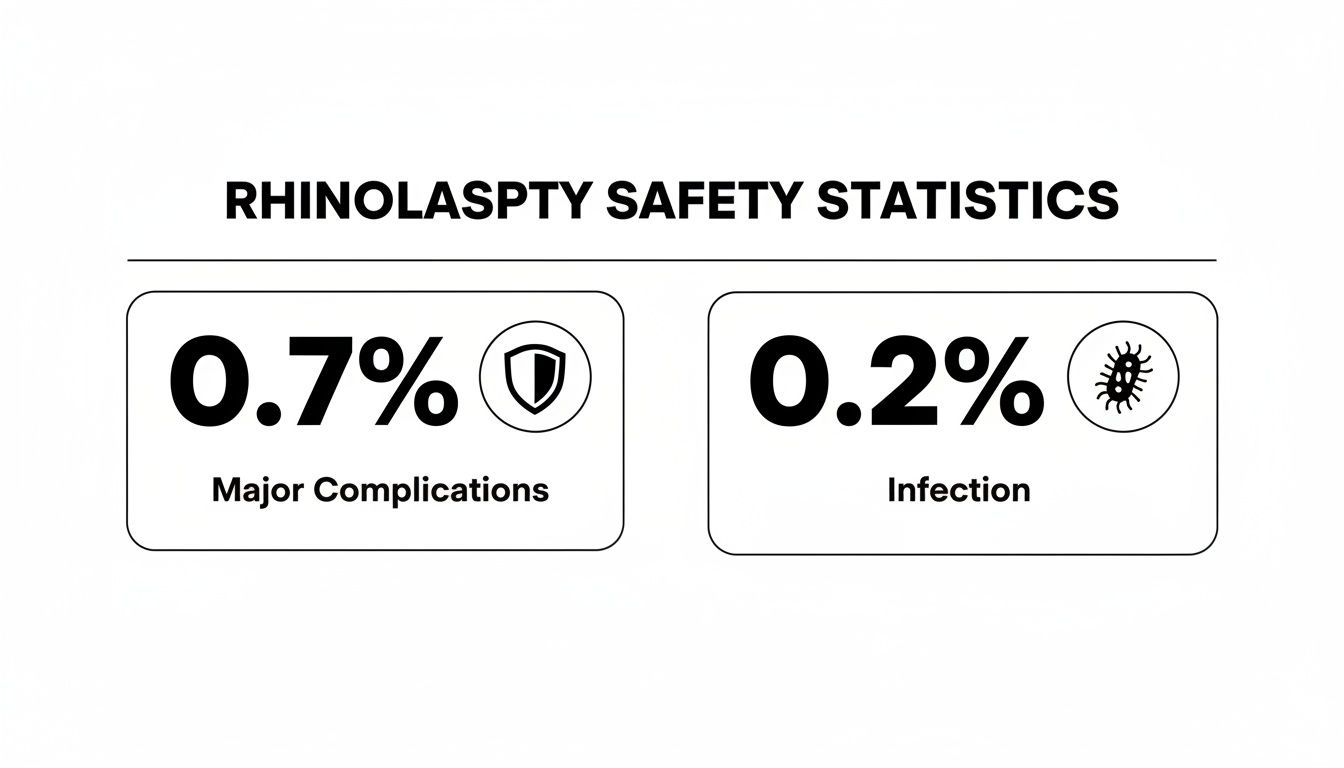
One of the most telling studies comes from the Aesthetic Surgery Journal. After analyzing nearly 5,000 rhinoplasty cases, researchers found the overall rate of major complications was a mere 0.7%.
To put that into perspective, that means fewer than 1 in 100 patients run into a significant problem. Issues requiring urgent medical attention, like a serious infection or a hematoma (a collection of blood under the skin), each occurred at a rate of just 0.2%. You can learn more about these rhinoplasty safety findings directly from the research.
This data shows us that what feels like a big, scary decision is actually a very routine and safe surgery for a skilled, experienced surgeon.
These numbers aren't just abstract figures; they represent thousands of successful, uneventful procedures.
To make this even clearer, here’s a quick summary of the common risks and just how likely they are to occur based on large-scale studies.
As you can see, the odds of a dangerous medical event are incredibly small. The primary "risk" is not being fully satisfied with the final look, which is why choosing the right surgeon is so critical.
Ultimately, a safe and successful nose surgery rests on three core pillars. Get these right, and you've managed the vast majority of the risk.
When these three elements align, rhinoplasty shifts from being a "gamble" to a well-controlled medical procedure. The danger isn't baked into the surgery itself; it comes from cutting corners on any of these three pillars. By taking control of these factors, you can approach your surgery with confidence, not fear.
So, is getting a nose job dangerous? To answer that honestly, we have to draw a clear line between the normal, temporary side effects of surgery and true, unexpected complications.
Think of it this way: a planned road closure for construction is an expected inconvenience. An actual multi-car pile-up on the highway is a rare, serious event. A successful rhinoplasty is all about knowing the road closures are coming and navigating them safely, not worrying about the pile-up.
Every single patient will have some swelling, bruising, and numbness. These aren't red flags; they're simply signs that your body is doing exactly what it's supposed to do: healing. Your nose and the area around your eyes will be puffy for a bit, and those "black eyes" are pretty much a given for the first week or two. It’s all just part of the journey.
The first couple of weeks are really more about discomfort than outright pain. Most people tell me it feels like a bad head cold—stuffy, congested, and a bit of pressure. It’s annoying, but it’s definitely manageable and completely normal.
Here’s a realistic look at what to expect for the first week or two:
These things aren't "risks" in the scary sense. They are predictable, temporary, and proof that your body is hard at work healing itself.
Alright, let's talk about the less common issues—the things that pop into your head when you ask, "is rhinoplasty dangerous?" It's important to know that these are exceedingly rare, especially when you're in the hands of a board-certified plastic surgeon working in a fully accredited facility.
These complications are the exception, not the rule. Modern surgical techniques and the safety protocols we follow are designed from the ground up to prevent them.
The point here isn't to scare you, but to give you the full picture. Knowing about these rare possibilities helps you ask the right questions and have a meaningful conversation with your surgeon about how they actively work to prevent them.
Here’s a breakdown of potential complications and just how unlikely they are:
1. Infection
Any time you have surgery, there's a risk of infection. But with the sterile environment of an operating room and preventative antibiotics, the rate of a serious infection after a nose job is incredibly low—around 0.2%. You’d watch for signs like increasing redness, warmth, pain, or a fever.
2. Hematoma
This is just a collection of blood that pools under the skin and might need to be drained. A significant hematoma that requires a doctor to step in is also very rare, happening in only about 0.2% of cases.
3. Breathing Difficulties
While that stuffy feeling is normal at first, a small number of patients (1-3%) might find they still have trouble breathing through their nose after all the initial swelling is gone. Frankly, a top surgeon's goal is always to improve or at least maintain nasal function, which is why this is such an uncommon outcome.
4. Poor Scarring
If you have an "open" rhinoplasty, there’s a tiny incision on the strip of skin between your nostrils (the columella). For most people, this scar fades until it’s virtually invisible. Unattractive scarring is rare and usually has more to do with an individual's unique healing process.
5. Dissatisfaction with the Look
This is probably the most "common" negative outcome, but it isn't a medical danger. The rate of needing a revision surgery is quite low when your first procedure is done by a specialist. The best way to avoid this is to choose a surgeon whose aesthetic sense matches yours and to go in with clear, realistic goals.
Knowing the difference between these categories is everything. The temporary side effects are a guaranteed part of the process. The serious complications are statistical long shots. By choosing a qualified professional, you put the odds squarely in your favor for a safe procedure and a smooth, predictable recovery.
When people ask, "is rhinoplasty dangerous?" there's no simple yes or no answer. The real answer is: it depends. The safety of your surgery hinges on a combination of factors, much like building a house requires a solid foundation, quality materials, and a skilled builder. The two most important pieces of this puzzle are your personal health and the expertise of your surgeon.
Think of your body as the foundation for the procedure. The healthier you are going in, the better you’ll handle the surgery and the more smoothly you'll heal. Your surgeon, then, is the architect and master craftsman whose skill and judgment directly determine not only the final look but also the structural integrity and safety of the entire process.
You’re not just a passenger on this journey; you are an active partner in your own safety. Your health before you ever set foot in the operating room plays a massive role in how things go. Certain health conditions or even daily habits can create unnecessary hurdles, which is why a completely honest conversation about your medical history is so critical.
Here are the main things on your side of the equation that can affect safety:
A safe procedure starts weeks, or even months, before the day of surgery. Your commitment to following pre-op instructions—like quitting smoking and pausing certain medications—is the most powerful thing you can do to ensure a smooth, predictable outcome.
By taking care of these things ahead of time, you aren't just crossing your fingers for a safe surgery. You are actively creating the best possible conditions for one.
The person holding the instruments is arguably the most critical safety variable of them all. The gap between an okay result and a fantastic one—and between a low-risk surgery and a high-risk one—often comes down to the surgeon’s training, hands-on experience, and meticulous technique.
A surgeon's expertise isn't just one-dimensional. It’s not about just knowing the textbook steps; it's about having a deep, intuitive understanding of nasal anatomy and an artist's eye to see potential challenges and adapt on the fly. This is never more true than in complex cases.
Choosing the right surgeon is the single most important decision you'll make to minimize any danger. We cover this in-depth in our guide on how to choose a surgeon, which breaks down exactly what to look for.
Finally, where your surgery happens matters just as much as who is doing it. Having your procedure in a fully accredited surgical suite provides a layer of safety that a simple in-office procedure room just can't offer. Accreditation from an organization like the American Association for Accreditation of Ambulatory Surgery Facilities (AAAASF) is your proof of the highest standards.
This seal of approval means the facility has met rigorous requirements for:
At the end of the day, safety is a shared responsibility. When a healthy, well-prepared patient teams up with a highly qualified, board-certified plastic surgeon in an accredited facility, the risks of rhinoplasty become exceptionally low.
A successful surgery is just the first step. The real work—and the key to a great outcome—happens during your recovery. Think of it this way: the surgery sets the stage, but how you manage the healing process determines the final performance.
The good news is that for most people, rhinoplasty recovery is more about dealing with stuffiness and discomfort than actual pain. It often feels like a really bad head cold. Your body is doing exactly what it's supposed to do, and knowing what's normal will help you relax and, more importantly, spot anything that seems off.
The first week is definitely the most intense phase. You'll see swelling and bruising, which is totally normal and usually hits its peak around day two or three before starting to improve. This is just your body's natural inflammatory response kicking in to start the healing process.
While you might look a bit rough, the feeling is usually more of a dull pressure and annoying congestion. For a few days, you'll have to be a "mouth breather," which is a temporary nuisance but a necessary part of the journey.
To make sure everything heals smoothly, there are a few golden rules for those first couple of weeks:
For a more in-depth look at the entire process, our rhinoplasty recovery week-by-week guide breaks down every stage of healing.
While major problems are uncommon, being an active participant in your recovery is your best safety net. It’s all about knowing the difference between "this is normal healing" and "this feels wrong." Although every surgery is different, understanding general post-surgical complications offers a great overview of what to look out for after any procedure.
Ultimately, you know your body best. If you have a gut feeling that something isn’t right, it’s always better to make the call than to sit at home worrying.
Key Takeaway: Normal healing involves swelling, bruising, and congestion that gradually get better. A potential problem often involves symptoms that get progressively worse, like escalating pain, spreading redness, or a fever.
Some signs are non-negotiable and require a prompt call to your surgeon. This doesn't automatically mean something is dangerously wrong with your rhinoplasty, but it does mean a professional needs to assess the situation to make sure a small issue doesn’t become a big one.
Get in touch with your surgeon's office right away if you notice any of these:
By knowing what to look for, you shift from being a passive patient to an empowered partner in your own healthcare. Understanding the road ahead—and knowing which detours require a call for directions—is the best way to ensure your journey to a new nose is a safe and successful one.
So, we've talked about the potential risks. Now for the empowering part: you have a tremendous amount of control over them. Asking "is rhinoplasty dangerous?" isn't really about the procedure in a vacuum. It's about the choices you make and the variables you can manage.
And the single most important decision you'll make? Choosing your surgeon.
This choice is the very foundation of your safety. It determines the skill of the hands performing your surgery, the quality of care you'll receive, and the environment where it all happens. By being proactive here, you can shift the odds dramatically in your favor. Your safety isn't a game of chance; it's the direct result of doing your homework.
Let's walk through the concrete steps you can take to ensure you're in the safest possible hands.
The most powerful way to slash your risk is to choose a board-certified plastic surgeon who has deep experience in rhinoplasty. I can't stress this enough—it's the absolute bedrock of a safe procedure. But what does "board-certified" actually mean, and why does it matter so much?
Think of it this way: board certification is a surgeon's Ph.D. in safety and skill. It proves that a surgeon has:
This isn’t some weekend course. It’s a years-long, intensive process. A board-certified plastic surgeon possesses an intimate understanding of facial anatomy, aesthetic balance, and the technical finesse to perform a complex surgery while putting your safety first. This level of expertise directly correlates to lower complication rates. It's as simple as that.
Once you've confirmed a surgeon is board-certified, the real research begins. This is your chance to look for proof of their skill and to find someone whose approach feels right for you.
1. Really Scrutinize Their Before-and-After Photos
A surgeon's photo gallery is their portfolio. Don't just give it a quick glance—study it. Look for patients who had a nose similar to yours to begin with and analyze the "after" shots. Do the results look natural? Do they harmonize with the rest of the patient's face? A truly great surgeon doesn't have one "signature nose"; they tailor every result to the individual.
2. Read Between the Lines of Patient Reviews
Look for reviews that tell a story, not just "I love my nose!" The most insightful ones will talk about the whole journey: the vibe during the consultation, the professionalism of the staff, the quality of post-op care, and how the surgeon addressed their fears and questions. When you see the same positive themes repeated across many reviews, you get a real sense of the practice's culture.
3. Verify the Credentials and the Facility
You can confirm a surgeon’s status with official groups like the American Board of Plastic Surgery. But don't stop there. Where the surgery happens is just as important. Your procedure must take place in an accredited surgical facility, like one certified by the AAAASF (American Association for Accreditation of Ambulatory Surgery Facilities). This accreditation is your guarantee that the operating room meets hospital-level standards for safety, equipment, and staff training.
Your surgeon may be the captain of the ship, but you're the most important crew member. Your honesty and diligence are absolutely essential for a safe and successful outcome.
Being completely transparent about your medical history allows your surgeon to plan for any potential risks specific to you. This means disclosing everything—pre-existing conditions, allergies, and every single medication or supplement you take, no matter how minor it seems. Following all pre-op and post-op instructions to the letter isn’t just a good idea; it's your primary responsibility for ensuring you heal correctly and avoid complications.
When you choose an expert surgeon and commit to being a cooperative patient, you forge a powerful partnership. The goal is singular: a beautiful, functional result achieved in the safest way possible.
Getting it right the first time is, by far, the best way to avoid future risks. A massive systematic review of over 11,000 rhinoplasty cases found the reoperation rate for primary open rhinoplasty was just 2.73%. This incredible statistic shows that when patients and surgeons do their part, more than 97% get a lasting result they're happy with, without ever needing a second surgery. You can read the full research on rhinoplasty reoperation rates for a deeper dive.
For anyone wondering just how risky a nose job might be, the idea of a non-surgical "liquid rhinoplasty" can sound like the perfect answer. This procedure uses injectable dermal fillers to smooth out a bump on the bridge or give the tip a little more definition. The whole thing can be done in minutes, without general anesthesia or a lengthy recovery.
It’s certainly an attractive option, but thinking of it as automatically "safer" isn't quite right. It's just... different.
A liquid nose job is a bit like using makeup to contour your face—it adds volume in strategic places to create a new shape or illusion. Surgical rhinoplasty, on the other hand, is like having a suit tailored to fit you perfectly; it permanently changes the underlying structure of bone and cartilage. The results from fillers are temporary, usually lasting somewhere between six months and two years, so you’ll need to come back for touch-ups to keep the look.
While you get to sidestep the risks that come with surgery and anesthesia, fillers bring their own set of potential issues to the table. Most are minor and expected, like some swelling, redness, or bruising where the injections were made. These usually fade on their own within a few days.
But there is a much more serious risk, even if it's quite rare: vascular occlusion. This is what happens if a bit of filler is accidentally injected into a blood vessel, which then blocks the flow of blood. This can cause the surrounding skin tissue to die (necrosis) and, in the most extreme and rare cases, can even lead to blindness. This is precisely why you cannot trust this procedure to just anyone; your injector must have a masterful understanding of the intricate anatomy of the nose.
A deep-dive 10-year study showed that while the overall complication rate for non-surgical rhinoplasty was 7.6%, truly serious issues like tissue death only happened in 0.20% of cases. What's really interesting is that patients who had already had a surgical nose job faced a 51% higher chance of complications. Discover more insights from this study on non-surgical rhinoplasty safety.
This data really drives home the point: while liquid rhinoplasty is generally safe, it comes with its own specific dangers. This is especially true when navigating the scar tissue left behind from a previous surgery.
You can get a better sense of all the different treatments out there by exploring our guide to non-surgical cosmetic procedures. In the end, neither path is inherently better or worse. They are simply different tools for different jobs, and both require an expert’s touch to be done safely and effectively.
It's completely normal to have a lot of questions when you're thinking about surgery. Let's walk through some of the most common concerns patients bring up about rhinoplasty safety.
This is a big one, and the good news is, the chances are very low when you choose the right surgeon. In fact, major clinical studies show that the reoperation rate for a primary open rhinoplasty is just 2.73%.
Think about that—it means more than 97% of patients are happy with their results after just one procedure. The single best way to land in that 97% is to put in the time upfront to find a truly experienced, board-certified plastic surgeon.
Adding another surgery does slightly increase the overall risk, and it’s important to be aware of that. For perspective, the rate of major complications for a standalone rhinoplasty is very low, around 0.58%. When you combine it with another procedure, that number can go up to 1.02%.
This is where a frank, detailed conversation with your surgeon is crucial. Together, you'll weigh the pros and cons of having multiple surgeries at once, making sure it's a safe and sensible choice for your specific health situation.
Most people are surprised to find that recovery is much more about discomfort than actual pain. Patients often describe the feeling as a "stuffy" or "congested" pressure, a lot like a bad head cold, rather than sharp pain.
The first couple of days are usually the toughest, but any discomfort is typically well-controlled with the medication your surgeon prescribes. For the vast majority of people, the healing period is a manageable and worthwhile part of the journey to their final result. Keeping you comfortable is always a top priority.
Ready to talk about your goals with an expert who puts your safety first? At Cape Cod Plastic Surgery, Dr. Marc Fater offers personalized consultations to help you feel confident and fully informed about your decision.
Schedule your consultation today and learn how you can get beautiful, natural results in our AAAASF-accredited surgical suite.
October 7, 2026
A Practical Guide to Healing After Breast Surgery
October 6, 2026
Your Safety Guide: What to Look for When Choosing a Plastic Surgeon
October 5, 2026
Why Our On-Site Accredited Facility Matters for Your Safety
Cape Cod Plastic Surgery offers expert cosmetic and reconstructive procedures in a safe, accredited setting. Led by Dr. Marc Fater, we combine advanced techniques with personalized care to help you look and feel your best.
Monday: 9:00 AM – 5:00 PM
Tuesday: 9:00 AM – 5:00 PM
Wednesday: 9:00 AM – 5:00 PM
Thursday: 9:00 AM – 5:00 PM
Friday: 9:00 AM – 5:00 PM