

October 7, 2026
What to Expect During Your Breast Surgery Recovery
A Practical Guide to Healing After Breast Surgery
Jul 24, 2026
You're looking at fine lines that don't quite bother you enough for surgery, but they're more than “just skincare,” and the clinic menu has turned into a wall of acronyms. That's the exact place where laser skin rejuvenation either becomes a smart, targeted tool or an expensive guess. The difference comes down to what the laser is doing to your skin, how much recovery you can tolerate, and whether your skin tone and goals match the device being offered.
Laser skin rejuvenation isn't a new beauty trend. Clinical use dates back to 1980, and dermatology reviews describe decades of development in wavelengths and treatment styles for wrinkles, texture changes, and pigmentation, including ablative, non-ablative, and fractional approaches, all aimed at controlled remodeling rather than surface-level cover-up (clinical review). That history matters because it explains why the field now has so many options, and why a good consult should feel specific, not generic.
A useful way to think about laser skin rejuvenation is this, the skin gets a very controlled signal to repair itself. The light energy is delivered in a way that creates a planned response, which can soften wrinkles, improve texture, and help fade uneven pigmentation over time. Modern reviews also describe it as a nonsurgical method that can stimulate collagen production, the protein that helps support firmness and elasticity (clinical review).
The marketing version of rejuvenation sounds immediate and dramatic. The clinical version is more gradual. A laser doesn't “erase” years of sun damage in one pass, it creates a skin response that unfolds as damaged tissue is replaced and new collagen is laid down.
That is why device choice matters so much. A deeper wrinkle, for example, usually needs a different energy profile than mild pigment irregularity. A patient with darker skin often needs a different risk discussion than someone with lighter skin, because the same treatment can behave differently depending on how much melanin is present.
Practical rule: if a provider can't explain what problem the laser is targeting, what layer of skin it's working on, and how long you'll be red or peeling, you're probably not getting a real medical explanation.
This field is mature enough that the conversation should be about matching the tool to the problem. That's the lens this guide uses, from the first appointment through the expected recovery, safety issues, and the tradeoffs that affect daily life.
A laser works because it sends a very specific wavelength of light into the skin, and that light gets absorbed by a target, often water, but sometimes pigment or blood. Once absorbed, the energy becomes heat. That heat is what starts the repair response, and the repair response is what leads to smoother texture and new collagen support.
Skin lasers work similarly to cooking with a hot pan. A gentle warm pan softens ingredients slowly, while a very hot pan sears fast and demands more attention. Stronger energy can create stronger remodeling, but it also raises the chance of redness, crusting, or a longer healing window.
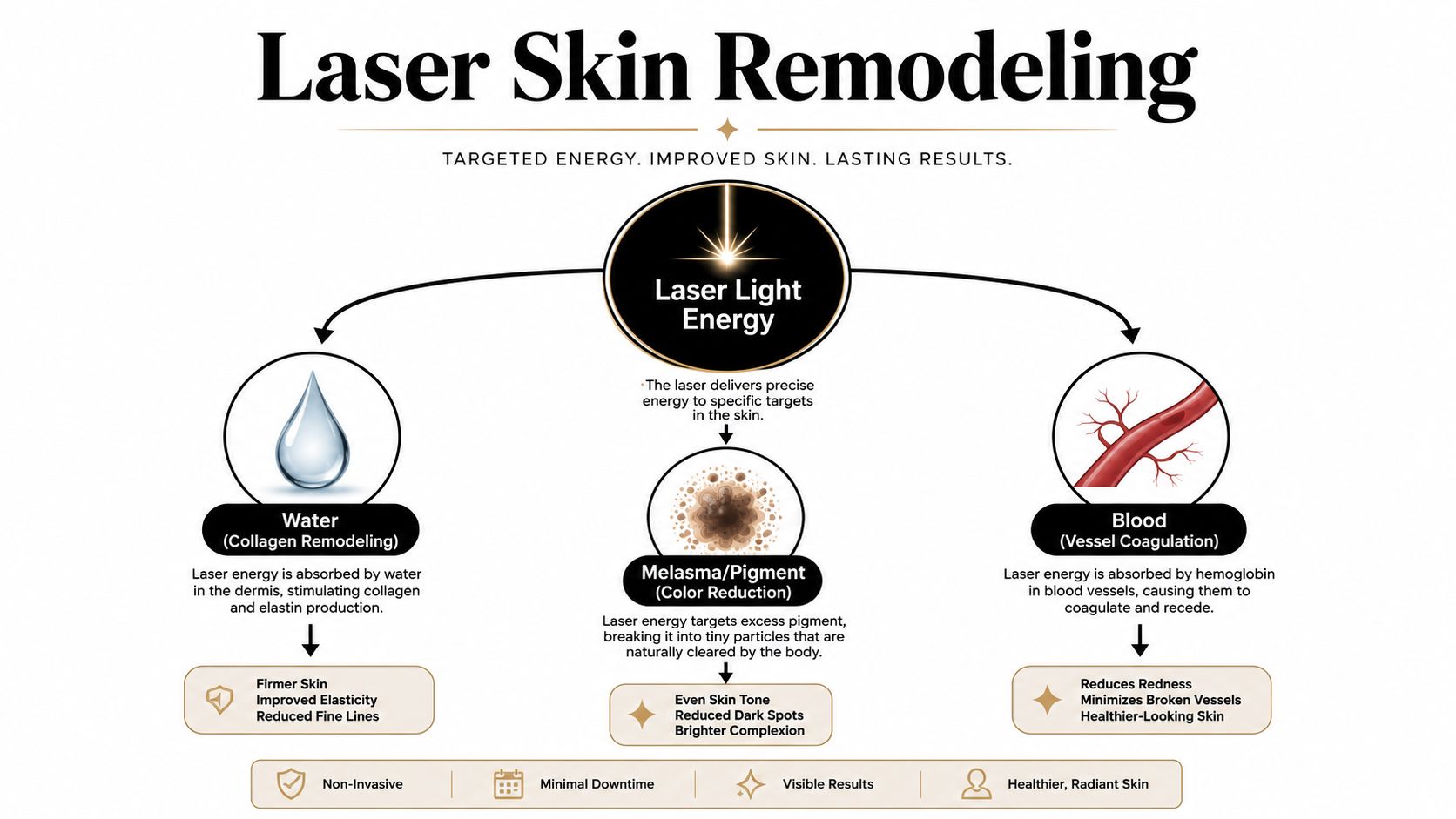
The most important split is ablative vs. non-ablative. Ablative lasers remove the epidermis and heat the upper dermis, so they can improve wrinkles and scars more aggressively, but they also come with more recovery and a higher side-effect burden (clinical review). Non-ablative lasers heat the dermis while sparing the surface, which usually means less downtime and more modest results.
Fractional platforms are a middle ground. Instead of treating the entire surface, they create microthermal columns and leave surrounding skin intact. That preservation of untreated skin is one reason healing can be faster and safer than with full-field resurfacing (clinical review).
The reason this matters in real life is simple. The more intense the injury, the more powerful the repair signal. But the more intense the injury, the more likely you are to need ointment, sun avoidance, and a real recovery window. That's also why the same patient can be offered different settings based on whether they care more about downtime, scar improvement, or pigment correction.
Wavelength is not a trivia detail, it's the device's operating language. Common non-ablative fractional wavelengths include about 1,440, 1,550, and 1,565 nm, while ablative fractional options include Er:YAG at 2,940 nm and CO2 at 10,600 nm (technical guidance). Different wavelengths interact with tissue differently, which changes how much heat is delivered and how much healing time follows.
The simplest way to compare devices is to ask three questions, what does it target, how much downtime follows, and how strongly does it remodel the skin. The answer changes a lot between fractional CO2, Er:YAG, non-ablative fractional lasers, and IPL. IPL isn't technically a laser, but patients see it on the same menu because it's often used for pigment and redness concerns.
| Technology | Typical Wavelength | Downtime | Best For | Skin-Type Fit |
|---|---|---|---|---|
| Fractional CO2 | 10,600 nm | Longest of the group, with visible healing and peeling | Deeper wrinkles, etched texture, acne scarring | Best selected carefully, especially in darker skin |
| Er:YAG | 2,940 nm | Shorter than CO2 in many cases | More precise surface ablation | Can be used selectively with expert judgment |
| Non-ablative fractional | 1,440 to 1,565 nm | Usually lighter, with less peeling | Collagen stimulation, milder rejuvenation goals | Often the safer path for darker skin tones |
| IPL | Broad-spectrum light, not a laser | Usually light | Pigmentation and vascular concerns | Depends on concern and skin tone |
If your main issue is etched-in lines or acne scarring, deeper ablative options may be more appropriate. If your concern is uneven tone, mild texture, or a lower-downtime path, a non-ablative fractional treatment often makes more sense. IPL sits in a different lane, because it's often chosen for discoloration and vascular changes rather than deep resurfacing.
For patients who want a gentler, maintenance-style approach, it can help to think beyond lasers alone. A resource on anti-aging LED mask benefits can be useful for understanding how lower-intensity light-based care fits into a broader skin plan, especially when someone isn't ready for resurfacing.
If your skin concern is mostly redness, pigment, or early texture changes, ask whether the plan is trying to remove tissue, heat collagen, or simply calm visible color differences. Those are not the same treatment goals.
For a practical comparison of common clinic options, this internal overview on laser Genesis vs IPL can help you understand why two light-based treatments that sound similar often solve different problems.
The right candidate is not the person who wants the strongest laser. It's the person whose skin concern, skin type, and downtime tolerance all point in the same direction. That usually means a careful review of sun exposure, prior scarring, pigmentation history, active breakouts, medications, and whether the person is trying to improve wrinkles, pigment, acne scars, or overall texture.
Before treatment, the area is cleaned, protective eyewear goes on, and numbing may be used depending on the device and depth. During the procedure, patients often describe snapping, heat, or a prickly sensation rather than a painless glide. Afterward, the skin is often red, warm, and coated with an ointment or healing barrier.
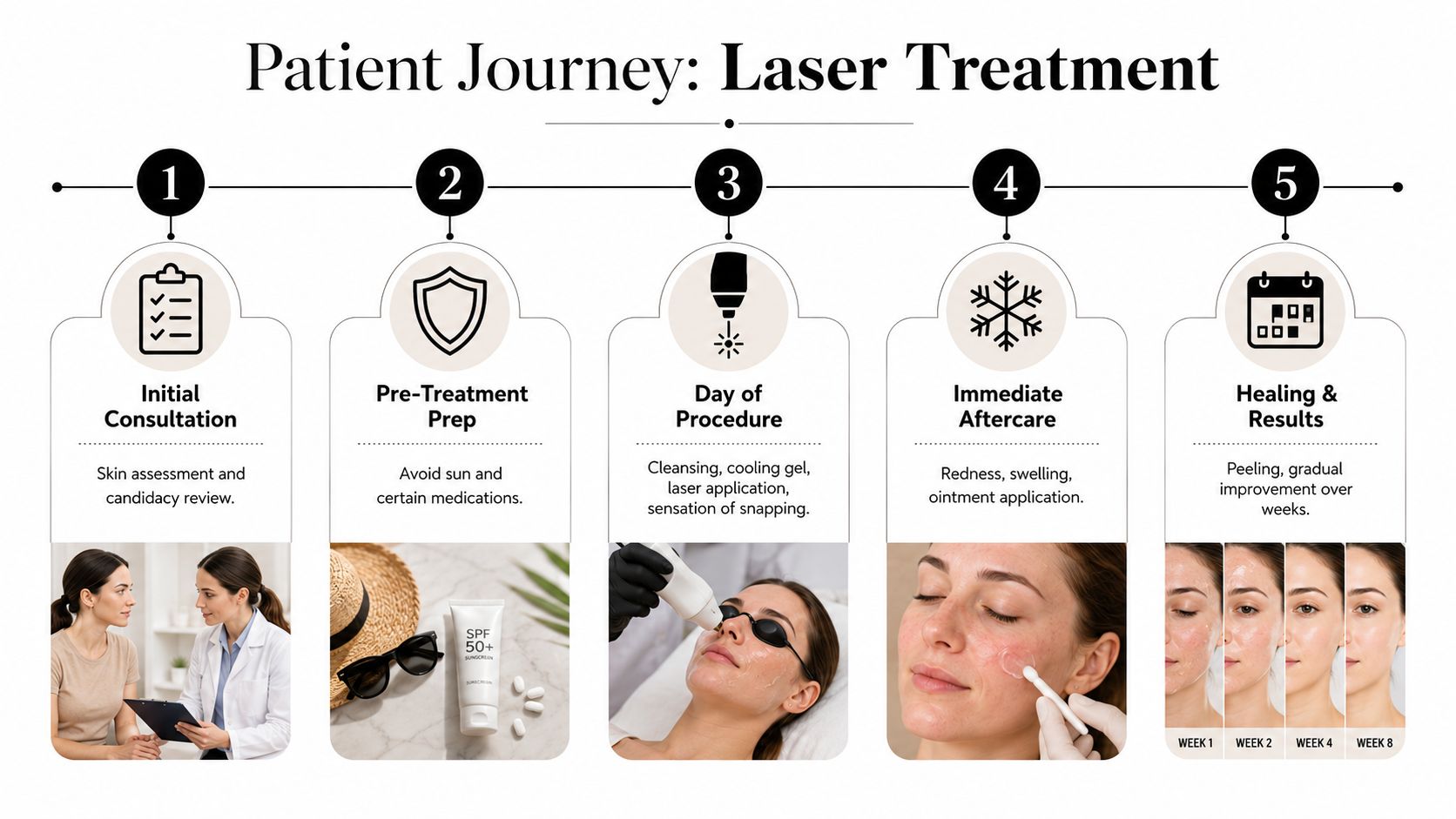
The recovery window depends on device type and the condition treated, and healing commonly ranges from 5 to 21 days according to Cleveland Clinic guidance in the clinical literature summary (technical guidance). That range matters because it separates a lunch-break procedure from a real healing event. A patient may feel camera-ready in a week with some devices, while deeper resurfacing can require more patience.
Day 1 is usually redness, swelling, and a tight or hot feeling. Over the next several days, peeling or flaking can start, and fresh skin gradually replaces the treated surface. The treated area often looks pink before it looks “done,” and that pinkness can last longer than the initial peeling.
The first social checkpoint is usually not “perfect skin,” it's “nothing is visibly raw anymore.” Exercise, sun exposure, and makeup timing depend on the device and the provider's instructions, but strict sun protection is part of the recovery because new skin is especially vulnerable. A strong clinic will give you a written aftercare plan and tell you what changes should prompt a call back.
For a deeper day-by-day view of one resurfacing type, this internal guide on Erbium laser day by day recovery is a useful companion read.
The honest version of laser rejuvenation is that it helps a lot of texture and color concerns, but it does come with predictable short-term side effects. Redness, swelling, peeling, and procedure pain are common enough that they should be treated as normal parts of the tradeoff, not surprises. In the 2024 review comparing lasers with chemical peels, short-term side effects were more common with lasers, even though both approaches improved rejuvenation outcomes overall (2024 systematic review).
For skin of color, the question is often not “Does it work?” but “What is the pigment risk?” Medical guidance from Johns Hopkins says nonablative lasers are suitable for darker skin tones because they don't carry the same hypopigmentation risk as ablative lasers, and they're gentler with fewer side effects and shorter recovery, though they usually require 4 to 6 sessions (Johns Hopkins Medicine). That creates a real tradeoff, lower pigment risk, but more visits and often subtler change.
The safest plan is rarely the most aggressive one. For darker skin tones, the best first question is whether the device choice protects pigment before it chases dramatic resurfacing.
It also helps to know what lasers can't do. Mayo Clinic notes that laser resurfacing can improve fine wrinkles, age spots, uneven pigment, sun damage, and mild-to-moderate acne scars, but it does not correct skin laxity or sagging (Mayo Clinic guidance summarized in clinical review). That line is important because loose neck skin, jowling, or significant sagging often need a different discussion, sometimes surgery, sometimes a combined energy-based plan.
If the main complaint is laxity, not surface texture, a laser may only give part of the answer. Adjacent technologies such as radiofrequency, ultrasound, infrared, and LED are often used to target collagen with less downtime, although results are usually more modest than a true resurfacing procedure (adjacent energy review). For some people, that's exactly the right tradeoff. For others, it means a laser is only one piece of the plan, not the whole solution.
For readers trying to understand how treatment choices affect aftercare expectations, this explanation of bad skin burn recovery can be a helpful reference point for why good wound care and realistic timelines matter after any skin injury.
The machine matters, but the person operating it matters more. A qualified provider should be able to explain why a certain wavelength fits your skin type, what side effects are expected, and what they would change if your skin tone, history, or goal is different from the average patient. That level of specificity is a better sign than a long list of devices on a brochure.
Look for clear answers to a few basic questions.

Cape Cod Plastic Surgery is led by Dr. Marc Fater and features an on-site, AAAASF-accredited surgical suite (practice site). That combination matters because laser treatment is not just about the device, it's about supervision, safety culture, and what happens if a treatment needs escalation.
If you're also comparing skin-focused treatment planning with non-prescription routines, this guide to non-prescription solutions for clear skin is a practical way to separate home care from office-based procedures. They solve different problems, and a good provider should be honest about where each one fits.
A laser quote can feel straightforward at first, then the details start to matter. The device used, the size of the treatment area, and whether your plan involves one session or a series all shape the final price. In many clinics, a single session may fall around $200 to $500, while a full series may run $1,500 to $4,000, depending on the plan and complexity. Those figures work best as planning numbers, not guarantees, because treatment depth and device choice can change the total quickly.
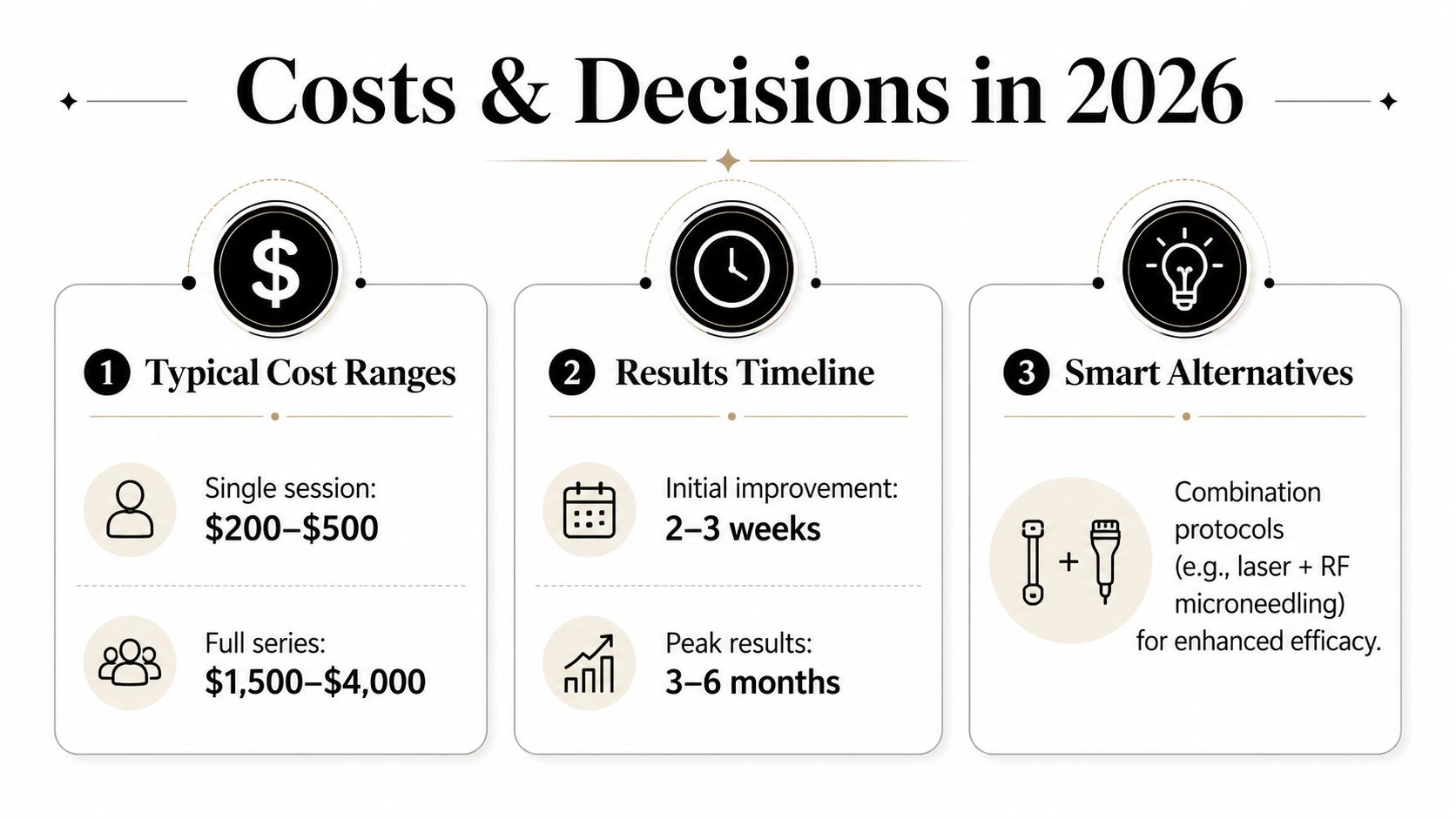
The first change is often subtle. Skin may look a little clearer and feel smoother, with less roughness at the surface. Collagen remodeling continues after the redness fades, so the most noticeable improvement can arrive later than the first calm day after treatment. That delay is normal, because the laser starts a repair process that keeps working below the surface after the visible reaction settles.
Combination protocols are getting more attention for a reason. A 2024 meta-analysis found higher satisfaction and lower pain with laser combination therapies than with laser monotherapy, along with shorter post-laser erythema duration. For patients, that usually translates into a plan that may feel less harsh and recover a bit more comfortably than a single-device approach, especially when a clinic matches the treatment to the actual skin concern instead of forcing one technology to do everything.
For skin of color, the conversation should be especially careful. The wavelength and heat profile matter because pigment can respond differently across skin tones, a bit like using different bulbs in a room, where one throws off a narrow beam and another spreads heat more broadly. A cautious provider should explain how they lower pigment risk, what redness or darkening might look like, and how the aftercare changes if your skin tends to mark easily.
Lasers are not always the smartest first move. For skin laxity, body concerns, or patients who want less recovery, radiofrequency, ultrasound, microneedling, or combined approaches may fit better. For a practical comparison point, see this internal overview on radiofrequency skin tightening cost.
A simple decision rule helps. Choose laser when the main issue is surface texture, pigment, or acne scarring. Choose combination treatment when more than one mechanism needs to be addressed. Choose surgery or tightening technologies when sagging is the main concern. If you are unsure where you fit, a consultation at Cape Cod Plastic Surgery should focus on wavelength choice, expected downtime, and how the plan changes if your skin reacts more strongly than expected. That conversation should also cover recovery milestones in plain language, including what a concerning healing course can look like, with context from bad skin burn recovery.
If you are comparing laser treatment with other office-based skin tightening options, costs should be discussed in the same breath as recovery and expected benefit. A device that looks cheaper on paper can become less appealing if it needs more visits or creates more downtime, while a slightly higher upfront plan may make sense if it reduces repeat treatments and fits your schedule better.
October 7, 2026
A Practical Guide to Healing After Breast Surgery

October 6, 2026
Your Safety Guide: What to Look for When Choosing a Plastic Surgeon
October 5, 2026
Why Our On-Site Accredited Facility Matters for Your Safety

Cape Cod Plastic Surgery offers expert cosmetic and reconstructive procedures in a safe, accredited setting. Led by Dr. Marc Fater, we combine advanced techniques with personalized care to help you look and feel your best.
Monday: 9:00 AM – 5:00 PM
Tuesday: 9:00 AM – 5:00 PM
Wednesday: 9:00 AM – 5:00 PM
Thursday: 9:00 AM – 5:00 PM
Friday: 9:00 AM – 5:00 PM