

September 9, 2026
How to Care for Surgical Incisions Properly
Expert Guide to Proper Surgical Incision Care
Jun 23, 2026
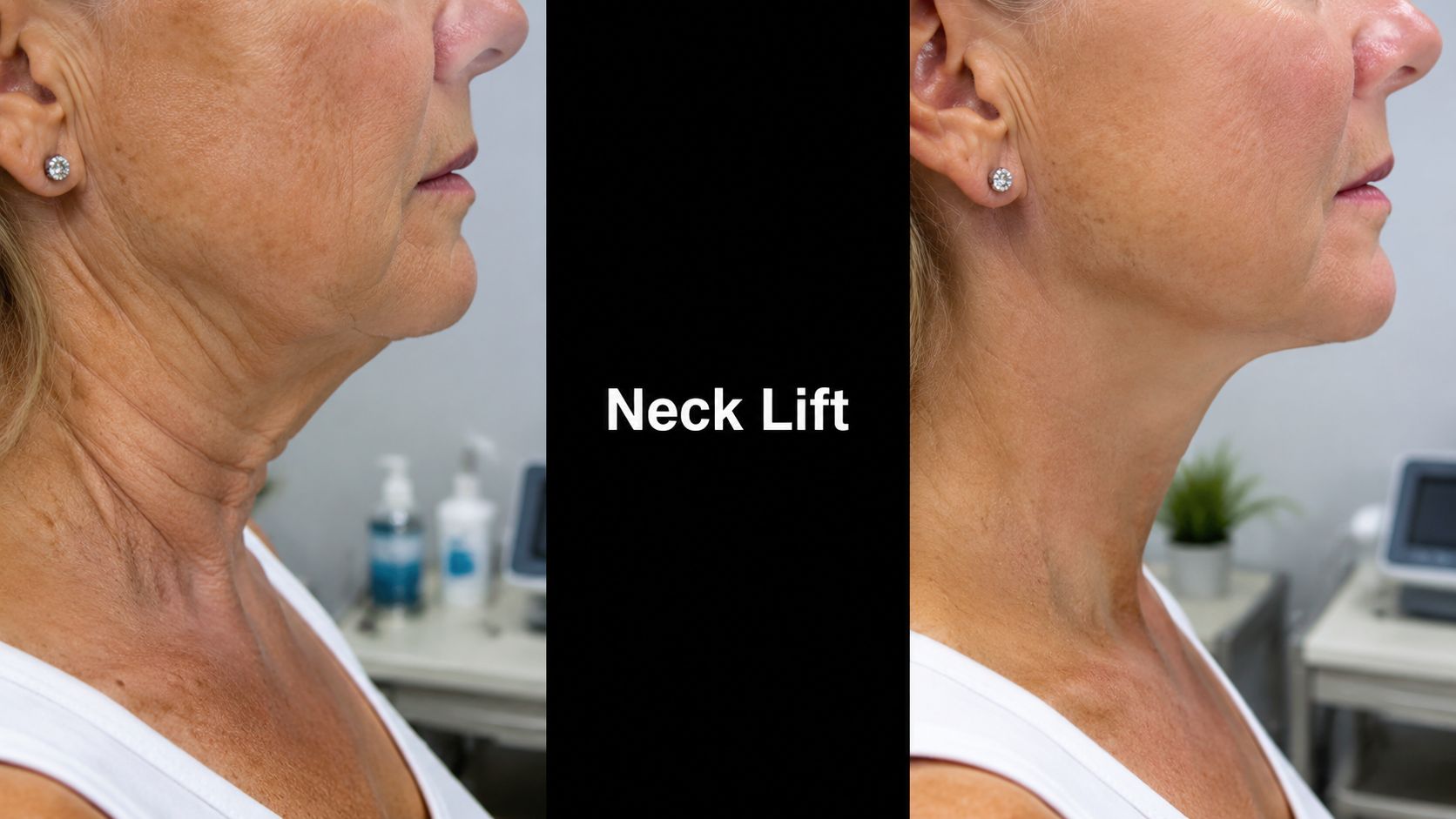
Transforming your profile often starts with a small, unsettling moment. You catch yourself in a side-view photo, or glance in the mirror while brushing your teeth, and the jawline you remember doesn't look as clean as it used to. Maybe the fullness under the chin seems heavier, or the skin at the neck looks looser than the rest of your face. That reaction is common, and it's one of the main reasons people start searching for neck lift before and after photos.
At Cape Cod Plastic Surgery, those photos matter most when they're paired with context. A strong result isn't just about pulling skin tighter. It comes from understanding what's creating the problem: fat under the chin, platysmal banding, skin redundancy, weak chin projection, or a combination of several factors. That's where surgical judgment makes the difference.
This curated look at neck lift before and after results from our practice is meant to feel closer to a consultation than a gallery. Dr. Marc Fater approaches each neck differently because no two aging patterns are the same. Some patients need a limited correction. Others need deeper structural work to restore a cleaner angle from chin to neck without creating a tight, operated look.
A large 2024 meta-analysis covering 183 published studies found consistently favorable patient-reported and physician-assessed aesthetic outcomes for neck lift and combined facelift-necklift procedures across a broad range of patients, supporting the reliability of visible improvement in jawline and neck contour as described in Plastic and Reconstructive Surgery – Global Open.
This is the patient who says, “I don't look old everywhere. I just hate what's happening under my chin.” In practice, that usually means two things are happening at once: a pocket of submental fat is blunting the jawline, and the skin no longer contracts the way it did years ago.
A woman in her mid-50s might show mild jowling with soft fullness beneath the chin. A man around 60 may have a heavier neck with thicker skin and more diffuse fullness. These aren't identical problems, so they shouldn't get identical procedures. In many of these cases, the right answer is a combination of targeted liposuction and selective tightening rather than an aggressive lift.
If fat is the only issue, liposuction can work beautifully. But when skin quality has already started to slip, removing volume without controlling the envelope can leave the contour only partly improved. The best neck lift before and after images in this category show a cleaner transition from chin to neck, not just a smaller neck.
Practical rule: If your skin doesn't recoil well during the exam, liposuction alone usually under-delivers.
Patients often ask whether they're “too early” for surgery. Usually, they're asking the wrong question. The relevant question is whether the anatomy still allows a more limited approach with a natural result and shorter recovery than waiting until the neck becomes far more advanced.
For patients comparing options for a looser, heavier neck, our guide on how to get rid of turkey neck helps explain why fat reduction and skin tightening often need to be planned together.
Some necks don't need a touch-up. They need a full structural reset. This is the patient with visible platysmal banding, hanging skin, and loss of definition from the jawline down to the base of the neck. In these cases, surface tightening alone won't hold.
A woman in her 70s with severe vertical and horizontal neck changes may also have a descended lower face. A man in his late 60s may present with broad jowling, heavy skin redundancy, and a poorly defined cervicomental angle. If only the neck is addressed and the lower face is ignored, the result often looks disconnected.
The deeper work matters here. Muscle tightening, contouring beneath the chin, and thoughtful skin management create the change patients notice in photos. This is also the category where a neck procedure frequently pairs best with some degree of facelift work to keep the face and neck aging pattern consistent.
The American Society of Plastic Surgeons describes neck lift results as often becoming fully apparent at 3 to 6 months and remaining stable for several years, with well-performed procedures typically maintaining a younger neck contour for about 7 to 10 years, as outlined in their discussion of neck lift results.
A strong result in an advanced neck should look restored, not tightened.
Many patients in this group need time away from public-facing obligations because swelling, bruising, and tissue settling are more substantial than they are with a limited correction. That doesn't mean the recovery is alarming. It means planning matters.
If you want to understand why a properly planned operation can make someone look rested rather than overdone, our article on how neck lift surgery creates a natural rested look explains the aesthetic decisions behind that difference.
Not every good neck lift before and after story is dramatic. Some of the happiest patients are younger, fit, and frustrated by one inherited problem: fullness under the chin that doesn't match the rest of the face.

A woman in her early 40s may have excellent skin elasticity but a soft profile because of localized submental fat. A man in his late 30s may be lean everywhere else but still look like he has a small double chin on video calls. When the skin is still resilient, liposuction alone can create a precise, understated improvement.
Examination carries more weight than enthusiasm. If the skin pinch test suggests strong recoil and there's little banding or hanging skin, a more limited contouring procedure may be all that's needed. Done well, the result doesn't announce surgery. It makes the lower face look cleaner.
The mistake in this category is overtreatment. Younger patients usually don't need skin excision or a larger operation just because they dislike the profile in photos. They need accurate diagnosis and restraint.
This type of improvement is especially appealing to patients who want a visible but not dramatic change. Friends may notice you look sharper or leaner. They usually can't tell why.
Weight loss changes the whole face, including the neck. Patients often expect the neck to tighten on its own once the extra weight is gone. Sometimes it does. Often, especially after major weight loss, it doesn't.
A woman in her late 40s who has lost a substantial amount of weight may have a slimmer face but hanging skin under the chin and along the neck. A man in his 50s after bariatric surgery may have residual fullness mixed with lax, deflated tissue. The emotional context is different here. These patients have usually worked hard for a healthier body and feel frustrated that the neck still tells the old story.
Operating too early is one of the common mistakes. If weight is still changing, the surgical plan can become less predictable. A stable baseline gives the surgeon something reliable to contour.
Post-weight-loss neck surgery usually requires more than one maneuver. Remaining fat may need to be reduced, muscle support may need to be tightened, and excess skin often has to be removed in a measured way. If the lower face has also become lax after weight loss, combining neck contouring with jowl and lower face treatment often gives a more balanced finish.
Patients after major weight loss often need contour restoration, not just tightening.
The strongest results in this group don't try to make the neck look artificially young. They aim to make the neck look proportional to the patient's new frame. That distinction matters. When proportion is right, the result feels believable and satisfying.
Some “neck problems” are really profile problems. A patient may focus on fullness under the chin, but the deeper issue is weak chin projection that shortens the jawline and makes the neck look heavier than it is.
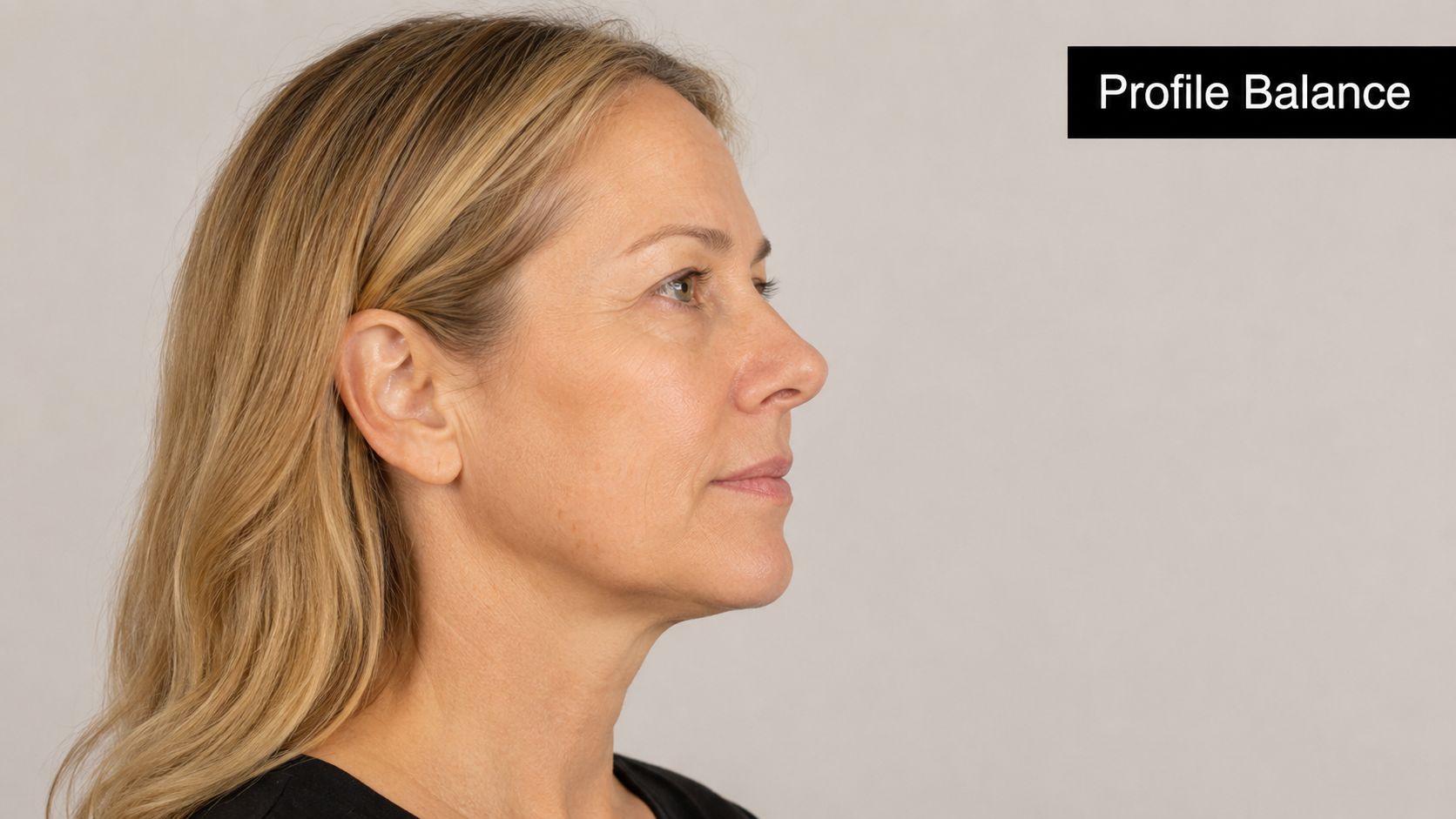
A woman around 50 with early neck laxity and a small chin may never get the profile she wants from neck surgery alone. A man in his 40s may request a stronger jawline, but unless projection is addressed, tightening the neck can only do so much. In these cases, combination planning becomes powerful.
The eye reads the profile as a single line. If the chin sits back, the neck appears fuller and shorter. When chin projection is improved, the neck often looks better even before any tissue is tightened. Add selective neck contouring and the result can be far more harmonious than either procedure on its own.
This doesn't mean everyone needs an implant. Some patients are better served with soft-tissue contouring alone. Others may want to trial a nonsurgical option first to understand how added projection changes their appearance. The key is not to force a jawline trend onto a face that needs balance more than boldness.
These are often some of the most striking neck lift before and after cases because the improvement isn't isolated to one area. The whole profile starts to make sense.
Not everyone needs surgery today. Some patients aren't ready for it, and some do not need it yet. Mild early banding, fine creasing, and modest loss of definition can sometimes be softened with injectables and energy-based devices.
A woman in her late 30s may be trying to stay ahead of early changes. A man in his early 50s may want improvement but won't accept surgical downtime. In those situations, non-surgical care can be useful, as long as expectations stay realistic.
Botulinum toxin can soften visible platysmal activity in selected patients. Fillers may support adjacent contour in the jawline. Energy-based skin-tightening treatments may modestly improve skin quality. What they won't do is remove hanging skin or recreate the sharper contour possible with surgery when laxity is established.
The Cleveland Clinic notes that prior cosmetic interventions can alter anatomy, scar patterns, tissue quality, and the complexity of later face and neck surgery, which is why a full treatment history matters before planning either a first procedure or a revision, as described in their overview of neck lift and platysmaplasty.
If you're considering office-based options first, our overview of neck skin tightening treatments is a practical starting point, and this outside discussion of non-surgical neck line solutions gives patients another way to compare what these approaches can and can't realistically address.
Non-surgical treatment is best for maintenance, prevention, or modest refinement. It isn't a substitute for surgery when the problem is excess skin.
This category works best for patients who value gradual change and are comfortable with maintenance. It works poorly for patients hoping to avoid surgery forever despite clearly surgical anatomy.
Revision surgery is a different conversation from primary surgery. The patient isn't just disappointed in the neck. They're often disappointed in the experience, the uncertainty, and the feeling that they went through recovery without getting the result they expected.
Some arrive with residual laxity because the original correction was too conservative. Others have asymmetry, visible scar concerns, contour irregularities, or a neck that looks tight in one area and heavy in another. In revision work, the anatomy is less forgiving. Scar tissue changes how planes separate, how skin moves, and how safely certain adjustments can be made.
The first consultation for revision should be slower and more candid. The surgeon has to determine what was done, what can still be improved, and what shouldn't be promised. Revision can be very rewarding, but it's rarely a matter of repeating the original operation.
A review of long-term outcome patterns notes that roughly two-thirds of patients remain satisfied with their neck lift appearance at the 5- to 7-year mark, which is useful context because not every later concern reflects a failed operation. Some changes represent normal aging, while others do require revision planning. That durability pattern was summarized in the background data provided for this article.
The best revision results often look quiet. The neck stops drawing the wrong kind of attention.
A man usually sits down in consultation and says some version of the same thing. He wants his neck to look cleaner in a dress shirt, on video calls, and in profile, without looking surgically altered.

That goal sounds straightforward, but male neck work requires a different aesthetic target than the one used for many women. At Cape Cod Plastic Surgery, this is one of the details I pay close attention to when reviewing before and after cases with patients. A successful male result usually keeps a stronger jaw, a firmer cervicomental angle, and a natural transition from face to neck. The neck should look rested and more defined, not pulled, narrowed, or overly sculpted.
The technical planning also changes. Beard-bearing skin has to be respected so hairline patterns do not shift into an unnatural position. Male skin is often thicker and heavier, which affects how much contour can be revealed and how much support is needed underneath. Incisions must be placed with discretion, especially in men who wear short hair or shave closely.
Overcorrection is the main aesthetic mistake to avoid.
If the neck is tightened too aggressively, the lower face can lose its masculine weight and start to look operated on. If fat is removed without enough judgment, the jawline may look sharp at first but hollow or harsh later. In the best male cases, the improvement is controlled. Fullness under the chin is reduced, platysmal laxity is addressed when needed, and skin redraping is kept natural enough that the result fits the rest of the face.
A curated portfolio matters more than a generic gallery. Looking at male neck lift before and after photos from a single practice lets patients see the surgeon's pattern of judgment, not just isolated good outcomes. The question is not only whether the neck looks tighter. The better question is whether the man still looks like himself, only less tired and more defined.
The best male neck lift preserves character and restores structure.
Men often prefer refinement over aggressive change. That choice usually ages better, looks more believable in motion, and keeps attention on the whole face rather than on the surgery itself.
| Procedure | 🔄 Implementation Complexity | ⚡ Resource & Recovery | ⭐ Expected Outcomes | 📊 Ideal Use Cases | 💡 Key Advantages / Tips |
|---|---|---|---|---|---|
| Moderate Neck Laxity with Submental Fullness Correction | Moderate, combined liposuction + skin-tightening; local or general anesthesia | Moderate resources; single operation, compression garment; recovery 2–6 weeks | Strong jawline improvement; natural-looking; long-lasting (5–10+ yrs) | Patients 45+ with mild–moderate laxity and good skin elasticity | Dramatic profile change; follow compression and weight-stability guidance; results mature over 3–6 months |
| Advanced Neck Aging with Horizontal Banding and Significant Skin Redundancy | High, platysmaplasty, significant skin excision, often combined with facelift | High resources; longer OR time (2–3 hrs), general anesthesia; recovery 3–8+ weeks | Most dramatic transformation; durable results (7–10+ yrs) | Patients 60+ with severe bands, skin redundancy, and facial aging | Addresses multiple issues at once; plan for hidden but longer scars and higher cost |
| Neck Liposuction with Minimal Skin Excess - The Subtle Enhancement | Low, targeted submental liposuction only; quick procedure | Low resources; office or short-OR case, local anesthesia possible; recovery 1–3 weeks | Subtle, immediate jawline definition; dependent on skin recoil; lower cost | Patients 30–55 with localized fat and good skin elasticity | Minimally invasive; excellent preventative or maintenance option; assess elasticity (pinch test) |
| Post-Weight Loss Neck Contouring with Excess Skin Removal | High, strategic skin excision + liposuction ± platysmaplasty; complex planning | High resources; staged planning, longer recovery 4–8 weeks; requires weight stability | Dramatic contour restoration; removes redundant skin; improves comfort and proportion | Post-bariatric or large weight-loss patients with redundant neck skin and stable weight | Completes body transformation; wait ≥6 months after major weight loss; expect more scarring |
| Combination Neck and Jawline Contouring with Chin Augmentation | High, multi-modal (implant, liposuction, tightening, fat grafting) | High resources; longer operative time, coordinated planning; recovery 3–6 weeks | Significant profile balance and stronger cervicomental angle; single recovery for multiple changes | Patients with weak chin plus neck laxity seeking comprehensive enhancement | Use 3D imaging, precise implant sizing; expert facial-harmony planning critical |
| Non-Surgical Neck Rejuvenation Using Injectables and Energy-Based Treatments | Low, office-based injectables and energy devices; minimal invasiveness | Low resources; no downtime but requires repeat sessions; maintenance every 6–12 months | Subtle, reversible improvements; effective for mild–moderate concerns | Patients 30–60 seeking prevention or unwilling/unable to have surgery | No surgical downtime; lower cost; best when combining modalities and scheduling maintenance |
| Revision Neck Lift - Correcting Previous Surgical Results | Very high, complex revision through scar tissue; advanced surgical judgment required | High resources; detailed reassessment, possible longer recovery 3–8 weeks; higher cost | Can correct prior issues but more limited and higher risk than primary surgery | Patients unhappy with prior neck surgery seeking improved outcomes | Thorough review of prior approach essential; set realistic expectations; consider waiting 6–12 months |
| Male Neck Lift with Natural Masculine Aesthetics Preservation | Moderate–High, similar techniques with male-specific planning to preserve masculinity | Moderate resources; tailored approach, recovery 2–6 weeks | Improved masculine neck and jaw definition; long-lasting (7–10+ yrs) | Men 45+ desiring defined, natural masculine profile | Surgeon experienced in male aesthetics required; avoid over-tightening; use imaging to set expectations |
If you've spent time looking at neck lift before and after photos, you've probably already realized something important. The same operation doesn't belong on every neck. Some patients need fat removal. Some need platysma repair. Some need skin redraping, chin support, or a combined lower face approach. And some don't need surgery yet at all.
That's why a consultation matters more than a gallery. Photos can show what's possible, but they can't diagnose your anatomy. A neck that looks “full” may be a weak chin. A neck that seems to need liposuction may really need skin control. A neck that bothered you for years may be better treated with restraint than with an aggressive plan.
There's also the question of durability and maintenance. Well-performed neck lift procedures can hold a visibly younger contour for years, but they don't stop normal aging. Sun exposure, weight changes, posture, skin quality, and prior cosmetic treatments all influence how your result ages over time. Patients do best when they understand that surgery resets the clock. It doesn't freeze it.
A thoughtful surgeon should also explain trade-offs plainly. More extensive correction can create more dramatic improvement, but usually with more recovery and more swelling. A limited procedure can be elegant and effective, but only if your anatomy supports it. Non-surgical treatment can help early or mild concerns, but it won't reliably replace surgery once skin laxity becomes substantial.
At Cape Cod Plastic Surgery, Dr. Marc Fater approaches facial rejuvenation with that balance in mind. With over 30 years of experience, he's known for tailoring each plan to the patient instead of forcing the patient into a standard package. That kind of judgment is what helps a result look natural in motion, in conversation, and in everyday life, not just in a before-and-after image.
The setting matters too. Safety, privacy, and continuity of care shape the experience from the first visit through recovery. Cape Cod Plastic Surgery offers that in an on-site, AAAASF-accredited surgical suite, where patients can move through consultation, surgery, and follow-up in one cohesive practice environment.
If your neck no longer matches the way you feel, the next step is simple. Get a professional evaluation. A good consultation should leave you with a clear diagnosis, a realistic plan, and the confidence to decide whether now is the right time.
If you're ready to explore your options, Cape Cod Plastic Surgery offers private consultations with Dr. Marc Fater in Hyannis, Massachusetts. You'll get a personalized evaluation, an honest discussion of what will and won't work for your anatomy, and a treatment plan designed to create a natural, confident profile.
September 9, 2026
Expert Guide to Proper Surgical Incision Care

Master dermal fillers aftercare with do's and don'ts, swelling tips, activity limits and warning signs to protect your results and heal smoothly.

September 8, 2026
Ensuring Safety: Why Your Surgeon's Credentials Matter Most

Cape Cod Plastic Surgery offers expert cosmetic and reconstructive procedures in a safe, accredited setting. Led by Dr. Marc Fater, we combine advanced techniques with personalized care to help you look and feel your best.
Monday: 9:00 AM – 5:00 PM
Tuesday: 9:00 AM – 5:00 PM
Wednesday: 9:00 AM – 5:00 PM
Thursday: 9:00 AM – 5:00 PM
Friday: 9:00 AM – 5:00 PM