

September 9, 2026
How to Care for Surgical Incisions Properly
Expert Guide to Proper Surgical Incision Care
May 14, 2026

Revision rhinoplasty often falls between $10,000 and $25,000, and it's usually priced well above a primary nose surgery because the work is far more complex. In published patient-reported and practice-based pricing, the range can run from $3,500 to $25,000 in some datasets, while more complex revision cases may reach much higher totals depending on grafting, surgeon expertise, and location.
If you're researching revision rhinoplasty cost, you're probably not doing it casually. Most patients at this stage are balancing disappointment, caution, and a strong desire to get it right this time. They're also asking a harder question than “What does it cost?” Instead, the question is whether the next operation is worth the investment, or whether a lower price now could create a much bigger emotional and financial problem later.
That's the right question to ask.
A revision rhinoplasty isn't just another elective procedure. It's often a corrective operation in tissue that has already been altered, scarred, weakened, or over-resected. That changes the surgical plan, the time in the operating room, the need for graft material, and the level of judgment required. The cheapest quote can end up being the most expensive decision if it leads to another revision.
A common scenario goes like this. A patient had a first rhinoplasty hoping for a subtle refinement. Instead, the nose still feels crooked, the tip looks pinched, breathing is worse, or the result doesn't fit the face the way they expected. By the time they look into a second surgery, they're not just comparing prices. They're trying to protect themselves from making the same mistake twice.

That mindset makes sense. Revision patients are usually more analytical than primary rhinoplasty patients. They ask better questions, read quotes more carefully, and want to know what's included, what might change, and what drives the fee.
In revision surgery, value comes from reducing the chance that you'll need a third operation. That means paying attention to the factors that affect durability and safety, not just the line-item total.
A useful way to think about it is the way people evaluate professional services in other high-stakes situations. A polished website, for example, is only part of the equation. Value comes from structure, usability, and execution, which is why resources like Wise Web's website design guide are useful. They show that price alone tells you very little about what you're getting. Surgical planning works the same way.
Revision surgery is rarely the place to shop for the lowest number. It's the place to look for the most reliable path to a stable result.
Revision rhinoplasty fees usually reflect several realities at once:
That's why a quote for revision rhinoplasty cost should be judged in terms of long-term value, not sticker shock.
Nationally, published pricing shows a broad spread. One widely cited patient-review average places revision rhinoplasty at $10,375, with a reported range of $3,500 to $25,000, while the average fee for primary rhinoplasty reported by ASPS is $7,637, excluding anesthesia and facility fees, according to this revision vs primary rhinoplasty cost overview. That difference is the first clue that revision surgery is its own category, not just a repeat of the original procedure.
When patients see a quote, they often focus on the total and not the structure behind it. That's a mistake. A well-prepared quote should show how the final number is built.
| Cost Component | Description | Estimated Percentage of Total Cost |
|---|---|---|
| Surgeon's fee | Covers the surgeon's operative planning, technical execution, and revision-specific expertise | Largest share |
| Anesthesia fee | Reflects the anesthesia professional and the length of surgery | Moderate share |
| Facility fee | Covers use of the operating room, equipment, staff, and recovery area | Moderate share |
| Graft-related expense | Applies when cartilage harvest or added structural material is needed | Variable |
| Pre-op and post-op care | Includes standard visits and routine surgical follow-up, depending on the practice | Smaller share |
This isn't a universal billing template, but it shows the logic. The quote isn't one number pulled from thin air. It's a combination of professional expertise, time, support staff, operating room resources, and sometimes graft reconstruction.
When I review quotes with patients, I encourage them to compare them the way they'd compare any other complex professional estimate. A detailed, component-based quote is far more useful than a vague bundled number. In that sense, consumer guides outside medicine can be surprisingly instructive. A clear example is this certified document translation cost breakdown, which shows how pricing becomes easier to evaluate once the parts are separated.
For a broader look at procedural pricing trends, Cape Cod readers may also find these plastic surgery cost statistics and average procedure prices helpful when trying to place revision rhinoplasty in the wider surgical cost context.
Practical rule: If a quote is dramatically lower than others, ask what has been left out, not just what has been discounted.
Revision rhinoplasty is closer to restoring an altered structure than shaping a new one. I often compare it to renovating a historic home after someone else already removed support beams, covered original details, and left hidden damage behind the walls. The outside problem may look small. The internal work rarely is.
Published pricing discussions consistently point to geographic location and procedural complexity as major drivers, especially in higher-cost regions such as the Northeast, California, and Texas, as explained in this review of revision rhinoplasty cost factors. The same source also notes that 10-15% of rhinoplasty patients need secondary surgery. That number matters because it reminds patients that revision surgery is common enough to be recognized, but specialized enough that surgeon selection still makes an enormous difference.
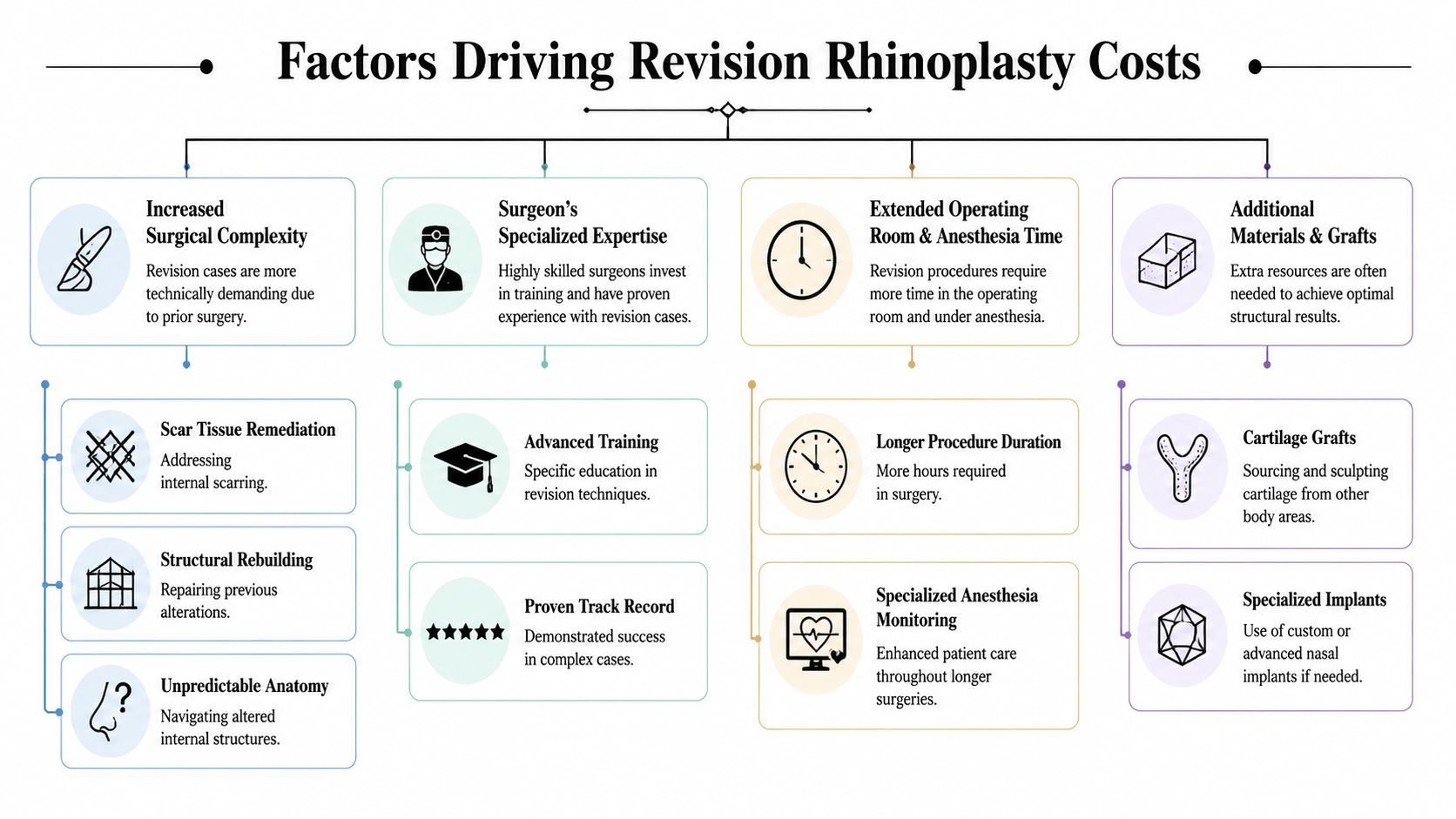
In a primary rhinoplasty, the tissue planes are more predictable. In a revision, scar tissue can obscure landmarks, restrict mobility, and make delicate reshaping much harder.
That affects cost in practical ways:
Some revision cases are refinements. Others are reconstruction. If prior surgery removed too much support, the operation shifts from cosmetic adjustment to structural repair.
That may involve:
The more a surgeon needs to rebuild, not just revise, the less meaningful a bargain quote becomes.
Not every surgeon who performs rhinoplasty performs a high volume of revision rhinoplasty. That distinction matters. Revision work asks for different judgment than first-time surgery. The surgeon has to identify what was changed, what was weakened, what can safely be improved, and what limits the tissue now imposes.
A higher quote often reflects:
Patients sometimes assume that local pricing differences are arbitrary. They usually aren't. Regional overhead, staffing, accredited facility costs, and access to highly sought-after surgeons all influence the final number. Coastal and urban markets tend to run higher for those reasons.
That doesn't mean the highest fee is automatically best. It means a revision quote should be interpreted in context. A lower number may reflect lower overhead, or it may reflect less experience, less detailed planning, or fewer resources built around the operation.
The cleanest way to understand revision rhinoplasty cost is to compare the surgery directly with a primary procedure. These are not the same operation performed twice.
According to one revision cost review based on RealSelf data, revision rhinoplasty typically involves 4-6 hours of operative time compared with 2-3 hours for primary rhinoplasty, and grafting or structural reconstruction can add $4,000-$12,000 in material fees alone. That same review reports an average revision cost of $17,167, with cases ranging from $7,000 for minor corrections to $31,357+ for complex surgery, in this analysis of primary and revision rhinoplasty pricing.
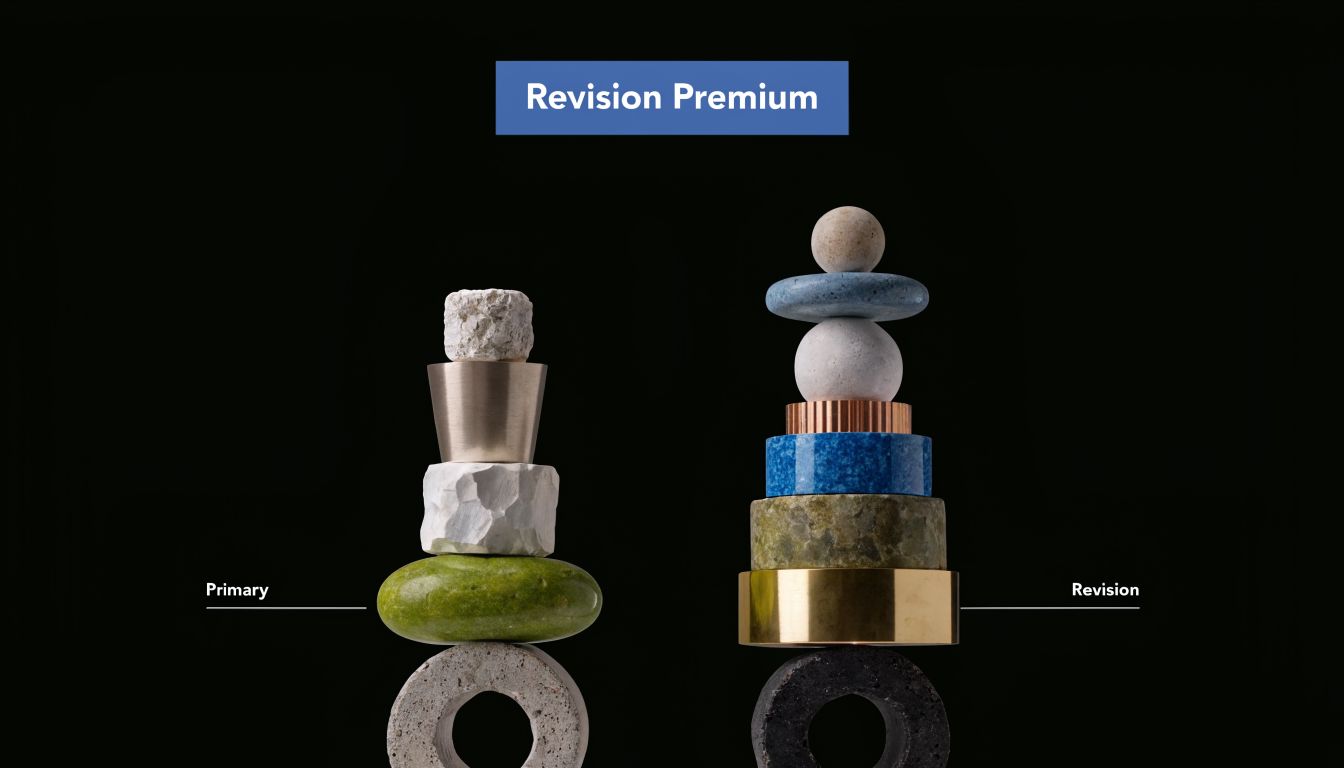
| Issue | Primary rhinoplasty | Revision rhinoplasty |
|---|---|---|
| Tissue condition | Untouched anatomy | Previously altered anatomy with scar tissue |
| Operative time | Often shorter | Often substantially longer |
| Structural support | May be preserved or modestly reshaped | Frequently needs reinforcement or rebuilding |
| Graft need | Sometimes limited | More commonly required |
| Surgical predictability | Higher | Lower, due to prior healing and changes |
A revision procedure usually asks the surgeon to do three jobs at once. First, identify what happened in the prior surgery. Second, correct functional or cosmetic problems without causing new ones. Third, rebuild support in tissue that may no longer behave normally.
That raises cost across every category, not just the surgeon's fee. Longer operating time increases anesthesia charges and facility use. Added grafting increases complexity. More difficult anatomy increases planning demands.
What doesn't work well is treating revision surgery like a commodity. Patients who compare only totals often miss the variables that create the result.
A lower fee can make sense for a very limited touch-up. It usually doesn't make sense for a structurally difficult revision.
Many patients need a straight answer. If the revision is purely cosmetic, insurance usually doesn't cover it. If the surgery includes a legitimate functional problem, such as breathing impairment tied to nasal structure, there may be partial coverage for that portion of care.
A published cost review notes that functional components may potentially reduce out-of-pocket expense to $3,000-$10,000 via insurance, and it also states that financing through CareCredit can help patients manage the upfront burden in more complex cases averaging $17,000+, as discussed in this 2025 rhinoplasty cost and financing review.
Insurance tends to focus on function, not appearance. That means coverage is more likely when the revision addresses internal nasal problems rather than cosmetic dissatisfaction alone.
Situations that may qualify for discussion with your surgeon and insurer include:
The important point is expectation management. Partial coverage can help, but it usually doesn't convert revision rhinoplasty into a fully insured procedure.
Financing matters because it gives patients room to choose the right surgeon instead of the cheapest one available at that moment. Medical financing programs such as CareCredit are often used for exactly that reason.
If you're exploring options, this guide on how to finance cosmetic surgery is a practical place to start.
Here's the approach I recommend:
If your goal is to avoid a third surgery, the most important line item isn't the cheapest surgeon's fee. It's the quality of the judgment behind the operation.
Revision rhinoplasty punishes shortcuts. An aggressive plan, weak support strategy, or casual approach to airway function can leave a patient paying again, healing again, and hoping again. That's the hidden cost people often miss when they focus only on the initial quote.

In revision work, value comes from reducing preventable risk and improving the odds of a stable, natural result. That usually means choosing a surgeon who is disciplined, experienced, and honest about what can and cannot be improved.
Look for evidence of value in areas like these:
Patients sometimes treat the facility as a background detail. It isn't. Revision surgery benefits from a setting with dependable systems, trained staff, and appropriate oversight. An accredited operating suite supports better process control from anesthesia through recovery.
For readers evaluating credentials more broadly, this resource on how to choose a surgeon is worth reviewing before you commit.
The right surgeon may not give you the lowest quote. The right surgeon is the one most likely to keep you from needing another quote later.
What doesn't work is choosing a surgeon based mainly on a discount, social media appeal, or a vague promise to “fix everything.” Revision patients need candor more than confidence theater.
A strong consultation should leave you understanding:
That clarity is part of the value you're paying for.
Practices handle this differently, but a revision consultation often covers the surgeon's evaluation of your prior result, a physical exam, discussion of goals, and a preliminary opinion on feasibility. In some offices, imaging or photo review may also be part of that process. The point of the consultation isn't just to give a price. It's to determine whether your nose needs refinement, reconstruction, functional repair, or some combination of the three.
If the consultation feels rushed, that's a warning sign. Revision planning needs time.
Ask directly about anything that falls outside the surgical quote. The most common surprises are medications, preoperative testing, specialized imaging if needed, and travel-related costs for out-of-town care. Some practices include routine follow-up in the global fee, while others may distinguish between standard follow-up and additional care outside the usual postoperative course.
The best question is simple: “What is not included in this quote?”
That phrasing works better than “Is this the total?” because it invites a more complete answer.
Sometimes it is. Sometimes it shouldn't be. A prior surgeon may reduce or waive part of the surgeon's fee in selected situations, but that doesn't automatically make returning the best decision. If the original result failed because of a mismatch in technique, judgment, or communication, a discount doesn't solve the underlying problem.
What matters most is whether that surgeon is the right person to perform the revision well.
Don't compare them as if they're identical products. Compare the plan, the surgeon's revision experience, whether grafting is anticipated, what facility standards are in place, and how carefully each surgeon explains limits and trade-offs.
A useful checklist is:
Price matters. In revision rhinoplasty, context matters more.
If you're considering revision rhinoplasty and want a careful, transparent evaluation of your options, Cape Cod Plastic Surgery offers personalized consultations for patients seeking both cosmetic refinement and structural expertise. The right next step isn't chasing the lowest price. It's getting a clear surgical plan from an experienced team so you can make a confident decision once.
September 9, 2026
Expert Guide to Proper Surgical Incision Care

Master dermal fillers aftercare with do's and don'ts, swelling tips, activity limits and warning signs to protect your results and heal smoothly.

September 8, 2026
Ensuring Safety: Why Your Surgeon's Credentials Matter Most

Cape Cod Plastic Surgery offers expert cosmetic and reconstructive procedures in a safe, accredited setting. Led by Dr. Marc Fater, we combine advanced techniques with personalized care to help you look and feel your best.
Monday: 9:00 AM – 5:00 PM
Tuesday: 9:00 AM – 5:00 PM
Wednesday: 9:00 AM – 5:00 PM
Thursday: 9:00 AM – 5:00 PM
Friday: 9:00 AM – 5:00 PM