

September 9, 2026
How to Care for Surgical Incisions Properly
Expert Guide to Proper Surgical Incision Care
May 12, 2026
You're likely doing what most thoughtful patients do before a breast augmentation consultation. Opening ten browser tabs. Comparing Mentor, Allergan Natrelle, Sientra, and newer names like Motiva. Trying to figure out whether “gummy bear,” “cohesive gel,” “smooth shell,” or “anatomical” matters, or whether it's all branding.
That confusion is understandable. Implant selection isn't a beauty counter decision. It's a surgical decision with aesthetic, structural, and long-term consequences. The brand matters, but only in context. The central question isn't “Which implant is best?” It's “Which implant is best for my anatomy, my goals, and the way my surgeon plans the operation?”
A patient often comes in with a list. One brand she saw on social media. Another her friend had. A third she found in a forum discussion about softness or rippling. By the time she sits down for consultation, she's usually less certain than when she started.
That's because the modern silicone implant market is large and still growing. The global silicone breast implant market was valued at $2.75 billion in 2024 and is projected to reach $5.15 billion by 2033, and silicone implants are projected to represent 81.86% of the full breast implant market in 2026, reflecting strong preference for their natural feel and aesthetic result according to Custom Market Insights' silicone implant market analysis.
What I want patients to understand early is this. A strong result doesn't come from choosing the trendiest label. It comes from matching device design to tissue quality, chest width, skin behavior, implant pocket control, and the look you want when you're dressed, undressed, standing, and moving.
Three things tend to create the most noise:
A good consultation should reduce options, not multiply them.
There's also an emotional layer that doesn't get enough attention. Cosmetic decisions can stir up body image stress, relationship concerns, or anxiety about recovery. If that's part of your experience, outside support can help. Some patients benefit from licensed therapy for Grande Prairie residents or similar counseling resources in their own area while they work through body-image decisions in a grounded way.
The good news is that the field isn't random. A relatively small number of established manufacturers account for most of what surgeons use, and there are real differences between them. Once you understand how surgeons evaluate those differences, the choice becomes much clearer.
Before comparing silicone implant brands, patients need a practical vocabulary. Without it, every brochure starts sounding the same.
If you're still weighing fill material itself, this overview of silicone vs saline breast implants is a useful companion. Once you've decided silicone is your preference, the next layer is understanding how one silicone implant differs from another.
Cohesivity describes how firmly the silicone gel holds together. It functions similarly to gelatin at different set points. A softer gel moves more easily and can feel more supple. A more cohesive gel holds shape more strongly and can reduce visible collapse or waviness in certain patients.
That doesn't mean firmer is always better. In a patient with thin soft tissue, a highly structured implant may help maintain contour. In another patient, too much firmness can create a look or feel that seems less natural to her.
Most patients hear “round versus teardrop,” but that's only part of the story.
A high-profile implant is not a “bigger” implant. It is a narrower implant that projects farther. That matters when a patient has a narrower chest and wants projection without excessive side fullness.
Every silicone implant has an outer shell. Surface design changes how the implant interacts with surrounding tissue.
Current conversations often focus on smooth versus textured surfaces. In practical terms, many surgeons today favor smooth implants in routine cosmetic augmentation because they move more freely in the pocket and fit current safety preferences. Textured devices still belong in some reconstructive or highly selective situations, but they require a very specific discussion.
Practical rule: The best shell isn't the one with the most marketing behind it. It's the one that behaves predictably in your tissue.
Patients usually focus on cubic centimeters. Surgeons focus on dimensional fit. Base width, projection, shell behavior, and gel response all affect how the implant handles in surgery and settles afterward.
Here is what matters during planning:
When patients understand these basics, brand comparisons become much more meaningful because they can see what each device is trying to accomplish.
A patient may come in asking for “the best implant brand.” In practice, that question usually becomes more specific within a few minutes. Which implant fits a narrow chest without pushing too far laterally? Which gel gives better upper-pole support in thin tissue? Which device feels soft enough for the patient's priorities without giving up too much shape control?
The market is still concentrated among a few major manufacturers. Allergan, Mentor, and Sientra collectively control 69% of the global market, and Mentor is the world's most adopted brand, with more than 9 million women worldwide having received Mentor implants, according to Future Market Insights' breast implant market share analysis.
That market share matters less than how each implant behaves in real surgery.
| Feature | Mentor (Johnson & Johnson) | Allergan Natrelle (AbbVie) | Sientra |
|---|---|---|---|
| Market position | Widely adopted global brand | Major market leader with strong silicone portfolio | One of the dominant tier-one companies |
| Broad identity | Longstanding clinical familiarity and surgeon comfort | Broad silicone portfolio with many aesthetic planning options | Silicone-focused brand with emphasis on cohesive gel performance |
| Best known for | Extensive adoption and long market presence | Versatility across patient goals | HSC+ gel technology and form stability |
| Silicone focus | Strong | Strong | Exclusive focus on silicone noted in brand comparisons |
| Useful for | Patients seeking a familiar, widely used option | Patients needing broad aesthetic customization | Patients where shape control is a high priority |
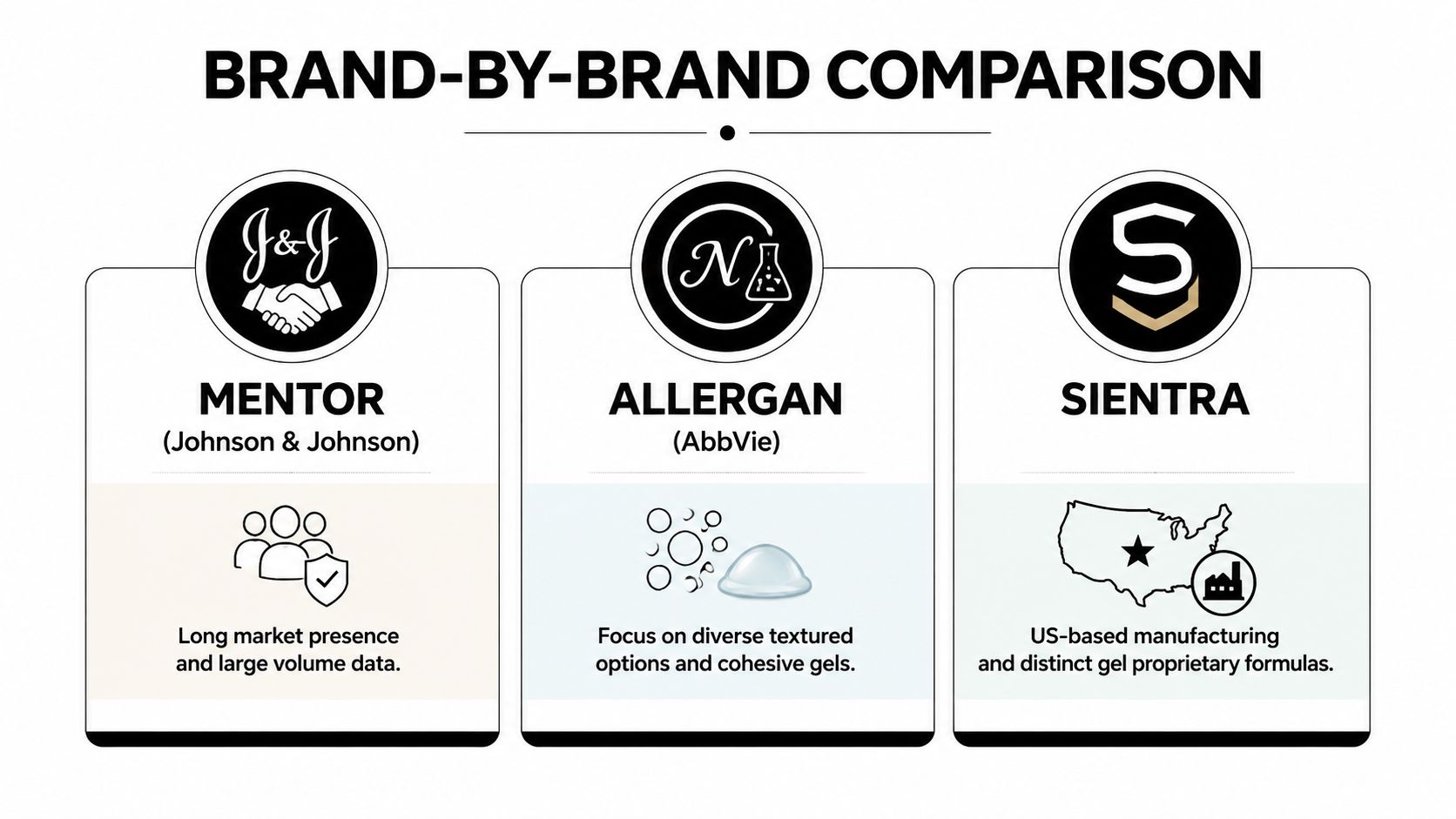
Mentor's advantage is familiarity. That sounds less exciting than a proprietary gel name, but it matters in the operating room and in long-term follow-up.
A widely used implant gives surgeons a large base of practical experience. We know how it tends to fill the pocket, where it sits early, how it settles, and which patients are likely to prefer its feel. That kind of predictability helps with fine adjustments during surgery, especially when symmetry is not perfect at baseline.
Mentor often makes sense for patients who value a proven, established option and for surgeons who want consistent handling across a broad range of routine cosmetic cases. The trade-off is that broad adoption alone does not make it the right implant for every anatomy. A familiar device still has to match chest width, tissue coverage, and the desired final shape.
Allergan's Natrelle line is useful because it offers breadth. That becomes important when the patient's anatomy sits between categories and a standard “natural” or “full” plan does not quite solve the problem.
Some patients want more upper-pole presence but still need a gentle transition at the cleavage line. Others have mild asymmetry, a constricted lower pole, or soft tissue that needs more support to keep the breast from looking empty in certain areas. A larger menu of implant dimensions and gel options gives the surgeon more ways to tailor the result instead of forcing a compromise.
According to the same Future Market Insights' breast implant market share analysis, Allergan leads the silicone segment with a 23% market share, while Mentor follows with 21%. From a surgeon's perspective, the more useful point is what that presence reflects. Both brands are common enough that most experienced augmenting surgeons have meaningful clinical familiarity with them.
Sientra usually comes up when I want more form stability and more control over contour. That can be helpful in selected cosmetic cases and in some reconstructive settings where shape support matters.
The practical appeal is its cohesive feel. A more structured implant can resist collapse better in the upper breast and may hold a defined shape more reliably in patients with looser tissue or specific contour goals. The trade-off is straightforward. As cohesion increases, some patients will perceive the implant as slightly less soft than options designed to prioritize drape and softness first.
That does not make Sientra better or worse. It makes it a better fit for certain patients.
The best brand choice is the one that solves the anatomical problem in front of you and still looks good years later.
Even though this comparison table centers on Mentor, Allergan, and Sientra, patients increasingly ask about Motiva.
A useful clinical summary is that Motiva has drawn attention for ProgressiveGel®, BluSeal®, and optional RFID-based lifetime tracking, all described in Motiva's patient implant overview. Its Ergonomix® line is designed to shift dynamically with gravity, and the manufacturer describes Ergonomix2® as having 5x improved adaptability by manufacturer benchmarks.
That design philosophy appeals to patients who want softer motion and a breast that changes shape more naturally with position. My caution is practical. Any newer or less universally available system has to be judged not just on appealing features, but also on surgeon experience, local availability, revision planning, and whether the device suits the patient's tissue characteristics.
A short explainer on implant options may help if you want to hear this discussed verbally:
From a surgical standpoint, good brand selection follows a few simple principles.
Brand matters. Surgical judgment matters more.
A patient may sit in consultation with one simple question: “Which implant is safest?” The honest surgical answer is more specific. Safety depends on the device, the surface, the pocket, the patient's tissue, and how that implant is followed over time.
Modern silicone implants are regulated medical devices, and that matters. Approval standards, manufacturing controls, and post-approval monitoring create a baseline that is far more rigorous than marketing language suggests. Still, current implants are not interchangeable in the operating room or in long-term follow-up. Shell behavior, gel cohesivity, and surface characteristics all affect how I judge risk for a given patient.

Approval is the starting point, not the endpoint.
In practice, I look at several questions at once. How well does the shell hold up over time? If a rupture occurs, how much does the gel tend to stay in place versus spread within the pocket? Does the implant surface fit the clinical job it is being asked to do? How easy is it to monitor, revise, or exchange years later if the patient's anatomy or goals change?
Those are not abstract points. They affect real decisions in surgery. A more cohesive gel may offer better form control and may be reassuring in patients where shape retention matters, but that same implant can feel firmer in a thin patient who wants the softest possible motion. A smoother implant surface may align with a straightforward cosmetic augmentation plan, but only if the implant dimensions and pocket control support a stable result.
Patients are right to ask about textured implants and past recalls. That history changed the standard conversation in breast augmentation.
Today, surface choice should have a clear reason behind it. In aesthetic augmentation, many surgeons favor smooth implants because they meet the goal in a large share of patients without adding complexity that is not needed. If a specific surface is being considered, the discussion should be concrete. What benefit does it offer this anatomy? What trade-offs come with it? What does revision planning look like later?
Safety is built through selectivity, not slogans.
Brand safety discussions often get flattened into a single ranking. That is not how I assess implants for a patient in front of me.
For example, if I am treating a patient with tight skin, limited lower-pole stretch, or a breast shape that benefits from more form stability, I pay closer attention to how an implant maintains contour if the shell is stressed over time. If I am treating a patient with softer tissue and a strong preference for natural movement, I may accept a different set of trade-offs. In both cases, the question is not which brand sounds best. The question is which device gives the safest and most predictable result in that anatomy.
This is also why dimensions matter to safety. An implant that is too wide, too projecting, or poorly matched to the breast footprint can create tissue stress, visible edges, malposition, and a higher chance of revision. Patients who want to understand that planning process often find a Mentor implant size chart and sizing guide useful because it shows how width and projection shape the decision as much as volume does.
A useful consultation usually covers five points:
The safest choice is usually the implant that fits the patient's tissue well, is placed with precision, and remains easy to evaluate if something changes years later. That is how surgeons should frame the conversation, and it is how patients make better decisions.
The best implant choice usually becomes obvious only after anatomy is assessed. Two patients can ask for “natural” and mean completely different things.
One wants a subtle slope with soft side profile and minimal visible fullness in clothing. Another wants clear cleavage, upper-pole roundness, and a more augmented silhouette. Those are different surgical plans, and often different implant preferences.
If you want a sense of how dimensions translate into actual planning, a Mentor implant sizes chart can help you understand why width and projection matter as much as volume.
Here's how surgeons often think through the decision.
Not every good implant is equally available in every market. That's one reason surgeon perspective matters.
As noted by Sientra's discussion of U.S. accessibility considerations, brands like Motiva are popular in Europe, but limited FDA clearance in the U.S. creates accessibility challenges, which is why it's important to work with a surgeon who understands both domestic and international implant technologies and can manage logistics when a specific device is being considered.
That doesn't automatically mean an internationally popular implant is the best choice. It means availability, support, revision planning, and surgeon familiarity all belong in the decision.
A perfect-on-paper implant is not very useful if it's difficult to access, difficult to support, or poorly matched to the surgeon's workflow.
Patients often enter consultation thinking in this order: size, bra cup, brand.
Surgeons usually think in a different order:
That difference matters. It's why copying a friend's implant details almost never works as a planning strategy.
A well-matched implant should look coherent on your frame, feel appropriate to your tissue, and age reasonably with your body. That's a much better standard than choosing whatever device currently has the most attention online.
A proper consultation should feel less like a sales appointment and more like a planning session. You should leave understanding not only which silicone implant brands are being considered, but also why certain options were ruled out.
That conversation is strongest when it includes anatomy, incision planning, pocket design, shape preference, softness versus structure, and the long-term implications of each recommendation. Patients often get clarity when they bring photos of results they like and dislike, then discuss what those examples reveal about fullness, slope, cleavage, and proportion.
Bring questions that force specificity:
For recovery planning, small practical details matter too. Patients often appreciate straightforward resources on comfort measures such as recovery essentials at beautysecrets.agency while they prepare their home setup.
Dr. Marc Fater brings over 30 years of experience and has performed thousands of successful procedures, and the practice's on-site AAAASF-accredited surgical suite supports a high standard of patient safety and care, as described on the Cape Cod Plastic Surgery about page.
For patients considering next steps, the practice's breast augmentation overview is a practical place to review procedure details before scheduling.
The goal of consultation isn't to convince you that one implant brand wins. It's to identify which implant is most likely to give you a durable, balanced result on your body.
If you're ready for a personalized recommendation rather than more conflicting online advice, schedule a consultation with Cape Cod Plastic Surgery. Dr. Marc Fater can evaluate your anatomy, explain the trade-offs between leading silicone implant brands, and help you choose an option that fits your goals with safety and precision.
September 9, 2026
Expert Guide to Proper Surgical Incision Care

Master dermal fillers aftercare with do's and don'ts, swelling tips, activity limits and warning signs to protect your results and heal smoothly.

September 8, 2026
Ensuring Safety: Why Your Surgeon's Credentials Matter Most

Cape Cod Plastic Surgery offers expert cosmetic and reconstructive procedures in a safe, accredited setting. Led by Dr. Marc Fater, we combine advanced techniques with personalized care to help you look and feel your best.
Monday: 9:00 AM – 5:00 PM
Tuesday: 9:00 AM – 5:00 PM
Wednesday: 9:00 AM – 5:00 PM
Thursday: 9:00 AM – 5:00 PM
Friday: 9:00 AM – 5:00 PM