

September 9, 2026
How to Care for Surgical Incisions Properly
Expert Guide to Proper Surgical Incision Care
May 11, 2026
In the U.S., calf reduction surgery cost typically falls between $4,800 and $9,900, with $6,250 often used as a national average and liposuction-only cases starting around $4,400. What you pay depends on the method used, the surgeon's expertise, and where the procedure is performed.
Individuals who research calf reduction are often more than casual browsers. They have typically spent years adjusting hemlines, skipping fitted boots, or feeling that the lower leg never matches the rest of the body regardless of how lean or fit they become. That frustration is real, and it often comes from a simple question that deserves a straight answer: is there a reliable way to slim the calves, and what does it really cost to do it safely?
The answer is yes, but cost only makes sense when you connect it to anatomy. Some calves look full because of localized fat. Others are shaped by muscle hypertrophy. Some are a mix of both. If you choose the wrong treatment because the lower price looks appealing, you can end up paying twice. First for the procedure, then for revision, prolonged recovery, or a result that never matched your goal.
That's why patients do best when they evaluate value, not just price. A lower quote from a distant clinic or a less qualified provider can look attractive on paper. It may not include the details that matter most: accredited facility standards, careful surgical planning, follow-up care, and a surgeon who knows when not to operate.
A common consultation starts with a patient saying some version of the same thing: “My weight changes, my workouts change, but my calves still look the same.” That detail matters. It often tells me the issue isn't simple weight fluctuation. It may be anatomy, muscle dominance, or resistant fat in a very specific area.

For some people, the goal is subtle. They want boots to zip comfortably, pants to drape better, or their lower leg to look less square from the back. Others want a more defined taper from knee to ankle. Both goals are reasonable, but they require an honest review of what's causing the fullness.
When someone asks about calf reduction surgery cost, they're rarely asking for one number. They're asking several things at once:
Calf contouring is one of those procedures where accurate diagnosis matters as much as technical skill. A low price on the wrong treatment isn't a savings.
A thoughtful evaluation should leave you with more than a quote. It should give you a clear explanation of your anatomy, a realistic expectation of shape change, and a plan that makes sense for your life. That's what leads to long-term satisfaction.
A good calf reduction plan starts with a diagnosis, not a menu of treatments. In consultation, I look at how the calf feels on exam, how it moves when you stand and walk, and whether the fullness comes from surface fat, muscle bulk, or both. That distinction determines what can change, how much change is realistic, and whether the result is likely to justify the cost.
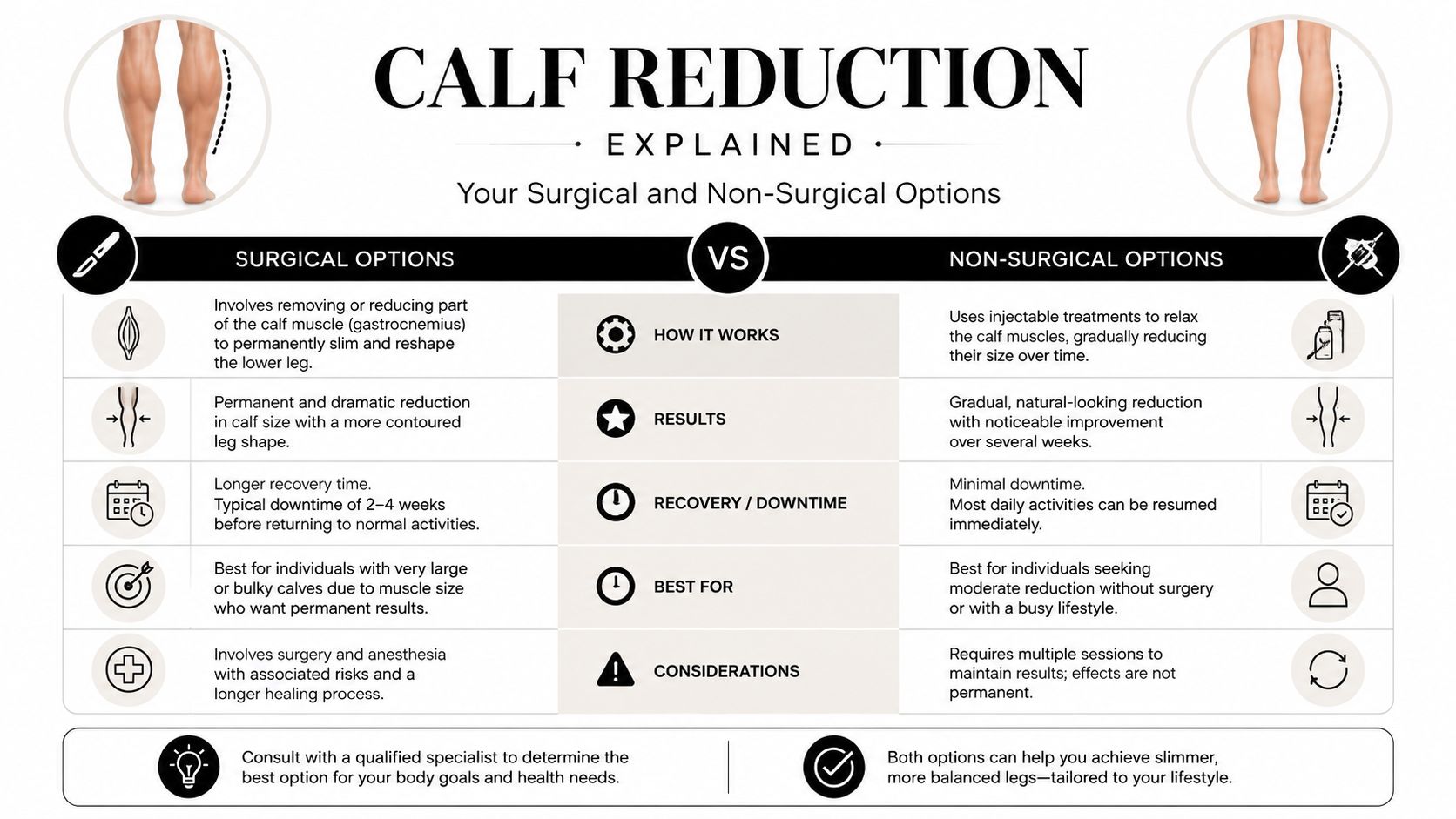
Patients with a softer calf and a pinchable layer of subcutaneous fat often benefit most from liposuction. The advantage is precision. Fat can be reduced and contoured in a controlled way, which usually produces a cleaner taper than weight loss alone in this area.
This is also the option many patients recover from more easily than muscle-focused surgery. It still requires restraint and judgment, because over-resection can create contour irregularities and under-resection can leave the leg looking unchanged. For a practical overview of how surgeons assess these cases, see our guide to calf slimming treatment options.
A firm, athletic calf with prominent gastrocnemius muscle is a different problem. Liposuction does very little if the bulk is coming from muscle. In that setting, some surgeons discuss muscle-reduction procedures or selective nerve-based approaches, but these are more technically demanding and carry real trade-offs in recovery, function, and risk tolerance.
One published overview of calf reduction methods notes that muscle-focused surgery can produce a more permanent size change than temporary treatments, but it also reports higher complication concerns, including seroma risk, and highlights how carefully these cases need to be selected (overview of calf reduction methods). That matches the practical reality. This is not the procedure to shop purely by price, especially if the consultation feels rushed or the surgeon cannot explain the effect on strength, contour, and scar placement.
Selective neurectomy aims to weaken part of the muscle by reducing its nerve input. In the right patient, it can be useful. In the wrong patient, it can lead to disappointment or an uneven result. It is a narrower tool than many online summaries suggest.
Botox is the least invasive option for muscular calves. It can slim the area by reducing muscle activity over time, but the effect is temporary and repeat treatment is part of the cost. For some patients, that makes sense as a trial run before surgery or as a modest change with little downtime. For others, the yearly maintenance ends up costing more than expected with less shape change than they hoped for.
That long-term math matters. The same is true in other major medical decisions, and articles on understanding surgery costs and insurance often make the same point. The cheapest entry price rarely reflects the full financial picture.
| Method | Target | Average US Cost | Permanence | Typical Downtime |
|---|---|---|---|---|
| Liposuction | Excess fat | $4,400+ in the U.S. according to AEDIT pricing context summarized here | Long-lasting | Shorter than muscle-focused surgery |
| Muscle resection | Enlarged gastrocnemius muscle | Higher than liposuction in many practices | Permanent | Longer, with more caution during recovery |
| Selective neurectomy | Muscle activity | Varies by anatomy and surgeon | More durable than Botox | Moderate |
| Botox | Mild to moderate muscle hypertrophy | Repeated treatment costs add up over time | Temporary | Minimal |
The best value usually comes from matching the procedure to the anatomy the first time. Patients who travel for a lower quote or choose a provider without focused contouring experience sometimes spend more later on revisions, prolonged recovery, or a result that never looked balanced. A local, board-certified surgeon like Dr. Fater offers something that is harder to put into a line item. Careful diagnosis, accredited surgical planning, and follow-up that remains available if recovery takes an unexpected turn. That is often what supports long-term satisfaction.
A surgical quote is like a building estimate. You're not paying for one line item. You're paying for the person doing the work, the setting where it happens, the support team, and the resources that protect you if recovery doesn't follow a perfectly straight line.
According to aggregated 2026 calf reduction pricing data, the global average price is $4,620, while U.S. pricing ranges from $4,800 to $9,900. The same source notes a U.S. average of $6,250, with liposuction-focused procedures starting around $4,400, and states that patients at a practice like Cape Cod Plastic Surgery often budget in the $4,000 to $7,000 range for full coverage.
A complete quote often includes:
Patients comparing quotes often focus on the surgeon's fee and overlook everything else. That's how two estimates that look similar at first can end very differently. One may include anesthesia, garments, and follow-up. Another may present those items later.
If you're trying to get better at understanding surgery costs and insurance, it helps to look at surgical pricing the same way you'd look at any medical bill: ask what is bundled, what is separate, and what happens if your care needs to extend beyond the standard follow-up window.
Ask for an itemized quote in plain language. If a clinic can't explain what's included, the number isn't useful.
A transparent estimate doesn't just protect your budget. It usually reflects a better-organized practice.
Two patients can both ask for slimmer calves and receive very different treatment plans. That isn't arbitrary. It reflects anatomy, technique, and the level of infrastructure supporting the surgery.

A patient who needs limited liposuction is not in the same category as a patient whose calf shape is dominated by muscle. The latter usually requires more planning, more technical precision, and a more cautious recovery path. That changes cost because it changes complexity.
According to AEDIT's calf reduction cost discussion, the U.S. average hovers at $6,250, but pre-op tests can add $200 to $500. The same source notes that combining calf liposuction with a thigh lift can reduce per-procedure overhead by up to 20% to 30%, especially when surgery is done in an on-site AAAASF-accredited suite that minimizes separate facility fees.
That tells you something important. A lower sticker price doesn't always mean lower total spending. If a patient is planning broader leg contouring, a combined approach can be financially smarter than spacing procedures out and paying repeated facility and recovery costs.
National and international prices vary widely, but patients often miss the practical cost of distance. Medical tourism can package surgery attractively, yet the quote may not capture the full burden of travel, remote follow-up, or complications managed back home by a surgeon who didn't perform the original procedure.
Consider the trade-offs this way:
For calf contouring, long-term satisfaction usually comes from a result that looks balanced and heals smoothly, not from getting the lowest quote in the search results.
Most calf reduction procedures are elective cosmetic surgery. That means patients should expect to pay out of pocket. It's better to know that at the start than to assume insurance might cover part of the bill and discover the answer too late.
Historical cost context from The Aesthetic Society's calf implant cost overview shows how cosmetic procedure totals can rise beyond the base fee. In that related category, the base surgeon and facility fee was $5,026 in 2021, while final costs often reached $7,000 to $12,000 once anesthesia, tests, and garments were added. Those add-on items are generally not covered by insurance for cosmetic procedures.
That principle applies here. Even if a patient focuses on the base number, the out-of-pocket reality is broader.
A practical financing plan often includes one or more of these:
For additional budgeting strategies, some patients find expert tips for uninsured patients useful as a general guide to asking better financial questions before treatment. If you're considering timing, terms, or monthly planning, this overview on cosmetic surgery financing options can also help frame the conversation.
The best financing plan is the one that lets you choose the right surgeon without forcing you to cut corners on safety or aftercare.
A well-planned procedure feels expensive. A revision usually feels more expensive.
The result doesn't depend only on the operation. It depends on recovery, restraint, and close follow-up. Calves are active every time you stand, walk, or climb stairs, so this area demands patience.
In the first part of recovery, most patients notice swelling, tightness, and a sense that the legs feel heavier than expected. That doesn't automatically mean something is wrong. It usually means the tissues are reacting to surgery.
Your surgeon will usually guide walking, compression, leg positioning, and return to exercise in stages. Patients who try to “push through” too early often make recovery harder on themselves.
Every calf reduction approach has trade-offs. Liposuction can lead to contour irregularity if the treatment plan is too aggressive or poorly matched to anatomy. Muscle-focused procedures carry more concern because they affect deeper structures and can create a more demanding healing process.
Potential issues to discuss at consultation include:
This is one of the strongest arguments for choosing a qualified local surgeon rather than chasing the lowest travel package. Recovery is not just a date on the calendar. It's a series of decisions. Compression questions, swelling concerns, activity adjustments, scar care, and reassurance all matter.
A good recovery resource should prepare you for that process. This guide to recovering from plastic surgery is a useful starting point because it emphasizes the practical side of healing, not just the operation itself.
Good surgery includes good follow-up. If you can't easily reach the surgeon who treated you, that convenience you saved on the front end may cost you peace of mind later.
A patient sits down after comparing quotes online and realizes the prices are all over the map. One surgeon offers a bargain package out of state. Another promises a dramatic result with very little discussion. A useful consultation cuts through that noise. It should explain what you are paying for, what result is realistic for your anatomy, and who will be available if recovery does not follow the usual course.
That matters in calf reduction more than many patients expect. This is a procedure where planning, judgment, and follow-up shape the experience as much as the operation itself. Lower pricing can look attractive at first glance. The value equation changes quickly if the treatment plan is too aggressive, the diagnosis is wrong, or you are left managing questions from a distance after surgery.

Use this checklist to judge both the quote and the surgeon behind it:
Will I have visible scars?
That depends on the technique. Liposuction uses small entry points. Muscle-focused surgery requires a larger incision plan. You should leave the consultation knowing where scars are likely to sit, how they usually mature, and what scar care will involve.
How long until I see the final result?
You will see improvement before you see the final contour. Swelling settles gradually, and the calves often take patience. Early photos rarely show the finished result.
Is non-surgical treatment enough?
Sometimes. It can help in selected patients with mild muscle prominence. It is often a poor match when fullness comes from fat, when calf shape is strongly structural, or when the goal is a lasting reduction.
Is going abroad worth it to save money?
Some patients are tempted by the lower starting quote. You have to ask whether those savings still make sense if you need extra visits, treatment for a complication, or a revision after you return home. In my view, many patients are happier when their surgeon is close enough to examine them, answer questions directly, and stay involved through recovery.
What usually leads to the happiest patients?
Clear goals, a method matched to the anatomy, and a surgeon who respects proportion. Patients also tend to feel better about the investment when they choose a board-certified surgeon with a setting they trust, rather than shopping on price alone.
A strong consultation should leave you informed, not rushed. The right choice is not the lowest number on a quote sheet. It is the plan that gives you a realistic path to a better contour, safer treatment, and follow-up you can use.
If you're considering calf contouring and want a careful, board-certified evaluation, Cape Cod Plastic Surgery offers consultations with Dr. Marc Fater in Hyannis, Massachusetts. With over 30 years of experience and an on-site AAAASF-accredited surgical suite, the practice focuses on personalized planning, honest guidance, and results that fit your anatomy rather than a one-size-fits-all formula.
September 9, 2026
Expert Guide to Proper Surgical Incision Care

Master dermal fillers aftercare with do's and don'ts, swelling tips, activity limits and warning signs to protect your results and heal smoothly.

September 8, 2026
Ensuring Safety: Why Your Surgeon's Credentials Matter Most

Cape Cod Plastic Surgery offers expert cosmetic and reconstructive procedures in a safe, accredited setting. Led by Dr. Marc Fater, we combine advanced techniques with personalized care to help you look and feel your best.
Monday: 9:00 AM – 5:00 PM
Tuesday: 9:00 AM – 5:00 PM
Wednesday: 9:00 AM – 5:00 PM
Thursday: 9:00 AM – 5:00 PM
Friday: 9:00 AM – 5:00 PM