

October 7, 2026
What to Expect During Your Breast Surgery Recovery
A Practical Guide to Healing After Breast Surgery
Sep 6, 2026

You may have reached a stable weight, improved your strength, and still feel frustrated by skin hanging along your inner thighs. It can rub during walking, bunch beneath clothing, or make you avoid activities you otherwise enjoy. Diet and exercise can reduce fat and build muscle, but they can't remove skin that has lost its elastic “snap,” especially after substantial weight loss or with aging.
Thigh lift surgery, also called thighplasty, reshapes the thigh by removing excess skin and tightening supporting tissue. It isn't the same as liposuction, which removes selected fat, and it differs from non-surgical skin tightening, which may offer more limited improvement when lax skin is substantial.

The most important decision isn't only about wanting a shorter scar. The incision pattern determines how much skin can be corrected, and it also influences wound-healing demands, swelling, and the possibility of revision. This guide explains candidacy, technique choices, the surgical process, recovery, risks, and long-term expectations so you can approach a consultation with useful questions rather than vague hopes.
A patient who has lost significant weight often describes the same experience: the number on the scale has changed, but the thighs still feel heavy or loose. The remaining skin may fold over the inner thigh, pull downward toward the knee, or create friction where the legs meet. That concern can be aesthetic, but it can also affect comfort, clothing, hygiene, and movement.
Thigh lift surgery addresses excess skin and tissue laxity, not every possible cause of thigh fullness. A surgeon may remove a measured amount of skin and reposition the remaining tissue to create a smoother transition from the groin or hip toward the knee. The result is usually a more supported contour, not a perfectly tight or completely scar-free leg.
Liposuction is designed for localized fat volume. If the skin still contracts well, liposuction may improve contour without removing skin. If the skin hangs significantly, removing fat alone can leave the surface looser. Some patients may need a combination approach, but that decision depends on tissue quality, fat distribution, medical history, and the planned incision.
Non-surgical treatments may be appropriate for mild laxity, yet they can't duplicate the skin removal achieved through surgery. A consultation should distinguish the main problem: skin excess, fat excess, muscle shape, or a mixture of all three.
Practical rule: Choose the operation for the tissue problem you actually have, not for the procedure name that sounds least intimidating.
The trade-off is visible. More correction generally requires a longer or more strategically placed incision, and that can create a greater healing burden. The right operation balances contour improvement with the amount of wound care, activity restriction, swelling, and scar management you're prepared to accept.
Thigh lift surgery works much like tailoring a garment. A surgeon identifies the extra fabric, removes what won't lie smoothly, and brings the remaining edges together so the shape follows the body more naturally. In the thigh, that “fabric” is stretched skin and supporting tissue. Once skin has been expanded beyond its ability to recoil, exercise can strengthen the muscles underneath but can't reliably restore the original skin envelope.
The procedure may focus on the inner thigh, the outer thigh, or a broader area. The correct plan depends on where the skin hangs and whether the laxity continues around the hip, buttock, or knee. A surgeon also evaluates fat distribution, skin quality, prior operations, scars, circulation, and conditions that may interfere with healing.
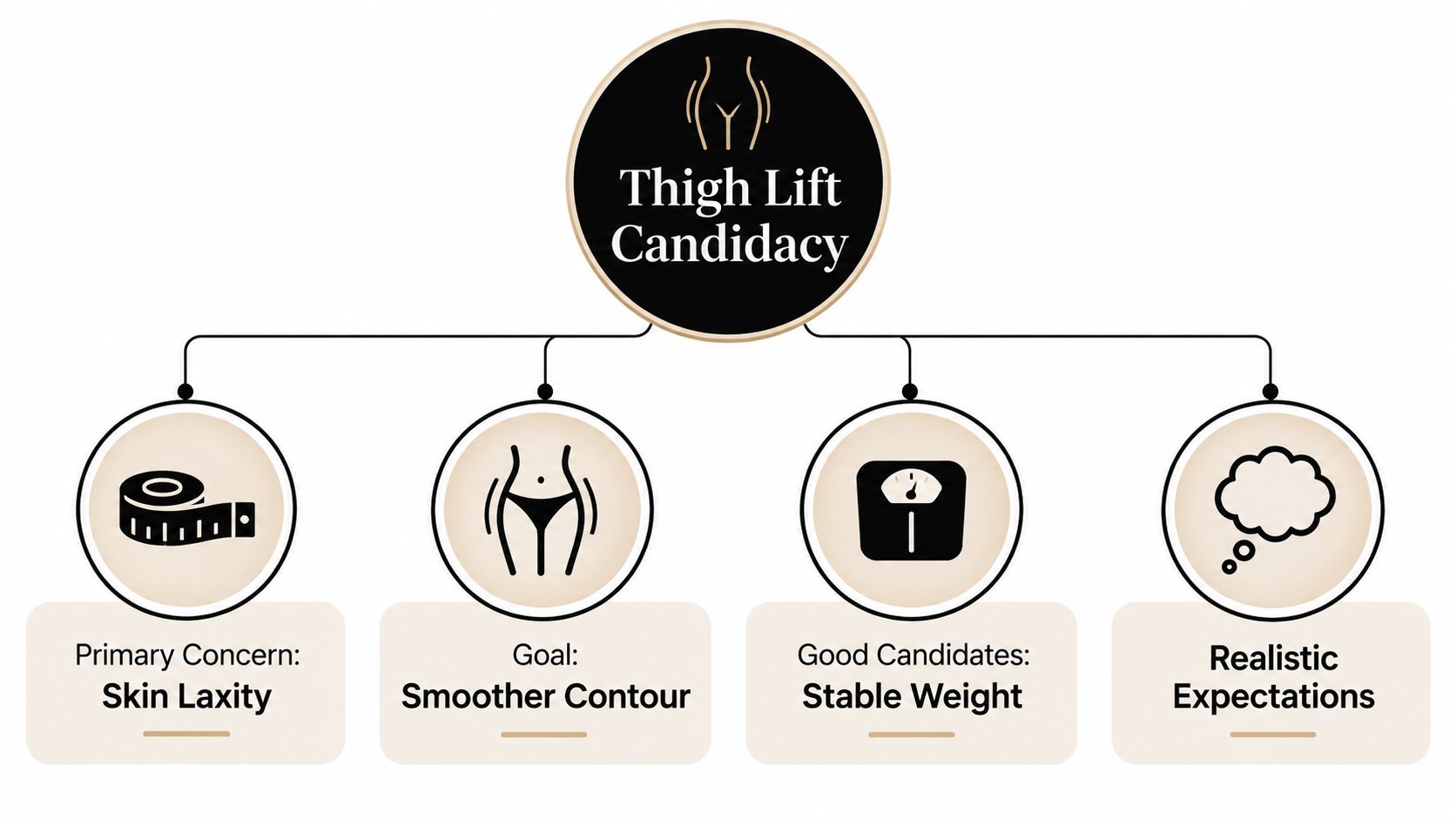
A strong candidate usually has a stable weight, sufficient general health for surgery, and a clear understanding that scars are part of the operation. Surgeons commonly ask about:
The surgeon may also consider body mass index as one part of the safety assessment, but it isn't a stand-alone verdict. The same BMI can represent different muscle mass, fat distribution, skin quality, and medical risk in different people.
For a broader explanation of procedures used to address loose skin after weight loss, see this guide to excess skin removal surgery. The most useful consultation ends with a plan that explains not only what will be removed, but also where the incision will sit and why that design fits your anatomy.
Thigh lift techniques differ mainly by where the incision runs and how far the correction extends. A small incision can address a limited fold. A longer incision can treat skin that continues vertically down the thigh, but it also creates more closure to protect during healing.
| Technique | Incision Location | Best For | Scar Consideration |
|---|---|---|---|
| Inner or medial thigh lift | Groin crease, sometimes extending downward | Laxity concentrated near the upper inner thigh | Often more concealed, but tension in the groin can challenge healing |
| Vertical thigh lift | Along the inner thigh, extending toward the knee | Significant vertical skin excess after weight loss | Longer visible scar, broader correction, greater wound-care burden |
| Outer or lateral thigh lift | Along the outer hip or upper thigh | Laxity that continues around the outer thigh and hip | Scar placement must balance contour correction with visibility |
| Mini thigh lift | Shorter upper-inner-thigh incision | Mild, localized laxity near the groin | Less extensive correction and a smaller treatment field |
| Combination lift | More than one incision pattern | Laxity spanning inner, outer, or adjacent body areas | More correction can mean more swelling, incisions, and healing demands |
A medial thigh lift is often considered when the main complaint is inner-thigh skin, including rubbing or folding near the groin. A vertical lift can reach farther down the leg when the excess skin extends toward the knee. An outer lift addresses a different contour problem, so it isn't a substitute for an inner lift just because both use the word “thigh.”
Liposuction may be discussed when fat remains after weight loss, but it doesn't remove hanging skin. Patients comparing that option with surgery can review the practical factors discussed in this overview of inner thigh liposuction cost, while remembering that cost and suitability depend on the actual treatment plan.
Ask three questions:
The least visible scar isn't always the least demanding operation. Technique should be selected by anatomy first, then by scar preference.
The process begins with an assessment, not a measurement taken from a photograph. During consultation, you discuss the areas that bother you, your weight history, previous operations, medications, nicotine exposure, circulation, swelling, and any history of delayed healing. The surgeon examines the skin while you stand and move, because gravity reveals laxity that may be hidden when you're lying down.
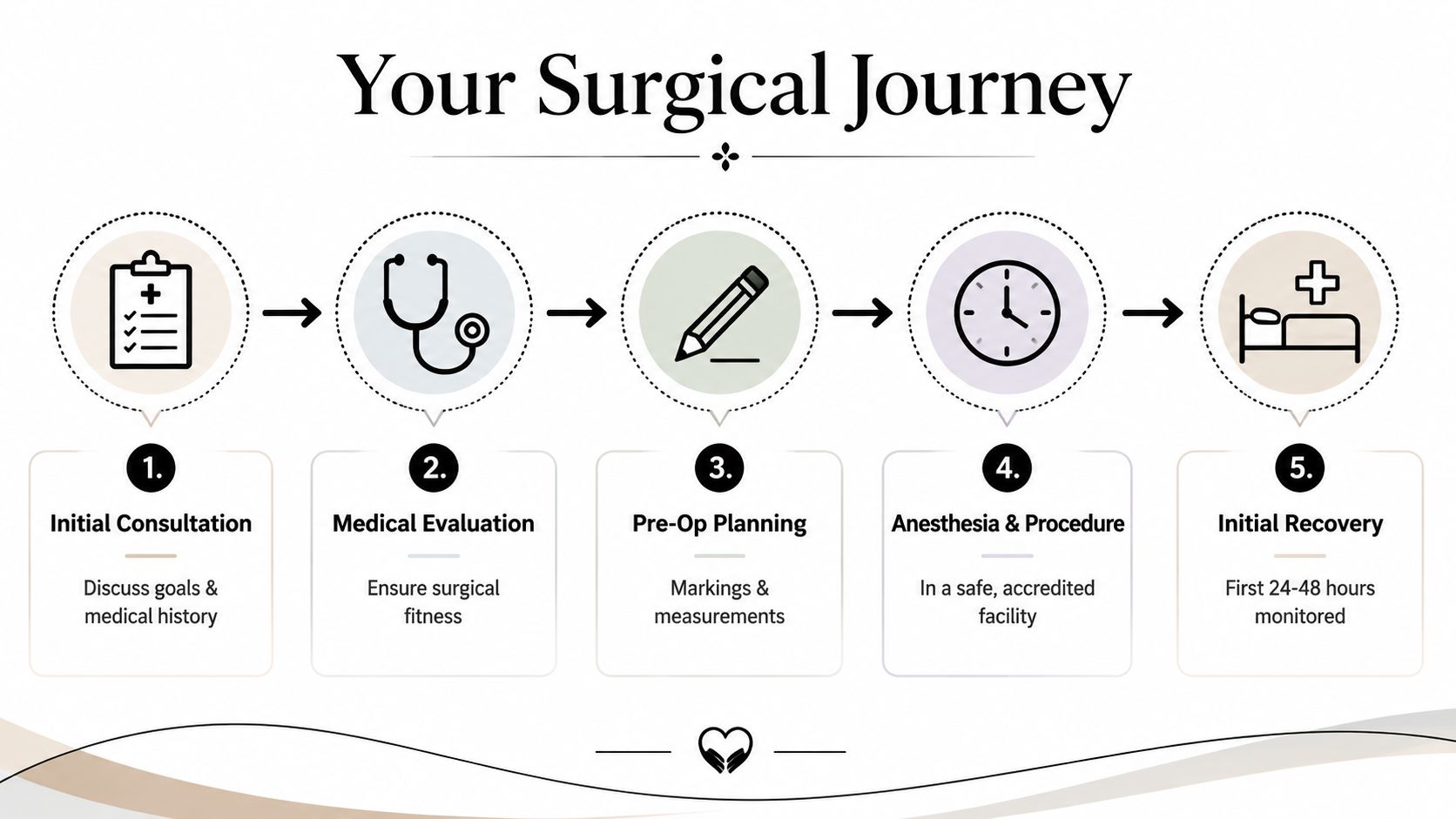
Once the procedure is selected, the team reviews medical clearance, medication instructions, transportation, home support, and clothing for the recovery period. Incision markings are made with you standing so the surgeon can map the amount and direction of skin movement. This planning is especially important around the groin, where scars must be positioned carefully and closure must withstand normal movement.
Thigh lift surgery may use sedation or general anesthesia, depending on the extent of correction and the anesthesiologist's assessment. General anesthesia means you're fully asleep and continuously monitored. The anesthesia plan should be explained before the procedure, including fasting instructions and which medications or supplements need to be paused.
After anesthesia, the surgeon makes the planned incision, removes excess skin, and tightens or repositions deeper supporting tissue when appropriate. The skin edges are then brought together in layers. Drains may be used when the surgeon believes they will help manage fluid, and compression may support the tissues afterward.
A facility's accreditation and emergency protocols matter because safety involves more than the surgical technique. Cape Cod Plastic Surgery describes an on-site AAAASF-accredited surgical suite, and patients should ask any practice how it handles anesthesia, monitoring, unexpected findings, and postoperative communication.
You should leave with written instructions, prescriptions or medication guidance, a follow-up schedule, and a clear phone number for urgent concerns. Knowing who will answer questions after the operation is part of preparation, not an administrative detail.
Recovery after thigh lift surgery is best planned as a gradual return, not a single date on the calendar. The first days focus on protecting the incisions, controlling swelling, taking short supported walks when permitted, and avoiding movements that pull across the groin or inner thigh.
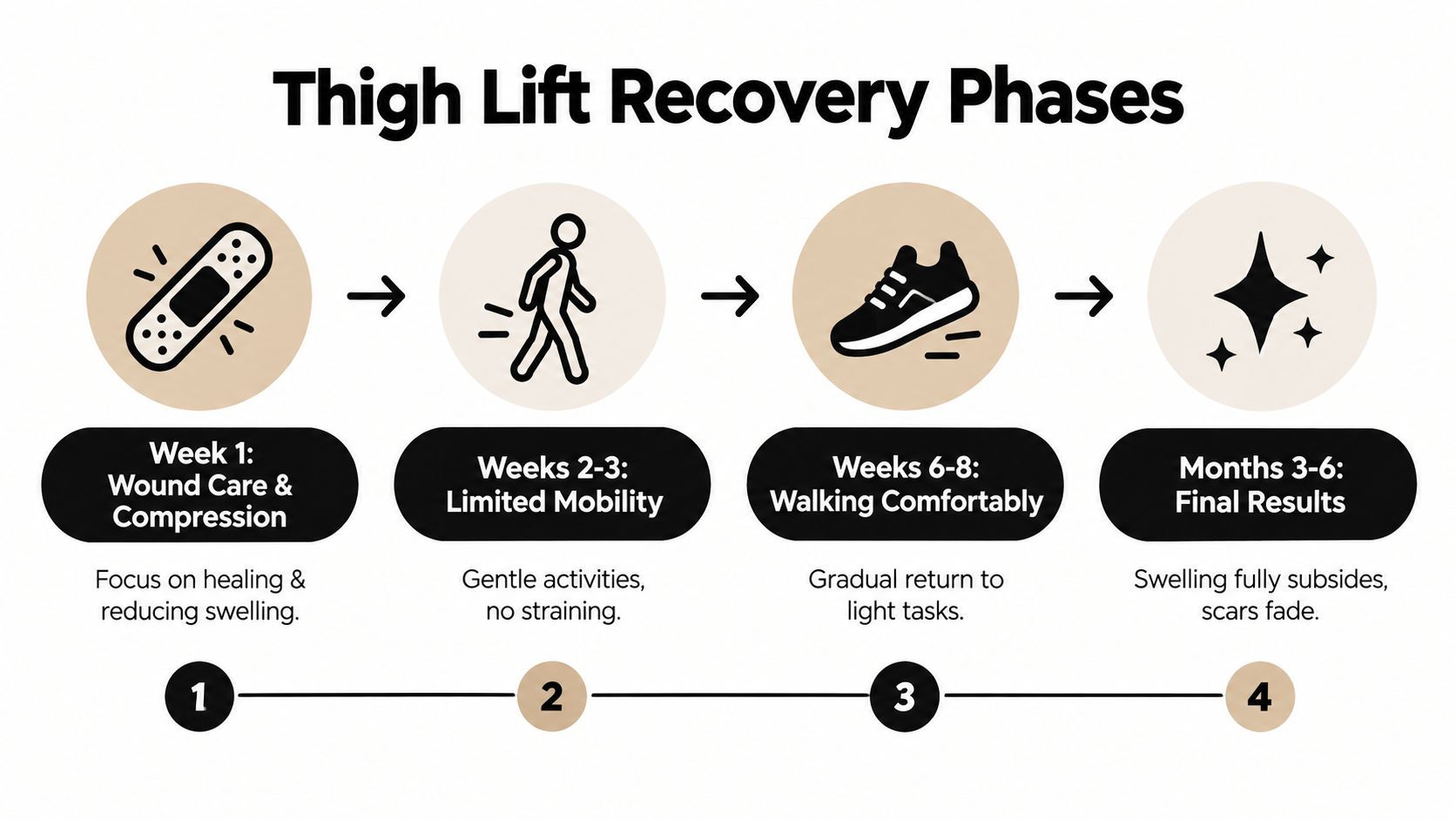
Week one usually centers on wound care, compression if prescribed, medication management, and help with bathing, meals, stairs, and transportation. Drain care may be required if drains are placed. Keep the home arranged so essential items are within reach, and use loose clothing that doesn't scrape or compress the incisions.
During weeks two and three, many patients still need limited mobility. Gentle movement may support circulation, but bending, wide leg movements, lifting, and strenuous exercise should wait until the surgeon clears them. Your instructions take priority over a generic online timeline because the incision pattern and healing response vary.
Comfortable walking commonly takes six to eight weeks, according to an American Society of Plastic Surgeons report discussing thigh lift recovery and swelling. The same report warns that people with preexisting leg swelling may experience worsening edema, and chronic swelling can occur. Older clinical evidence also reported leg swelling in 22% of patients in one series, with most cases resolving within a year but some persisting, as summarized by the American Society of Plastic Surgeons.
Recovery is not only about pain. Swelling can change how you walk, how clothing fits, and how long you need follow-up.
Compression garments should fit as directed, not so tightly that they cause numbness, color change, or increasing discomfort. Elevating the legs may be recommended, but positioning must protect the incisions and avoid pressure on vulnerable areas. Gentle walking, hydration, nutrition, and adherence to restrictions are more useful than trying to accelerate the process.
A practical checklist for organizing your home is this resource on post-surgery home recovery tips. For more on garment selection and use, review guidance about compression wear after surgery.
Call the surgical team promptly for spreading redness, worsening pain, fever, foul drainage, sudden swelling on one side, opening of the incision, chest pain, or shortness of breath. Scar maturation and final contour continue gradually after early healing, so temporary firmness, asymmetry, and swelling don't necessarily represent the final result.
Thigh lift surgery has a well-documented complication profile, and the central issue is often local wound healing, not a dramatic systemic event. A systematic review of 16 studies covering 447 patients found complications in 191 patients, or 42.72%, with wound separation, called dehiscence, occurring in 18.34% and seroma, a fluid collection, in 8.05%. These findings come from the medical literature review on medial thigh lift complications.
Dehiscence can happen when tension, motion, blood-flow limitations, or infection prevents the incision from staying closed. A seroma forms when fluid collects beneath the skin. Both problems may require extended dressings, drainage, additional appointments, or delayed scar maturation, even when the overall contour eventually improves.
A clinical report involving 106 patients found at least one complication in 68% of cases. The reported rate varied by procedure extent, from 43% for horizontal thighplasty to 67% for short-scar thighplasty and 74% for full-length vertical thighplasty. In that report, dehiscence occurred in 51%, seroma in 25%, infection in 16%, and hematoma in 6%, as reported in the PubMed-indexed clinical study.
More recent evidence also shows a sharp difference by incision type in post-massive-weight-loss patients. A 2025 study reported complication rates of 40.3% for I-incision, 66.6% for T-incision, and 73.9% for L-incision approaches, with major complications ranging from 9.5% to 39.1% depending on technique, according to the PubMed-indexed study.
BMI and age matter as well. A multivariate analysis found that age and BMI of 30 kg/m² or higher independently predicted postoperative complications, with an odds ratio of 2.82 for BMI at or above that threshold, as described in the same PubMed source. The implication isn't that a particular BMI automatically rules out surgery. It means your surgeon should treat weight, medical conditions, and incision extent as connected risk factors.
Risk reduction starts with reducing closure tension, designing the incision carefully, evaluating circulation and swelling, and monitoring wounds closely after surgery. Ask exactly how your surgeon would respond if an incision opens or a seroma develops. Clear answers are part of informed consent.
The lasting value of thigh lift surgery comes from removing skin that diet and exercise can't remove. With stable weight, the improvement can be durable, but the body continues to age and future weight changes can stretch the remaining skin. Scars usually soften and become less noticeable over time, although their final appearance depends on genetics, tension, pigmentation, wound healing, and aftercare.
Before-and-after photographs can help you understand a surgeon's aesthetic approach, but they don't predict your exact result. Look for examples with similar skin laxity, body proportions, weight-loss history, and incision pattern. Ask whether a proposed technique is being limited for a safety reason or expanded because a shorter operation wouldn't correct the area adequately.
Cost varies with the extent of skin removal, whether liposuction or another procedure is added, anesthesia, facility charges, postoperative supplies, and follow-up care. A written estimate should separate these components and explain what happens if wound care or revision becomes necessary. Financing may be available, but it shouldn't replace a realistic plan for time away from work and home support.
Cape Cod Plastic Surgery in Hyannis presents thigh lift surgery as a body-contouring procedure performed under sedation or general anesthesia. The practice is led by Dr. Marc Fater, a board-certified plastic surgeon with over 30 years of experience, and includes an on-site AAAASF-accredited surgical suite. Those facts are useful starting points, but the consultation should still focus on your anatomy, swelling history, technique options, scar placement, and recovery responsibilities.
Administrative responsiveness also affects the patient experience. Practices evaluating communication systems may find resources such as an AI receptionist for med spas useful for handling routine inquiries, but clinical decisions and medical advice should come from the qualified surgical team.
Cape Cod Plastic Surgery offers personalized evaluation for patients considering thigh lift surgery, including discussion of incision choice, wound-healing risk, swelling, and realistic contour goals. Visit Cape Cod Plastic Surgery to request a consultation and bring your questions about technique, recovery support, and long-term results.
October 7, 2026
A Practical Guide to Healing After Breast Surgery

October 6, 2026
Your Safety Guide: What to Look for When Choosing a Plastic Surgeon
October 5, 2026
Why Our On-Site Accredited Facility Matters for Your Safety

Cape Cod Plastic Surgery offers expert cosmetic and reconstructive procedures in a safe, accredited setting. Led by Dr. Marc Fater, we combine advanced techniques with personalized care to help you look and feel your best.
Monday: 9:00 AM – 5:00 PM
Tuesday: 9:00 AM – 5:00 PM
Wednesday: 9:00 AM – 5:00 PM
Thursday: 9:00 AM – 5:00 PM
Friday: 9:00 AM – 5:00 PM