
September 9, 2026
How to Care for Surgical Incisions Properly
Expert Guide to Proper Surgical Incision Care
Jan 30, 2026
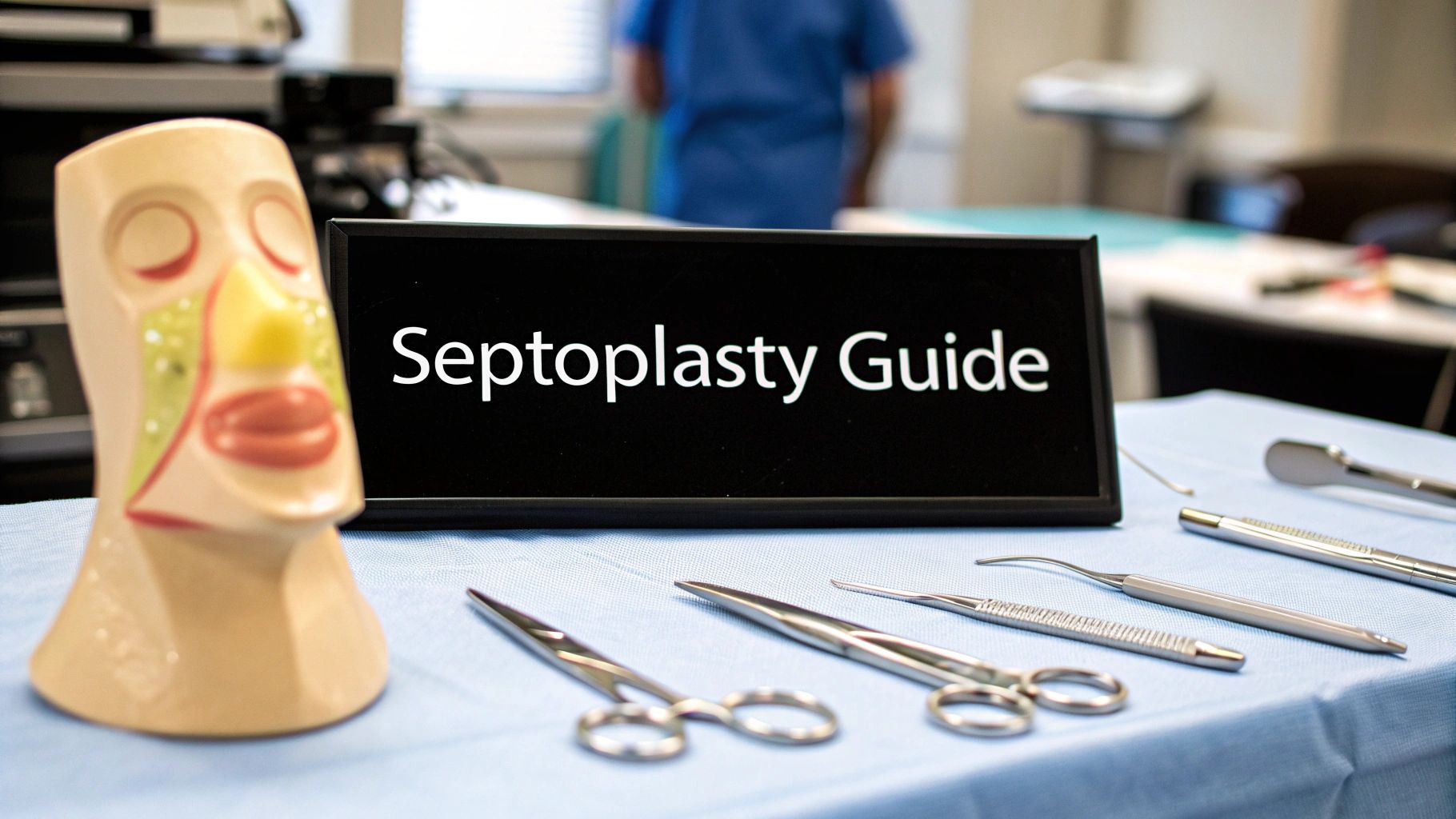
A septoplasty is a surgical procedure designed to straighten the nasal septum—the wall of bone and cartilage that divides your nasal cavity in half. When this internal wall is crooked, a condition known as a deviated septum, it can seriously obstruct airflow on one or both sides.
The entire point of a septoplasty is functional. It's about improving how well you can breathe, not about changing the way your nose looks on the outside.
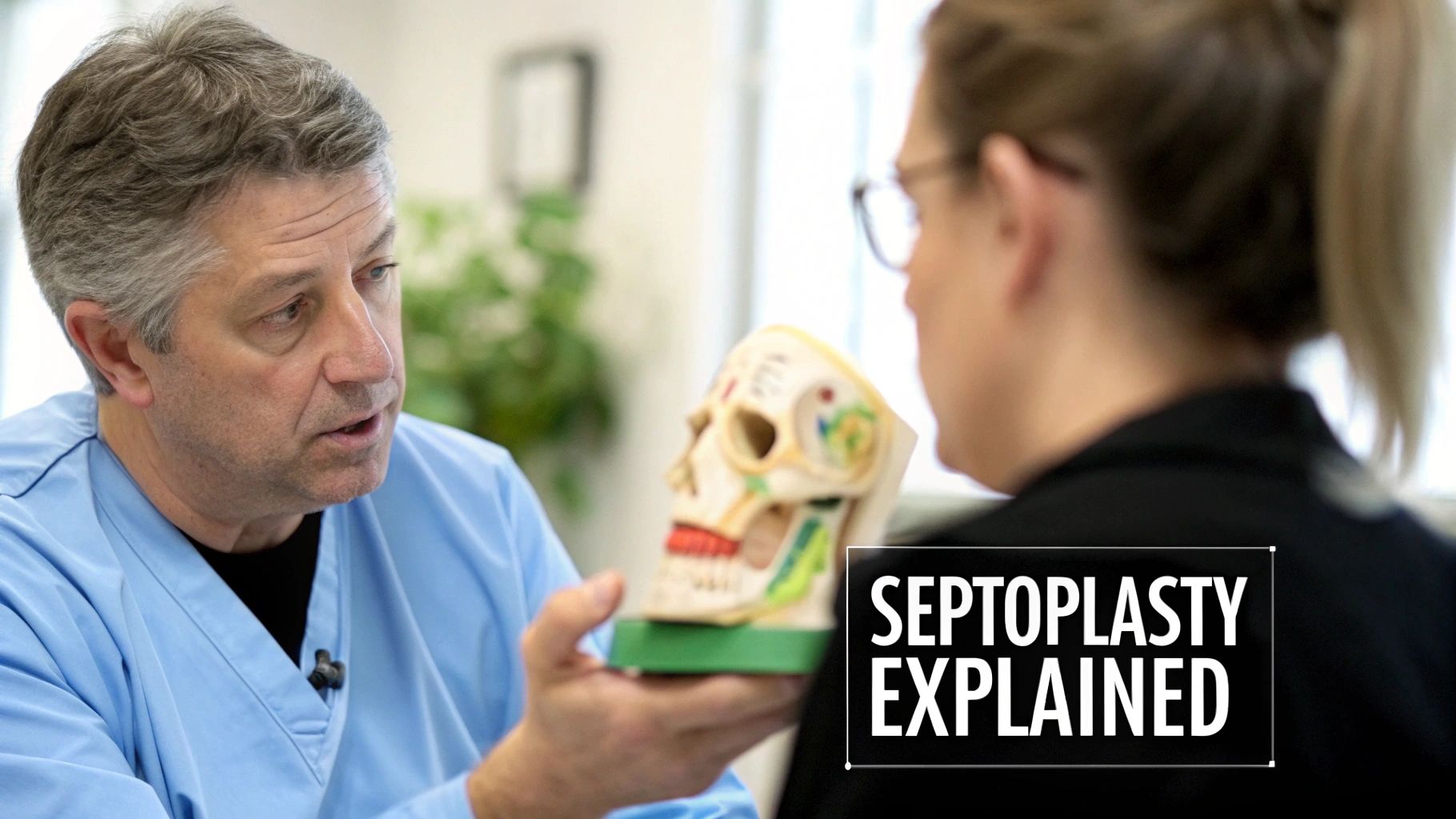
Think of your septum like the dividing wall in a two-lane tunnel. If that wall is straight, traffic (or air, in this case) flows smoothly on both sides. But if the wall is bent and juts into one of the lanes, it creates a major bottleneck, slowing everything down. A septoplasty is like a construction project that rebuilds that internal wall, opening up the passage for clear, easy breathing.
The surgery is performed entirely inside the nose. Your surgeon makes small, hidden incisions inside the nostrils to access the septum. From there, they will carefully trim, reposition, and sometimes remove the crooked parts of the cartilage and bone. Because all the work happens internally, you’re left with no visible scars. The end result is a straighter septum and a much more open airway.
Not every deviated septum is a problem. But when the deviation is severe enough, it can cause a whole host of frustrating symptoms that interfere with your quality of life. Recognizing these signs is the first step toward finding relief.
Use this quick reference table to see if your symptoms align with those commonly addressed by a septoplasty.
If you find yourself nodding along to several of these points, a septoplasty might be the solution you've been looking for.
If you're weighing your options, you can take comfort in knowing that septoplasty is one of the most common and successful procedures performed by ear, nose, and throat (ENT) specialists. It's a time-tested surgery with a proven track record.
In fact, a massive study that looked at 295,236 patients found that only a tiny fraction—just 1.1%—ever needed a second (revision) surgery. That’s an incredibly low number, and it speaks volumes about the procedure's high success rate when performed by a skilled, board-certified surgeon. You can explore the research on septoplasty success rates and outcomes for yourself.
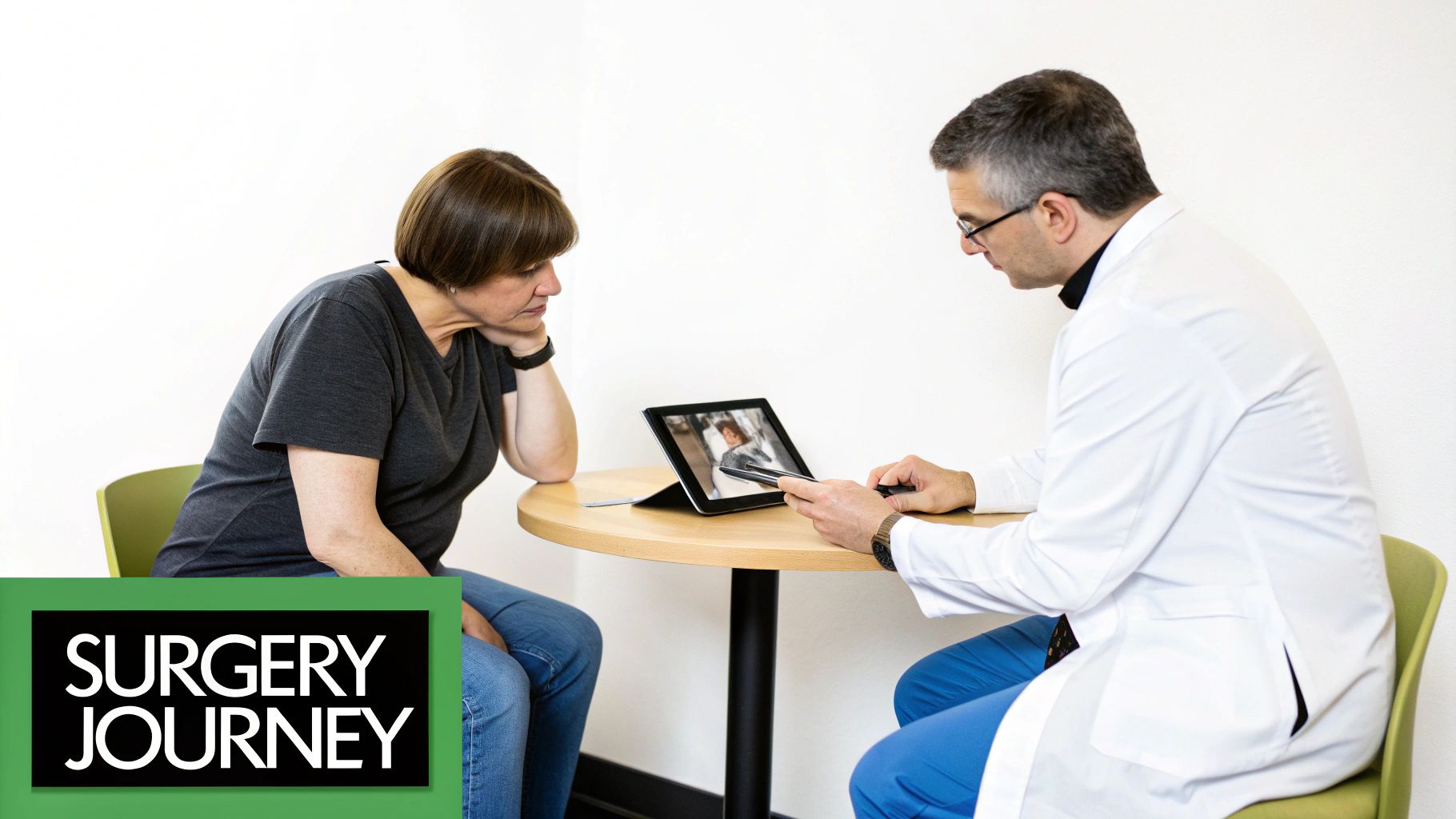
Knowing what to expect can make any medical procedure feel less intimidating and far more manageable. Your path to clearer breathing is a well-defined journey, one that starts with a simple conversation and culminates in a straightforward surgery designed for lasting relief. Let's walk through the process together, from your initial meeting right up to the day of your operation.
The first step is always the consultation. This is your dedicated time to sit down with us, talk about your symptoms, go over your medical history, and share what you’re hoping to gain. It’s an open conversation where we listen carefully to the challenges you're facing, whether that's chronic stuffiness, terrible sleep, or relentless sinus problems.
During that first visit, your surgeon will conduct a thorough physical examination of your nose. Using a bright light and a small tool called a nasal speculum to gently open your nostrils, they’ll get a good look at your septum. This initial inspection often gives us a clear idea of how significant the deviation is.
To get the full picture, we’ll often perform a nasal endoscopy. This isn't as scary as it sounds. We use a very thin, flexible tube with a tiny camera on the end to see deep inside your nasal passages. This gives us a detailed, real-time view of your septum and other structures, like the turbinates. It confirms the blockage and helps us map out the perfect surgical approach for you.
Think of a nasal endoscopy as a crucial "look under the hood." It lets your surgeon see exactly where your septum is off-kilter and how severe it is, ensuring the surgical plan is perfectly tailored to your unique anatomy.
Once we've confirmed that a deviated septum is the root cause of your breathing issues, we’ll explain the septoplasty procedure in detail. We’ll answer every question you have until you feel completely confident and informed. This is also the perfect time to discuss whether combining your surgery with another procedure makes sense for you.
Sometimes, a deviated septum is just one piece of the puzzle. For many people, achieving the absolute best airflow means tackling a couple of issues at once.
Talking through these options during your consultation ensures your surgical plan is fully aligned with both your breathing needs and your personal goals.
When your surgery day arrives, you can rest easy knowing you're in experienced hands. A septoplasty is an outpatient procedure, which means you’ll be heading home the very same day. The surgery itself is also quite quick, typically lasting between 60 to 90 minutes.
You’ll be under either local or general anesthesia, so you will be completely comfortable and feel no pain. Your surgeon will work entirely through your nostrils, making small, hidden incisions on the inside of your nose. This meticulous internal approach is why a septoplasty leaves no visible external scars.
So what’s happening on the inside? Your surgeon will carefully lift the delicate mucous membrane that covers the septum to get to the cartilage and bone beneath. They will then straighten the deviated areas by trimming, repositioning, or removing tiny pieces of the crooked material. Once the septum is straight and centered, the membrane is laid back down, and the internal incisions are closed with dissolvable stitches. That's it—your journey from consultation to correction is complete.
It's one thing to talk about the technical details of a septoplasty, but what really matters is how it changes your day-to-day life. Fixing a deviated septum is more than just a structural repair—it’s about getting back your comfort, your rest, and your energy. So many of our patients tell us that after they’ve healed, it feels like they’re taking their first truly deep, satisfying breath through their nose in years.
That single improvement, clear airflow, can kick off a whole chain reaction of positive changes. It’s no exaggeration to say that breathing better can genuinely lead to a better life, improving everything from how you sleep to how you perform physically.
Once your nasal passages are clear, you'll start to notice the benefits pop up in all sorts of ways. That constant, low-grade struggle for air simply vanishes, replaced by an ease you might have forgotten was even possible.
Here are some of the biggest improvements people tell us about:
Often, the most powerful benefit is also the simplest: the quiet relief of breathing without thinking about it. That background noise of stuffiness and struggle just gets turned off, opening the door to a new level of daily comfort.
For many people, the most life-changing result is the end of constant sinus issues. A deviated septum can easily block your sinuses from draining properly, which creates a perfect breeding ground for bacteria and leads to one infection after another.
By opening up those drainage pathways, a septoplasty helps break that miserable cycle of congestion, pressure, and headaches that comes with chronic sinusitis. If you struggle with this, you might also find it helpful to learn how to manage sinusitis at home alongside medical treatment. The surgery addresses the root cause, offering a lasting solution instead of just temporarily masking symptoms.
The numbers really back this up. One huge study that followed 5,865 septoplasty patients for ten years found that an incredible 76% had total or near-total relief from their symptoms within just six months. Another trial showed that the surgery significantly improves nasal airflow, boosting quality-of-life scores far more than any non-surgical options ever could. You can read more about these compelling septoplasty outcomes and see just how much of a difference it makes.
Knowing what to expect after your septoplasty is the single best way to make the experience as smooth and comfortable as possible. The term "recovery timeline" can sound a bit clinical, but it's really just a predictable path back to feeling great and, most importantly, breathing freely.
Your body is an incredible healer, and the process happens in clear, manageable stages. This guide will walk you through the entire journey, from your first day home to that amazing moment you take a deep, effortless breath through your nose.
The first day is all about one thing: rest. Once you're settled in at home, your only job is to take it easy. You’ll feel very congested—think of the worst head cold you’ve ever had—which is caused by swelling and any splints or packing inside your nose.
Don't expect sharp pain; it’s more of a dull ache or pressure headache, which is easily managed with the medication we prescribe. The most important thing you can do is keep your head elevated on pillows, even when sleeping, to help bring that swelling down.
This first week is where the most significant healing begins, and it’s also where your patience will pay off. Swelling and stuffiness will peak in the first few days before starting to improve. A little bit of bloody drainage is also completely normal, so don't be alarmed.
Following your aftercare instructions to the letter is crucial. This will almost always include:
Toward the end of the week, you'll come back to see us for a follow-up. At this appointment, we’ll remove any internal splints. This is a huge milestone for most people, as it’s often the first time you get a real sense of how much better your airflow will be.
By week two, you’ll start feeling much more like yourself. The congestion will continue to fade, and you'll notice your breathing getting easier each day. You might still feel a bit stuffy, especially in the mornings, but the toughest part of recovery is officially behind you.
Most people can return to a desk job or school during this time. We’ll clear you for light exercise like walking or using an elliptical, but you must continue to avoid contact sports or any activity where your nose could get bumped. It's also important to know what to look for as you heal; learning about the signs of infection after septoplasty is a smart way to stay proactive.
By the end of the first month, the improvement in your breathing is usually dramatic. It’s not the final result just yet, but it’s an incredibly encouraging preview of what’s to come.
To help you plan, we've put together a simple table that outlines what you can expect and when. This gives you a clear, at-a-glance guide to your healing journey.
This timeline is a general guide, and everyone's body heals at its own pace. The key is to listen to your body and follow our specific instructions.
While you'll feel almost fully recovered after about a month, your nose's internal tissues are still quietly healing and settling. Over the next several months, the last traces of swelling will vanish, and your breathing will become even more refined. Most surgeons agree that the final, optimal results of your septoplasty are fully realized around three to six months after the procedure.
This is when you can truly appreciate the full benefits of your surgery.
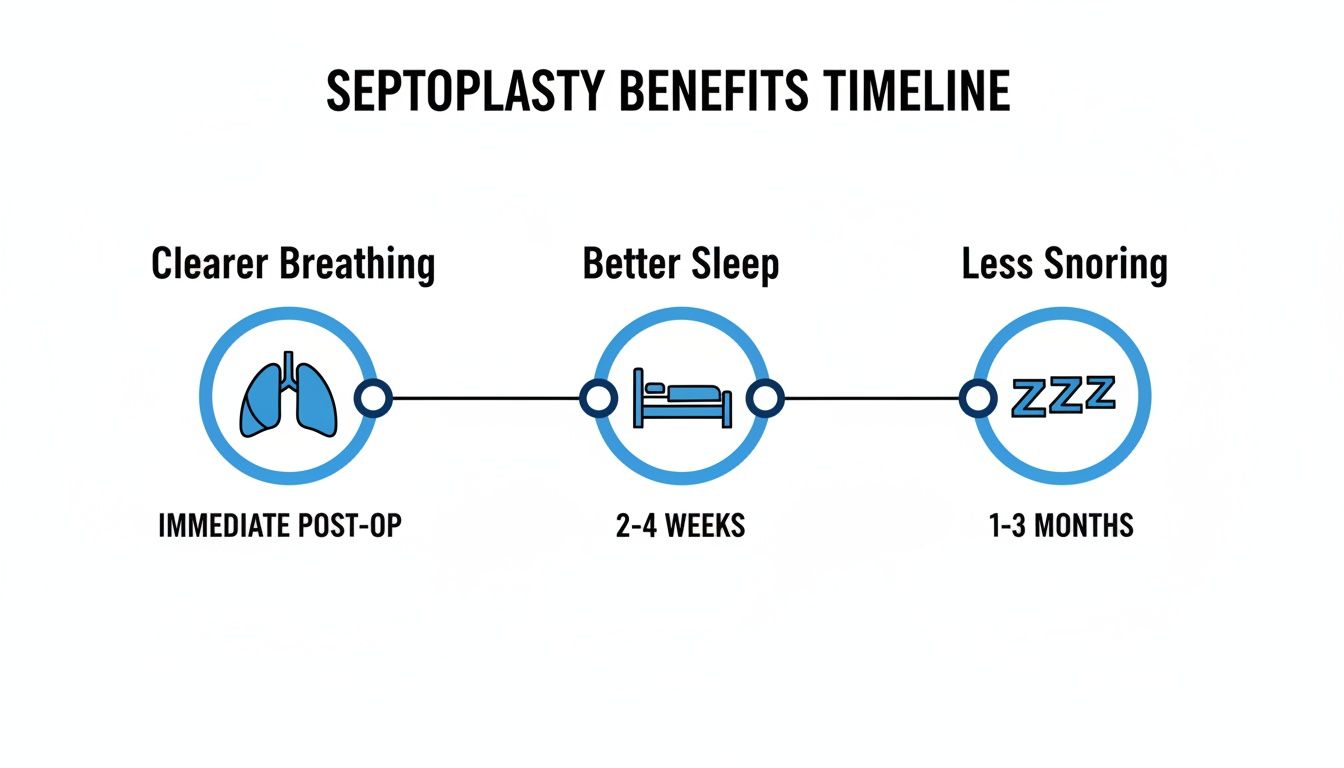
As you can see, the primary goal—clearer breathing—unlocks so many other quality-of-life improvements, like deeper sleep and less snoring, as your healing journey progresses.
Whenever you consider surgery, it's completely natural to weigh the benefits against the risks—and of course, to figure out the financial side of things. I want to walk you through both so you feel confident and fully prepared for what's ahead.
Let’s be clear: septoplasty is an overwhelmingly safe and common procedure. The vast majority of our patients sail through it with fantastic results and no complications. In fact, its effectiveness is so well-established that the demand continues to grow, with the market expected to reach USD 5.27 billion by 2035. A large study involving over 5,600 patients also confirmed what we see every day: very low complication rates.
While every surgery has some level of risk, the ones associated with septoplasty are rare and usually minor. The single best way to ensure a smooth experience is by choosing a board-certified surgeon who has performed this procedure hundreds, if not thousands, of times.
Here are a few of the infrequent risks we discuss with every patient:
It’s important to remember that these complications are the exception, not the rule. During your consultation, we will discuss these transparently so you have a complete understanding.
Now for the practical part: paying for it. Here’s the good news—since a septoplasty is done to fix a real, functional breathing problem, it's considered a medically necessary procedure. This means that most health insurance plans will cover it.
The process might seem a little daunting, but it really comes down to a few key steps. You’ll need to know the details of your specific plan, like your co-pay, co-insurance, and annual deductible. For instance, knowing what a deductible is in insurance is crucial for estimating what you'll pay out-of-pocket.
Don't worry, you won't have to figure this out alone. Our office team is fantastic at this and will help you get pre-authorization from your insurance company. This is simply the formal green light needed before we schedule the surgery. We handle all the necessary paperwork to prove medical necessity, making things as simple and stress-free for you as possible.
If you want to dive deeper, we have a helpful guide on whether insurance covers a deviated septum.
It's completely normal to have more questions even after you've learned the basics. Getting clear, direct answers is the best way to feel confident and prepared for what's ahead. Let's walk through some of the most common questions we hear from patients every day.
We want to tackle those lingering thoughts head-on, from what you'll see in the mirror to how you'll feel during recovery, so you have the clarity you need.
This is probably the number one question we get, and the answer is simple: a standard septoplasty will not change the look of your nose.
This surgery is purely functional. Its sole purpose is to straighten the wall inside your nose to help you breathe. Since all the work is done through your nostrils, there are no external incisions or visible scars. If you're also interested in changing the shape or size of your nose, we can easily combine a septoplasty with a rhinoplasty. This popular combination, often called a "septorhinoplasty," lets us fix your breathing and refine your nose's appearance in one go.
You’ll be completely comfortable under anesthesia during the procedure itself. Afterward, most patients tell us the recovery feels more like significant stuffiness than sharp pain.
Think of it like a very bad head cold. You'll likely feel pressure, congestion, and maybe a dull headache for the first few days. We'll make sure you have the right pain medication to manage this discomfort easily. The worst of it is usually over within the first week.
Most patients are surprised to learn that recovery is less about pain and more about managing congestion. The feeling of being "stuffed up" is the biggest hurdle, but it improves dramatically once the internal splints come out.
Patience is the name of the game here. Even though we fix the structural problem during surgery, you won't feel the full effect immediately because of post-op swelling.
Many people start to notice a real improvement in their breathing within 2 to 4 weeks as that initial swelling goes down. But your nose continues to heal and settle on the inside for quite a while. Most patients find that their breathing reaches its final, optimal state about 3 to 6 months after the septoplasty.
For very mild cases, some non-surgical options can offer temporary relief. Things like nasal steroid sprays, antihistamines, or decongestants can help by calming down inflammation inside your nose.
You might also get some relief from over-the-counter nasal strips that you wear at night, which physically pull your nostrils open a bit wider. It's crucial to remember that these are just temporary patches—they only manage the symptoms. They don't correct the crooked septum causing the problem in the first place.
For a significant structural blockage, septoplasty is the only way to get a permanent fix.
Ready to find out if a septoplasty is the right solution for you? At Cape Cod Plastic Surgery, Dr. Fater and our experienced team are here to guide you toward lasting relief and clearer breathing. Schedule your personalized consultation today and take the first step.
September 9, 2026
Expert Guide to Proper Surgical Incision Care
Master dermal fillers aftercare with do's and don'ts, swelling tips, activity limits and warning signs to protect your results and heal smoothly.

September 8, 2026
Ensuring Safety: Why Your Surgeon's Credentials Matter Most
Cape Cod Plastic Surgery offers expert cosmetic and reconstructive procedures in a safe, accredited setting. Led by Dr. Marc Fater, we combine advanced techniques with personalized care to help you look and feel your best.
Monday: 9:00 AM – 5:00 PM
Tuesday: 9:00 AM – 5:00 PM
Wednesday: 9:00 AM – 5:00 PM
Thursday: 9:00 AM – 5:00 PM
Friday: 9:00 AM – 5:00 PM