

October 7, 2026
What to Expect During Your Breast Surgery Recovery
A Practical Guide to Healing After Breast Surgery
Jun 8, 2026

Readers of advanced hair restoration reviews often treat them as if they were restaurant ratings. They scan stars, look at a few before-and-after photos, and assume the clinic with the strongest marketing must offer the best surgery. That's the gap. Hair restoration is closer to a long-term treatment plan than a one-time purchase, and the reviews that matter most usually answer different questions: who directly performs the surgery, how the clinic handles larger or corrective cases, what techniques it offers when a patient isn't a fit for one approach, and whether the published results look consistent rather than selectively dramatic.
That distinction matters because “advanced” in hair restoration isn't just branding. The term often tracks procedural complexity. A Wimpole Clinic cost analysis of advanced hair restoration notes an average cost of £4,820 for a 1,500-graft transplant, while much larger cases rise steeply into far higher totals, and fewer than 1% of first FUE or FUT procedures require 4,000 grafts or more. In plain English, advanced cases are uncommon, expensive, and harder to judge from generic reviews.
This guide approaches advanced hair restoration reviews differently. Instead of treating clinics as interchangeable, it reviews the review signals themselves. You'll see which centers make verification easier, which ones appear strongest for repair work or technique breadth, and how to apply the same logic to a local practice if you're comparing options closer to home.

Advanced Hair Restoration is one of the easier brands to evaluate if your goal is verification, not just persuasion. The clinic group points patients toward multiple review environments and publishes a large volume of visual proof, which is exactly what a cautious reader should want from advanced hair restoration reviews.
Its biggest strength is procedural breadth. The group promotes FUE, no-shave FUE, hybrid FUE, FUT, and medical hair-loss care. That matters because a clinic that only sells one technique can end up making every patient look like a fit for that technique.
The brand states that it has helped over 40,000 patients through its testimonial hub. That doesn't prove every outcome is strong, but it does change how you should interpret the review ecosystem. A high-volume practice generates more patient stories, more before-and-after variation, and more chances to see whether quality looks repeatable across hairlines, densities, donor types, and repair scenarios.
For comparison, another major industry provider says more than 20,000 men have chosen its procedure, which reinforces a broader market point already noted. This isn't a niche category with only scattered anecdotal evidence. Large practices can produce enough real-world material for patients to compare patterns rather than isolated success stories.
Practical rule: When a clinic has high patient volume, don't ask only whether it has good reviews. Ask whether the reviews are consistent across locations, surgeons, and case types.
No-shave FUE is a meaningful differentiator for patients who care about keeping the procedure less visible during recovery. That's especially useful for people with public-facing jobs or limited time away from work.
A second positive signal is that the company makes third-party checking straightforward. If you're weighing a national provider against a local surgeon, Cape Cod readers can use the same standards described in Cape Cod Plastic Surgery's guide on how to choose a hair transplant surgeon.
For readers who are still comparing transplant surgery with non-surgical regrowth ideas, Morfose's hair regrowth guide is a useful companion read.

Bauman Medical occupies a different lane. Where some clinics compete on broad accessibility, this center presents itself more like a surgeon-led specialty practice built around privacy, niche grafting, and adjunctive care.
That profile changes how its reviews should be read. Instead of focusing only on hairline photos, look for signs of decision quality. Did patients explain why they were offered no-shave VIP|FUE rather than a conventional approach? Did eyebrow or eyelash patients describe planning in anatomical detail? Those details are more useful than generic praise.
Bauman Medical stands out for combining surgical transplant options with non-surgical and supportive therapies such as PRP, low-level laser therapy, and follicle banking. Even without public pricing, that breadth tells you something important about positioning. This is a clinic trying to manage hair restoration as a continuum, not just a one-day procedure.
That can be a strength in advanced cases because many consumers searching advanced hair restoration reviews are not limited to choosing FUE versus FUT. They're trying to understand whether the clinic can build a staged plan that protects remaining hair while restoring lost areas.
Reviews are more credible when the patient can explain the treatment logic, not just say the staff was nice.
A practical way to vet any consultation is to borrow a framework from Cape Cod Plastic Surgery's article on how to choose a plastic surgeon. The same principles apply here. You want clear explanation of candidacy, tradeoffs, and who does what in the room.
Bauman Medical may be most compelling for patients who prioritize discretion and add-on care. It may be less attractive for price-first shoppers because premium specialty centers usually reveal cost only after individualized assessment.
Focus on these review signals:
The strongest reviews from centers like this aren't the most enthusiastic. They're the most specific.

Bernstein Medical – Center for Hair Restoration is one of the clinics where the educational material itself becomes part of the review. A center with a long-standing research and patient-education presence gives you more than testimonials. It gives you a way to test whether its public explanations are nuanced or sales-driven.
That matters in advanced hair restoration reviews because methodical clinics often sound less flashy. They spend more time discussing donor limits, design strategy, and why one patient may need FUT while another is better served by robotic or manual FUE.
Bernstein Medical is known for combining FUT with ARTAS robotic FUE and for publishing extensive FAQs and technical updates. For consumers, that creates a useful filter. If a clinic explains limitations clearly in public, it's more likely to be candid in consultation.
This is also where cost interpretation can go wrong. In expensive urban markets, patients often overfocus on headline price and underfocus on planning discipline. That's risky in hair transplantation because an aggressive first surgery can create future problems if native hair continues to thin.
A useful local benchmark is Cape Cod Plastic Surgery's discussion of cosmetic surgery cost, because it encourages readers to think beyond sticker price and ask what's included in expertise, facility standards, and follow-up.
Bernstein Medical tends to appeal to analytically minded patients. If you like surgeon-authored education, detailed limitations, and structured technique selection, the clinic is easy to place high on a shortlist.
A sophisticated review doesn't just ask, “Did it work?” It asks, “Was this the right first move for this patient's lifetime donor supply?”
That's where Bernstein Medical tends to score well in a review-of-reviews framework.
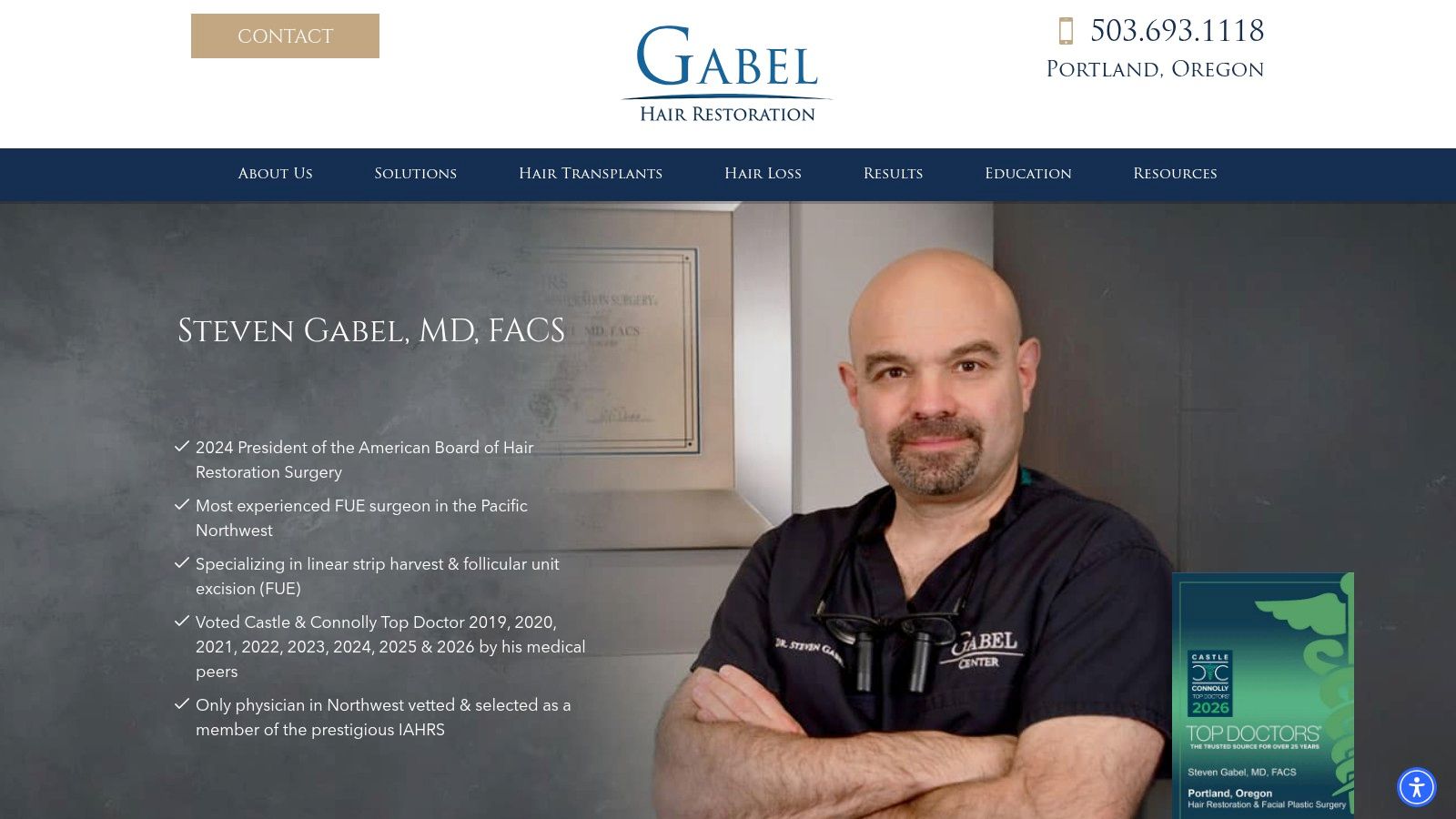
Gabel Hair Restoration Center represents the boutique end of the market. A narrower, surgeon-led practice with an exclusive focus on hair surgery often produces a very different review pattern from multi-location brands. You usually see fewer total reviews, but more detailed comments about design, communication, and continuity of care.
That makes this clinic especially relevant if you're reading advanced hair restoration reviews for artistry, repair work, or gender-affirming planning rather than for convenience alone.
Gabel's reputation is closely tied to meticulous hairline planning, revision work, and transgender or gender-affirming hairline procedures. Those are categories where generic five-star summaries tell you almost nothing. What matters is whether patients describe subtle, individualized choices that fit their face, scalp laxity, donor supply, and long-term goals.
Repair and revision cases are particularly important. Corrective surgery is one of the strongest real-world indicators that a surgeon can solve problems, not only perform straightforward first-time transplants.
If a clinic is repeatedly trusted with repair cases, that's often a sign peers and patients believe its judgment is stronger than average.
This kind of practice tends to suit patients who want direct surgeon involvement and are willing to trade convenience for consistency. You should still read cautiously. Boutique models can generate highly loyal word-of-mouth, but lower volume means each published result carries more visual weight.
Use a tighter screen here:
In a review-of-reviews ranking, Gabel stands out less for breadth and more for surgical taste. That's a meaningful distinction. Some patients need every available technology. Others need a surgeon with a narrower focus and a better eye.

Shapiro Medical Group is one of the clearer examples of why longevity matters differently in hair restoration than in many cosmetic categories. A long-established practice accumulates not only more reviews, but also more chances to demonstrate restraint over time. In hair surgery, restraint is often the difference between a result that still looks good years later and one that ages badly.
The practice is widely associated with hairline design, repair work, and both FUT and FUE. That combination makes it a useful case study for evaluating whether a clinic can handle first procedures and corrective ones with the same planning philosophy.
Shapiro's review profile tends to attract readers who care about naturalism more than aggressive coverage promises. That's important because many patients enter consultations wanting density everywhere, even when donor supply or future loss pattern makes that unrealistic.
The most revealing reviews here are usually the least dramatic. They talk about why the clinic advised a more conservative hairline, why a repair case required patience, or why FUT versus FUE was recommended for a specific donor strategy.
Practices with a deep educational library can help patients cross-check what they're being told in person. If the consultation and the published teaching material line up, credibility rises. If the website sounds cautious but the consultation sounds like a hard sell, that discrepancy should concern you.
This is one of the clinics that often rises in advanced hair restoration reviews because the underlying planning philosophy shows up repeatedly, even when patients had different starting points.

Chicago Hair Institute is often discussed as a high-aesthetic practice with a small, specialized team. That setup matters because staffing model is one of the most overlooked factors in advanced hair restoration reviews. Patients tend to fixate on the brand name and forget to ask how many cases the team handles in a day, who performs extraction and placement, and whether the surgeon is spread thin.
A small team can be a real advantage when the clinic's identity depends on precision and limited volume.
Chicago Hair Institute emphasizes individualized FUE and FUT planning, refined graft placement, and natural hairline design. Those aren't unique phrases in this industry, but in a small-team context they mean something more concrete. The clinic is implicitly telling you it values control over throughput.
That's worth paying for in some cases, especially if you're a patient who has finite donor supply and wants highly conservative graft use. In those situations, fewer daily cases may align better with your priorities than a larger operation designed for convenience.
The clinic with the longest wait isn't automatically better. But a clinic that protects time for design and placement often produces reviews that sound more detailed and less transactional.
This clinic tends to appeal to readers who study photos closely and care about fine aesthetic decisions. If you're comparing advanced hair restoration reviews with an eye for macro density alone, you might miss its strongest value.
Look for these clues:
That review profile doesn't suit everyone. It does suit patients who'd rather do less, more carefully, than chase an immediate visual win that may not hold up.
New England Center for Hair Restoration is one of the most relevant entries for Massachusetts readers because it combines regional convenience with a wide mix of technologies, including manual FUE, FUT, ARTAS robotic FUE, and NeoGraft. For local consumers, that breadth makes it a useful comparison point. You can see how a center frames different tools and whether it explains them as genuine options or as branding layers around the same sales pitch.
That distinction matters because the global hair transplant services market is projected to grow from US$7.9 billion in 2026 to US$11.3 billion by 2033, with a 5.2% CAGR according to Persistence Market Research. In a steadily expanding market, clinics have an incentive to market technology aggressively. Patients need a way to separate meaningful choice from technology theater.
NEhair's value in advanced hair restoration reviews is less about one signature procedure and more about side-by-side comparison. A center that offers manual and robotic pathways gives patients a chance to ask better questions. Does the surgeon explain when robotics help? Does the clinic discuss when FUT still makes sense? Are adjunctive therapies positioned as support, not substitutes for surgical planning?
For Cape Cod and Boston-area patients, location matters too. A local or in-state option can make consultation, follow-up, and staged care more realistic.
This is the clinic I'd treat as a regional benchmark, not an automatic winner. Its broad menu is useful only if the consultation narrows choices intelligently.
| Provider | Implementation complexity 🔄 | Resource requirements ⚡ | Expected outcomes ⭐📊 | Ideal use cases 💡 | Key advantages ⭐ |
|---|---|---|---|---|---|
| Advanced Hair Restoration | Moderate–High, multiple techniques (FUE, no‑shave, hybrid, FUT) | High, surgeon involvement, multi‑location staff; typical US range ~$4k–$15k+ | Good to very good; outcomes vary by location; third‑party verification available 📊 | Patients wanting discreet/no‑shave options and multi‑site convenience | Technique variety, convenience options, visible patient reviews |
| Bauman Medical | High, VIP no‑shave FUE and broad adjunct programs | Very high, premium clinic resources, specialty tech (PRP, follicle banking) | High aesthetic and adjunctive results; strong specialty grafting ⭐📊 | Clients seeking VIP experience, eyebrow/eyelash work, and advanced adjuncts | Specialty grafting, extensive patient education, minimal‑downtime focus |
| Bernstein Medical – Center for Hair Restoration | High, robotic ARTAS + FUT with methodical surgeon protocols | High, academic/clinical resources, NYC pricing often above average (~$8k+) | Consistently natural planning and documented outcomes; research‑backed ⭐📊 | Patients valuing academic reputation, robotic options, and long track record | Longstanding leader, publishes research, transparent technique selection |
| Gabel Hair Restoration Center | Moderate, surgeon‑led boutique FUE/FUT focused on hair surgery | Moderate–High, low‑volume surgeon fees; boutique staffing model | High aesthetic consistency, strong repair and revision success ⭐📊 | Repair/revision cases and gender‑affirming hairline procedures | Boutique consistency, meticulous aesthetic planning, strong follow‑up |
| Shapiro Medical Group | High, established surgeon‑led protocols emphasizing hairline design | High, experienced team, extensive educational resources | Reliable conservative planning and corrective outcomes; large review library 📊 | Conservative planners and complex corrective/transplant repairs | Teaching lineage, extensive patient education and reviews |
| Chicago Hair Institute | High, individualized design with refined graft placement | High, small specialized team, limited daily volume, premium fees | High‑aesthetic, long‑term outcomes for patients prioritizing natural results ⭐📊 | Patients prioritizing superior aesthetics and conservative graft use | Refined placement technique, strong reputation for aesthetics |
| New England Center for Hair Restoration (NEhair) | Moderate–High, offers manual FUE/FUT, ARTAS, NeoGraft | Moderate, regional center with multiple technologies; consult‑based pricing | Good outcomes with option to compare manual vs robotic approaches 📊 | Massachusetts/Cape Cod patients wanting local access and tech comparison | Multiple technologies in one center, detailed cost explainer and patient blog |
The best use of national advanced hair restoration reviews isn't to copy someone else's shortlist. It's to build a sharper standard for your own consultation. After looking across these clinics, a pattern emerges. The strongest providers usually do four things well. They explain technique choice clearly, they show a deep before-and-after archive, they handle complex or corrective planning without overselling, and they make it easier to verify results beyond their own marketing.
That last point matters more than many patients realize. Public-facing hair restoration content still leans heavily on procedure labels like FUE, while long-term durability and maintenance questions often stay underexplained. A California Hair MD overview of advanced hair restoration notes the global hair transplant market was estimated at about USD 6.4 billion in 2024 and argues that consumers increasingly need better evidence on how results hold up over time. That's a blind spot in many reviews. A transplanted graft may be permanent, but your cosmetic result still depends on what happens to surrounding native hair in the years that follow.
So bring different questions into your local consult. Ask who designs the hairline. Ask who performs extraction and placement. Ask whether the plan assumes future thinning, staged sessions, medical therapy, or later touch-ups. Ask to see not only immediate transformations but also mature results that show how the work ages.
For a local practice such as Cape Cod Plastic Surgery, the same framework applies. Don't evaluate the office only on reputation or convenience. Evaluate whether the surgeon discusses donor supply, facial balance, scar visibility, downtime, and realistic coverage in terms you can understand. A practice that communicates limits well is often safer than one that promises maximum density too quickly.
There's also a practical financial reason to ask better questions. Surprise billing and unclear treatment scope can complicate elective care decisions, which is why broader resources on mastering NSA compliance for practices are useful background for consumers who want transparent cost discussions. Even in self-pay aesthetics, clarity matters.
The right surgeon isn't the one with the loudest marketing. It's the one whose case selection, documented results, and consultation logic still make sense after the sales language fades. If you use advanced hair restoration reviews that way, they stop being social proof and become a screening tool.
If you're comparing hair restoration options in Massachusetts, Cape Cod Plastic Surgery is worth evaluating with the same evidence-based lens used in this guide. Review the practice's consultation approach, ask detailed questions about candidacy and planning, and use national benchmarks to decide whether the recommendations you receive are specific, realistic, and built for long-term results.
October 7, 2026
A Practical Guide to Healing After Breast Surgery

October 6, 2026
Your Safety Guide: What to Look for When Choosing a Plastic Surgeon

October 5, 2026
Why Our On-Site Accredited Facility Matters for Your Safety

Cape Cod Plastic Surgery offers expert cosmetic and reconstructive procedures in a safe, accredited setting. Led by Dr. Marc Fater, we combine advanced techniques with personalized care to help you look and feel your best.
Monday: 9:00 AM – 5:00 PM
Tuesday: 9:00 AM – 5:00 PM
Wednesday: 9:00 AM – 5:00 PM
Thursday: 9:00 AM – 5:00 PM
Friday: 9:00 AM – 5:00 PM