

October 7, 2026
What to Expect During Your Breast Surgery Recovery
A Practical Guide to Healing After Breast Surgery
Jun 9, 2026

Some people reach the point of researching facial feminization surgery after a long stretch of small, private moments. You catch your reflection in a store window. You open your phone camera and immediately turn it away. You feel good in your clothes, your voice may be changing, your life may already reflect who you are, but your face still doesn't feel fully in sync.
That disconnect can be exhausting.
For many patients, the question isn't “How do I become someone else?” It's “How do I look more like myself?” That's an important difference. Best facial feminization surgery isn't about copying one ideal face. It's about identifying the specific features that read as more masculine on your face and deciding, carefully, whether changing them would help you feel more at ease in daily life.
Some people want a softer brow and nothing more. Others feel that the jaw, chin, and nose work together and need to be planned as a group. Some are ready for surgery now. Others want to start with education, photos, and consultations before making any decision. All of those approaches are valid.
What matters is that you understand the process well enough to make choices from a place of clarity, not pressure. The most successful FFS journeys usually start there. Not with a procedure list, but with a thoughtful look at your goals, your anatomy, your recovery tolerance, and the kind of result that would feel right when you look in the mirror.
A patient once described the experience this way: “I don't hate my face. I just feel like it tells the wrong story.”
That's often the heart of facial feminization surgery. You may already recognize yourself internally. Friends may see you as you are. But certain facial structures can still create friction between how you feel and how strangers read you. That friction can show up in photographs, in social situations, or in the simple act of passing a mirror.
Facial feminization surgery, or FFS, is a group of procedures designed to soften facial features that were shaped by testosterone during puberty. It's not one operation. It's not one standard package. It's a personalized surgical plan that may involve the forehead, brow, nose, cheeks, chin, jawline, lips, or Adam's apple, depending on your goals and anatomy.
For many people, that's where the confusion starts. You search for the “best” facial feminization surgery and find long lists of procedures, dramatic before-and-afters, and opinions that often contradict each other. One source says the forehead matters most. Another emphasizes the jaw. Another focuses only on finding the “best surgeon,” as if every patient needs the same exact plan.
The better question is usually not “Which FFS procedure is best?” It's “Which changes would make the biggest difference for my face?”
That shift in thinking makes the whole process easier to understand.
You don't need to walk into a consultation already knowing whether you need brow reduction, genioplasty, or a tracheal shave. You do need to understand what bothers you, what feels affirming, and what kind of trade-offs you're willing to accept in surgery and recovery. When you approach FFS that way, the process becomes less overwhelming and far more personal.
Facial feminization surgery changes the facial features that tend to read as more masculine after testosterone-driven puberty. In practice, that can mean working on bone, soft tissue, or both. This distinction matters, because some concerns respond well to styling, makeup, or hormones, while others come from the underlying framework of the face and usually need surgery to shift in a lasting way.
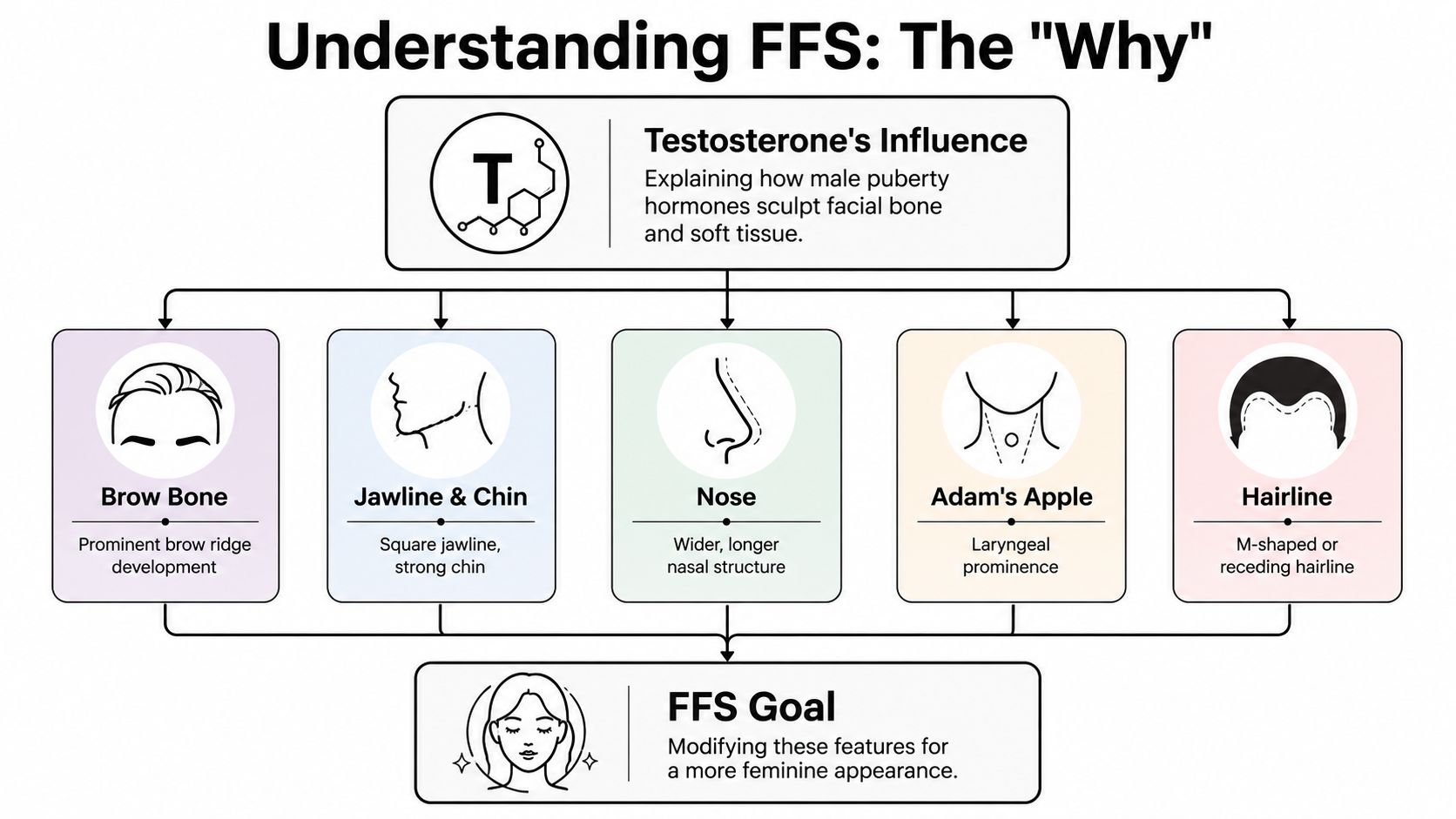
The simplest way to understand FFS is to see it as facial planning, not procedure collecting. A good plan starts with one question: which features are creating the biggest mismatch between how you want to be seen and how your face is currently read? The answer is rarely every feature at once.
Patients often arrive focused on a single area, such as the nose or jawline. Surgeons usually assess the face more globally. They look at the upper, middle, and lower thirds together, because gender perception depends heavily on proportion, balance, and the relationship between features.
A published clinical series on FFS procedures reported that forehead surgery, rhinoplasty, and jaw angle reduction were among the procedures performed most often. That matches what many surgeons see in practice. Certain structural areas tend to influence first impressions more strongly than others.
Here is the practical takeaway:
This is why choosing FFS is not like ordering from a menu. It works more like editing a portrait. A few changes in the right places can shift the whole image.
FFS does not erase your identity or replace your face with someone else's. The goal is to adjust proportions and contours so your features align more closely with how you see yourself. For some people, that means a major change to the brow and almost nothing else. For others, the lower face carries more of the gendered signal. Some patients want subtle refinement. Others want the largest safe shift their anatomy allows.
That is why two people asking for a “feminine result” may leave the same consultation with very different surgical plans.
A useful rule is simple. If a proposed plan sounds nearly identical for every patient, it is probably too generic to be good planning.
Many prospective patients assume FFS happens in one long operation. Sometimes it does. Sometimes it should not.
Surgeons may divide treatment into stages based on your anatomy, the number of procedures involved, operating time, recovery burden, or your own priorities. The World Professional Association for Transgender Health describes facial surgery as part of gender-affirming care that should be individualized through shared decision-making and careful assessment in its Standards of Care Version 8. In real consultations, that can translate into sequencing. You might address the forehead and nose first, then revisit the jaw or soft tissue work later once swelling resolves and you can judge what still feels necessary.
Staging is often a sign of thoughtful planning. It gives you and your surgeon room to balance safety, recovery, budget, and aesthetic goals without forcing every decision into one day.
For many patients, that is a relief. It means you do not have to solve your whole face at once. You and your surgeon can build a plan in the right order, with clear priorities and realistic trade-offs.
A consultation for FFS often starts with a simple question: what is this feature doing to the overall impression of my face? That question matters more than memorizing procedure names. The same operation can be helpful, unnecessary, or even distracting depending on the rest of your anatomy.
FFS works like facial editing with structure, proportion, and soft tissue. Some changes affect the framework of the face. Others refine how that framework is read by the eye. The goal is not to collect procedures. The goal is to choose the changes that create the clearest improvement in harmony.
The upper face often carries a lot of visual weight. Brow projection, forehead slope, brow position, and hairline shape can influence first impressions before anyone notices smaller details.
| Procedure | Primary Goal | Target Area | General Recovery Note |
|---|---|---|---|
| Forehead contouring or frontal sinus setback | Reduce brow prominence and smooth the forehead contour | Forehead and brow bone | Swelling and tightness can take time to settle |
| Brow lift | Open and soften the eye area | Brows and upper eyelids | Early swelling can make the brow look higher before it settles |
| Hairline advancement | Shorten or round the hairline shape | Hairline and forehead border | Incision healing and scalp numbness may be part of recovery |
Forehead surgery often has an outsized effect because it changes a structural area that frames the eyes. A small reduction in brow prominence can shift the whole expression of the upper face. In other patients, the issue is less about bone and more about brow position or hairline shape, so the plan may center on a brow lift, hairline advancement, or a combination.
Anatomy matters. Some brow bones can be burred down conservatively. Others require frontal sinus setback because the underlying bone shape limits how much surface contouring is safe. If you are trying to understand the financial side of upper-face planning, this guide to brow bone reduction cost can help you prepare better questions for consultation.
The middle third of the face is often where balance becomes more subtle. A nose that feels too strong, cheeks that look flat, or an upper lip that appears long can each pull the face away from the softer look a patient wants.
These procedures are often easier to understand if you picture the middle face as the transition zone between the eyes and the jaw. If one feature dominates that zone, the eye keeps returning to it. Good planning reduces that visual pull without making the result look overdone. A rhinoplasty, for example, may be less about making the nose small and more about adjusting width, rotation, or projection so it no longer overpowers nearby features.
Soft-tissue procedures also play a different role from bone work. Fat grafting and lip surgery can soften, round, or brighten the face, but they do not replace structural correction when the main issue is skeletal shape. That distinction helps prevent disappointment.
The lower face often matters most for patients who feel their face reads broad, square, heavy, or bottom-dominant.
Lower-face planning can be deceptively complex because width is not always coming from the same place. In one patient, the jaw angles are the main driver. In another, the chin is too wide from the front. In another, muscle bulk, bite position, or overall skeletal balance contributes to the look. That is why a recommendation for jaw reduction alone is not always enough.
Some patients also need evaluation of bite, jaw position, and skeletal balance, especially if facial width or projection involves more than cosmetic contour. In those situations, understanding jaw realignment can help you separate orthodontic or functional issues from purely feminizing contour goals.
A strong surgical plan narrows the list to the few changes that will matter most on your face. That usually produces a better result than treating every feature that could be changed.
You may already know this moment well. You look in the mirror and feel that something reads too masculine, but the problem is hard to name. Then you start researching FFS and suddenly face a long list of procedure names that feels more confusing than helpful.
A better starting point is to study your face the way a good surgeon will. The goal is not to build a wish list from the internet. The goal is to figure out which few features are creating the overall impression that bothers you most, and which changes would shift that impression.
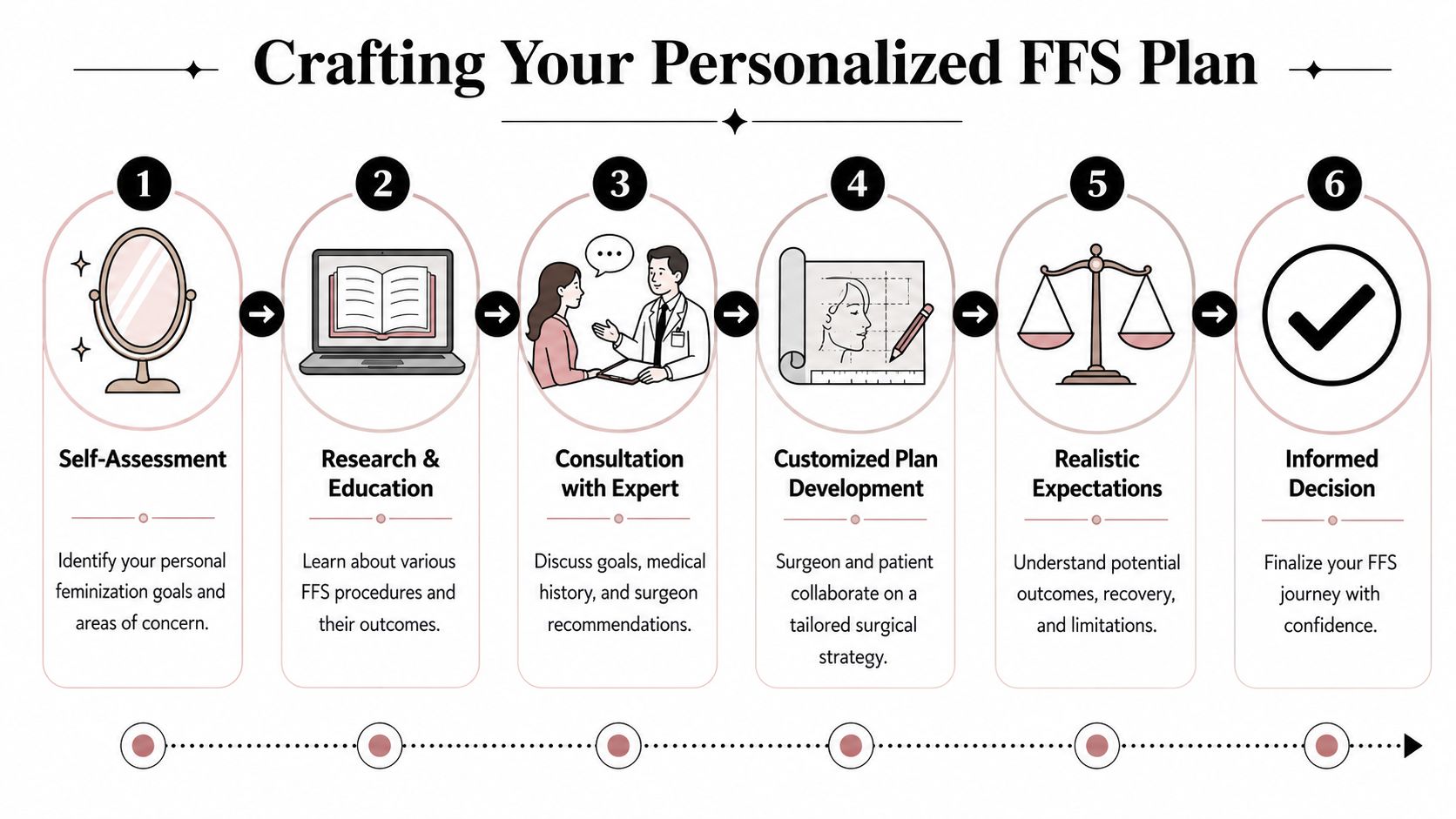
Patients often come to consultation saying, “I think I need forehead work, rhinoplasty, jaw reduction, chin contouring, and a tracheal shave.” Sometimes that list is accurate. Sometimes one or two structural changes would do far more than five smaller ones.
Your first job is simpler. Put your concerns into plain language.
For example:
That wording gives a surgeon something useful to work with. It points to perception first, anatomy second, and surgery third. That order matters because FFS is not a menu. It is a planning process.
Try reviewing your face with neutral front and profile photos, relaxed expression, and even lighting. A mirror can be misleading because you see movement, angle changes, and emotion. Photos freeze the structure and make patterns easier to spot.
Use a top-to-bottom approach:
Upper face
Does the brow project forward? Does the forehead slope in a way that makes the upper face look heavier? Does the hairline shape change how open or compact the forehead appears?
Midface
Does the nose draw attention before anything else? Are the cheeks adding balance, or does the center of the face look flatter and more angular than you want?
Lower face
Is the width coming from the jaw angles, the chin, or both? Does the chin look wide, tall, short, or prominent in profile?
Neck and transitions
Does the laryngeal prominence stand out on its own? Do the jawline and neck create a sharp, heavy transition rather than a softer one?
One feature can also change how another feature is perceived. A prominent brow can make the nose seem stronger. A broad chin can make the whole lower face look heavier even if the jaw angles are not especially wide. Facial planning works like composition in a portrait. The eye reads relationships, not isolated parts.
Many people get stuck. A surgeon may be able to change several areas, but that does not mean every possible change belongs in your plan.
Try dividing your goals into four categories:
This helps you walk into consultation with direction instead of rigidity. A good plan should reflect both anatomy and life circumstances.
A strong consultation is partly diagnostic. You describe what you see and what you want to change. The surgeon then identifies which structures are creating that appearance.
That translation step is where personalized planning happens.
For one patient, “I hate how masculine my upper face looks” may point to brow bone reduction and hairline work. For another, the key factor may be brow position, eyebrow shape, or forehead height rather than bone projection alone. For someone else, lower-face width may matter far more than the forehead. The same complaint can lead to very different plans because faces are built differently.
This is also why bringing inspiration photos requires caution. Photos can help communicate style, softness, or degree of change. They are less useful as blueprints. Your bone structure, skin thickness, soft tissue, hairline, age, and healing pattern will shape what is possible on your face.
One of the smartest questions you can ask is, “If I do this procedure, what changes in the way my face is perceived?” If the answer is small, subtle, or uncertain, that procedure may belong lower on the list.
Patients usually get the best value, both aesthetically and emotionally, from the changes that alter the overall read of the face rather than tweaking details no one else notices. That does not mean subtle procedures have no role. It means they should support the main plan, not replace it.
Some surgeons place more weight on the forehead because it often affects gender perception quickly. Others focus on whichever area creates the strongest masculine cue in that individual patient. The right answer depends on your anatomy, not a universal rule.
In practice, the best facial feminization surgery plan is usually a custom sequence. It reflects what bothers you, what your face is doing structurally, and what level of change fits your goals. One patient's ideal combination can be unnecessary, or even counterproductive, for someone else.
You wake up after surgery, look in the mirror a few days later, and your first thought is, "This does not look like the final result." That reaction is common. Early recovery can make a carefully planned change look unclear, exaggerated, or incomplete because healing and outcome unfold on different schedules.
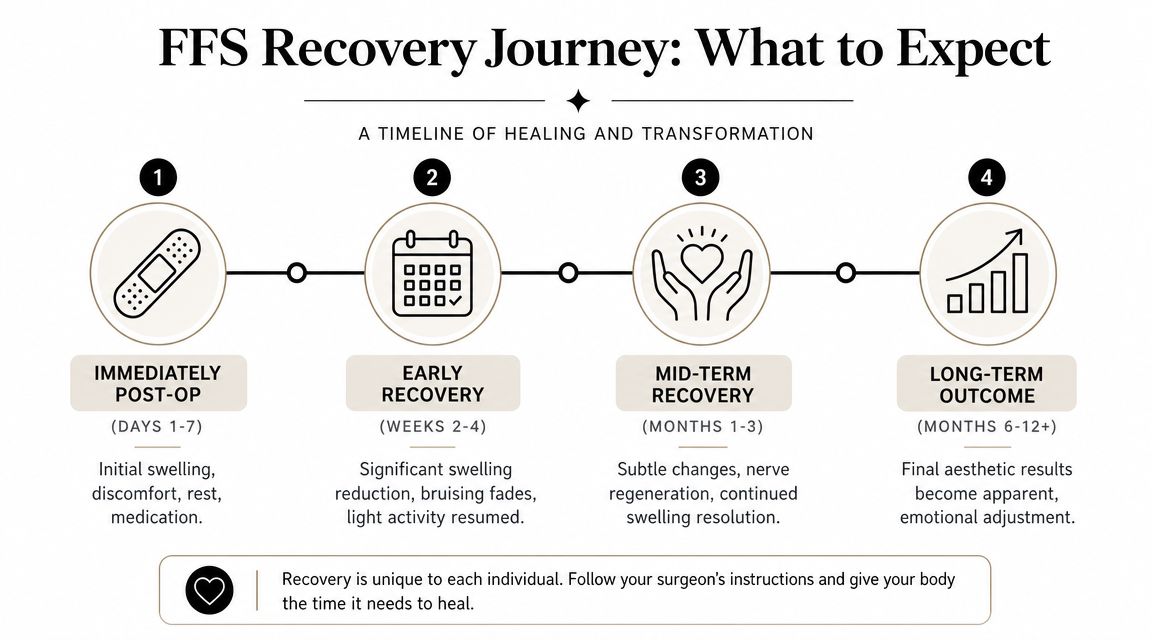
FFS recovery often includes swelling, bruising, tightness, numbness, fatigue, and mood shifts. Your face has been through real structural surgery, so it helps to expect a healing period that feels uneven rather than neatly linear.
The hardest part for many patients is psychological, not just physical.
You may know, logically, that swelling hides definition. Even so, it can be unsettling when the nose looks puffy, the jaw feels stiff, or the forehead seems unfamiliar. If rhinoplasty is part of your plan, this week-by-week guide to rhinoplasty recovery is a useful example of how facial refinement appears gradually as swelling settles.
A simple way to frame this is to separate three timelines: healing, appearance, and adjustment. Healing starts right away. Visible refinement takes longer. Emotional recognition, the moment when your reflection starts to feel more like you, can take longer still.
Meaningful improvement does not mean every feature becomes delicate, perfectly symmetrical, or identical to someone else's face. In FFS, a good result usually means the face reads more consistently with your gender goals while still looking like you.
That distinction matters.
As noted earlier in the reported outcomes research, patients can show substantial gains in feminization after surgery without matching every comparison group on every measure. That is a more useful expectation than perfection. The goal is better alignment between your facial structure, your self-image, and how others perceive you.
A skilled plan often improves the strongest gender cues first. The rest of the face then has room to work together more naturally, much like adjusting the frame of a painting changes how the whole image is seen.
Recovery is easier to handle when you expect stages instead of one dramatic reveal:
These phases do not move at the same speed in every area. A forehead may look settled sooner than a nose. A jawline may feel firm even after it looks better. Soft tissue also has to adapt to the new underlying structure, which is one reason patience matters so much after FFS.
The most helpful expectations are specific and personal. Instead of asking, "Will I look perfect?" ask questions you can measure against your own goals:
Those questions keep you focused on decision-making, not fantasy. They also lead to better conversations with your surgeon before surgery, which is when expectations are easiest to shape well.
Reality check: The aim of FFS is relief, congruence, and a better overall facial read. It is not flawless symmetry or a universal beauty standard.
Some patients feel immediate relief. Others need time for their eyes and emotions to catch up with the changes. Both responses are normal.
The surgeon matters, but not in the simplistic “best surgeon” ranking sense. The right surgeon for FFS is someone whose training, planning style, and communication fit the complexity of your case.

Before-and-after images matter, but they shouldn't be your first filter. Ask more basic questions first.
When choosing a surgeon, it's important to ask about experience, complication rates, and staged care pathways, especially because approaches can differ between private practice and larger hospital-based settings, as discussed in this guide to evaluating FFS surgeons.
A good consultation should feel collaborative, not sales-driven. The surgeon should ask what bothers you, explain how they see your anatomy, and discuss trade-offs candidly.
Pay attention to whether they:
A consultation can be technically polished and still feel wrong if you don't feel heard.
Whether you're consulting locally or traveling, the standards should stay the same. You're looking for relevant credentials, a personalized plan, a safe operating environment, and communication you trust.
As one example of what patients often look for in any surgical practice, Cape Cod Plastic Surgery provides consultations with a board-certified plastic surgeon and operates an on-site AAAASF-accredited surgical suite. That doesn't replace FFS-specific evaluation, but it reflects the kind of credentialing and facility standards worth checking in any practice you consider.
A question-and-answer list can make FFS sound like a menu. Real planning works more like tailoring. Two people may both ask for a softer brow or a more refined nose, yet the right plan can look very different because their bone structure, soft tissue, healing priorities, and budget are different.
It can be either. Some patients choose one operative plan because they want a single recovery period. Others stage treatment over time so they can focus first on the features that affect gender recognition most for them, then revisit secondary goals later.
Neither approach is automatically better. The better approach is the one that fits your anatomy, your health, your tolerance for recovery, and the order of changes that matter most to you.
Costs vary widely based on the procedures included, surgeon fees, anesthesia, facility charges, geographic location, and whether any part of care is covered by insurance. A brow reduction and hairline procedure creates a very different budget than a larger plan that also includes rhinoplasty, jaw contouring, and tracheal shave.
Ask for an itemized quote. That helps you compare consultations clearly and understand what is and is not included, such as pre-op testing, overnight observation, medications, and possible revision-related costs.
Risks depend on the specific procedures in your plan. Common topics to discuss include numbness or nerve changes, infection, visible scarring, asymmetry, contour irregularity, breathing changes after rhinoplasty, and dissatisfaction with the final aesthetic result.
The useful question is not just, "What can go wrong?" Ask, "What is most likely in my case, what usually improves with time, and what problems might require additional treatment?" That conversation gives you a clearer picture than a generic risk list.
Sometimes, for selected goals. Fillers, botulinum toxin, fat grafting, hairstyling changes, and skin treatments can soften facial cues or support surgical results. They do less when the main issue is bone structure, which is why consultation matters.
For patients thinking about facial presentation as a whole, including hair reduction as part of daily comfort and grooming, resources on safe laser hair removal solutions may also be useful.
If you're weighing facial surgery and want a careful, personalized conversation about your options, Cape Cod Plastic Surgery offers consultations focused on clear guidance, realistic expectations, and treatment planning that starts with your goals.
October 7, 2026
A Practical Guide to Healing After Breast Surgery

October 6, 2026
Your Safety Guide: What to Look for When Choosing a Plastic Surgeon

October 5, 2026
Why Our On-Site Accredited Facility Matters for Your Safety

Cape Cod Plastic Surgery offers expert cosmetic and reconstructive procedures in a safe, accredited setting. Led by Dr. Marc Fater, we combine advanced techniques with personalized care to help you look and feel your best.
Monday: 9:00 AM – 5:00 PM
Tuesday: 9:00 AM – 5:00 PM
Wednesday: 9:00 AM – 5:00 PM
Thursday: 9:00 AM – 5:00 PM
Friday: 9:00 AM – 5:00 PM