

October 2, 2026
When Is the Right Time for Plastic Surgery
Beyond the Calendar: How to Know You’re Truly Ready for Plastic Surgery
May 22, 2026

You're probably here because the mirror started giving you a different answer than it used to. The lines around your mouth look a little deeper. Makeup settles into creases that weren't there before. You search for the best wrinkle filler, and within minutes you're buried in brand names, before-and-after photos, and advice that sounds confident but doesn't tell you what applies to your face.
That's where most filler research goes off track. Patients are usually asking one question, but the internet answers a different one. You want to know what will soften your specific wrinkle, preserve normal facial movement, and still look like you. Many articles respond with a list of products.
A better consultation starts somewhere else. The best wrinkle filler isn't a universal product. It's the filler that fits your wrinkle pattern, skin thickness, volume loss, and tolerance for maintenance. In many cases, the most important decision isn't the label on the syringe. It's whether the injector can diagnose what's causing the line.
A common scenario goes like this. Someone notices folds beside the mouth that seem more visible in photos than in the mirror. A friend recommends one filler. Social media recommends another. A med spa menu makes all of them sound interchangeable.
They aren't.
Two patients can point to the same line and need completely different treatment plans. One may have a fine etched crease that needs a soft, precise filler. Another may have lost cheek support, so the fold won't improve much unless the midface is treated first. That's why broad “best filler” rankings often create more confusion than clarity.
The useful question is, what filler fits my anatomy and my goal?
That changes the conversation in an important way. Instead of chasing the most talked-about brand, you start looking at why the wrinkle formed, how thick the skin is in that area, how much support the tissue needs, and whether you want a reversible option or a longer-lasting structural treatment.
If you're still sorting through the basics, this overview of dermal fillers explained, including types, results, and safety is a helpful starting point.
The best filler plan usually treats the face as a structure, not a list of isolated lines.
What works is matching product choice and technique to the reason the wrinkle exists.
What doesn't work is treating every line as if it only needs to be filled directly. That's how patients end up with puffiness around folds that still don't look refreshed. Good filler should restore support, soften transitions, and keep the face in balance.
Wrinkle fillers are not one thing. Modern wrinkle fillers are a family of materials, and that matters because each material behaves differently once it's placed in the face. Healthline describes this category as including hyaluronic acid, calcium hydroxylapatite, and poly-L-lactic acid, each used for different anatomical goals and durability profiles in wrinkle treatment, which reflects the move toward more customized treatment planning in aesthetics (Healthline's wrinkle filler overview).
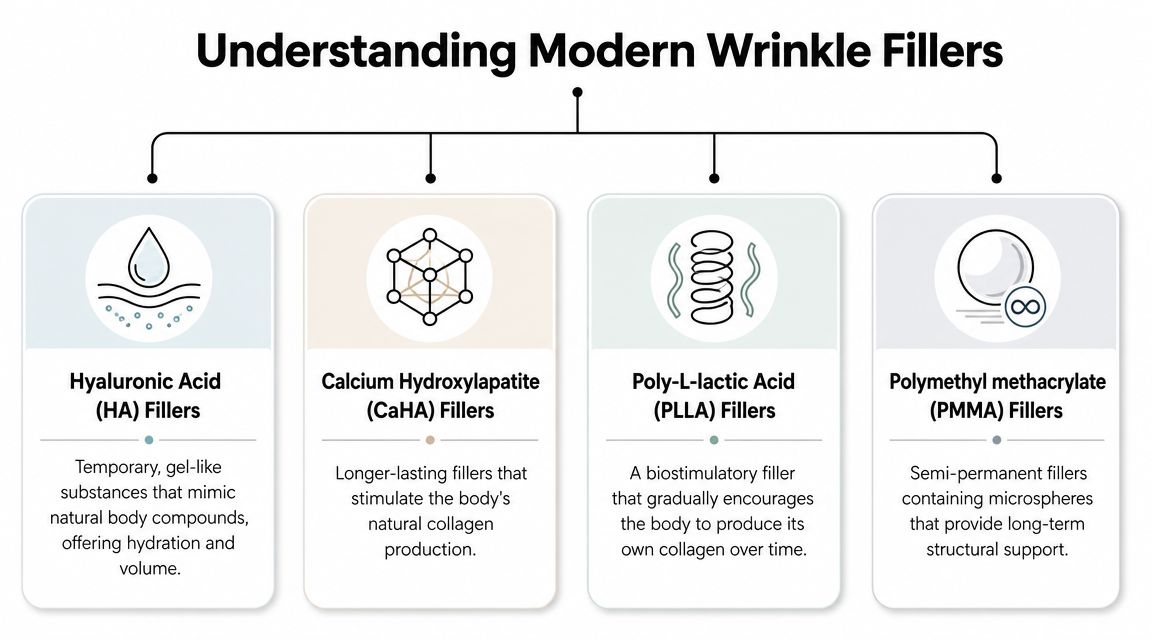
Hyaluronic acid, or HA, is the workhorse material in modern filler practice. It's a gel that behaves a bit like a sponge. It attracts water, adds volume, and can soften lines or rebuild contour depending on how it's formulated and where it's placed.
Clinically, HA fillers are popular because they're versatile. Some are soft and spread easily, which helps in delicate areas. Others are firmer and better for support. That range is one reason HA-based products such as Juvederm and Restylane are used so often in facial rejuvenation.
Calcium hydroxylapatite, or CaHA, behaves more like a structural scaffold. It's often chosen when an area needs stronger support, especially in deeper folds or regions with more significant volume loss.
In practical terms, this category tends to feel more architectural than delicate. It can be useful when the problem isn't a superficial line but a loss of underlying framework.
Clinical lens: A filler that works beautifully in the cheek can look heavy in the lip. Material matters as much as placement.
Poly-L-lactic acid, or PLLA, works differently. Instead of acting mainly as an instant space-occupying gel, it stimulates the body to build its own collagen over time. I often explain it the way I'd describe fertilizing a garden. You're not laying down a finished lawn that day. You're creating conditions for growth.
That makes PLLA a poor choice for patients who want an immediate fine-line correction in a tiny area, but it can be very useful when broader facial volume has faded and the goal is gradual restoration.
Patients often focus on the brand name because it's familiar. However, the decision itself is more technical. Is the area thin-skinned or thick-skinned? Is the concern a crease, a hollow, or sagging from volume loss? Does the patient want instant change, gradual improvement, or reversibility if needed?
Those answers shape the plan far more than a “top 10 fillers” list ever will.
A patient may walk in asking for the “best” filler, but the more useful question is narrower. Are we treating a fine etched line, a fold created by volume loss, or an area that needs structural support? The category matters because each material behaves differently once it is placed in living tissue.
Here is the practical comparison I use in consultation.
| Filler Type | Primary Material | Best For | Longevity | Results Onset |
|---|---|---|---|---|
| Hyaluronic acid filler | Hyaluronic acid gel | Lines, folds, lips, flexible contouring | Often temporary and easier to adjust over time | Often visible quickly |
| Calcium hydroxylapatite filler | Calcium hydroxylapatite | Deeper wrinkles, folds, structural support | Longer-lasting in many cases | Generally visible quickly |
| Poly-L-lactic acid filler | Poly-L-lactic acid | Broader volume restoration | Varies by treatment plan and area | Gradual |
| Permanent or semi-permanent soft tissue filler | Longer-lasting structural materials | Select cases requiring durable support | Can be long-lasting | Depends on material |
HA fillers are still the workhorse category for a reason. They are versatile, they can be used in several facial regions, and they give the injector room to fine-tune. As noted earlier from Mayo Clinic's facial filler guidance, HA fillers are temporary, which often makes them a sensible first choice for patients who want refinement without a long commitment.
That flexibility matters in real practice.
For a first-time filler patient, a reversible option is often more valuable than the longest duration on paper. It allows careful adjustment as the patient learns how much correction looks natural on their own face.
Calcium hydroxylapatite fills a different role. I consider it when the problem is less about a shallow crease and more about support. In the right anatomy, it can hold shape better than a softer gel and do more for a deeper fold or an area with framework loss.
The trade-off is straightforward. More structure can be an advantage in one zone and a liability in another. A product with stronger lift may be useful in the lower face or along areas that need support, but it can feel too firm in a delicate, highly mobile area.
PLLA belongs in a different conversation entirely. Patients sometimes compare it to HA as if they are interchangeable options, but they solve different problems. HA is often chosen when the goal is a visible change at the visit. PLLA is better suited to broader collagen stimulation and a more gradual improvement.
Permanent and semi-permanent fillers require even more caution. Their durability appeals to some patients, but longevity is only an advantage if the placement, product choice, and facial aging pattern all stay in harmony over time.
Brand recognition tends to drive online searches. Treatment planning should be based on tissue behavior.
Duration should be part of the discussion, but not the only one. If you want a clearer sense of maintenance over time, this guide on how long filler lasts in different treatment areas is a helpful reference.
Many patients assume the longest-lasting product is automatically the best wrinkle filler. In clinic, that assumption usually falls apart once I examine the wrinkle itself and the skin around it.
A longer-lasting filler may be appropriate for a deeper structural problem. The same product can look heavy in thin skin, feel less natural in a mobile area, or create a result that is harder to refine if the first treatment plan was too aggressive. That is why the brand on the box is rarely the deciding factor. The better result comes from choosing the right material, depth, and technique for the specific wrinkle and the face it belongs to.
A patient sits down wanting “the best wrinkle filler,” then points to three different concerns: fine vertical lip lines, deepening folds around the mouth, and hollow temples. Those are not the same problem, and they should not be treated the same way. Good treatment planning starts with the wrinkle's cause, the thickness of the skin, the amount of movement in that area, and the support underneath it.

Lines around the mouth usually reward a conservative hand. The skin is thin, the area moves constantly, and even a small amount of excess product can create puffiness or an unnatural ridge.
I usually prefer a softer approach here, both in product choice and in volume. Some patients also need the muscle activity addressed, especially if repeated pursing has etched the lines over time. If the lines are very superficial, skin resurfacing may do more than filler alone.
Precision matters more than syringe size.
Nasolabial folds and marionette lines often look like a simple crease problem, but they frequently reflect a support problem higher in the face. If the cheek has flattened or descended, filling the fold directly can make the area heavier without restoring a natural contour.
For some patients, a small amount placed in the fold is appropriate. For others, the better result comes from rebuilding cheek support first and then deciding whether the fold still needs direct correction. That is one of the clearest examples of why the best filler is not a universal product. It is the material and placement plan that fits your anatomy.
These areas call for structure. The goal is usually to restore framework, not to blur a surface line.
Cheek volume loss can deepen the lower face and make the under-eye area look more fatigued. Temple hollowing can change the balance of the upper face and create a sharper, more gaunt look. In both areas, a filler with more support may make more sense than a very soft gel. Diffuse volume loss may also be better served by a collagen-stimulating approach rather than trying to spot-treat each shadow.
This is also where injector selection starts to matter in a very practical way. If you are still deciding who should perform treatment, this guide on how to choose a qualified plastic surgeon for cosmetic procedures will help you assess training and judgment, not just marketing.
Many patients asking about lip filler are not asking for larger lips. They want to restore definition, replace age-related thinning, or soften lipstick lines without changing their expression.
That requires restraint. The white lip, vermilion border, lip body, and the vertical lines above the lip are separate targets. They often need different depths, different amounts, and sometimes different products. A plan that adds volume without respecting those subunits is how lips start to look overdone.
Poor filler outcomes in wrinkle treatment usually come from pattern-recognition errors, not from choosing the wrong brand alone.
The right question is not “Which filler is best?” It is “What is causing this wrinkle on my face, and what treatment plan fits that anatomy?”
Two patients can ask for treatment of the same wrinkle and need completely different plans.

One may have a shallow etched line in thin skin. The other may have a fold caused by deeper volume loss, ligament laxity, or muscle pull. If both receive the same filler in the same amount, one may look refreshed and the other may look puffy, stiff, or merely unchanged. That is why the brand name matters less than the diagnosis and the technique.
A skilled injector studies how your face is built and how it moves. That includes skin thickness, asymmetry, facial proportions, the depth of support loss, and the blood vessels and danger zones that should guide injection planes.
In practice, the hard part is rarely choosing between two good products. The hard part is deciding whether to place filler at all, where to place it, at what depth to place it, and how much correction your face can carry without looking treated.
A patient may point to a line beside the mouth, but the better correction may start higher in the cheek. A patient may ask to fill under-eye hollows, but thin skin or puffiness may make filler a poor choice there. Those decisions come from training and restraint.
Board-certified plastic surgeons are trained to assess facial anatomy in layers. We do not treat wrinkles as isolated grooves on the surface. We assess skin, fat compartments, retaining ligaments, muscle activity, and bony support, then decide which layer needs treatment.
That approach improves both safety and aesthetics. It lowers the chance of placing product in the wrong plane, and it helps avoid the overfilled look that happens when each line is chased as a separate problem.
At Cape Cod Plastic Surgery, filler discussions often include products such as Juvederm and Radiesse, but the more important part of the visit is the facial analysis and the treatment plan built around your anatomy.
Good filler work is usually hard to spot. The face looks rested, balanced, and natural because the injector treated the cause of the wrinkle, not just the crease itself.
Credentials alone are not enough, but they matter. So does the ability to explain a plan clearly and say no when filler is the wrong tool. Patients comparing providers should review this guide on how to choose a plastic surgeon for cosmetic treatment.
During a consultation, listen for answers to questions like these:
The best wrinkle filler for your face is the one selected and placed by someone who can read your anatomy accurately, inject safely, and stop before correction turns into distortion.
Most patients feel better once they know what happens on treatment day. Filler appointments are usually straightforward, but they should never feel rushed or casual.
A proper visit begins with planning.
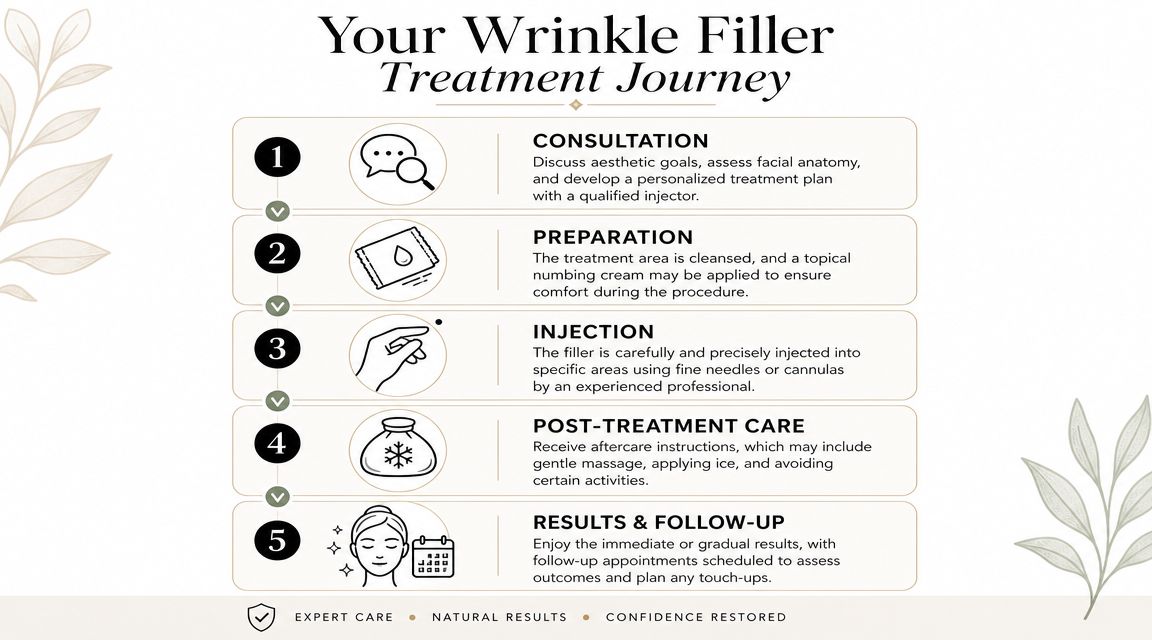
The consultation should cover your goals, medical history, facial anatomy, and whether filler is the right tool at all. Some wrinkles come from movement, some from sun damage, some from laxity, and some from volume loss. Those aren't treated the same way.
This is also when cost is discussed. The exact total depends on the product used, how many areas are treated, and how much correction is appropriate. A careful injector will talk about value in terms of treatment plan, not just price per syringe.
The skin is cleansed, and a numbing approach may be used depending on the area. The filler is then placed with a needle or cannula, with frequent reassessment as the treatment proceeds.
For patients who want to see a general walkthrough, this video gives a useful visual overview:
Most patients can return to normal routines quickly, but some swelling, tenderness, or bruising can happen. The exact recovery experience depends on the area treated, your own tendency to bruise, and the technique used.
A few practical rules help:
Some fillers look better once early swelling settles. Others, especially collagen-stimulating treatments, improve gradually. What matters is whether the result fits your face, softens the concern you came in for, and still looks like you in motion as well as in photos.
Most patients tolerate filler well. Some areas are more sensitive than others, especially the lips. Numbing measures can improve comfort, and experienced technique makes a noticeable difference.
That depends on the filler type used. This is one reason many first-time patients prefer HA fillers. They offer flexibility and are often a sensible place to start when someone wants a more adjustable approach.
Yes, often very effectively. Fillers restore volume and soften certain folds. Botox and similar neuromodulators reduce muscle-driven lines. Many patients need both because facial aging usually involves more than one process.
You usually can't decide that accurately from a product list alone. The right answer comes from an in-person assessment of wrinkle type, facial balance, skin thickness, movement, and your comfort level with maintenance and longevity.
If you're considering treatment, the next step shouldn't be guessing between brand names. It should be getting a careful facial analysis and a plan built around your anatomy.
If you'd like individualized guidance, schedule a consultation with Cape Cod Plastic Surgery. A thoughtful filler plan starts with understanding your face, your goals, and which treatment makes sense for both.
October 2, 2026
Beyond the Calendar: How to Know You’re Truly Ready for Plastic Surgery

October 2, 2026
Exploring Your Breast Augmentation Options: Implants, Shapes, and What to Expect

October 1, 2026
Reshaping Your Silhouette: A Guide to Body Contouring

Cape Cod Plastic Surgery offers expert cosmetic and reconstructive procedures in a safe, accredited setting. Led by Dr. Marc Fater, we combine advanced techniques with personalized care to help you look and feel your best.
Monday: 9:00 AM – 5:00 PM
Tuesday: 9:00 AM – 5:00 PM
Wednesday: 9:00 AM – 5:00 PM
Thursday: 9:00 AM – 5:00 PM
Friday: 9:00 AM – 5:00 PM