

September 9, 2026
How to Care for Surgical Incisions Properly
Expert Guide to Proper Surgical Incision Care
Jun 22, 2026

You may be looking in the mirror and seeing two different stories at once. One story says you've carried pregnancies, weight changes, stress, time, and a full life. The other says your body no longer reflects how energetic, healthy, or confident you feel inside.
That disconnect is common. A patient may tell me, “My breasts lost volume after breastfeeding,” and in the next breath say, “My abdomen still looks stretched no matter how carefully I eat or how often I exercise.” Those concerns often travel together. The breasts and abdomen both change with pregnancy, aging, and major weight shifts, but they don't always recover in the same way.
For some patients, breast augmentation and tummy tuck can address both areas in a coordinated way. The appeal isn't only cosmetic. It's also practical. You're looking at the body as a whole, not as separate compartments.
A woman in this stage of life often isn't chasing perfection. She wants alignment. She wants clothes to fit better, posture to feel easier, and the mirror to make sense again.
One patient may feel bothered by deflated upper breast fullness after breastfeeding. Another may be frustrated by loose abdominal skin after significant weight loss. A third may have both concerns and feel that neither problem tells the full story on its own. That's where combining surgery enters the conversation.
These are not fringe procedures. Breast augmentation and tummy tuck are two of the most established cosmetic operations in the U.S. In 2021, there were 365,000 breast augmentations and 234,696 abdominoplasties, according to ASPS-linked reporting on cosmetic surgery quick facts. That matters because patients are not considering something experimental. They're considering procedures with long clinical histories and broad surgeon familiarity.
A common reason patients seek surgery isn't vanity. It's the wish to feel at home in their body again.
That said, established doesn't mean automatic. The right plan depends on your anatomy, your health, your goals, and your life. Some people do best with one combined operation. Others get a safer or more predictable result by spacing surgeries apart.
That timing question deserves a thoughtful answer. Not a sales pitch. Not a blanket “yes.” A real plan.
A combined procedure brings together two separate surgeries that solve different problems.
Breast augmentation restores or enhances breast volume and shape, usually with implants. Patients often seek it when breasts feel smaller or less full after pregnancy, breastfeeding, or weight loss. You can think of it as rebuilding the framework and fullness of a garment so it fits the upper body more harmoniously.
Abdominoplasty, also called a tummy tuck, addresses the lower torso. The procedure removes excess abdominal skin and fat, and it can include tightening of the abdominal fascia. Mayo Clinic describes abdominoplasty as removal of excess abdominal skin and fat with fascial tightening in its overview of tummy tuck surgery.

The reason surgeons often combine these procedures is straightforward. A combined approach means one anesthetic event and one recovery period rather than two separate operations months apart. If you're researching breast augmentation options, that single-recovery concept is often what first makes the pairing appealing.
The situation can be compared to renovating two connected rooms in the same home. If both spaces need work, it can make sense to plan them together instead of tearing up the house twice. But that only works if the scope of the renovation is still safe and manageable.
Many patients hear the phrase “mommy makeover” and assume it's a single standard operation. It isn't. It's more like a category of combined procedures. One person may need implants plus a full tummy tuck. Another may need a different breast operation and a more limited abdominal procedure.
Practical rule: Combined surgery is common because it can reduce overall downtime, but common does not mean right for every patient.
The biggest misunderstanding is this. People often assume the question is, “Can these surgeries be done together?” In many cases, yes. The better question is, “Should your surgeries be done together?” That answer changes from one patient to the next.
Good candidates aren't defined by one body type or one age group. They're defined by readiness, health, and goals that fit the procedure. This is a medical decision as much as an aesthetic one.
Breast augmentation is largely an adult decision. In one ASPS-linked dataset, 50.5% of breast augmentation patients were ages 19 to 34, while only 2% were 18 or younger, as summarized in this review of breast augmentation statistics. That pattern reflects what surgeons see in practice. Patients are usually adults making considered choices after major life changes, not impulsive ones.
A strong candidate usually checks several boxes at once:
Sometimes the best answer is “not yet.”
That may happen if you're early after pregnancy, still breastfeeding, actively losing weight, or unsure whether you're finished having children. It may also happen if your health history suggests that a smaller first step would be wiser.
A careful surgeon also looks at how your recovery environment will work. If you have young children who need lifting, limited home support, or a job that requires upper-body and core strain, those details matter. They don't always rule surgery out. They do shape the safest timing.
The goal of a candidacy visit isn't to “qualify” you in a superficial way. It's to decide whether your current moment is the right moment.
Some patients are excellent candidates for both procedures, but not for having them on the same day.
That distinction is where personalized planning starts. The right plan fits your body, but it also fits your health, schedule, and recovery reality.
The conversation turns specific. Two patients can both want a flatter abdomen and fuller breasts, yet need very different surgical plans.
One patient may want subtle upper-pole fullness and have mild abdominal laxity. Another may need more significant abdominal repair and want a larger change in breast volume. Those differences affect implant selection, incision planning, abdominal technique, and whether surgery should be combined or staged.
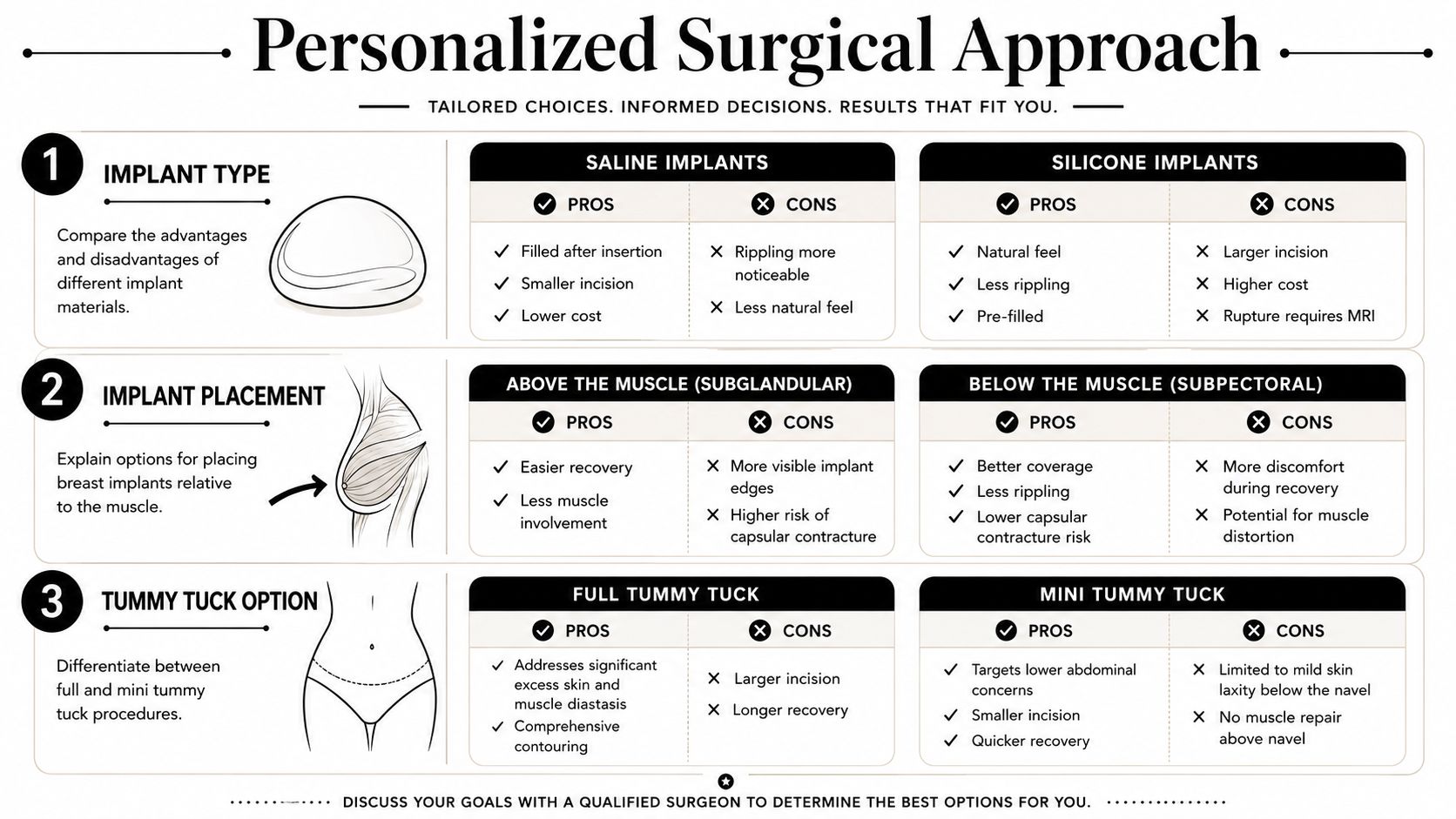
For the breast portion, planning often includes:
These aren't menu items. They interact. A patient with thinner tissue may benefit from one strategy, while another with different proportions may suit another.
The abdominal plan also has layers:
If you want a broader overview of abdominal contouring decisions, this tummy tuck article can help you understand the terminology before consultation.
Combined surgery is often reasonable when both procedures are clearly indicated, your health is solid, and the total operative plan stays within prudent limits. ASPS notes that many surgeons use a practical anesthesia time limit of about six hours when planning combination cases, and it also notes that the choice to combine or stage can depend on factors such as obesity, diastasis severity, and implant choice in its discussion of combination procedures and time considerations.
A combined plan may fit if:
Staging means doing one surgery first, recovering fully, and then returning for the second. That approach can be smarter when safety margins get tighter or when decision-making would benefit from seeing the first result settle.
A surgeon may favor staging if the abdominal repair is extensive, if implant decisions are more nuanced, or if your body would be better served by reducing operative length and recovery intensity.
| Factor | Combined Procedure | Staged Procedures |
|---|---|---|
| Recovery schedule | One main recovery period | Two separate recovery periods |
| Time under anesthesia | Longer in a single setting | Split across separate operations |
| Planning complexity | Higher on one surgical day | More spread out and adjustable |
| Early physical limitations | Chest and abdomen heal at the same time | Each area recovers more independently |
| Flexibility | Less opportunity to revise the plan mid-course | More opportunity to adapt between surgeries |
The safest plan is not always the fastest plan.
That idea sits at the center of personalized surgical planning. In a practice philosophy that values individual decision-making, the true skill isn't just offering combined surgery. It's knowing when not to.
Recovery from breast augmentation and tummy tuck is not just “healing from surgery.” It's healing from two operations that ask different things of your body at the same time. Your abdomen benefits from gentle walking early on. Your chest and abdomen both need protection from strain, lifting, and sudden movements.
This timeline helps patients picture the rhythm of recovery.
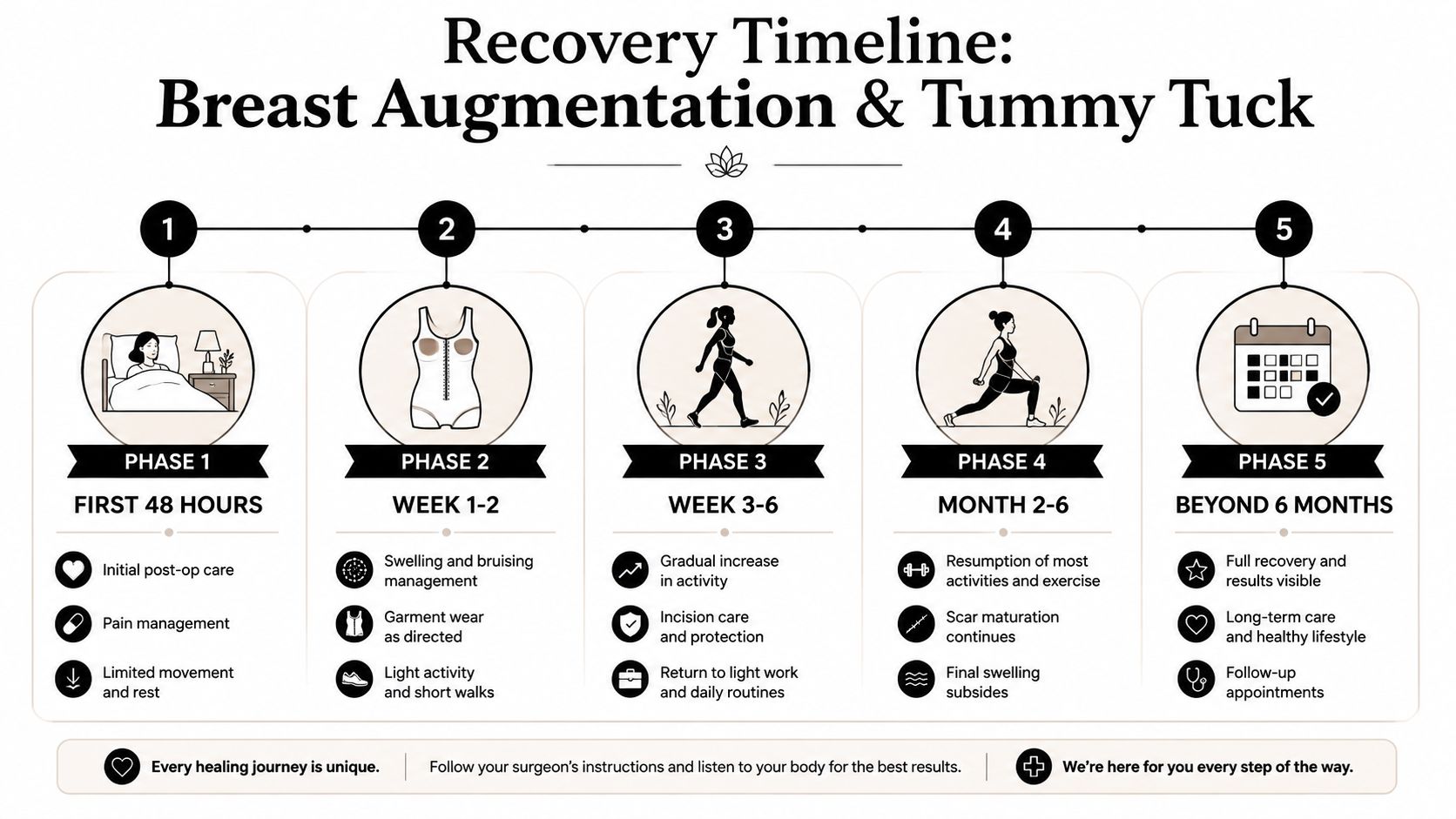
Expect to feel tight, sore, tired, and limited. You'll likely walk carefully and more slowly than usual. Many patients describe the abdomen as feeling especially snug, while the chest feels heavy or pressure-filled.
Your main jobs are simple: rest, take medication as directed, drink fluids, and get up for short assisted walks. Those walks matter. They support circulation and help reduce the risks that come with too much bed rest.
Recovery works best when patients respect the difference between movement and exertion. You should move early, but you should not push early.
This is the week when help at home matters most. Getting in and out of bed, standing upright, showering, and reaching for objects can all feel awkward.
You'll also be learning how to protect two surgical areas at once:
A good recovery doesn't look dramatic. It looks steady.
Here's a helpful discussion that expands on that process: recovery after plastic surgery.
Later in recovery, some patients find it useful to hear a surgeon talk through the process in plain terms.
Most patients begin to feel more independent during this period, but this is also when people are tempted to do too much. You may feel mentally ready before your tissues are physically ready.
Swelling, tightness, and fatigue can still come and go. That doesn't mean something is wrong. It usually means healing is still active. Light walking is usually encouraged, but strenuous exercise and heavy lifting remain off-limits unless your surgeon gives specific clearance.
By this point, many patients feel much more like themselves. Daily movement is easier, posture improves, and clothes begin to fit differently. But “feeling better” and “fully healed” are not the same thing.
Scars continue to mature. Swelling continues to settle. Implants settle into position over time. Abdominal tissues also keep refining as healing progresses. Patience here pays off.
Cost matters because this is elective surgery, and patients need to plan responsibly. The total price usually reflects several components rather than one single fee. Those may include the surgeon's fee, anesthesia, facility costs, implant-related expenses, postoperative garments, and follow-up care.
That's why comparing procedures by price alone can mislead patients. Two quotes may look different because the surgical plan is different, the implant choice is different, or the setting is different.

Every operation carries risk. With breast augmentation and tummy tuck, those risks can include issues related to anesthesia, bleeding, infection, wound healing, fluid collection, scarring, and dissatisfaction with shape or symmetry. Combined surgery can also feel more intense during early recovery because more than one area is healing at once.
The right response to risk is not fear. It's preparation.
That means choosing a board-certified plastic surgeon, being candid about your health history, following preoperative instructions carefully, and recovering exactly as directed. Smoking, rushed timelines, and underestimating the recovery period all make surgery harder than it needs to be.
The facility matters. The anesthesia team matters. The postoperative plan matters. These details are not secondary to the result. They're part of the result.
At Cape Cod Plastic Surgery, patients can review options in the context of Dr. Marc Fater's board certification and the practice's on-site AAAASF-accredited surgical suite. That kind of accreditation matters because it reflects formal standards for safety, equipment, and patient care processes.
A beautiful result starts with a safe operation. Safety is not separate from aesthetics. It's the foundation for them.
When patients ask me where to focus their attention, I tell them this. Don't shop for surgery the way you'd shop for luggage or furniture. Ask who will operate, where the surgery will take place, how candidacy is determined, and how the team handles recovery and follow-up.
Results can last many years, but your body will still respond to time, gravity, pregnancy, weight changes, and normal aging. Surgery resets contour. It doesn't stop life. Stable weight and good general health help preserve your result.
Some patients can breastfeed after breast augmentation, and some cannot. That depends on factors like your anatomy, prior breast changes, and the details of surgery. If future breastfeeding is important to you, bring that up early so it can shape incision and implant planning.
Follow your surgeon's instructions carefully. Protect incisions from tension, keep follow-up visits, and avoid sun exposure on healing scars unless your surgeon tells you otherwise. Scar quality depends partly on surgical technique and partly on how your body heals.
That uncertainty is normal. In fact, it's often a sign that you're thinking carefully. The decision usually becomes clearer once your surgeon examines you, understands your priorities, and estimates the complexity of each procedure. If your anatomy, health profile, or recovery situation makes a same-day combination less ideal, staging can be the smarter route.
The central question isn't whether breast augmentation and tummy tuck can be paired. It's whether pairing them serves you well. That's why a personalized consultation matters more than any generic online checklist.
A thoughtful surgeon will help you decide not only what can be done, but what should be done, in what order, and why.
The next step is a personal consultation with Cape Cod Plastic Surgery, where you can discuss your anatomy, goals, recovery needs, and whether a combined or staged approach makes the most sense for you.
September 9, 2026
Expert Guide to Proper Surgical Incision Care

Master dermal fillers aftercare with do's and don'ts, swelling tips, activity limits and warning signs to protect your results and heal smoothly.

September 8, 2026
Ensuring Safety: Why Your Surgeon's Credentials Matter Most

Cape Cod Plastic Surgery offers expert cosmetic and reconstructive procedures in a safe, accredited setting. Led by Dr. Marc Fater, we combine advanced techniques with personalized care to help you look and feel your best.
Monday: 9:00 AM – 5:00 PM
Tuesday: 9:00 AM – 5:00 PM
Wednesday: 9:00 AM – 5:00 PM
Thursday: 9:00 AM – 5:00 PM
Friday: 9:00 AM – 5:00 PM