

October 7, 2026
What to Expect During Your Breast Surgery Recovery
A Practical Guide to Healing After Breast Surgery
Sep 3, 2026
You notice that one breast feels firmer than it used to, or that an implant seems to sit higher, lower, or farther to the side. Perhaps the change appeared gradually after years of feeling completely comfortable. You may also be wondering whether a new operation means the first surgery failed. Often, it doesn't. Breast implants are medical devices with a long-term life cycle, and revision can be a planned response to changing tissue, device concerns, personal preferences, or the effects of aging.
Breast implant revision isn't one standardized operation. Some patients need an implant exchange, while others need capsule treatment, pocket correction, a lift, removal without replacement, or a combination of procedures. By understanding the reason for revision first, you can approach a consultation with clearer expectations and better questions.
A patient may come to the office several years after augmentation and say, “They used to look balanced in every shirt, but now one side feels tight and the other seems to have dropped.” Another may notice visible wrinkling near the outer breast, discomfort during exercise, or a gradual change after pregnancy or weight fluctuation. These changes can be unsettling, especially when they develop after a long period of satisfaction.
The first step is to separate a change that needs evaluation from an emergency. New pain, redness, swelling, a sudden size change, firmness, or a noticeable shift in shape deserves a professional examination. A stable cosmetic change may not require immediate treatment, but it still deserves an accurate diagnosis before you decide whether surgery is worthwhile.
Revision is a recognized part of implant life-cycle management. In a major FDA post-approval dataset, the reoperation rate by 7 years was 11.7% for primary augmentation and 25% for primary or revision reconstruction (FDA-linked post-approval analysis). Those findings don't mean every patient will need another operation. They do show why surgeons discuss long-term management rather than presenting implants as a one-time, permanent intervention.
A second operation isn't automatically evidence that the original operation was unsuccessful. The important question is what changed, why it changed, and which treatment addresses that cause.
This guide focuses on those decisions, including the difference between cosmetic and reconstructive revision, the procedures that may be combined, recovery expectations, cost factors, and how to prepare for a productive consultation.
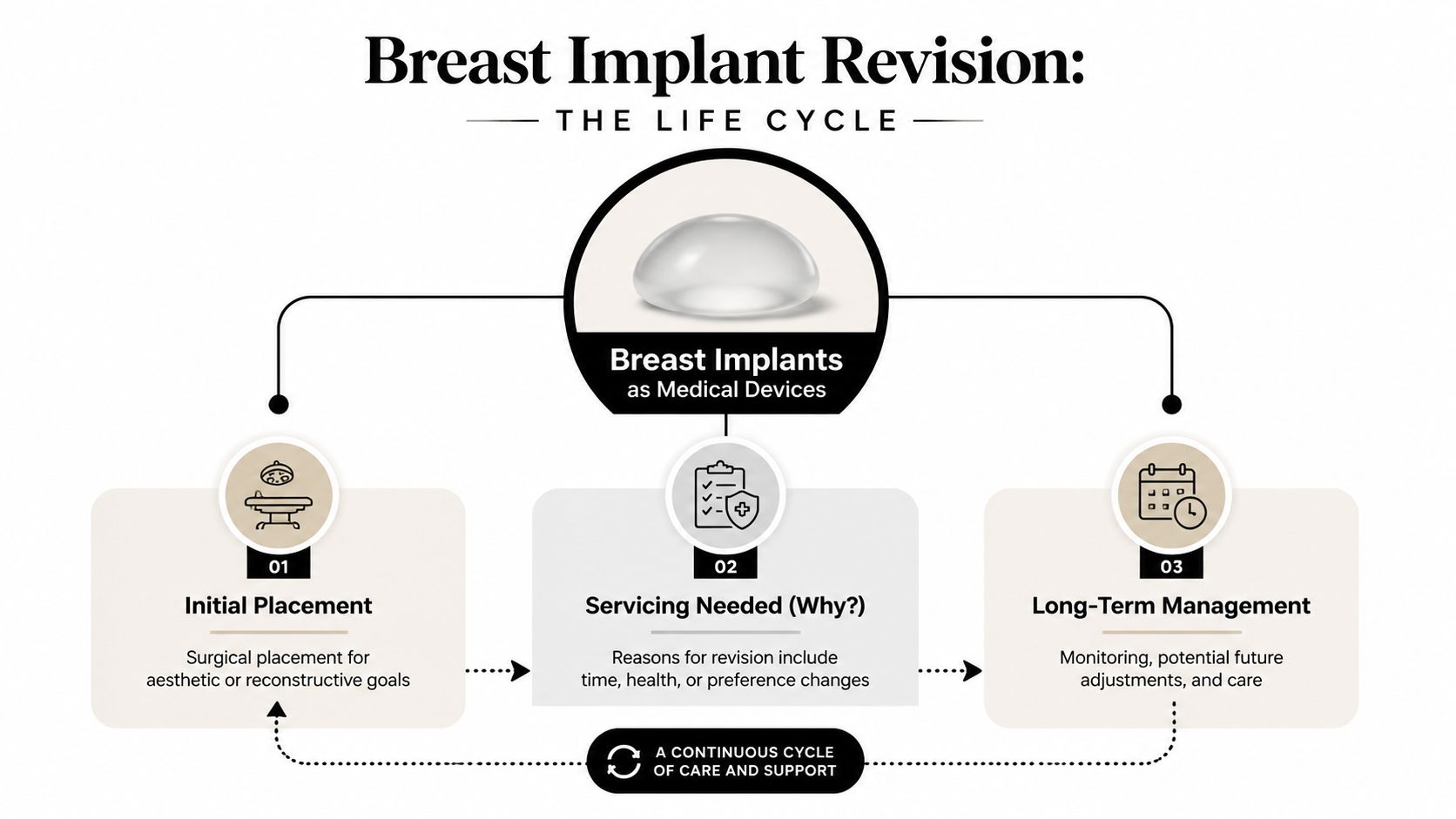
Think of a breast implant like another medical device with a life cycle. A joint replacement, dental crown, or pacemaker may function well for years, yet still require monitoring, adjustment, or replacement later. Breast implants can behave similarly. Revision doesn't necessarily mean the device has failed or that the original surgeon made an error.
Primary augmentation creates the initial implant pocket and places the device to achieve an aesthetic goal. Revision surgery evaluates an existing pocket, capsule, implant, breast envelope, and patient preference, then changes one or more of those elements. Explantation, or implant removal, is narrower in one sense, but it may be combined with a lift, fat grafting, or other contouring procedure to manage the breast after the implant is gone.
The term “revision” therefore covers a spectrum:
The need for one technique over another depends on the reason for revision, not on how old the implant is. A patient with a ruptured device may need an exchange and capsule assessment. A patient with malposition may need pocket repair even if the implant itself remains intact. Someone who no longer wants implants may need removal and a lift rather than replacement.
Patients often describe the problem in everyday terms: “It feels hard,” “It looks too high,” or “I can see ripples.” Those observations help, but they don't identify the underlying anatomy by themselves. A surgeon must examine the breast, implant position, skin envelope, capsule, and, when appropriate, imaging.
Capsular contracture occurs when the scar capsule around an implant tightens more than desired. You may notice increasing firmness, a high or rounded appearance, visible distortion, pressure, or pain. The FDA identifies capsular contracture, reoperation, and implant removal among the most common local adverse outcomes of breast implants, and explains that repeated operations may be needed over a lifetime as complications accumulate (FDA patient guidance on breast implants).
Treatment can involve capsulotomy, partial or complete capsulectomy, implant exchange, pocket change, or several of these together. The correct choice depends on the capsule and the surrounding tissues.
A saline implant that loses its contents usually produces a noticeable reduction in breast volume because the body absorbs the saline. A silicone implant rupture may not create an obvious external change, so a surgeon may recommend imaging when the examination or history raises concern. A confirmed rupture often leads to implant removal or exchange, with capsule management based on the individual findings.
An implant can sit too high, descend too far, move toward the armpit, or create uneven cleavage. These problems are described as malposition. The repair may require sutures, internal support, release of restrictive scar tissue, a change in implant size, or a different pocket plane.
A 2025 NIH review reported that malposition represented 3% to 27.6% of revision procedures in registries, while infection represented 0.6% to 4% (NIH review in JAMA Surgery). These figures come from differing registries and shouldn't be treated as an individual prediction, but they illustrate why “implant exchange” is often an incomplete description of revision surgery.
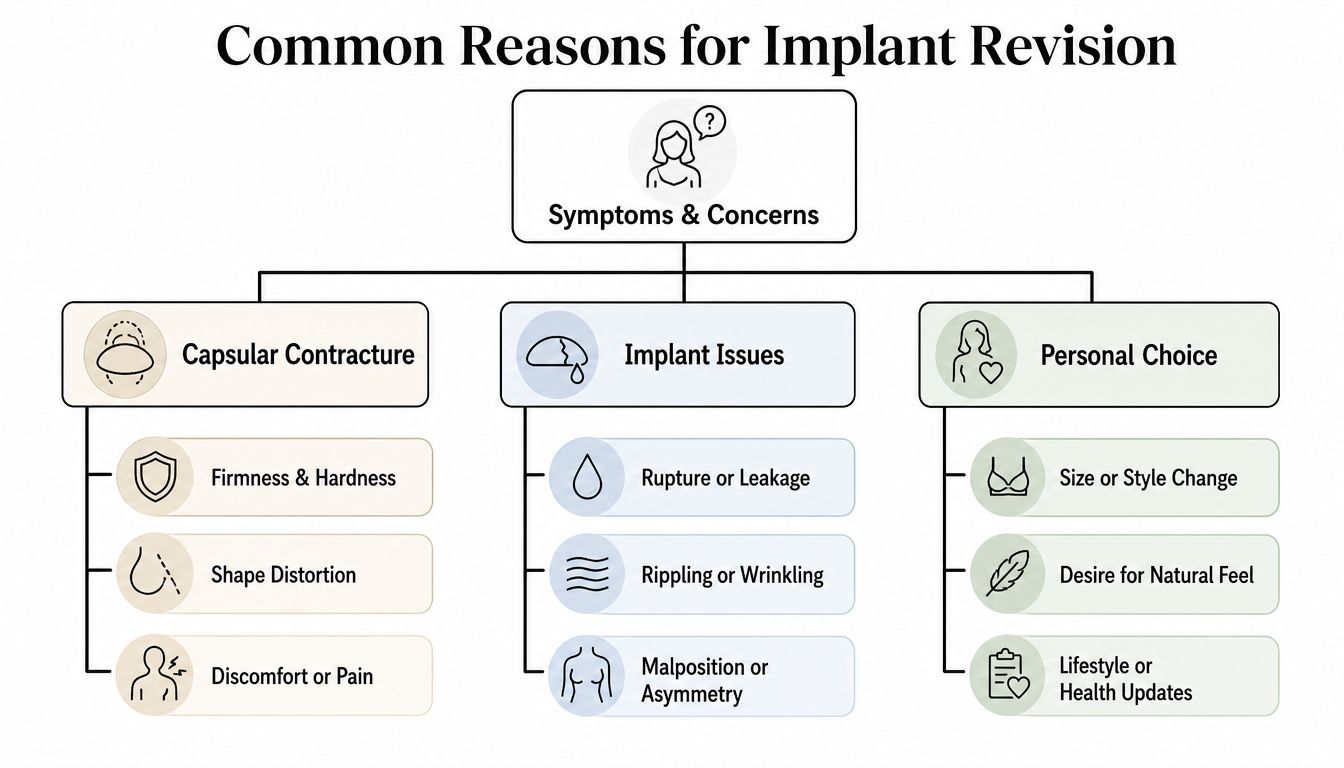
Breast skin and tissue can stretch with age, pregnancy, weight changes, and the ongoing weight of an implant. If the breast has developed ptosis, replacing the implant alone may leave excess skin or a downward-pointing nipple. A lift may be needed to reshape the envelope.
Other patients want a different size, a different feel, or no implant at all. That choice is just as legitimate as revision for a complication. Your surgical plan should reflect your current goals, not only the appearance you originally requested.
Patients interested in the specific scar-related condition can also review this educational resource on capsular contracture prevention, then discuss how prevention and treatment apply to their own history.
The surgeon's first question isn't “Which new implant do you want?” It's “What is the pocket and breast envelope doing now?” A revision plan must account for the implant, the capsule, the space around the implant, the skin, the muscle, and your desired appearance.
An implant exchange is the simplest pathway when the pocket is healthy, the position is acceptable, and the main issue is device age, rupture, or a desired size change. It becomes more involved when the surgeon must remove abnormal capsule tissue, narrow an enlarged pocket, or correct an implant that has shifted.
Capsule surgery has different purposes. Capsulotomy releases selected areas of constriction. Capsulectomy removes capsule tissue, partially or completely, when the capsule is thick, contracted, symptomatic, or otherwise part of the problem. Neither technique should be selected by name alone. The extent of capsule work should match the findings and the surgical objective.
Pocket correction addresses mechanics. A surgeon may tighten an overly large pocket, release a tight area, lower an implant that sits too high, or reinforce weak tissues when sutures alone aren't sufficient. If the existing plane creates inadequate coverage or contributes to the concern, moving from prepectoral to subpectoral placement, or the reverse, may be considered.
Removal is another complete pathway. Some patients choose explantation alone. Others combine removal with a mastopexy, fat grafting, or both to manage loose skin and restore contour. A discussion of implant removal and breast lift can help clarify why removal doesn't always mean accepting an unaddressed breast shape.
| Procedure | Typically addresses | Key consideration |
|---|---|---|
| Implant exchange | Rupture, deflation, age-related concerns, size preference | A new implant won't correct a damaged or enlarged pocket by itself |
| Capsulotomy or capsulectomy | Contracture, restrictive scar tissue, selected capsule problems | The amount of capsule treatment depends on anatomy and surgical goals |
| Pocket correction | High, low, lateral, or asymmetric implant position | Support and closure must match the direction of the displacement |
| Plane change | Coverage concerns, selected contracture or positioning problems | Muscle movement, coverage, and recovery can change |
| Removal with or without lift | Desire to stop using implants, rupture, complications | Excess skin and breast descent may require reshaping |
| Fat grafting | Contour irregularities, thin coverage, selected asymmetry | It refines tissue contour but doesn't replace every function of an implant |
Implant pocket mechanics also influence contracture planning. A 2025 systematic review found lower capsular contracture rates with textured-surface implants than with smooth implants, significantly lower rates with subpectoral placement than with prepectoral placement, and no significant difference between saline and silicone in contracture risk (systematic review of capsular contracture factors). That evidence doesn't make one implant or pocket universally correct. It gives the surgeon a framework for weighing coverage, position, feel, movement, and your medical history.
Recovery depends on what the surgeon changes. A straightforward exchange may feel less demanding than the original operation, while capsule removal, pocket repair, reinforcement, a lift, or a plane change can create more swelling and soreness. The incision may be familiar, but the internal work isn't always minor.
During the early period, most patients need substantial rest and help with household tasks. Your instructions may include a support garment, prescribed pain control, incision care, and management of drains if they're used. Arm movement is usually limited according to the repair, especially when the surgeon has modified the pocket or worked near the chest muscle.
Call your surgeon promptly for rapidly increasing swelling, significant bleeding, spreading redness, fever, worsening pain, drainage with an abnormal appearance, shortness of breath, or any symptom that feels markedly different from the expected course. Don't wait for a routine follow-up if one breast changes quickly.
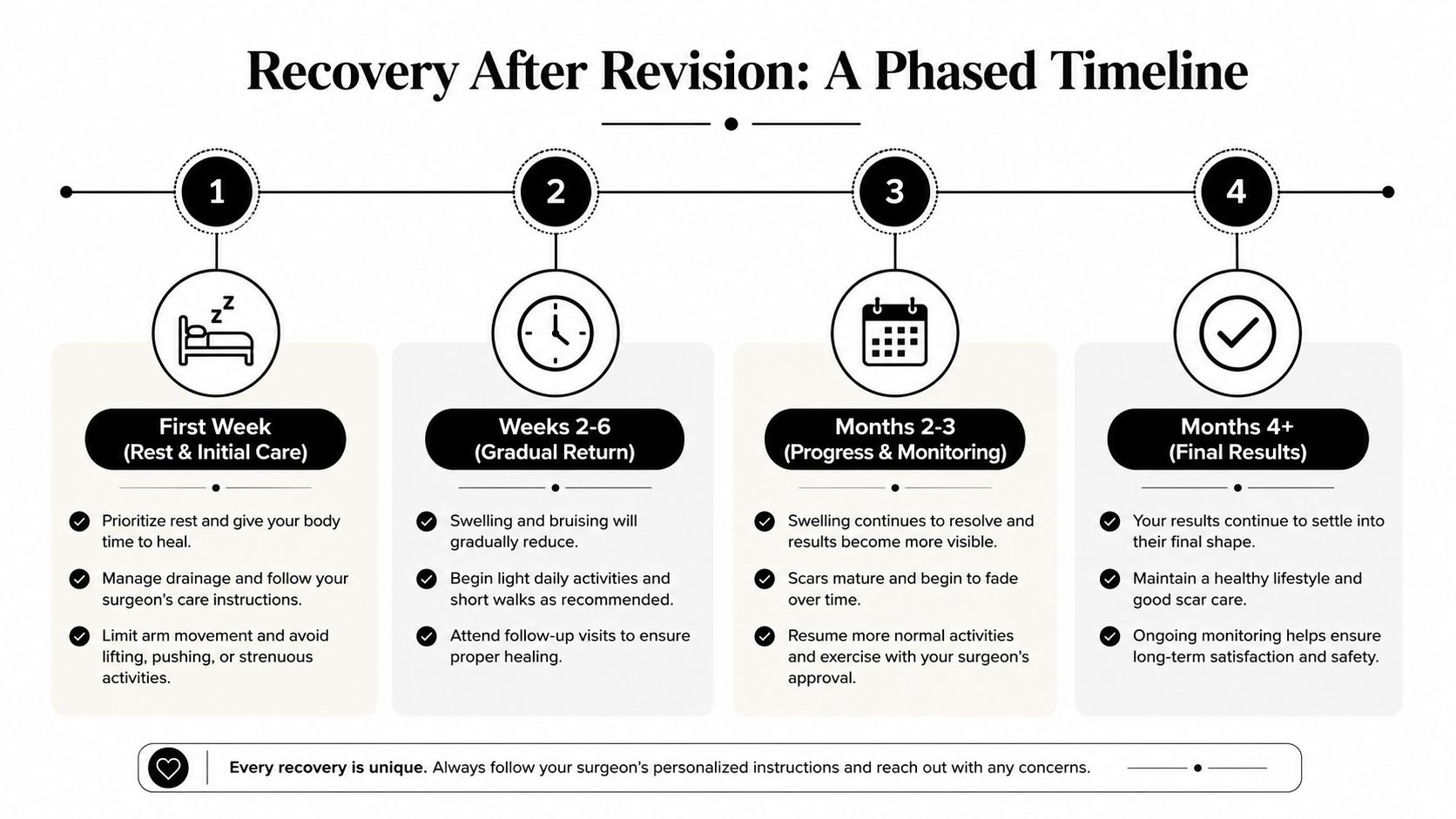
Many patients gradually return to desk-based work as comfort allows, but the timing depends on the procedure and the demands of the job. Light walking can support general recovery, while strenuous exercise, heavy lifting, forceful pushing, and repetitive upper-body activity should wait until the surgeon clears them.
Swelling may make the breasts look uneven or unusually high. Numbness, tingling, tightness, and changing sensation can occur as tissues heal. Scar care begins only when the incisions are closed and your surgeon approves the method, which may include silicone-based products, massage, or simple protection from sun exposure.
For practical postoperative guidance, review recovery after plastic surgery alongside the personalized instructions from your own surgical team.
The final contour develops gradually. The implant, capsule, muscle, skin, and any lifted tissue need time to settle into their new relationship. Follow-up appointments let the surgeon assess swelling, incision healing, implant position, sensation, and the durability of the repair.
Use this checklist to keep expectations grounded:
Online price ranges can mislead patients because “revision” may describe a short implant exchange or a complex reconstruction of the pocket and breast envelope. The meaningful estimate comes after the surgeon determines what needs to be corrected.
The total fee may include several components:
Elective changes, such as choosing a different size or deciding to remove implants because your preferences have changed, are generally handled as out-of-pocket cosmetic care. Revision for rupture or contracture may interact with an implant manufacturer's warranty program, which could offset some implant-related costs under its specific terms. A warranty doesn't automatically cover the surgeon, anesthesia, facility, or every associated procedure, so ask for the details in writing.
Financing may include practice payment plans or medical financing, subject to approval and contract terms. Ask whether the quote is global or itemized, what happens if the surgeon finds additional capsule work during the operation, and which follow-up visits are included.

A careful consultation should leave you with more than one number. You should understand the proposed operation, the alternatives, what the fee covers, and which costs could arise if the surgical findings differ from the initial examination.
Revision demands a different skill set from primary augmentation. The surgeon must be comfortable evaluating old scars, altered anatomy, stretched skin, capsule tissue, implant position, muscle behavior, and the possibility that the best solution isn't a new implant. Look for appropriate board certification, specific experience with revision and reconstructive cases, and a willingness to explain why a proposed operation fits your anatomy.
Bring your implant records if you have them, including the implant manufacturer, model, size, placement, and operative report. Photos showing how your breasts looked before the change can also help. Write down when you first noticed symptoms, whether the change is stable or progressing, and whether you have pain, swelling, firmness, or a history of infection.
A consultation should involve a physical examination rather than a discussion based only on photographs. The surgeon may assess skin quality, breast tissue, nipple position, implant location, capsule firmness, scars, asymmetry, and the relationship between the breast fold and the implant.
Imaging may be recommended when rupture is suspected or when the examination can't answer an important question. The visit should also clarify your priorities. Do you want a softer feel, a smaller size, improved symmetry, a lifted breast, relief from discomfort, or freedom from implants? Those goals can lead to very different operations.
Cape Cod Plastic Surgery in Hyannis offers breast procedures including implant exchanges, and Dr. Marc Fater is described by the practice as a board-certified plastic surgeon with over 30 years of experience. The practice also reports an on-site AAAASF-accredited surgical suite, which is one facility detail patients may ask about when comparing consultation and operative settings.
Reconstructive and cosmetic patients should also ask for risk information that matches their situation. A 2025 international study reported complication-related revision rates of 6.3% for reconstructive implants and 1.2% for cosmetic implants at 5 years, with no significant difference between implant types within either category during that period (international study of implant revision outcomes). These are group-level findings, not a personal forecast, but they reinforce why reconstruction and cosmetic augmentation shouldn't be discussed as if they carry identical revision pathways.
Take notes, request a written plan, and compare recommendations carefully. The strongest consultation is one in which you understand not only what the surgeon proposes, but also why a simpler implant swap may not solve the actual problem.
Cape Cod Plastic Surgery provides individualized evaluation for breast implant exchange, revision, lift, and reconstructive concerns in Hyannis. Visit Cape Cod Plastic Surgery to learn more and request a consultation focused on your symptoms, goals, and the surgical options that fit your anatomy.
October 7, 2026
A Practical Guide to Healing After Breast Surgery

October 6, 2026
Your Safety Guide: What to Look for When Choosing a Plastic Surgeon

October 5, 2026
Why Our On-Site Accredited Facility Matters for Your Safety

Cape Cod Plastic Surgery offers expert cosmetic and reconstructive procedures in a safe, accredited setting. Led by Dr. Marc Fater, we combine advanced techniques with personalized care to help you look and feel your best.
Monday: 9:00 AM – 5:00 PM
Tuesday: 9:00 AM – 5:00 PM
Wednesday: 9:00 AM – 5:00 PM
Thursday: 9:00 AM – 5:00 PM
Friday: 9:00 AM – 5:00 PM