

October 7, 2026
What to Expect During Your Breast Surgery Recovery
A Practical Guide to Healing After Breast Surgery
Sep 7, 2026

A mini tummy tuck typically costs about $5,500 to $10,500 all-in in the United States, including more than the surgeon's fee. The final amount can shift with anesthesia, facility charges, recovery supplies, medications, geography, and whether muscle repair or liposuction is added.
You may be looking at before-and-after photos late at night, comparing “starting at” prices and wondering why one practice lists a figure that seems far lower than another. You may also have a small, persistent lower-abdominal pouch that hasn't changed with exercise or weight loss, but you don't want to commit to a larger operation than you need.
The useful question isn't, “What does a mini tummy tuck cost?” It's, “What will I pay for the complete surgical plan, and is that plan appropriate for my anatomy?” The distinction matters because a surgeon-fee estimate can leave out anesthesia, the operating facility, garments, prescriptions, and other practical expenses. This guide breaks down the true mini tummy tuck cost, explains why Cape Cod prices may differ from national figures, and gives you a checklist for comparing consultations responsibly.
Consider someone who has reached a stable weight, feels healthy, and remains bothered by loose skin concentrated below the belly button. She isn't looking for dramatic weight loss from surgery. She wants the lower abdomen to look smoother in clothing, and she wants to understand the financial commitment before scheduling a consultation.
A mini tummy tuck, also called a mini abdominoplasty, generally focuses on excess skin and limited laxity in the lower abdomen. It typically involves a shorter incision than a full abdominoplasty and usually doesn't require repositioning the belly button. The operation may be appropriate when the concern is confined below the navel, but an examination is necessary to determine whether the upper abdomen or abdominal muscles also need treatment.
A full tummy tuck addresses a broader area. It can involve skin above and below the navel, more extensive muscle work, and changes to the belly button. Choosing the mini procedure solely because it sounds less expensive can create disappointment if it won't address the problem you have.
Practical rule: Compare complete surgical plans, not procedure names or advertised starting prices.
Recovery also belongs in your budget. You may need time away from work, help with household tasks, transportation, compression garments, and prescribed medications. For practical preparation and comfort suggestions, SunnyBay's insights on recovery can supplement the instructions provided by your surgical team.
If a lower-abdominal bulge may involve separated muscles, reviewing information about diastasis recti repair can help you prepare better questions. A consultation should clarify whether your concern is skin, fat, muscle laxity, or a combination.
The right procedure is the one that matches your goals and physical findings. A lower quote isn't useful if it covers an operation that can't produce the result you want.
A national average can help you set an initial budget, but it is not a guaranteed quote. CareCredit reports a $6,247 average for a mini tummy tuck, with prices ranging from $5,037 to $11,873. Operative time, the amount of lower-abdominal skin removed, muscle work, and added contouring can all change the total. Review the CareCredit mini tummy tuck cost guide for this broader benchmark.

Patient-reported totals may be higher because they can include more than the surgeon's professional fee. RealSelf reported an average of $10,088 in 2023, based on more than 635 recent patient reviews, with reported prices from about $5,000 to $16,500. Complexity and added procedures help explain that spread. Treat online averages as reference points, not promises.
The same operation can cost very different amounts across U.S. markets. RealSelf's July 2023 patient-reported data listed Michigan at $5,292, New York at $7,376, Florida at $8,084, California at $11,275, and Texas at $11,908. At the metro level, Detroit averaged $5,292, while Los Angeles reached $15,433. The RealSelf's mini tummy tuck cost data shows how widely reported prices can vary.
Cape Cod patients may compare local quotes with Boston-area or other Massachusetts pricing. Local staffing, facility costs, anesthesia services, and operating expenses can shift the final figure. CareCredit's state guide lists Massachusetts at $7,656 and Hawaii at $9,808, showing that regional benchmarks can differ by thousands of dollars.
For a useful Cape Cod comparison, place each quote beside its included services. One office may list only the surgeon's fee. Another may include the operating suite, anesthesia, garment, and follow-up care. A lower headline price is not necessarily the lower out-of-pocket investment.
For more context, review body sculpture prices. The meaningful comparison is the complete scope of care represented by each number.
A short visual explanation can clarify why both the procedure and its price vary.
The surgeon's fee is only one part of the financial picture. A transparent quote should show the professional surgical charge alongside the costs required to deliver the procedure safely and support your early recovery.
Recent pricing guides place an all-in mini tummy tuck around $5,500 to $9,000, with a reported breakdown of $3,500 to $6,000 for the surgeon, $800 to $1,800 for anesthesia, $600 to $1,500 for the facility, and $100 to $200 for a compression garment. The figures are reported in this mini tummy tuck cost breakdown, and your personalized quote may differ.
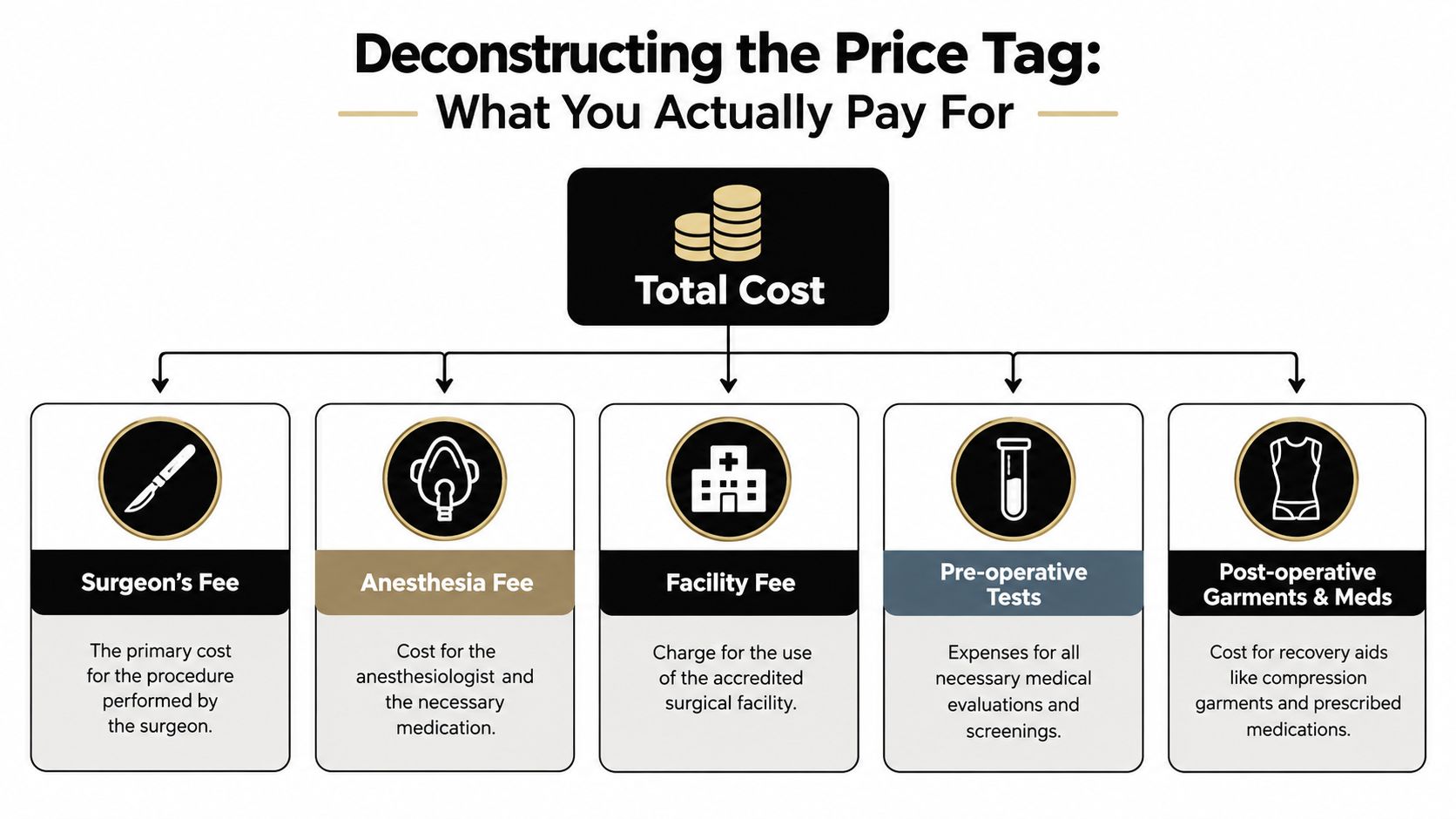
1. Surgeon's fee. This pays for the surgeon's planning, technical work, judgment, and postoperative oversight. It can reflect the complexity of removing lower-abdominal skin, shaping the contour, and addressing any muscle laxity included in the plan.
2. Anesthesia fee. Anesthesia charges cover the anesthesia professional, monitoring, and medications used during surgery. The amount can change when the operation requires more time or a more involved anesthetic plan.
3. Facility fee. The facility charge covers the operating room, surgical equipment, supplies, nursing support, and the environment where the procedure takes place. Ask whether the quote refers to an accredited outpatient suite, hospital operating room, or another setting, because those settings can have different cost structures.
4. Recovery-related expenses. Compression garments, prescriptions, and certain preoperative tests may be separate. Follow-up visits may be included in a surgical package, but you shouldn't assume that they are.
Suppose a practice advertises a surgeon's fee of $6,000. That number doesn't tell you whether anesthesia, facility charges, garments, tests, or medications have been added. A final bill of $9,000 isn't necessarily an unexpected increase if the first figure covered only the surgeon's professional service, but the practice should explain the distinction before you schedule.
Use this checklist during your consultation:
A reliable quote should help you budget for the whole episode of care, not just the moment you enter the operating room.
The goal isn't to eliminate every variation before your examination. Your anatomy determines the surgical plan. The goal is to understand which costs are known, which depend on the plan, and which may be outside the practice's package.
Two patients can ask for a mini tummy tuck and receive different quotes because the procedure isn't a standardized product. The final price reflects the surgeon's work, the amount of tissue addressed, the operating environment, and the resources required for anesthesia and recovery.
Training, experience, credentials, and demand can influence the surgeon's fee. A surgeon with extensive experience may charge more because the fee reflects specialized judgment, technical skill, consultation time, and postoperative management. That doesn't mean a higher fee guarantees a particular result, but price should be evaluated alongside qualifications, communication, facility standards, and the suitability of the proposed plan.
Broader abdominoplasty pricing has also risen over time. The American Society of Plastic Surgeons listed an average full-abdominoplasty surgeon fee of $6,154 in 2020 and $7,215 in 2022, after reporting $5,798 in 2016 and $8,000 to $13,500 in 2024. These figures are professional fee benchmarks, not all-in mini tummy tuck totals, and they appear in the American Society of Plastic Surgeons 2024 statistics.
A limited procedure below the navel may require less operative work than a plan that includes muscle repair or liposuction. Additional contouring can affect the surgeon's fee, anesthesia time, facility use, and recovery supplies. A consultation should identify these additions before you compare totals.
Patients considering combined contouring can read about liposuction and a mini tummy tuck before discussing whether that approach fits their goals.
An accredited private surgical suite and a hospital operating room have different staffing and overhead structures. The right choice depends on the procedure, your health, the surgeon's recommendation, and appropriate safety standards, not only on which setting has the lower fee.
Cape Cod pricing may also differ from nearby metropolitan markets. Travel can introduce transportation, lodging, and support costs, so a distant quote shouldn't be compared without considering the full practical budget.
Ask this directly: “Which parts of this quote could change after the surgical plan is finalized, and what would cause that change?”
That question turns a vague estimate into a useful financial discussion. It also helps you distinguish a genuine difference in surgical scope from a difference in billing presentation.
Mini and full tummy tucks address different areas of the abdomen. A mini tummy tuck usually focuses on loose skin and limited laxity below the navel. A full tummy tuck treats a broader area, which may include upper and lower abdominal skin and the abdominal wall. The right choice depends on where excess skin, fat, and muscle laxity are present, not solely on which procedure costs less.
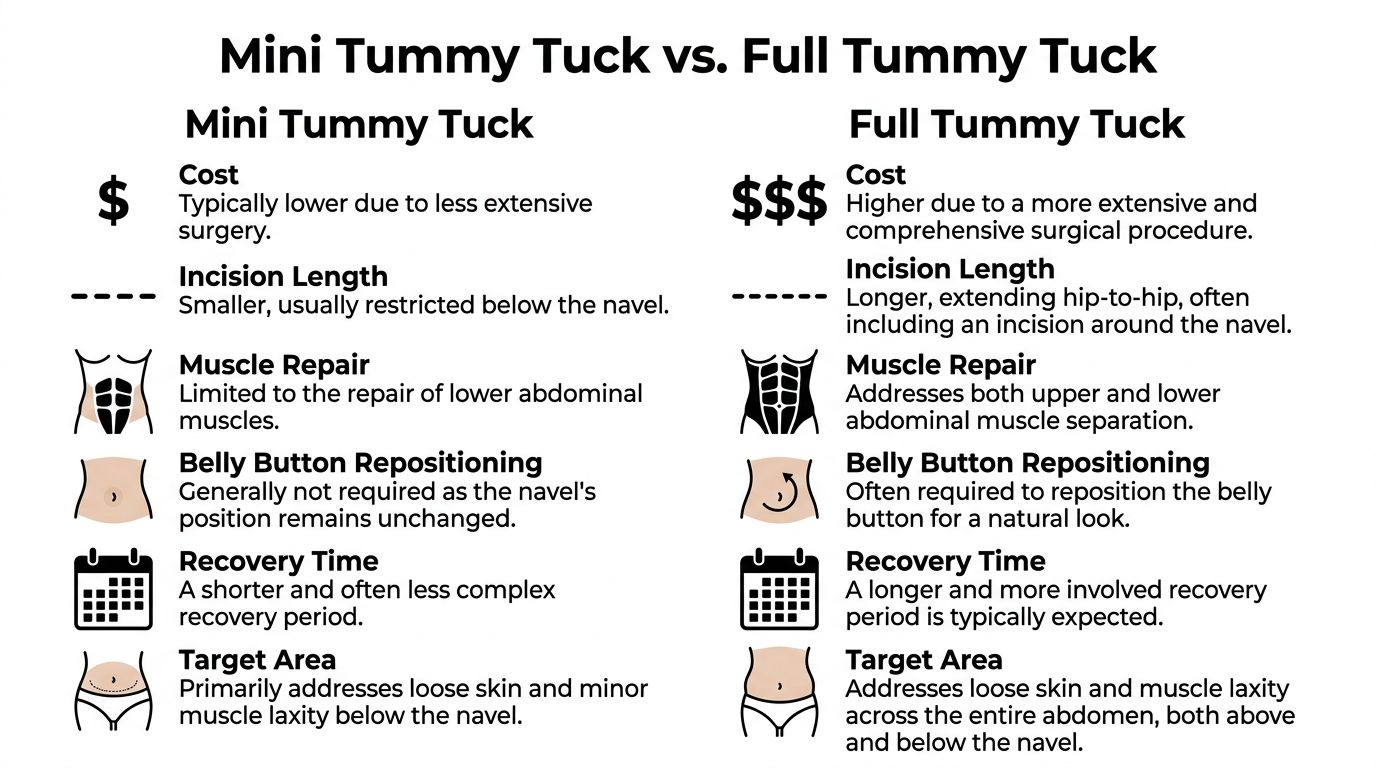
| Feature | Mini Tummy Tuck | Full Tummy Tuck |
|---|---|---|
| Cost | Typically lower because the surgical area is more limited | Typically higher because the operation is more extensive |
| Incision | Shorter incision, generally below the navel | Longer incision, often extending across the lower abdomen |
| Muscle repair | May address limited lower-abdominal laxity | Can address separation across the upper and lower abdomen |
| Belly button | Usually remains in its existing position | May require repositioning |
| Recovery | Often shorter and less involved than a full procedure | Usually more involved because more tissue and muscle may be treated |
| Target area | Loose skin and minor laxity below the navel | Loose skin and laxity across the abdomen |
A full tummy tuck generally involves a wider surgical field, more skin removal, and more extensive reshaping. Those requirements can increase operating time and change the surgeon, anesthesia, and facility portions of an all-in quote. A mini procedure may cost less because the work is limited, but the total still depends on the exact plan and what the quoted fee includes.
The CareCredit pricing overview reports a mini tummy tuck benchmark of $6,247 on average, with a range of $5,037 to $11,873. Treat those figures as a broad reference, not a Cape Cod price or a personal estimate.
The word “mini” describes the scope, not a guarantee of an easy operation. If loose skin reaches above the belly button or there is substantial muscle separation, a limited procedure may leave important concerns untreated. Choosing a lower quote for the wrong operation can create greater emotional and financial strain than selecting the appropriate plan at the outset.
A mini tummy tuck may require less healing than a full procedure, but it remains surgery. You may need help at home, limits on activity, prescribed medication, and follow-up appointments. A full tummy tuck commonly requires more recovery planning because more tissue and muscle may be treated.
Ask how the proposed operation will affect your incision, muscle repair, activity restrictions, medication, follow-up visits, and recovery supplies. Use those details to compare the full out-of-pocket investment, rather than assuming a shorter name automatically means a simple recovery or a lower final bill.
A Cape Cod consultation should begin with your goals, not with a price sheet. You can describe what bothers you, whether your weight has been stable, how pregnancy or weight changes affected your abdomen, and what result would feel natural to you.
The examination helps determine whether the concern is limited to skin below the navel or whether it also involves fat, upper-abdominal skin, muscle separation, or another issue. Dr. Marc Fater is a board-certified plastic surgeon with more than 30 years of experience, and Cape Cod Plastic Surgery describes an on-site AAAASF-accredited surgical suite as part of its facility. These publisher details come from the practice information supplied for this guide.

Bring a written list so the financial discussion is as clear as the surgical discussion.
A personalized quote should reflect the procedure recommended after examination. It should also separate the surgeon's fee from facility and anesthesia charges, so you can compare it fairly with another practice's estimate.
Patients on Cape Cod may also want to ask about transportation, postoperative support, and how follow-up is handled if they live away from Hyannis. These practical details affect the overall investment even when they don't appear on a surgical invoice.
Cost transparency doesn't replace surgical judgment. It gives you the information needed to decide whether the proposed operation fits your goals, health, schedule, and budget.
Usually, no. A mini tummy tuck is generally considered an elective cosmetic procedure, so patients should plan for an out-of-pocket expense. A separate medically necessary operation may be evaluated differently, but that isn't the same as coverage for cosmetic abdominal contouring.
Online figures may represent a surgeon's fee, a patient-reported total, or an estimate that includes selected extras. Patient-facing cost reports show base estimates of $4,000 to $8,000 moving to roughly $5,500 to $10,500 after anesthesia, facility charges, garments, and medications are added, as reported by this tummy tuck cost calculator. Ask which category a number belongs to before comparing it.
Patients commonly ask about healthcare financing, practice payment arrangements, personal loans, or savings. CareCredit is one example of a healthcare financing product, but terms, approval, interest, and repayment obligations vary. A practice coordinator can explain available options, while a healthcare conversational AI resource such as Simbie AI's healthcare conversational AI can help illustrate how patient questions may be organized before an appointment.
Follow your surgeon's instructions, attend scheduled follow-up visits, maintain a stable weight, and discuss future pregnancy plans before surgery. A tummy tuck can improve contour, but it doesn't replace healthy habits or prevent future changes to the abdominal tissues.
Request the complete written quote, the cancellation and rescheduling terms, the expected recovery requirements, and a list of included and excluded services. You should know the financial commitment and the surgical plan before making a nonrefundable decision.
Cape Cod Plastic Surgery offers personalized consultations, body-contouring planning, and an all-inclusive approach to discussing mini tummy tuck expenses. Visit Cape Cod Plastic Surgery to request a consultation and bring your questions about candidacy, recovery, and the complete out-of-pocket cost.
October 7, 2026
A Practical Guide to Healing After Breast Surgery

October 6, 2026
Your Safety Guide: What to Look for When Choosing a Plastic Surgeon

October 5, 2026
Why Our On-Site Accredited Facility Matters for Your Safety

Cape Cod Plastic Surgery offers expert cosmetic and reconstructive procedures in a safe, accredited setting. Led by Dr. Marc Fater, we combine advanced techniques with personalized care to help you look and feel your best.
Monday: 9:00 AM – 5:00 PM
Tuesday: 9:00 AM – 5:00 PM
Wednesday: 9:00 AM – 5:00 PM
Thursday: 9:00 AM – 5:00 PM
Friday: 9:00 AM – 5:00 PM