

September 9, 2026
How to Care for Surgical Incisions Properly
Expert Guide to Proper Surgical Incision Care
Jun 28, 2026

You may be reading this after months of telling yourself to “just give it more time,” while internally avoiding mirrors, photos, or side profiles. Or maybe the appearance isn't even the hardest part. You breathe differently now, you sleep poorly, and every cold feels worse because your nose never seemed to recover the way you expected. That mix of regret, frustration, and hesitation is common after an unsatisfying first rhinoplasty.
A second surgery is not a simple redo. It's a careful reconstruction of trust, structure, and expectations. Patients on Cape Cod often want more than technical answers. They want to know whether improvement is realistic, whether they'll have to travel to Boston for specialized care, and whether someone local can understand both the physical and emotional weight of a revision.
If you've been trying to decide whether to take the next step, it helps to start with a grounded idea of what natural improvement can look like. This discussion of natural looking results from medical aesthetics is useful because it frames the same principle that matters in revision rhinoplasty. The goal is not to make a nose look “done.” The goal is to restore balance so your features make sense together again.
Revision rhinoplasty is often the procedure people never expected to need. Most patients came into their first surgery hopeful, prepared, and ready to trust the process. When the result feels off, whether because the nose looks pinched, uneven, over-reduced, or unlike what they discussed, the disappointment cuts deeper than others around them realize.
On Cape Cod, that experience can feel even more isolating. Smaller communities are close-knit. People recognize one another at school events, restaurants, and the grocery store. If you feel self-conscious about your nose, it can start affecting everyday life in ways that are hard to explain to anyone who hasn't lived through it.
Revision surgery works best when it begins with honesty. Not every problem can be erased, but many can be improved in meaningful, lasting ways.
The good news is that a difficult first result does not mean you are out of options. It does mean you need a different level of analysis. Revision cases demand more planning, more restraint, and more structural judgment than primary rhinoplasty. A surgeon has to identify what changed, what support remains, what tissue can still be relied on, and what goals are achievable for your face and skin.
For many patients, the most important shift is emotional. The first time, they were sold on possibility. The second time, they want clarity. They want a surgeon who can say, “Here's what I can improve, here's what I would leave alone, and here's why.” That is exactly the mindset that separates revision rhinoplasty specialists from surgeons who treat a revision as a minor touch-up.
A primary rhinoplasty starts with untouched anatomy. A revision rhinoplasty does not. The difference is similar to renovating a historic home after several undocumented repairs. Walls may not be where the plans say they are. Support beams may have been removed. Materials may be missing. You can still create a strong result, but only if you understand what is already compromised.
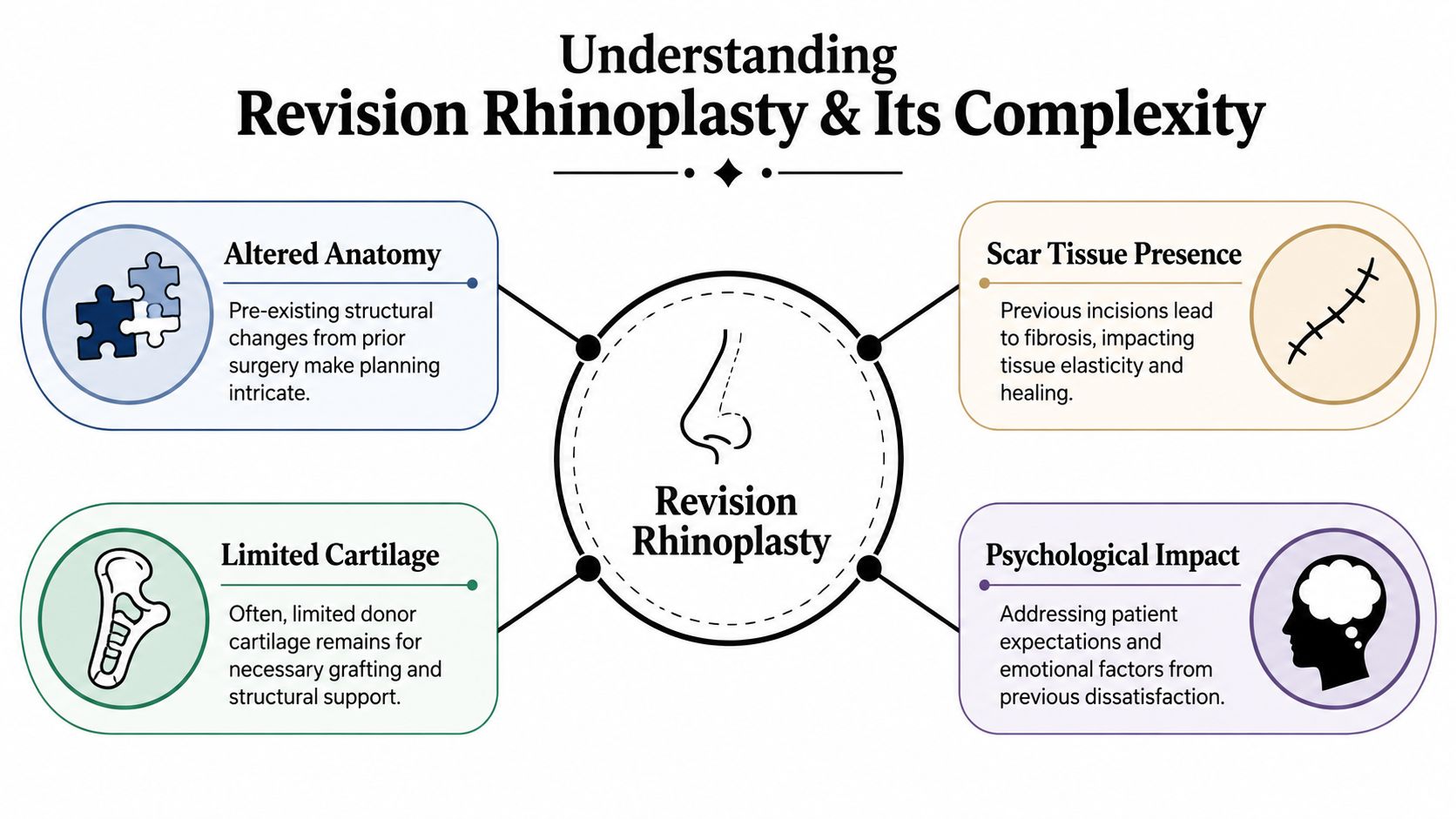
In revision surgery, the surgeon often faces several problems at once:
That's why revision rhinoplasty specialists spend more time evaluating structure than surface appearance. If the framework is weak, shaving, trimming, or narrowing more tissue often makes the nose look worse over time.
Patients often feel embarrassed that they're even considering a second surgery. They shouldn't. The national average rate of rhinoplasty procedures requiring revision is approximately 9.8% to 15%, which underscores why surgeons with focused expertise in secondary cases matter so much (revision rhinoplasty rate data).
That range tells patients something important. Revision is not a sign that you failed. It's a sign that rhinoplasty is one of the most demanding operations in aesthetic surgery, and small technical decisions can have lasting consequences for both appearance and breathing.
Practical rule: If a surgeon talks about your revision as if it's just “a little cleanup,” be careful. Complex noses rarely improve with oversimplified plans.
A good revision plan doesn't separate cosmetic concerns from functional ones. If your bridge looks crooked and your breathing feels restricted, those problems are often connected. If your tip is over-rotated or unsupported, the issue may be structural, not just visual.
What works is rebuilding support where support was lost, then refining shape on top of that. What usually doesn't work is chasing perfection through repeated reduction. Revision surgery succeeds when the nose becomes more stable, more balanced, and more believable on your face.
Some patients know immediately that something is wrong after their first rhinoplasty. Others notice it slowly. A profile that looked acceptable early on begins to drop, twist, or narrow in a way that feels unnatural. Breathing becomes harder. Photos become stressful. The question is not whether your concerns are “serious enough.” The question is whether the problem is structural, aesthetic, functional, or some combination of all three.
Breathing problems matter just as much as appearance. In revision consultations, common complaints include persistent congestion on one side, collapse when inhaling, a feeling that the nose is too narrow internally, or a nose that looks changed but never feels fully open.
A published analysis identified four factors statistically associated with higher revision risk: a preoperative respiratory functional disorder, a wide nose, a deviated aspect caused by nasal bones, and the use of certain camouflage cartilaginous grafts. Patients with wide or deviated noses showed an increased probability of needing revision (risk factors in revision rhinoplasty).
If you had breathing issues before surgery and they were not fully addressed, or if your nose was significantly wide or deviated before your first procedure, those details matter in evaluating what happened and what needs to be corrected now.
Aesthetic dissatisfaction isn't vanity. Sometimes it's the visible sign of an unstable framework.
Common concerns include:
Some of these problems are minor surface issues. Others reflect scar contracture, loss of cartilage support, or underlying deviation that wasn't fully corrected the first time.
The hardest advice to hear is often the most important. Don't rush into a second procedure before the tissues have declared themselves. Swelling, firmness, and scar remodeling can mask the final shape for a long time, especially after a first rhinoplasty that involved significant structural change.
If you're early in the healing process, the right next step may be evaluation, photography, and observation rather than immediate surgery. A careful surgeon should be willing to say, “I see the concern, but it's too soon to operate responsibly.”
Choosing among revision rhinoplasty specialists is not about finding the most polished website or the closest office. It's about finding a surgeon who understands structural nasal surgery, scarred tissue planes, grafting strategy, and the psychology of a patient who has already been disappointed once.
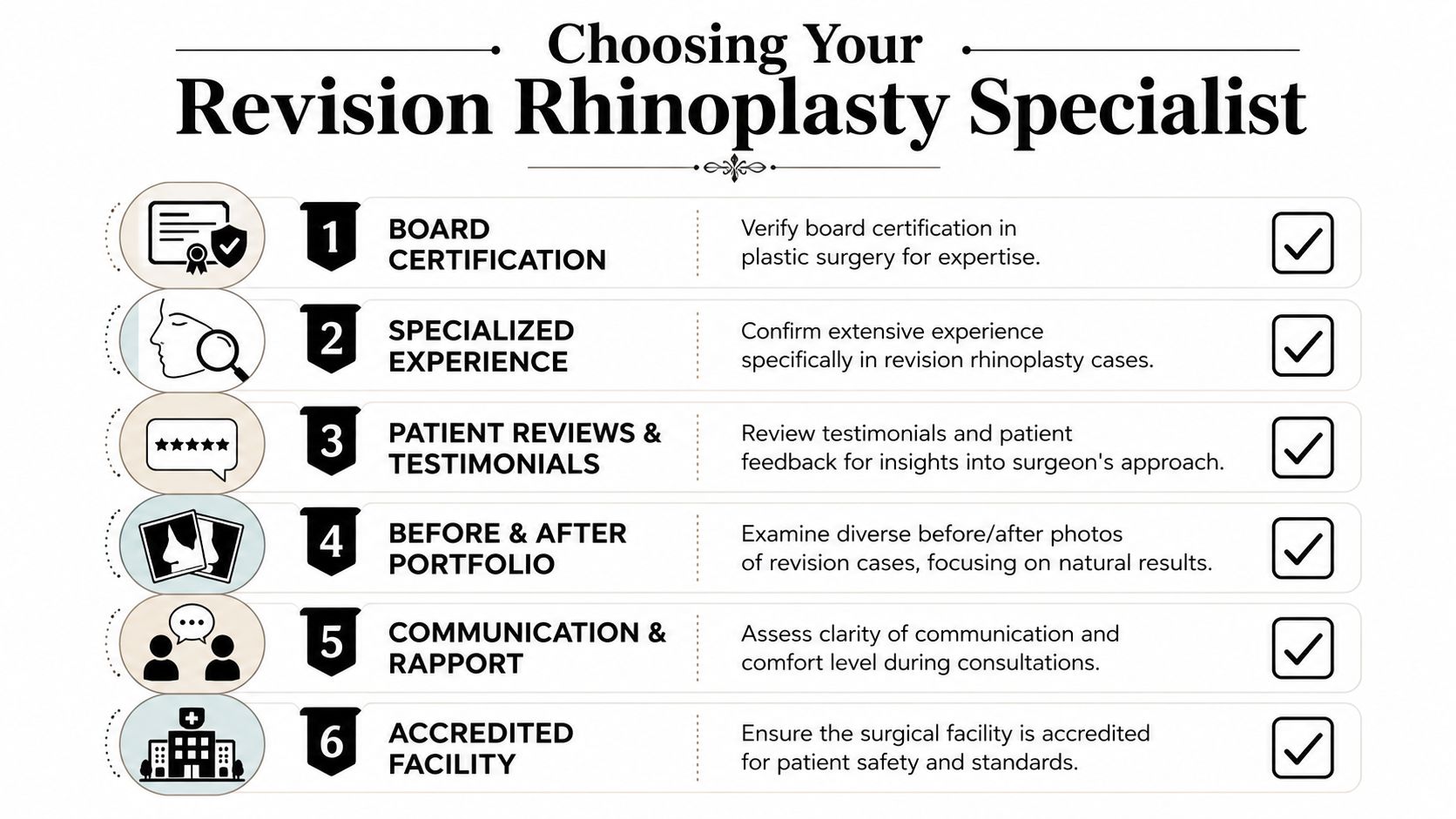
Board certification matters because it reflects formal training and standards, but certification alone is not enough for a revision nose. You want a surgeon whose practice includes a real commitment to facial surgery and rhinoplasty decision-making, not someone who treats nose work as an occasional add-on to body procedures.
Look for these signals:
If you want a broader patient checklist before you narrow your search, this guide on how to choose a plastic surgeon is a helpful place to start.
Before-and-after galleries can mislead patients if they only show straightforward primary cases. Revision work should be judged by subtlety, balance, and whether the nose looks structurally believable. A revision result that appears slightly less “dramatic” may be the more skillful operation because the surgeon preserved or rebuilt support instead of chasing an artificial ideal.
When you review photos, ask yourself:
| What to look for | Why it matters |
|---|---|
| Crooked noses improved, not just small humps removed | Revision skill shows up in difficult anatomy |
| Natural profiles from multiple angles | Good noses must work from the front, side, and base view |
| No repeated template nose | Revision surgery must be individualized |
| Balanced tip support | Overworked tips often create long-term problems |
A revision consultation should feel calm, detailed, and specific. Ask the surgeon what they think happened in your first operation. Ask whether your breathing issue is structural. Ask what graft material they may need and why. Ask what result is realistic for your skin thickness and existing support.
Later in the discussion, video can also help you hear a surgeon explain philosophy and approach in a less scripted format:
A local option for Cape Cod patients is Cape Cod Plastic Surgery, where Dr. Marc Fater brings over 30 years of experience, board certification, and an on-site AAAASF-accredited surgical suite. Those facts matter because revision cases demand both judgment and a controlled operative environment.
The surgeon you choose for revision should be comfortable telling you what not to change. Restraint is part of expertise.
A strong consultation does not leave you dazzled. It leaves you informed. If a surgeon promises perfection, minimizes risk, or seems too eager to agree with every request, step back. Revision surgery goes best when the plan is thoughtful, not flattering.
Most revision patients arrive carrying a folder of old photos, operative notes if they have them, and a private fear that they're being “too picky.” A productive consultation begins by removing that pressure. The conversation should focus on what changed, what bothers you now, how your nose functions, and what you hope will be different after revision.

Expect a longer conversation than you would for many cosmetic procedures. The details matter. Was your first surgery open or closed? Did your breathing worsen after surgery, or was it already limited before? Do you dislike the bridge, the tip, the nostrils, or the overall balance? Are you looking for repair, refinement, or both?
A careful consultation also includes a physical exam of the external shape and internal support of the nose. That exam helps distinguish between a visible asymmetry that is mostly scar-related and one that reflects a deeper structural issue.
Computer imaging can be useful in revision planning when it is used correctly. It should guide discussion, not serve as a guarantee. The most helpful imaging sessions show the direction of improvement and clarify trade-offs. For example, making a nose straighter may slightly affect perceived width. Improving support may require accepting that the nose cannot be made dramatically smaller without compromising function.
Patients who want a better sense of the full visit process often appreciate this overview of what to expect during your plastic surgery consultation.
A good consultation should lower your anxiety, not intensify it. You should leave with a clearer understanding of your anatomy and your options.
For Cape Cod residents, convenience isn't trivial. Revision rhinoplasty involves follow-up, healing checks, and questions that often come up after surgery when swelling changes from week to week. Having your consultation and postoperative care close to home can make the process feel more manageable, especially if you live on the Cape year-round or split time seasonally and want continuity from the same office.
Revision surgery often requires rebuilding before refining. That is the central difference patients need to understand. If your first rhinoplasty removed too much support, left a collapse, or created a contour problem caused by weakness rather than excess, the operation may involve structural grafting rather than more reduction.
In complex secondary cases, surgeons may need cartilage from a site outside the nose because septal cartilage is no longer available or strong enough. In revision rhinoplasty, costal cartilage from the rib is considered the most powerful structural tool due to its superior strength and volume, making it especially useful for reconstructing collapsed nasal frameworks (rib grafts in revision rhinoplasty).
That does not mean every patient needs a rib graft. It means the surgeon should be prepared to use strong structural material when the nose no longer has enough native support. What works in revision is rebuilding the framework first, then shaping the surface. What doesn't work is trying to conceal instability with minor trimming or camouflage alone.
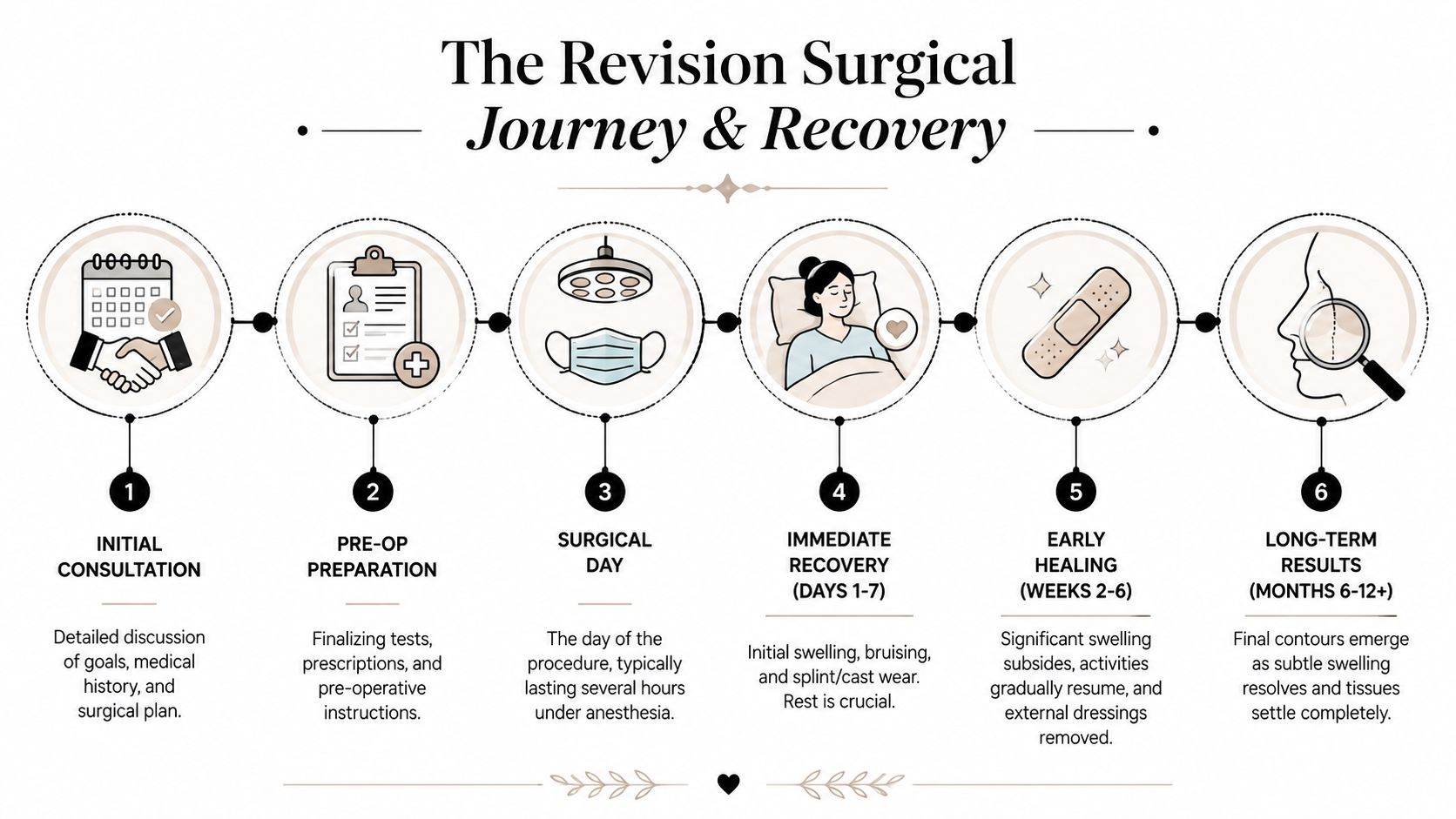
The first week is usually the most socially inconvenient. There may be a splint, bruising, congestion, and a strong sense of tightness. That part is temporary. The more difficult challenge is patience. Revision swelling can be stubborn, uneven, and emotionally misleading.
One practical resource many patients find helpful is this week-by-week guide to rhinoplasty recovery, because it helps normalize what healing often looks like in real life.
Revision healing is often slower than expected. According to published guidance, approximately 85% of the final aesthetic result is visible within one month, 95% by six months, and complete resolution of edema and scar maturation occurs over 12 to 24 months (revision healing timeline).
That timeline affects decision-making in a major way:
Recovery from revision is not a straight line. One side may look more swollen than the other for a period of time, and that alone does not mean something is wrong.
The patients who do best are usually the ones who understand the pace of healing before surgery. Revision rhinoplasty is not instant gratification. It is a long, careful process in which structure settles first and confidence returns gradually.
Patients usually reach this point with a few practical questions still hanging in the background.
Not always. Many patients describe revision as more of a pressure, congestion, and swelling experience than a sharp pain experience. The bigger issue is often emotional fatigue. Recovery can feel heavier because you are watching the result more closely and carrying the memory of the first disappointment.
The risks are different because the anatomy is different. Scar tissue, reduced cartilage reserves, and weakened support make planning more exacting. That is why revision rhinoplasty specialists focus so heavily on examination, imaging, operative history, and realistic goal-setting before scheduling surgery.
Often, yes. In fact, many of the same structural corrections that improve support can improve airflow. The key is to treat the nose as a functional structure with an external shape, not as a cosmetic surface alone.
The answer depends on surgical complexity, whether grafting is needed, the operative setting, and how much reconstruction is required. A simple quote without a detailed exam usually isn't meaningful. The better approach is to get a personalized assessment and understand exactly what the proposed plan includes.
If you live on Cape Cod or in the surrounding area and you're considering a second opinion, the most useful next step is a consultation that is thorough, calm, and specific to your anatomy. A good revision plan should give you a realistic path forward, not just reassurance.
If you're ready to talk through your options, schedule a consultation with Cape Cod Plastic Surgery. For patients considering revision rhinoplasty on Cape Cod, a personalized evaluation can clarify what's structurally possible, what may improve most, and what timeline makes sense for your next step.
September 9, 2026
Expert Guide to Proper Surgical Incision Care

Master dermal fillers aftercare with do's and don'ts, swelling tips, activity limits and warning signs to protect your results and heal smoothly.

September 8, 2026
Ensuring Safety: Why Your Surgeon's Credentials Matter Most
Cape Cod Plastic Surgery offers expert cosmetic and reconstructive procedures in a safe, accredited setting. Led by Dr. Marc Fater, we combine advanced techniques with personalized care to help you look and feel your best.
Monday: 9:00 AM – 5:00 PM
Tuesday: 9:00 AM – 5:00 PM
Wednesday: 9:00 AM – 5:00 PM
Thursday: 9:00 AM – 5:00 PM
Friday: 9:00 AM – 5:00 PM