
September 9, 2026
How to Care for Surgical Incisions Properly
Expert Guide to Proper Surgical Incision Care
Jun 26, 2026
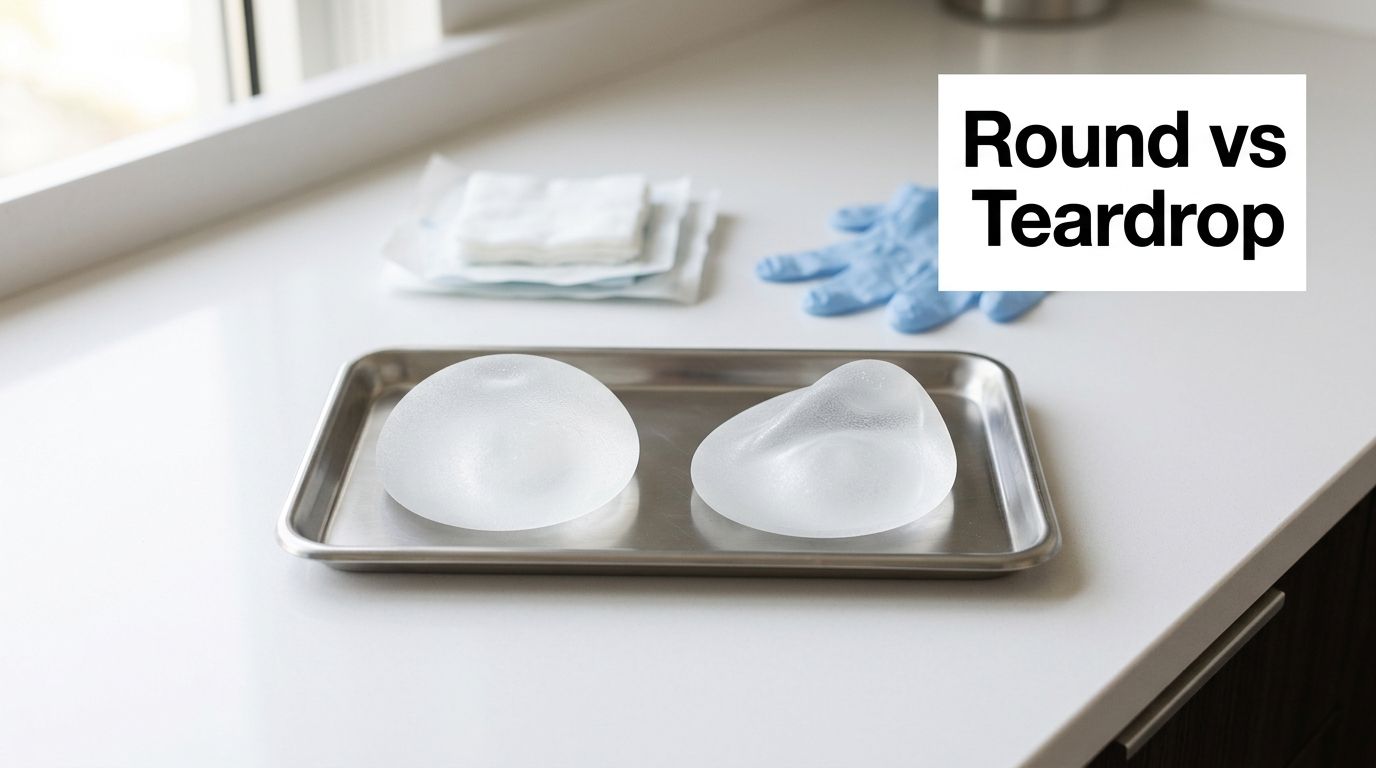
You're probably here after doing what most breast augmentation patients do first. You've looked at before-and-after photos, read surgeon websites, watched social videos, and come away with the same question you started with: should you choose round or teardrop implants?
The frustrating part is that the internet often reduces the decision to a slogan. Round means fuller. Teardrop means more natural. That sounds simple, but it leaves out the part that matters most in an actual consultation: your tissue, your skin quality, your breast shape, and how those factors will interact with an implant over time.
As a board-certified plastic surgeon, I can tell you that implant shape is only one variable. A good result doesn't come from choosing the implant that sounds best in marketing language. It comes from matching the implant to your anatomy and to what your breast can realistically support.
A patient sits down in consultation and says some version of the same thing almost every week. “I want to look natural, but I also want fullness.” Then comes the next question. “Does that mean I need teardrop implants?”
That question makes sense. Teardrop implants are marketed around the idea of a softer slope and a more anatomical shape. Round implants are often described as fuller and less subtle. If that were the whole story, the choice would be easy.
It isn't.
The better question is this: what shape works best with your starting anatomy? A patient with tight skin, minimal breast tissue, and a narrow frame may need a very different implant strategy than a patient with stretched skin, lower breast laxity, or postpartum volume loss.
Clinical reality: The “most natural” implant on paper can look unnatural if it doesn't match the patient's tissue characteristics.
What I want patients to understand early is that round vs teardrop implants isn't really a beauty contest between two products. It's a decision about fit, safety, long-term stability, and whether the implant helps or fights your anatomy.
A useful consultation strips away the buzzwords. It focuses on what will give you a result that looks balanced on your body, feels appropriate for your goals, and avoids avoidable complications.
At the most basic level, these implants differ in geometry.
A round implant is symmetrical. A teardrop implant, also called an anatomical implant, is narrower at the top and fuller at the bottom. That bottom-heavy design is meant to mimic the natural breast's lower-pole fullness.
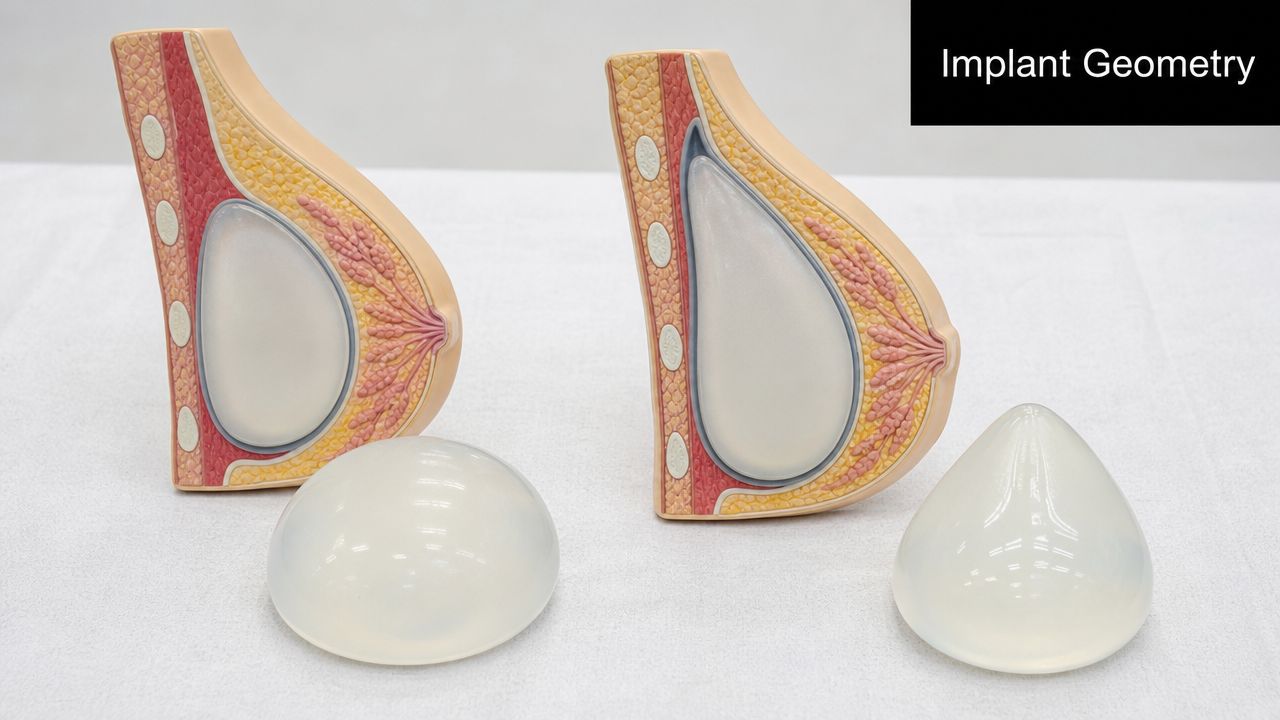
Round implants are geometrically symmetrical, with identical width, height, and projection on all axes, which means they maintain the same shape regardless of orientation, according to Partington Plastic Surgery's explanation of implant geometry.
That matters because if a round implant shifts within the pocket, the breast doesn't suddenly look distorted from the implant turning. The implant is still round.
Round implants also tend to create more upper pole fullness. Some patients want that softer upper slope. Others want more visible fullness in fitted clothing or swimwear. The same shape can support both goals, depending on implant size, profile, pocket design, and tissue coverage.
If you're comparing implant options more broadly, this overview of breast augmentation implant types and recovery is a helpful companion read.
Teardrop implants are designed with an intentional top-to-bottom difference. The upper part is slimmer. The lower part carries more volume. In theory, that creates a gentler transition from chest to breast.
They usually rely on a more form-stable gel so the implant keeps that anatomical contour. In practical terms, that can mean a somewhat firmer feel compared with an implant designed to redistribute more freely.
Their shape also creates a technical demand. Because the implant is not symmetrical, orientation matters. If it turns, the breast shape changes with it.
Patients often assume the implant's shape alone determines the final look. It doesn't. The breast pocket, overlying tissue, skin elasticity, chest width, and implant position all influence what you see after healing.
A simple way to think about it is this:
That last piece is why consultations should start with anatomy, not product labels.
The main reason patients compare round vs teardrop implants is visual outcome. They want to know which one looks more natural, which one gives cleavage, and whether one feels better than the other.
Here's the short answer. Either implant can look beautiful. Neither shape guarantees a better result on its own.
| Feature | Round Implants | Teardrop (Anatomical) Implants |
|---|---|---|
| Overall shape | Symmetrical and evenly contoured | Fuller at the bottom, tapered at the top |
| Upper pole fullness | Typically more fullness in the upper breast | Usually less upper fullness |
| Cleavage effect | Often better for patients seeking more visible fullness | Often more restrained |
| Orientation concerns | Shape looks the same if the implant turns | Shape can look distorted if it rotates |
| Feel | Depends on implant fill and tissue coverage | Often associated with a firmer, shape-holding gel |
| Common cosmetic use | Standard choice for augmentation | More selective use cases |
When patients say “natural,” they usually mean one of three things:
That's why shape alone can be misleading. A round implant placed thoughtfully under appropriate tissue coverage can look very natural. A teardrop implant placed in the wrong anatomy can look artificial, low, or awkward.
One of the more important points in this discussion is that board-certified plastic surgeons cannot reliably distinguish between round and teardrop implants once placed, which challenges the idea that teardrop implants consistently deliver a visibly more natural result, as discussed in Dr. Jeffrey Lind's comparison of round and teardrop implants.
That finding matters because it shifts the conversation away from marketing claims and toward what determines the outcome: sizing, pocket control, tissue quality, and implant placement.
A healed breast doesn't display the implant on a table. It displays the implant through skin, tissue, and surgical design.
Round implants usually do a better job creating a fuller upper breast and more obvious cleavage. For patients who want a “done but elegant” look, that can be a real advantage, not a drawback.
Teardrop implants are meant to produce a lower-weighted contour. In selected patients, that can be useful. In others, especially if the tissue is already loose or the nipple position is low, it may not create the correction they're hoping for.
The key is matching the implant's behavior to the breast's existing structure.
Feel is more complicated than shape. Patients sometimes expect round to feel soft and teardrop to feel firm, but the final feel depends on several factors:
That said, anatomical implants often rely on a firmer cohesive gel to maintain their shape. A round implant may feel softer in some settings, but that isn't universal.
In consultation, I focus less on abstract labels like soft or natural and more on whether the implant will look and behave appropriately in your tissues.
Aesthetic preference matters, but safety should matter just as much.
The round vs teardrop implants conversation often becomes much clearer when practical implications are considered. The shapes don't just look different on the shelf. They introduce different surgical considerations and different risk profiles.
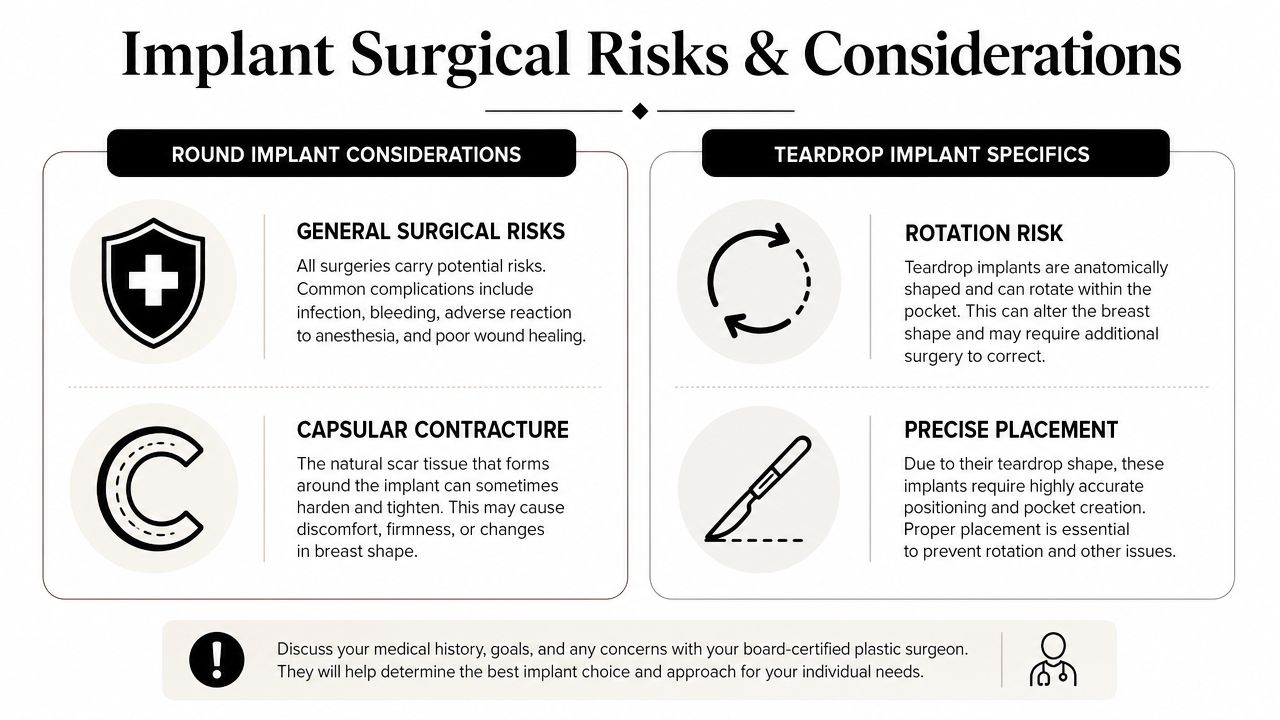
The most important shape-specific issue with teardrop implants is rotation.
If a round implant shifts, its appearance stays the same because it is symmetrical. If a teardrop implant rotates, the fuller lower portion may move to the side or upward. That can create visible breast distortion and may require correction.
This isn't a theoretical point. It's built into the design logic of the implant itself. Anatomical implants need correct orientation to look right.
A large multicenter study found that shaped implants had higher infection rates than round implants, 6.1% for shaped versus 2.3% for round, with the difference remaining significant after adjustment, while patient-reported outcomes at 2 years were comparable between the groups according to the published analysis in Plastic and Reconstructive Surgery Global Open.
That same study also showed a more nuanced trade-off. Shaped implants were associated with a lower need for contralateral symmetry procedures, even though the safety profile on infection favored round implants.
So the conversation isn't “one implant is perfect.” It's this:
If you're reviewing procedural options more broadly, this page on breast augmentation surgery gives a useful overview of how implant planning fits into the larger operation.
Risk filter: If an implant's potential aesthetic benefit is subtle, but its complication profile is more demanding, that should weigh heavily in the decision.
Teardrop implants typically require more exact positioning. The pocket has to support the implant in the intended orientation. Their design may also influence insertion technique and handling during surgery.
Round implants are generally more forgiving in this respect. That doesn't make surgery casual. Good implant surgery is never casual. But it does remove one major shape-specific complication from the equation.
For many cosmetic augmentation patients, that simplicity is part of why round implants remain such a common choice.
This is the part many online discussions miss.
The best implant shape isn't the one with the best branding. It's the one your tissues can support well. In real surgical planning, breast laxity, skin quality, breast footprint, nipple position, and tissue thickness usually matter more than whether an implant is round or anatomical.

A patient with postpartum changes often comes in focused on implant shape, when the underlying issue is tissue support. If the breast skin has stretched and the lower pole has loosened, a teardrop implant usually won't “fix” that by virtue of being anatomical.
In fact, patients with significant breast sagging, Grade 2+ laxity, achieve better correction with round implants of higher projection and fill rate, because teardrop implants are less effective at addressing laxity and may worsen bottoming-out, as described in this tissue-based analysis of round versus anatomical augmentation.
This is an important point. If the breast envelope is loose, a lower-weighted implant shape can work against the correction you want.
Patients with firmer tissue and minimal sagging have more flexibility. In that anatomy, a shaped implant may be useful when the goal is a very gentle slope and restrained upper fullness.
But even there, I don't start with shape stereotypes. I look at how much native tissue is present, where the nipple sits on the breast mound, how wide the chest is, and how the soft tissue will drape over the implant.
A consultation should answer questions like these:
Those are different problems. They don't all call for the same device.
A natural-looking breast is usually the result of proportion and support. It comes from choosing a width that fits the chest, a projection the tissue can handle, and a plan that respects the starting anatomy.
This short video helps illustrate how surgeons think through that anatomy-first approach in augmentation planning.
Most patients don't need a more “natural” implant. They need a better anatomical match.
That's why I often tell patients to stop asking which implant is best in general and start asking which implant is best for their breast.
In consultation, I don't begin by asking whether you want round or teardrop. I begin by evaluating what your anatomy allows us to do well and safely.
That means examining the breast base width, skin quality, existing breast volume, degree of laxity, nipple position, and the relationship between the breast and the chest wall. Those findings shape the recommendation far more than a patient's initial impression from online photos.
A sound implant choice should account for aesthetics, mechanics, and practical trade-offs.
For some patients, a shaped implant has a legitimate role. It can be useful in selected reconstructive situations and in some petite frames where a very specific contour is the priority. But for most cosmetic augmentation patients, round implants remain the standard choice, and teardrop implants are generally more expensive because of their more complex design and insertion demands, as noted earlier in the aesthetic comparison source.
That cost difference isn't the main reason to choose an implant, but it is part of an honest discussion.

Patients also do well when they come prepared. I encourage them to ask specific questions, not generic ones.
For patients who want to prepare before their visit, these top questions about breast implant types are a good place to start.
The goal of consultation isn't to sell one implant category. It's to choose the option that gives you the best balance of shape, support, longevity, and safety.
No. In healed patients, the final appearance depends heavily on tissue coverage, implant size, pocket design, and placement. The implant's shape is only one factor.
Yes. In many patients, they absolutely can. A round implant that fits the chest and works with the tissue often looks softer and more natural than an anatomical implant chosen for the wrong anatomy.
Because the implant is asymmetrical, rotation can distort the breast shape. That's one of the main practical drawbacks of anatomical implants.
There isn't one universal answer. Feel depends on gel cohesiveness, the thickness of your own tissue, implant position, and healing characteristics. Shape by itself doesn't decide feel.
Yes. They can be useful in selected reconstructive settings and in certain patients whose anatomy and goals support that design. They just shouldn't be treated as the default “better” or “more natural” option.
Choose based on anatomy, not labels. If you take one point away from this guide, let it be that. The most reliable plan is built from your tissues outward, not from a product description inward.
If you're thinking about breast augmentation and want a recommendation based on anatomy rather than marketing, Cape Cod Plastic Surgery offers consultation with Dr. Marc Fater, a board-certified plastic surgeon who takes a personalized, safety-focused approach to implant planning.
September 9, 2026
Expert Guide to Proper Surgical Incision Care

Master dermal fillers aftercare with do's and don'ts, swelling tips, activity limits and warning signs to protect your results and heal smoothly.

September 8, 2026
Ensuring Safety: Why Your Surgeon's Credentials Matter Most

Cape Cod Plastic Surgery offers expert cosmetic and reconstructive procedures in a safe, accredited setting. Led by Dr. Marc Fater, we combine advanced techniques with personalized care to help you look and feel your best.
Monday: 9:00 AM – 5:00 PM
Tuesday: 9:00 AM – 5:00 PM
Wednesday: 9:00 AM – 5:00 PM
Thursday: 9:00 AM – 5:00 PM
Friday: 9:00 AM – 5:00 PM