

October 7, 2026
What to Expect During Your Breast Surgery Recovery
A Practical Guide to Healing After Breast Surgery
Jul 25, 2026
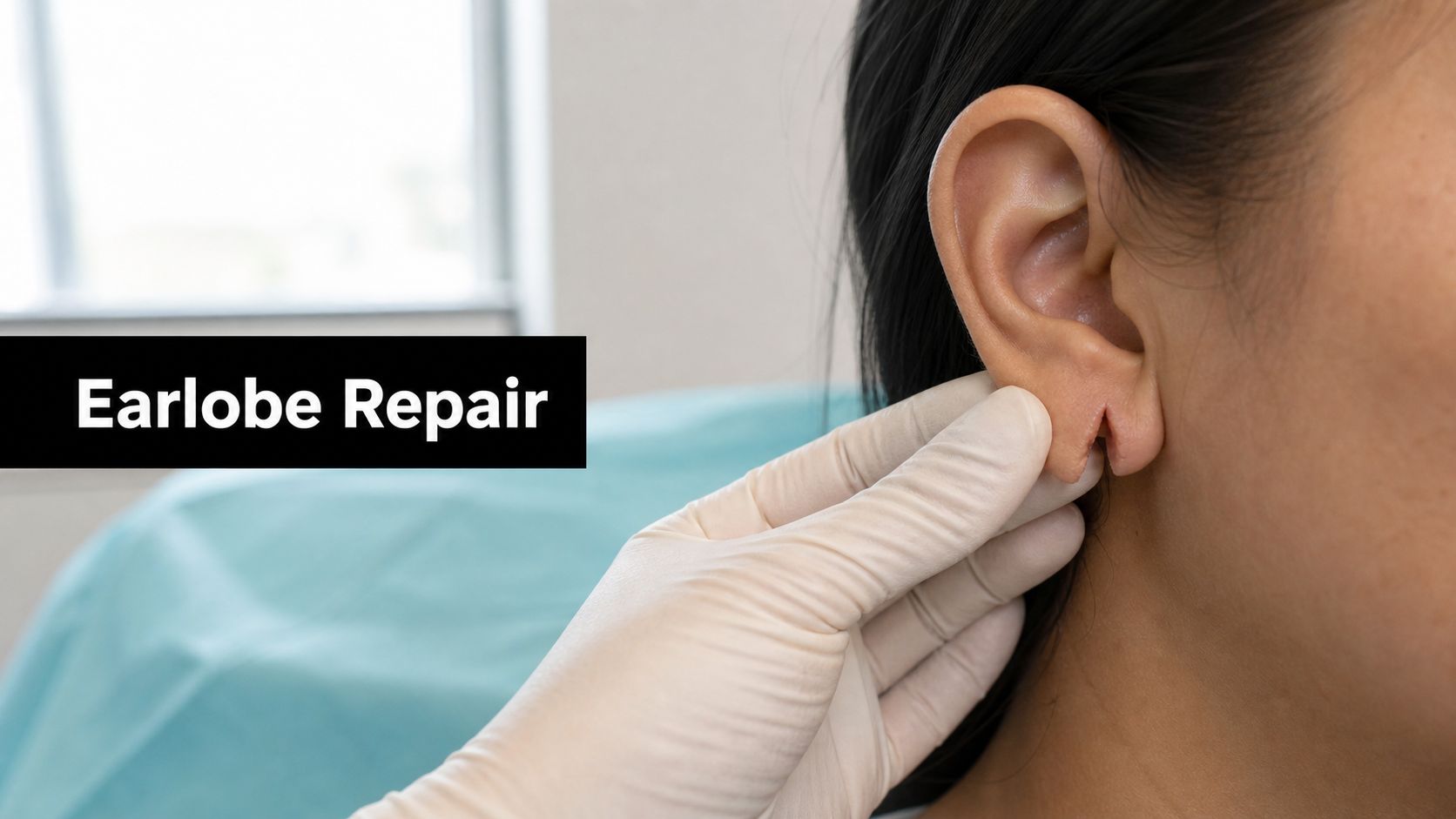
You tugged on an earring, a sweater caught the backing, or a child pulled your lobe just hard enough to split the tissue. Sometimes the damage is gradual instead, a piercing that's been stretched over years finally gives way and leaves a tear that won't settle back into place. Either way, the moment feels surprisingly personal, because the change is visible every time you look in the mirror.
Split earlobe repair is the straightforward name for the procedure that fixes that tear, but the decision-making behind it is more nuanced than most online summaries admit. A good surgeon is not just closing skin, they're choosing where to place stitches, whether to preserve the piercing canal, and how to avoid a lobe that looks elongated or notched after it heals. The procedure is generally considered a low-risk outpatient repair, and clinical literature describes it as easy with very satisfactory results, while also acknowledging technique-dependent differences in shape and complication risk. Clinical review of auricular lobuloplasty
A torn lobe can feel like a small problem until you try to wear an earring again and realize the hole has turned into a slit, or the lower edge has split clean through. That's usually when people start looking for answers, not because they want a dramatic cosmetic change, but because the ear no longer behaves the way it used to. The repair is designed to restore the contour of the lobe, close the defect, and, when appropriate, leave room for a future piercing.
The useful way to think about it is this, the surgeon is repairing a soft edge with no cartilage support, so the tissue has to be handled carefully to avoid tension, distortion, and a visible scar. Cleveland Clinic's overview lists the complications patients should know about, including asymmetry, bleeding, infection, numbness, scarring, sensitivity, and skin discoloration, even though the overall procedure is usually uncomplicated. Cleveland Clinic overview cited in clinical review
A patient sitting in the consultation chair often wants one simple answer, “Can you just stitch it?” Sometimes yes, but not always in the same way. A clean partial tear may need a different approach than a complete split, and a person who wants to keep their piercing hole has a different surgical goal than someone who only wants the lobe restored.
Practical rule: the best repair is the one that matches the tear, the tissue quality, and the patient's future plans for earrings.
That's why this procedure is worth taking seriously even though it's brief and usually done under local anesthesia. Published cost guidance places basic earlobe repair at about $400 to $900 per ear, and the procedure typically takes about 20 to 30 minutes per earlobe. Those numbers help explain why the repair is so accessible, but they also hide the part that matters most, the technique choices made in the room. Cost and timing guidance
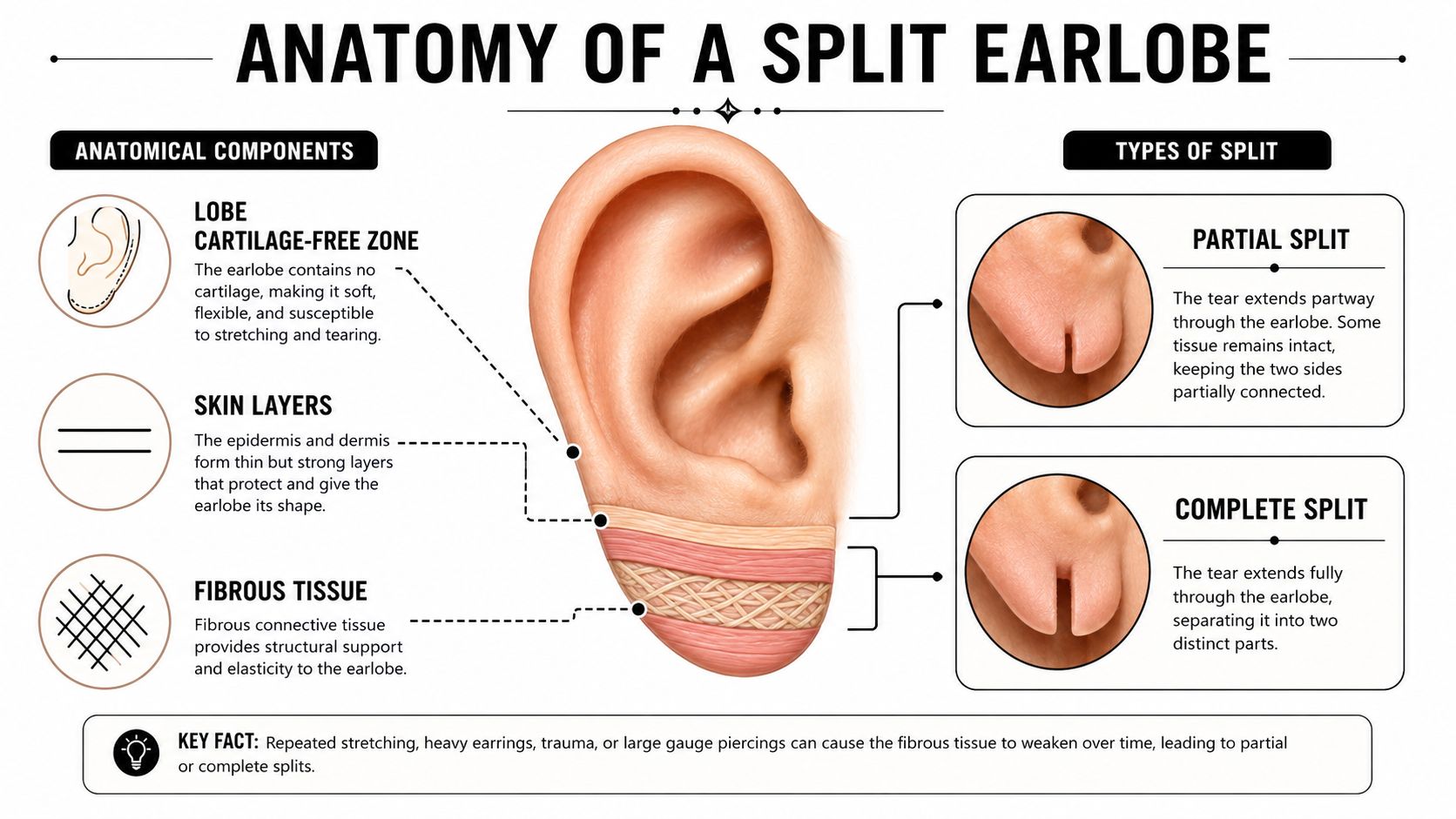
The earlobe is the soft lower part of the ear, and unlike the upper ear it doesn't have cartilage inside it. That matters because cartilage gives shape and stiffness, while the lobe is mostly skin and soft connective tissue, so it stretches more easily under repeated pull or weight. A useful analogy is to think of it as a fabric hem without a rigid backing, once the stress starts to concentrate at one point, the edge can split.
A partial split is often an elongated piercing hole or a tear that hasn't fully divided the lobe. A complete split runs through the bottom edge, so the lobe is separated into two parts. Surgeons often classify clefts by size, and the comparative study in the repair literature looked at 4–6 mm, 7–9 mm, and 10–12 mm groups, because size helps predict what kind of closure will hold shape best. Technique comparison study
The causes are usually familiar. Heavy earrings can slowly pull the tract wider, accidental snags can create a sudden tear, gauges can leave a widened defect that doesn't close on its own, and tissue thinning over time can make the lobe more vulnerable. In everyday life, pressure from mask straps or telephone receivers can also aggravate a weakened piercing, especially if the tract is already stretched.
If you're trying to decide whether your issue is “just a stretched hole” or a true split, look at the lower edge of the lobe. If the opening still sits above the rim, it's usually a partial problem. If the bottom border is interrupted, the repair needs to restore the edge itself, not just close the center. For patients in the UK looking for a local example of how clinics describe this problem, ear piercing repair in Bournemouth is a useful patient-facing resource.
The anatomy sounds simple, but that simplicity is exactly why the lobe tears so readily. It's a soft, unsupported edge, and once the tissue has stretched or split, it usually needs a planned repair rather than hoping the skin will reset itself.
The main choice in split earlobe repair is not whether to close the wound, it's how to close it so the lobe keeps a natural shape. That decision changes depending on whether the tear is straight, whether the patient wants to keep a piercing canal, and whether the surgeon is trying to reduce the chance of notching or recurrence.
Simple side-to-side closure is the most direct method. The surgeon freshens the edges and closes them together, which is often a good match for a clean partial tear. In the comparative study, this technique produced 1.85 mm greater mean elongation than anterior-posterior flap modification, and the difference was significant at P < 0.001. That means the simpler repair can leave the lobe a bit longer, which may matter when symmetry is a priority. Comparative study of repair methods
Anterior-posterior flap modification changes the geometry so the tissue overlaps in a way that better controls final contour. Surgeons may favor it when they want to reduce elongation, especially across the cleft-size groups studied, since the same elongation pattern held in 4–6 mm, 7–9 mm, and 10–12 mm tears. That consistency suggests the effect isn't limited to one kind of split. Comparative study of repair methods
Z-plasty, L-plasty, and V-flap variants are used when the surgeon wants to break up a straight scar line and lower the chance of contracture pulling the edge inward. The systematic review of traumatic ear lobe repair techniques found a post-operative infection rate of 11.5% for Z-plasty type 2, while still concluding that overall complication rates are low and technique choice should depend on surgeon and patient preference. Systematic review of traumatic ear lobe repair
For a completely split lobe, surgeons often pay close attention to the inferior border, because notching there is one of the easiest ways for the repair to look “off.” Expert surgical guidance recommends placing the first stitch at the bottom edge, using vertical or horizontal mattress sutures to create eversion, and undermining the wound edges by about 1 mm when needed. Thicker lobules may need one or two dermal sutures, and suture removal is typically done 7–14 days later. Expert surgical guidance on split earlobe repair
Some patients care greatly about keeping the piercing tract. In canal-sparing reconstruction, the surgeon de-epithelializes the cleft, maintains an epithelialized tract, and then reapproximates the edges with simple or mattress sutures. That approach is different from a plain linear closure, because it's trying to preserve function as well as shape. Canal-sparing technique review
Important trade-off: keeping the piercing canal can be useful, but recurrence prevention and contour control sometimes matter more, especially if the lobe has already torn once.
A surgeon's real job here is to match the method to the problem, not force every tear into the same repair. If you've seen a clinic talk about gauged ears separately, this repair discussion on stretched lobes helps explain why enlarged tracts often need a different plan than a clean split.
The consultation usually starts with the surgeon looking at three things, the size of the cleft, how much healthy tissue is left, and whether the ear needs a repair that preserves a future piercing. Marking the lobe while you're sitting upright matters, because ear shape changes a little when you're lying down. The procedure is typically done with local anesthesia, so you stay awake but don't feel the repair itself. Procedure overview and anesthesia
The in-room part is usually brief, about 20 to 30 minutes per earlobe. In practical terms, that means a visit can fit into a normal outpatient schedule rather than a hospital day. The surgeon repairs the tissue, places the sutures, and applies a dressing before you leave.
The first 24 to 48 hours often involve a bandage and a little swelling or tenderness. That early stage is less about appearance and more about protecting the repair from traction, moisture, and accidental bumps. Suture removal is typically done 7–14 days after surgery, depending on the material used and how the skin is healing. Suture timing guidance
After that, the scar keeps maturing for months. It's common for the area to look pink or feel a bit firm at first, then soften gradually. If the goal is to wear earrings again, many surgeons advise waiting long enough for the tissue to fully stabilize, and then re-piercing away from the healed scar rather than through it.
Keep the ear dry and protected early on, because most avoidable setbacks happen when a fresh repair gets pulled, soaked, or irritated.
For wound-care habits that matter after this kind of repair, these surgical incision care instructions are a helpful reference point. The main idea is simple, the repair is small, but it still heals best when you treat it like a real incision, not a cosmetic afterthought.
The honest answer is that split earlobe repair is usually well tolerated, but no repair is risk-free. The main issues people worry about are infection, asymmetry, notching, visible scar, recurrence, temporary numbness, and skin discoloration. Cleveland Clinic's overview lists those same possibilities, which is reassuring in one way, because it means the concerns patients notice are the ones clinicians already expect and monitor. Clinical overview of complications
Technique matters. The comparative study showing more elongation with simple closure compared with flap modification is a good example of how the choice of method changes the final contour. The systematic review's 11.5% infection rate for Z-plasty type 2 also shows that some approaches carry different trade-offs, even when the overall complication profile is still low. Technique comparison study Systematic review
Patient behavior matters too. Pulling on the ear too early, re-piercing before the tissue is ready, or ignoring wound care instructions can undermine an otherwise well-done repair. Smoking is another practical concern because it can interfere with healing quality.
Here's the part many people miss, small problems are often correctable if they're caught early. Mild asymmetry, tiny contour irregularities, or a little firmness along the scar are not the same thing as a failed repair, and they often improve as the tissue settles.
For scar-specific concerns, this guide to minimizing surgical scarring gives a broader framework that applies well to earlobe repairs too. The general rule is simple, the finer the closure and the calmer the healing, the less the scar tends to show.
For a straightforward repair, published cost guidance places basic earlobe repair at about $400 to $900 per ear, with more complex reconstruction costing more. Those numbers vary by region and surgeon, but they give a realistic sense of why the procedure is often done in an office or outpatient setting rather than in a hospital. Published cost guidance
A good candidate is usually someone with healthy tissue, realistic expectations, and a willingness to protect the repair afterward. A history of keloids, poorly controlled medical conditions, or a tendency to keep wearing heavy earrings right away changes the conversation, because the repair can still be done, but the planning needs to be more careful.
| Option | Best For | Typical Cost Range | Recovery | Limitation |
|---|---|---|---|---|
| Simple split earlobe repair | Clean partial tears | $400 to $900 per ear | Brief outpatient healing | May elongate the lobe more than flap modification Published cost guidance Comparative study |
| Flap-based reconstruction | Tears where contour control matters | Higher than basic repair | Similar outpatient recovery | More technique-sensitive Comparative study |
| Canal-sparing reconstruction | Patients who want to preserve a piercing tract | Variable | Similar healing window | Not always the right choice for recurrence control Canal-sparing review |
| Fillers, glue, laser, TCA, radiofrequency | Small defects or volume loss | Not specified in the verified data | Minimally invasive | Suturing remains the gold standard for torn, split, or stretched holes Minimally invasive review |
The non-surgical conversation is where a lot of consumer content gets blurry. Recent review literature notes that dermal fillers, glue, laser rejuvenation, trichloroacetic acid, and radiofrequency are being used for earlobe defects, but it also says suturing remains the gold standard for torn, split, or stretched holes and for larger repairs. That distinction matters, because a small contour issue is not the same as a fully divided lobe. Recent review of minimally invasive options
If the tear is complete or the canal is enlarged, surgery is usually the method that restores structure most predictably. If the defect is small and cosmetic rather than structural, a less invasive option may be reasonable, but only if the patient understands that those approaches are more limited.
A split earlobe can sound minor until you see how much depends on a few millimeters of stitch placement. That's why credentials matter here, not because the procedure is dramatic, but because the margin for aesthetic error is small. Board certification in plastic surgery, an accredited surgical facility, and a clear portfolio of earlobe repairs are the basics to look for.

A provider who does this well should be able to explain why they're choosing one closure pattern over another, and what they're doing to protect the contour of the inferior rim. If the consultation feels vague, or if the answer is only “we'll just sew it up,” that's a sign the decision-making may be too rushed for a repair that's so visible.
Cape Cod Plastic Surgery, led by Dr. Marc Fater, is one option in this category, with over 30 years of experience and an on-site AAAASF-accredited surgical suite in Hyannis, Massachusetts. That kind of setting is the right type of environment for a brief outpatient repair like this, because it combines office convenience with a proper surgical workflow. Practice information
The goal isn't to chase the fanciest title or the lowest price. It's to find someone who understands earlobe geometry, can discuss the trade-offs clearly, and has enough experience to make the final scar look like a natural part of the ear rather than an obvious repair. If you're comparing providers, ask to see examples of prior earlobe repairs that match your tear pattern, not just a general cosmetic gallery.
One of the most common questions is whether the repair can preserve or recreate the piercing hole. The answer is yes, sometimes, but that choice comes with a trade-off. Canal-sparing methods can maintain an epithelialized tract, while simpler edge-to-edge closure is widely used because the new hole is not aligned with the scar and recurrence risk is usually small. The right option depends on whether you care more about keeping the original piercing path or maximizing contour stability. Canal-sparing review
Another frequent concern is numbness or discoloration. Cleveland Clinic's complication list includes both, and in practice these are usually part of the healing process rather than proof that something went wrong. The ear can feel a little strange while the tissue settles, and the color often changes gradually as the scar matures. Clinical overview of complications
The biggest source of confusion is thinking of the procedure as a single act instead of a sequence of decisions. The surgeon's plan, the suture placement, and whether the canal is preserved all shape the final outcome. If you remember only one thing, remember that the repair is not just about closing skin, it's about restoring a lobe that can heal cleanly and still look like your ear.
If your split earlobe is getting in the way of earrings, confidence, or comfort, schedule a consultation with Cape Cod Plastic Surgery to review your options, compare repair techniques, and choose a plan that fits the shape of your tear and your goals for future piercing.
October 7, 2026
A Practical Guide to Healing After Breast Surgery

October 6, 2026
Your Safety Guide: What to Look for When Choosing a Plastic Surgeon

October 5, 2026
Why Our On-Site Accredited Facility Matters for Your Safety

Cape Cod Plastic Surgery offers expert cosmetic and reconstructive procedures in a safe, accredited setting. Led by Dr. Marc Fater, we combine advanced techniques with personalized care to help you look and feel your best.
Monday: 9:00 AM – 5:00 PM
Tuesday: 9:00 AM – 5:00 PM
Wednesday: 9:00 AM – 5:00 PM
Thursday: 9:00 AM – 5:00 PM
Friday: 9:00 AM – 5:00 PM