

October 7, 2026
What to Expect During Your Breast Surgery Recovery
A Practical Guide to Healing After Breast Surgery
Jun 10, 2026
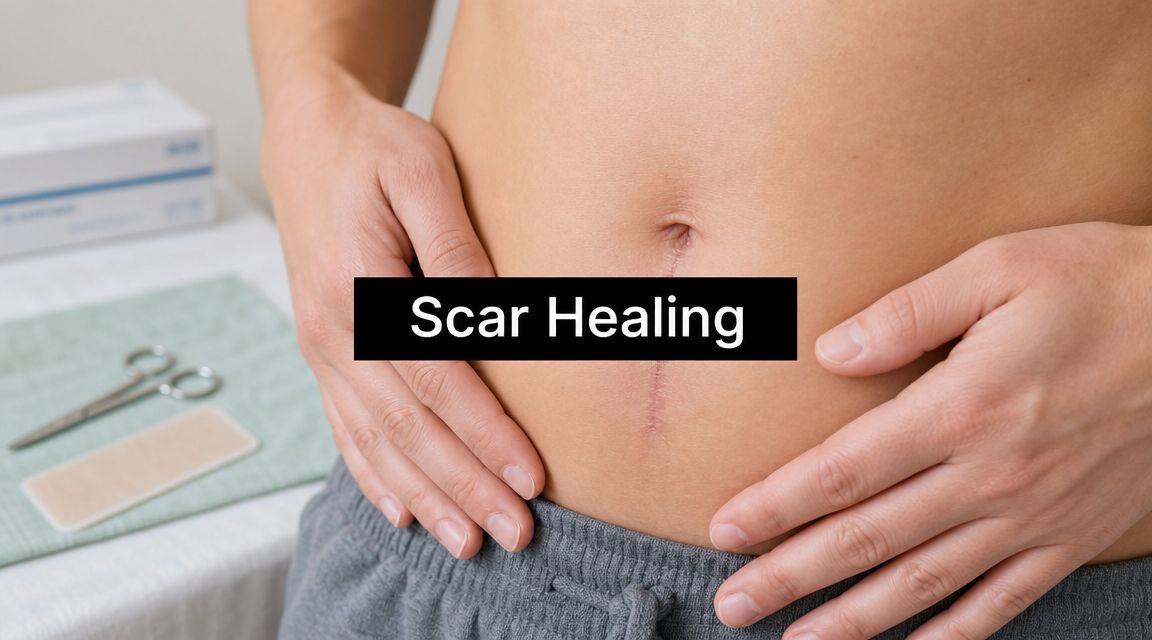
You've had your umbilical hernia repaired. The soreness is easing, but now your attention keeps drifting to your belly button. The scar looks red. Maybe it feels firm. Maybe the shape looks different than you expected. A lot of patients wonder the same thing: Is this normal, and will it always look like this?
That concern makes sense. People are often told how the hernia will be fixed, but they're given much less guidance about what the umbilical hernia scar will look like over time. That gap matters, because for many patients the repair is only part of the story. The appearance of the belly button afterward can affect comfort, confidence, and clothing choices in a very real way.
A common moment happens a week or two after surgery. The pain is improving, you finally look closely at your belly button, and your first thought is, That does not look like I expected. As a plastic surgeon, I can tell you that this reaction is common, and in many cases it reflects normal healing rather than a poor final result.
Part of the confusion comes from how umbilical hernia repair is usually discussed. Patients often hear how the hernia will be closed, but not how the closure method, incision placement, swelling, and scar maturation can change the look of the navel for months. That connection matters. The operation fixes the hernia, but the details of the repair also shape the scar you will live with afterward.
Surgical teaching on open umbilical hernia repair shows that surgeons often place the incision within the umbilical fold and may try to preserve the inward contour of the belly button during closure, yet the early appearance can still look distorted while tissues settle, as described in the JOMI transcript on open umbilical hernia repair.
A fresh scar behaves a lot like wet cement. It has been placed, but it has not finished setting. Early redness, stiffness, and shape changes are part of that process.
Many patients expect one fine line tucked neatly inside the navel. Early healing is often less polished. Swelling can flatten the usual "innie" shape, make one side look higher than the other, or pull the scar into view before the tissue relaxes.
You may notice:
That does not mean the result is final.
I also tell patients to judge the scar like a time-lapse, not a snapshot. A mirror check after a hot shower, exercise session, or a day in snug clothing can make the area look more swollen and dramatic than it usually is.
At this stage, your job is simple. Protect the incision and learn what normal healing looks like so you can spot a true problem if one develops.
If you want practical instructions for the basics, this guide on how to care for surgical incisions is a helpful companion. For a separate example of how appearance can change in stages after controlled skin injury, Day-by-day microneedling recovery offers a useful comparison. The procedures are different, but the larger lesson is similar. Early texture and color changes rarely represent the final cosmetic outcome.
The goal right now is patience with a purpose. Good support early on gives your scar the best chance to mature into a flatter, softer, less noticeable line, and if the final shape of the belly button still bothers you later, there are treatment options that go far beyond generic scar cream advice.
Scar healing is easier to understand if you stop thinking of it as one event. It's a sequence. Your body moves through phases, and each phase has its own look and feel.
Patient guidance from Bupa notes that scars usually soften and fade gradually for up to a year, which is one of the most reassuring facts I can give patients because it means the angry-looking scar you see early on is not the final result, as explained in Bupa's guidance on umbilical hernia repair.
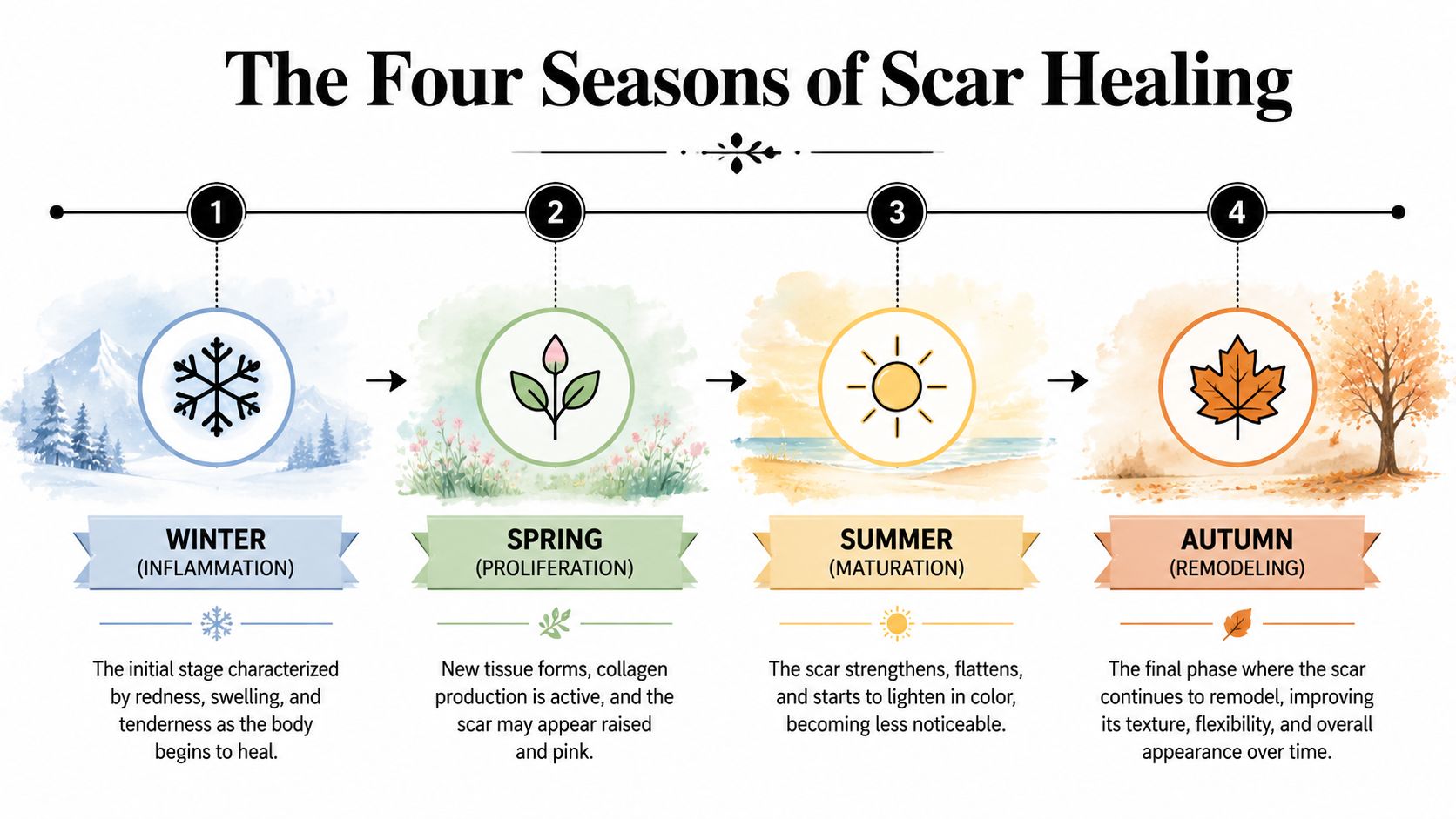
Think of the first phase as winter. The body is reacting to surgery. The area can look swollen, feel tight, and appear more noticeable than expected. This is the inflammatory period. Patients often worry they've done something wrong here, but what they're usually seeing is the body's normal early repair response.
Then comes spring. New tissue forms. The scar may look pink, slightly raised, and a bit shiny. This can be frustrating because many patients expect steady daily improvement, but scars often become more visible before they begin to settle.
A helpful way to think about this is to compare it with other skin recovery patterns. If you've ever looked at a treatment timeline like this Day-by-day microneedling recovery from Skinsation Aesthetics Inc., you've seen the same principle. Early redness is part of recovery, not proof of failure.
The next stage is summer. The scar starts organizing itself. It gradually flattens, softens, and becomes less vivid. The tugging sensation usually eases during this period, although some firmness can linger.
Finally, autumn is the long remodeling phase. This is when the scar continues to change in the background. Color fades. Texture improves. The belly button often regains a more natural contour.
Here's the pattern in a simple table:
| Phase | What you may notice | What it usually means |
|---|---|---|
| Winter | Redness, swelling, tenderness | Early inflammation |
| Spring | Pink, raised, active scar | New tissue formation |
| Summer | Less redness, more softness | Scar maturation |
| Autumn | Fading and flattening | Long-term remodeling |
Early scar appearance is a poor predictor of the final cosmetic result.
Patients often assume a scar should improve in a straight line. It rarely does. Some days it looks flatter. Then it looks irritated again after activity, heat, or friction from clothing.
That doesn't automatically signal a problem. What matters more is the broader direction over time. If the scar is gradually becoming less red, less firm, and less tight, healing is usually moving in the right direction.
Two patients can have the same operation and end up with very different-looking scars. That isn't random. The final appearance usually reflects a mix of surgical design, your biology, and what happens during recovery.
Open umbilical hernia repair commonly uses a curvilinear transverse incision placed in a natural skin crease, and one technique guide specifies that the incision should not exceed 180°, while another describes a lateral border umbilical incision of about 5–7 cm, all with the goal of minimizing visible scarring, according to Medscape's overview of open umbilical hernia repair technique.
That sounds technical, but the cosmetic principle is straightforward. A scar is easier to hide when the cut follows a natural fold and doesn't travel farther than necessary.
Not every belly button begins with the same shape, depth, or skin thickness. Some umbilici naturally conceal scars better because they have a deeper crease. Others are shallow, stretched, or slightly asymmetric before surgery. After repair, those original features still influence the result.
This is one reason patients compare themselves unfairly. Your friend's scar may be harder to see not because her surgeon was better, but because her anatomy gave the scar a better place to hide.
A few common variables affect appearance:
Even a well-placed incision can become more noticeable if healing is disrupted. Friction from waistbands, excess moisture, delayed wound care, or pulling on the area too soon can all make the scar look worse.
The cosmetic stakes are meaningful for a large patient group. The American College of Surgeons notes, in the surgical literature summarized in the minimal-incision paper, that umbilical hernias account for about 10% of adult hernias and are three times more common in women, which helps explain why scar appearance becomes a frequent concern in real practice, as discussed in the minimal-incision umbilical hernia repair study.
A scar's final appearance reflects planning, anatomy, and aftercare together. It isn't just luck.
Once the incision has closed and your surgeon says it's safe to begin scar care, your daily habits start to matter. You can't erase a scar at home, but you can often help it heal more subtly and more attractively.
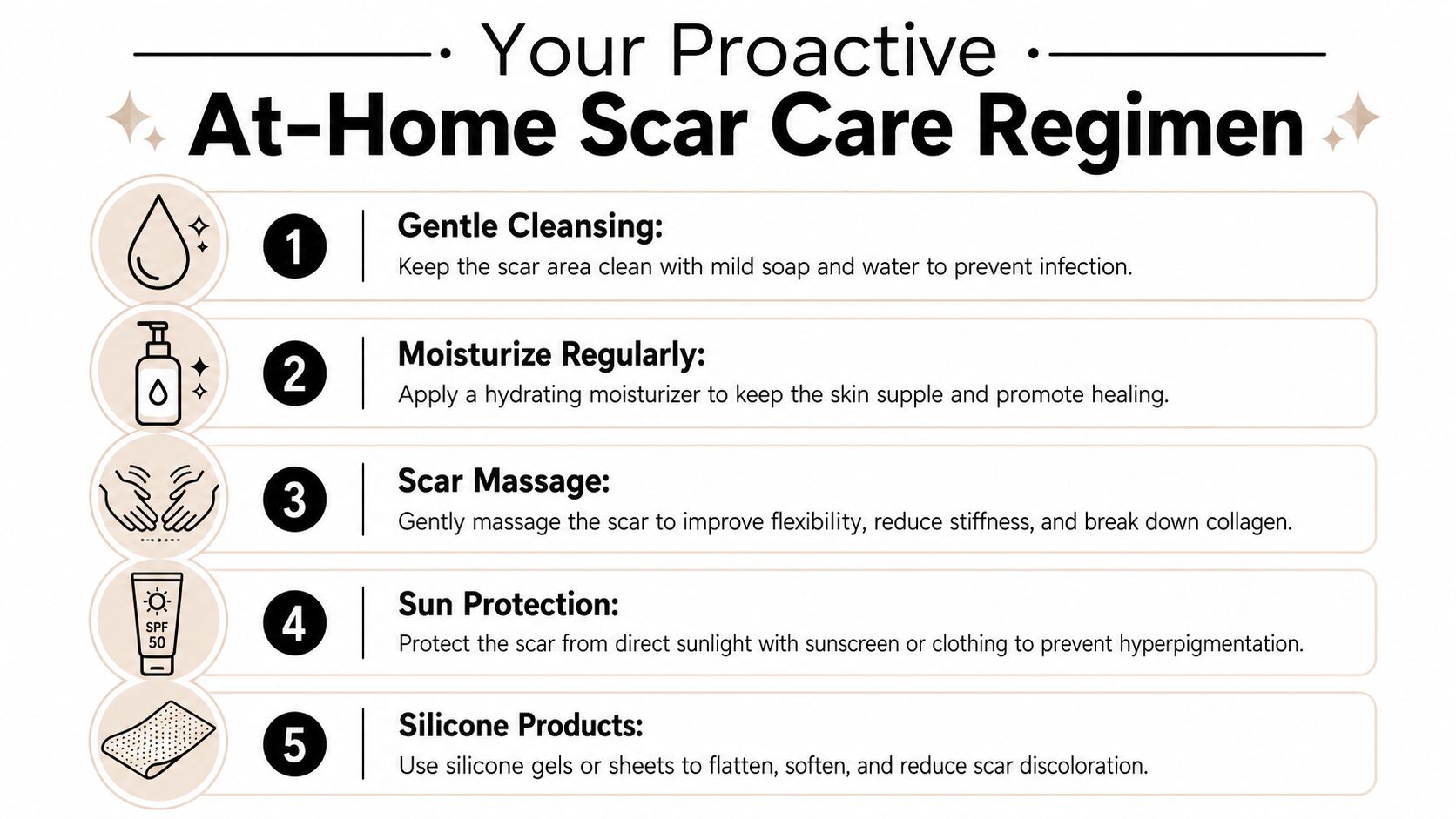
Start with clean, boring basics. Scar care is one of those areas where consistency beats complexity.
For a broader overview of post-op scar habits, this article on how to minimize scarring after surgery gives practical guidance that fits well with belly button scars.
Many people start enthusiastically, then stop after a week because the routine feels fussy. Make it simple. Tie scar care to something you already do every day, like showering or brushing your teeth at night.
If you're considering silicone products, some patients look at options like Hansaplast scar treatment from Healtsy as an example of the type of over-the-counter scar support that may be used once your incision is fully closed and your surgeon agrees it's appropriate.
This short video gives a helpful visual overview of scar management principles:
A few practical details are easy to miss:
Some umbilical scars settle nicely with time and home care. Others stay raised, wide, tethered, discolored, or distort the belly button enough that patients continue to notice them every day. That's when a plastic surgery consultation becomes useful, because treatment depends on the specific problem you're trying to fix.
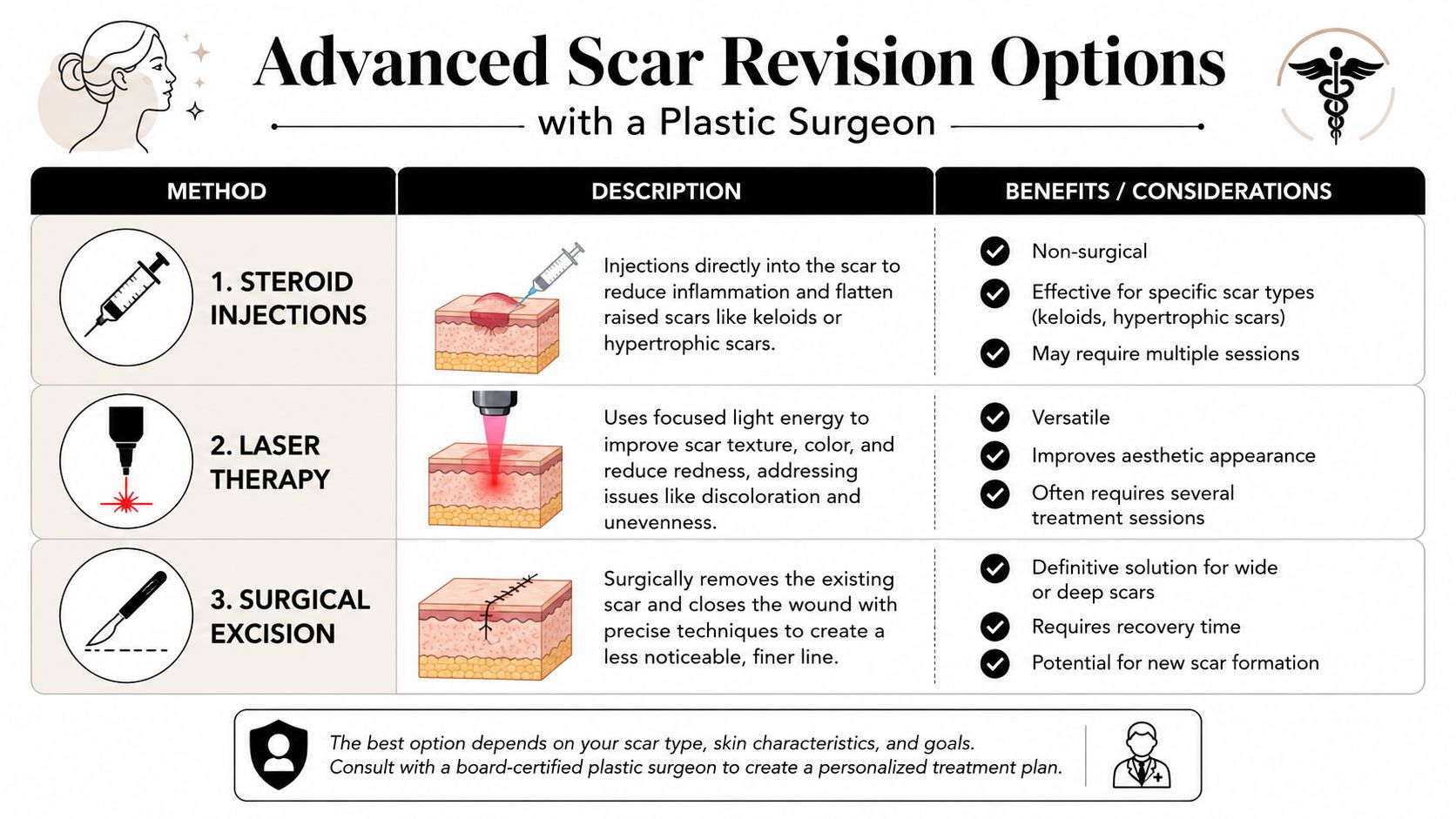
Not all revision options do the same job. A raised scar, a red scar, and a distorted belly button may each need a different plan.
| Treatment | Best suited for | Main goal |
|---|---|---|
| Steroid injections | Raised, thick scars | Flatten and soften |
| Laser therapy | Redness, color mismatch, texture issues | Improve color and surface quality |
| Microneedling | Mild textural irregularity | Support remodeling |
| Surgical revision | Wide scars, tethering, distorted shape | Reshape and re-close more precisely |
| Umbilicoplasty | Significant contour or belly button shape concerns | Restore a more natural umbilical form |
Steroid injections are often useful when a scar is thick, itchy, or climbing upward instead of settling down. The goal is to calm that overactive scar response so the tissue can flatten.
Laser therapy is usually chosen when the scar's main issue is color or surface quality. If the scar remains red or uneven, laser treatment may help make it blend better with nearby skin.
Microneedling can be helpful for selected scars once healing is mature enough. Patients who want to understand how skin can look before and after a collagen-stimulating treatment sometimes find it useful to read about ways to accelerate tissue repair with red light from MedEq Fitness, not as a replacement for medical treatment, but as part of the broader conversation around tissue recovery and remodeling.
The right scar treatment depends less on what the scar is called and more on what it is doing.
At times, the problem isn't the scar line alone. The belly button itself may have healed with distortion, flattening, pulling, or a shape that feels unnatural. In those cases, a more structural revision may be the best option.
Surgical scar revision removes the old scar and closes the area with more deliberate attention to line, tension, and contour. Umbilicoplasty goes further. It addresses the shape of the navel itself.
This can be especially helpful when patients say things like:
For patients exploring aesthetic options involving the navel area more broadly, this discussion of belly button ring scar removal shows how plastic surgeons think about reshaping and camouflage in a very small, highly visible area. In practice, the same principles apply to many umbilical scar revisions.
Revision can often make a scar less noticeable, softer, flatter, and better integrated into the belly button. The goal is improvement, not the promise of scarless skin. That distinction matters, because good plastic surgery aims for a result that looks natural rather than overworked.
One option patients may discuss in this setting is evaluation through Cape Cod Plastic Surgery, where scar appearance and belly button contour can be assessed alongside reconstructive options for revision.
You are a few months out from hernia repair. The incision has closed, but your belly button still looks pulled, the scar feels firm, or you keep catching yourself checking it in the mirror. That is often the moment to stop guessing and get an expert opinion.

Scar healing can be slow, and patience matters. So does timing. A consultation makes sense when the scar remains raised, firm, painful, itchy, or visually distracting after a reasonable healing period, or when the shape of the belly button seems off in a way that has not improved.
A visit is especially helpful if you notice any of the following:
That last point matters. Scar concerns are not vanity. The umbilicus sits in the center of the abdomen, and even a small contour problem can draw the eye.
The first visit is usually an assessment, not a commitment to a procedure. A plastic surgeon will examine the scar itself, study the contour and position of the umbilicus, review your original operation, and decide whether the issue is mainly in the skin, deeper tissue, or both.
I often explain this to patients in layers. The top layer is the scar line you can see. The deeper layer is the support underneath that gives the belly button its shape. If the foundation is stable but the surface healed poorly, treatment may stay relatively simple. If the scar is tethered or the navel contour changed during healing, the plan may need to address both appearance and structure.
A useful consultation usually answers three questions:
If the scar bothers you often, that alone is a reasonable reason to ask for an evaluation.
Will I need surgery?
Sometimes, but not always. Scars that are primarily raised, discolored, or firm may improve with office-based care. A belly button that looks twisted, shallow, pulled downward, or tethered may need a structural revision to get a better shape.
Can the belly button look natural again?
Often it can look more balanced and less obviously operated on. The amount of improvement depends on the original repair, the quality of the scar, and whether the contour problem is mild or more pronounced.
What is recovery like after revision?
Recovery depends on the treatment. Non-surgical options usually involve little downtime. Surgical revision requires another healing period and another scar maturation cycle, but it also gives the surgeon a chance to improve line, tension, and contour in a more controlled way.
If your umbilical hernia scar still feels too visible, too firm, or not quite like you, a consultation can replace uncertainty with a clear plan. Cape Cod Plastic Surgery offers evaluation of scar appearance, belly button contour, and revision options so you can understand what is healing normally, what may improve with time, and what may benefit from treatment.
October 7, 2026
A Practical Guide to Healing After Breast Surgery

October 6, 2026
Your Safety Guide: What to Look for When Choosing a Plastic Surgeon

October 5, 2026
Why Our On-Site Accredited Facility Matters for Your Safety

Cape Cod Plastic Surgery offers expert cosmetic and reconstructive procedures in a safe, accredited setting. Led by Dr. Marc Fater, we combine advanced techniques with personalized care to help you look and feel your best.
Monday: 9:00 AM – 5:00 PM
Tuesday: 9:00 AM – 5:00 PM
Wednesday: 9:00 AM – 5:00 PM
Thursday: 9:00 AM – 5:00 PM
Friday: 9:00 AM – 5:00 PM