
September 9, 2026
How to Care for Surgical Incisions Properly
Expert Guide to Proper Surgical Incision Care
Jun 15, 2026
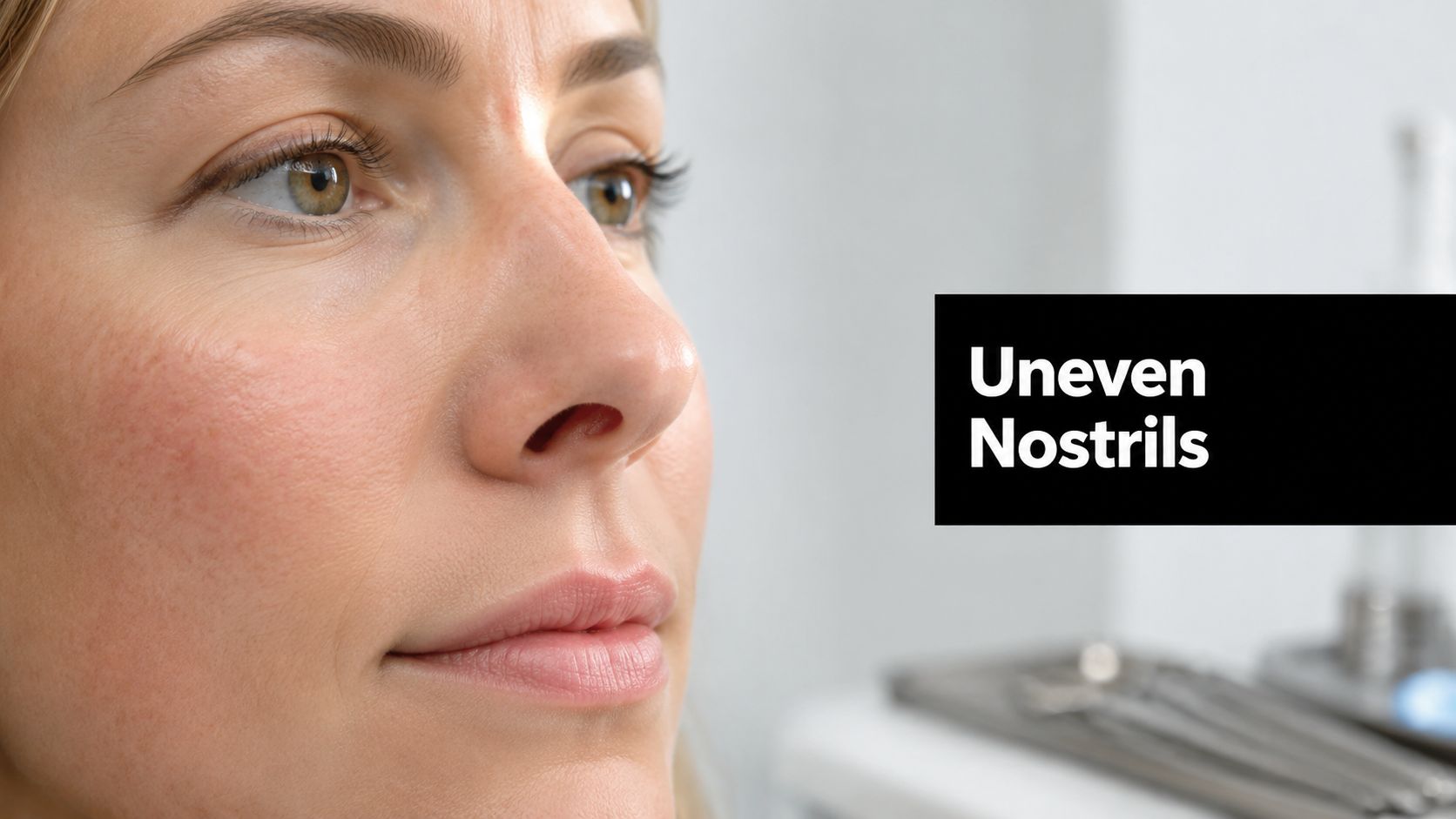
You had surgery, the cast is off, and now your eyes keep going straight to the same detail in the mirror. One nostril looks a little higher. Or wider. Or tighter. Maybe it seems different every time you check. That kind of worry is very common after rhinoplasty, and it can feel surprisingly intense.
Most patients don't get anxious because they expect perfection. They get anxious because they don't know what's normal. When a small asymmetry shows up after a procedure you planned carefully, it's easy to jump to the worst conclusion and wonder if something went wrong.
In many cases, uneven nostrils after rhinoplasty are part of healing, not proof of a bad result. The nose is a delicate structure with thin skin in some areas, thicker tissue in others, and a blood supply that responds to surgery with swelling and scar formation. That response is rarely perfectly even from side to side.
The hard part is that healing can look messy before it looks refined. A nose often improves in stages, not all at once. Patients need reassurance, but they also deserve an honest explanation of when asymmetry is expected, when it deserves closer evaluation, and what can be done if it doesn't settle the way we hoped.
If you're checking your nostrils several times a day, you're not overreacting. You're having a normal response to a very visible recovery. The nose sits in the center of the face, so even a subtle change can feel magnified.
Early on, patients often describe a few specific worries:
That doesn't mean you should ignore what you're seeing. It means you should interpret it in context. The nose after surgery is like a house after renovation. The structure may be sound, but the walls, trim, and flooring still need time to settle into place.
What matters most early on: whether the area is gradually calming down, not whether it looks perfectly balanced right away.
Another point that helps many patients breathe easier is this: nostrils were almost never perfectly identical before surgery. Once you focus on the nose during recovery, natural asymmetries become easier to spot. Surgery can improve balance, but it can't make the human face mathematically exact.
That's why a good follow-up relationship matters. You shouldn't have to sit at home trying to decide on your own whether what you see is normal swelling, scar tension, or something that needs a more detailed exam. A thoughtful surgeon treats this as a partnership. Your job is to heal and report changes accurately. Your surgeon's job is to track the pattern over time and help you make sense of it.
Rhinoplasty healing isn't symmetrical. Even if surgery was meticulous, the body may swell differently on the right and left sides. That's one of the main reasons patients notice uneven nostrils after rhinoplasty.
Independent clinical guidance notes that this asymmetry often improves within the first 3–6 months, while the nose may continue to settle for 6–12 months before its final shape is visible. Multiple sources also advise waiting about 1 year before judging whether persistent asymmetry needs revision because that's when tissue maturation is much more complete (Berkeley Square Medical guidance on uneven nostrils after rhinoplasty).
Think of the nose as a small building made of different materials. Bone, cartilage, skin, lining, and soft tissue don't all respond at the same pace. If one area holds more fluid, develops firmer scar tissue, or has more tension along a suture line, that side can look different even though the deeper framework is acceptable.
A few common reasons this happens include:

Patients are often surprised by how non-linear recovery can be. Improvement doesn't move in a straight line. Some days the nose looks balanced. The next day one side seems fuller again.
Here's a practical way to think about the healing arc:
| Healing period | What patients often notice |
|---|---|
| Early recovery | Significant swelling, unevenness, and shifting appearance |
| First several months | Gradual refinement, but side-to-side differences can still be visible |
| Later healing phase | The tip, nostril rims, and soft tissue settle more fully |
If you want a more detailed overview of the broader recovery pattern, this explanation of how long swelling lasts after rhinoplasty can help put daily changes into perspective.
Waiting isn't just emotional advice. It's part of accurate diagnosis. If a surgeon judges the nose too early, temporary swelling may be mistaken for a permanent problem. That can lead to unnecessary worry and, in some cases, poor decisions about additional treatment.
A nostril that looks uneven in the early months isn't automatically a failed result. It may simply be a nose that hasn't finished healing.
This is especially true in the tip and nostril region, where skin memory, scar tissue, and edema can linger. Patients often expect the bridge to heal first, then assume the whole nose should match that pace. It usually doesn't. The lower third tends to be slower and more temperamental.
When a patient says, “My nostrils look uneven,” I don't only look at the openings. I look at the whole support system around them. A nostril's shape is influenced by the tip, the septum, the alar rims, the sidewall support, and the way the tissue is healing over the framework.
In the early post-rhinoplasty period, uneven nostrils are often a healing phenomenon rather than a fixed deformity. Asymmetric edema, suture-line tension, splints, and scar tissue can temporarily distort nostril shape, and the nose may not reach its final contour for 6 to 12 months. Persistent asymmetry after that window is more concerning for a structural issue such as inadequate alar support, septal deviation, cartilage shift, or fibrosis, especially if one nostril collapses on inspiration or airflow is reduced on one side (Dr. Yunus Kaplan on asymmetry issues after rhinoplasty).
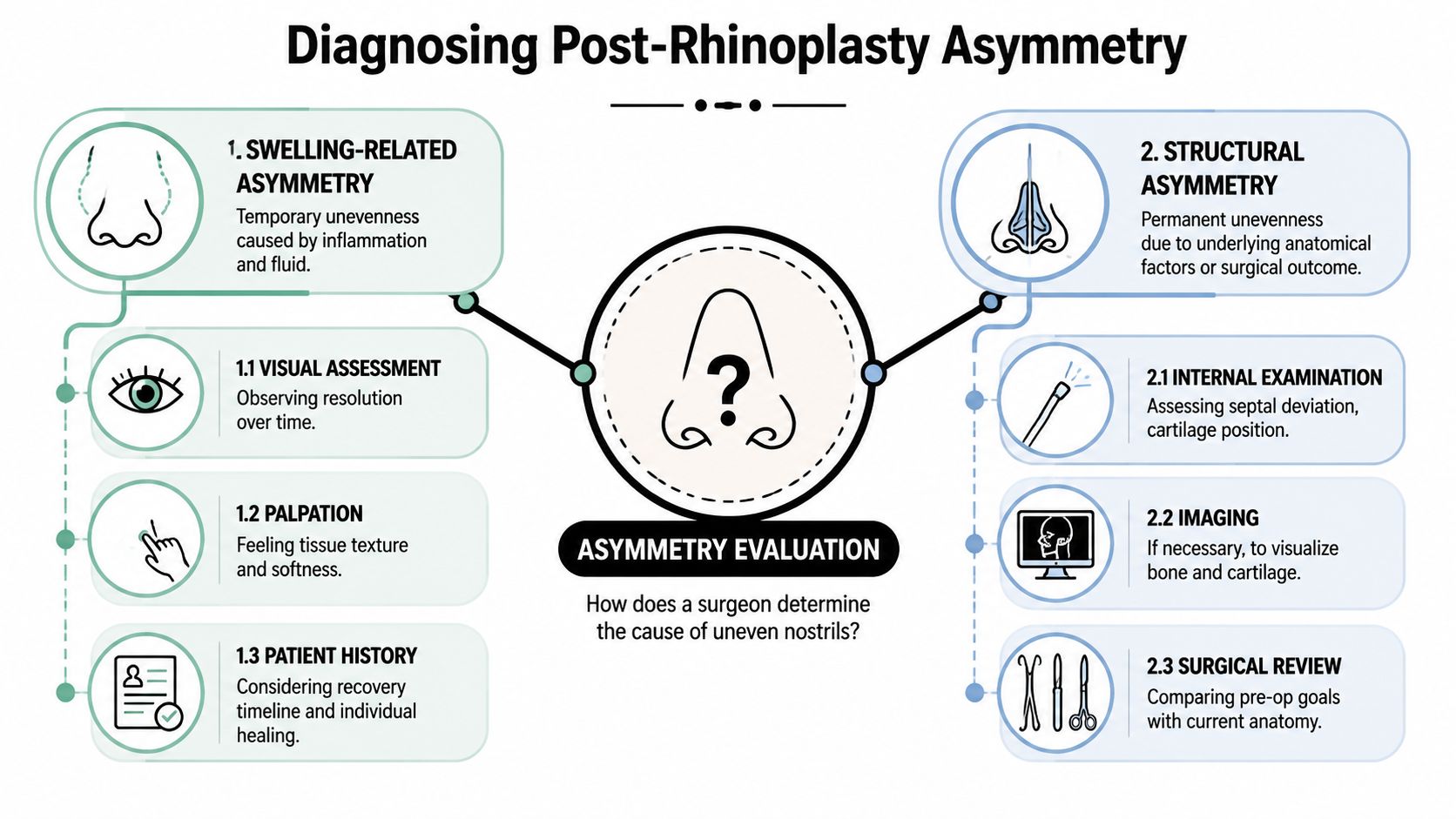
A careful exam usually includes more than a front-view photograph. I assess the nose from below, from the side, and in motion while the patient breathes and smiles.
Key points include:
Patients usually notice the visible edge of the nostril. Surgeons think in layers.
| What you notice in the mirror | What your surgeon is assessing underneath |
|---|---|
| One nostril looks taller | Rim position, cartilage support, tip rotation |
| One side looks narrower | Internal swelling, scar pull, septal alignment |
| One nostril collapses when inhaling | Sidewall stability and airway support |
| The shape changes over time | Whether the pattern suggests swelling rather than fixed anatomy |
This discussion can also be easier to follow in video form.
A shifting asymmetry is often less concerning than one that remains fixed. If the nostril looks different week to week, that usually points toward healing dynamics. If the shape stays unchanged for a long time and breathing is affected, the conversation becomes different.
If one nostril collapses during a breath in or one side has consistently reduced airflow, mention that clearly at follow-up. Function matters as much as shape.
Not every concern requires another operation. When asymmetry is mild, or when the issue comes from scar behavior rather than a major structural problem, non-surgical treatment may be enough to improve balance.
The first rule is timing. These options only make sense when the surgeon can tell what part of the appearance is likely to improve on its own and what part may benefit from a gentle adjustment. Treating too early can blur the picture.
Some patients benefit from a targeted steroid injection. This isn't used casually. The goal is to soften a firm area of scar tissue that may be pulling on the nostril or making one side look fuller and stiffer than the other. In the right setting, it can help a tight area relax.
Dermal filler can also help in select cases. If one nostril margin or nearby contour has a slight hollow or imbalance, a very small amount of filler may create a more even appearance. This is best for camouflage, not for correcting a major support issue.
A few patients are also taught specific massage or taping techniques. These are not one-size-fits-all. If used incorrectly, they can irritate tissue or create more swelling, so they should only be done under your own surgeon's guidance.
Minor asymmetry can sometimes be improved without surgery, but these treatments are fine-tuning tools. They are not substitutes for revision when the real problem is structural.
It's also important to remember that non-surgical treatment aims for improvement, not perfection. A softer rim, a less obvious shadow, or a more balanced base view may be enough to make the nose look natural again. That's often the right endpoint.
Some nostril asymmetry does persist. When it does, the central question isn't only “Can this be fixed?” It's “Is the timing right, and is the problem structural?”
Expert guidance commonly recommends reassessment after 6–12 months, with revision rhinoplasty typically considered at 1 year or later so swelling and scar contracture have fully stabilized. The same guidance also notes that no face is 100% symmetrical, so some mild residual difference may remain even after complete healing. For smaller contour problems, filler may be an option, while more significant imbalance may call for revision surgery (The Rhinoplasty Center on addressing uneven nostrils after rhinoplasty).
This waiting period can feel frustrating, especially if you've already convinced yourself something is wrong. But revision rhinoplasty is more complex than primary surgery. The tissues are healing, the anatomy has changed, and scar contracture can continue to alter the picture for months.
Operating before the nose has stabilized creates two problems:
That's why patience is part of good planning, not a dismissal of your concerns.
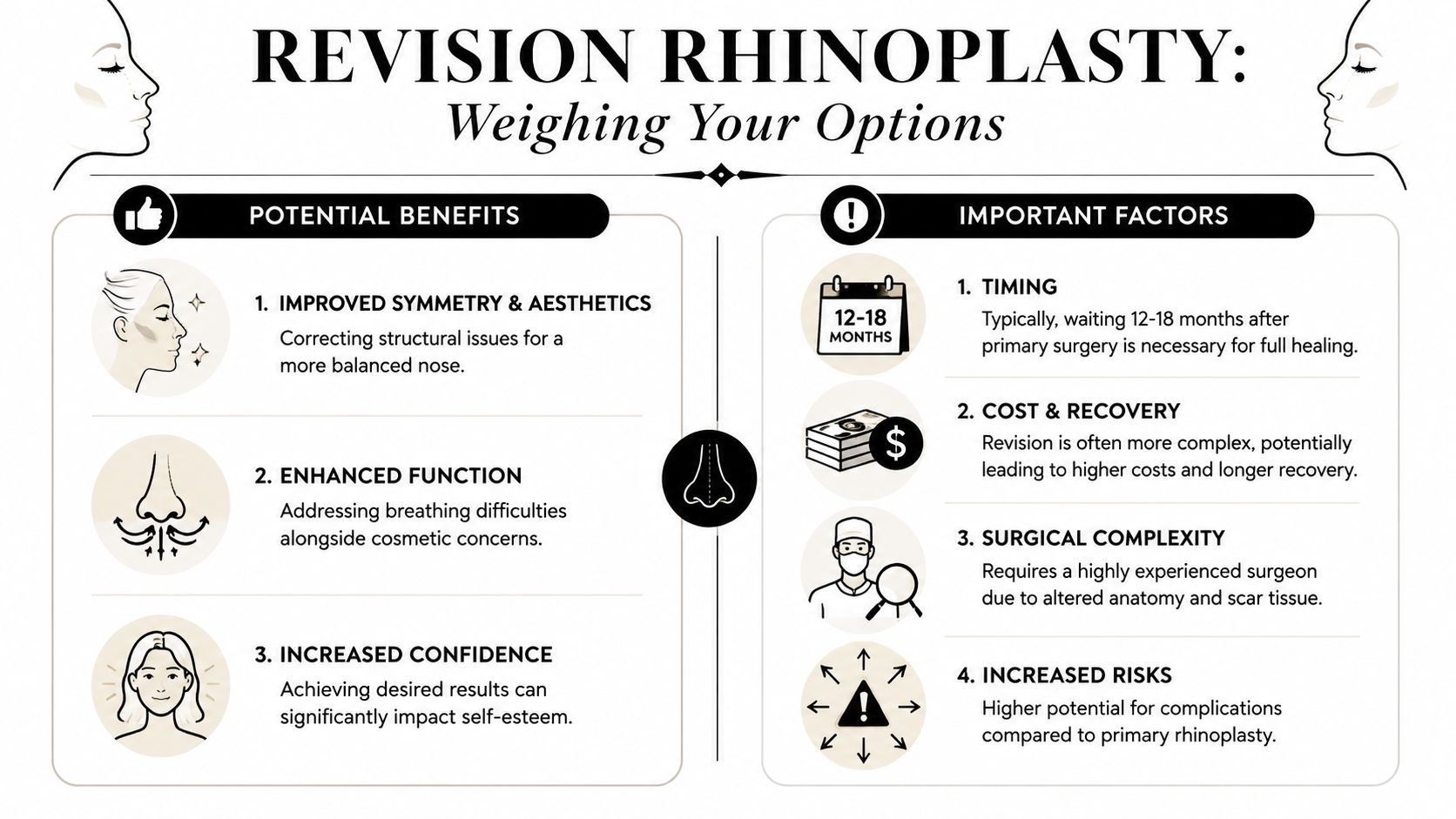
Revision for uneven nostrils after rhinoplasty depends on the cause. There isn't a single standard operation.
A surgeon may consider:
A helpful overview of the process is available in this guide to revision rhinoplasty surgery.
Patients often come into a revision consultation asking for symmetry. What they usually mean is harmony. They want the nose to stop drawing attention. That's a healthy goal.
A realistic revision plan should answer three questions:
| Question | Why it matters |
|---|---|
| Is the problem stable? | Stable findings are easier to correct reliably |
| Is it structural? | Structural problems often need structural solutions |
| Will improvement be meaningful? | Surgery should offer a worthwhile benefit, not chase tiny irregularities |
Revision is best when the problem is clear, the tissues are ready, and the expected improvement justifies another recovery.
Recovery can feel passive, but it isn't. Patients do influence healing. Not by forcing the nose into shape, but by protecting it while the tissues settle.
A few aftercare basics make a real difference:
Patients sometimes ask whether interest in other cosmetic treatments means they're being too appearance-focused during recovery. Not at all. Many people want balanced, natural-looking features overall. If you're comparing subtle enhancements in different areas of the face, a resource on natural-looking lip augmentation can be useful for understanding how conservative aesthetic planning works across features, not just the nose.
Instead of asking only “Is this normal?” ask questions that help your surgeon explain the reasoning behind the assessment.
Consider bringing this list:
If you want to prepare for that conversation more broadly, this list of questions to ask a cosmetic surgeon can help you make the most of a follow-up visit.
Bring photos taken in the same lighting and angle over time. Trends are more useful than a single close-up taken on a stressful day.
The best rhinoplasty care doesn't end when the splint comes off. It continues through the long, uneven, sometimes emotional healing period that follows. That's especially true when a patient is worried about asymmetry and needs honest guidance instead of guesswork.
Cape Cod Plastic Surgery approaches rhinoplasty and revision with that long view in mind. Dr. Marc Fater is a board-certified plastic surgeon with more than 30 years of experience, and the practice is known for tailoring treatment plans to the individual rather than forcing every patient into the same template. That matters in nose surgery, where anatomy, healing style, and expectations vary so much.
The practice also offers the reassurance of an on-site AAAASF-accredited surgical suite. For patients, that means safety and quality standards are built into the setting where care is delivered. Just as important, it supports continuity. Consultation, surgery, follow-up, and any later discussion about fine-tuning happen within a care environment designed around the full patient experience.

If you're concerned about uneven nostrils after rhinoplasty, the most helpful next step is a careful examination and a timeline-based plan. Good care doesn't rush to reassure, and it doesn't rush to reoperate. It looks closely, listens well, and stays present through the full healing process.
If you want experienced, personalized guidance for primary or revision rhinoplasty, schedule a consultation with Cape Cod Plastic Surgery. Their team can help you understand whether your asymmetry is part of normal healing, a candidate for minor correction, or something that deserves a revision discussion after full recovery.
September 9, 2026
Expert Guide to Proper Surgical Incision Care
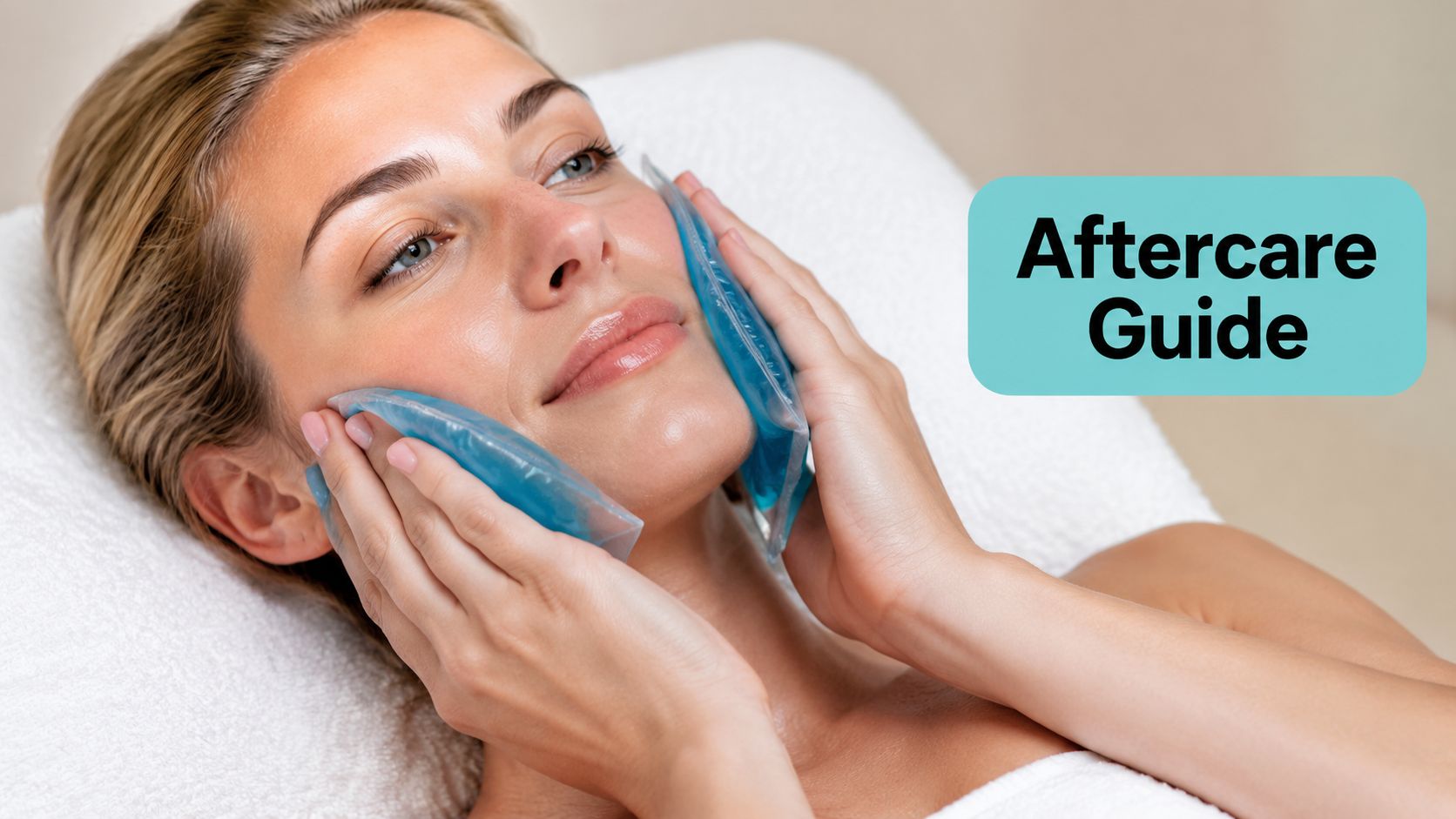
Master dermal fillers aftercare with do's and don'ts, swelling tips, activity limits and warning signs to protect your results and heal smoothly.

September 8, 2026
Ensuring Safety: Why Your Surgeon's Credentials Matter Most
Cape Cod Plastic Surgery offers expert cosmetic and reconstructive procedures in a safe, accredited setting. Led by Dr. Marc Fater, we combine advanced techniques with personalized care to help you look and feel your best.
Monday: 9:00 AM – 5:00 PM
Tuesday: 9:00 AM – 5:00 PM
Wednesday: 9:00 AM – 5:00 PM
Thursday: 9:00 AM – 5:00 PM
Friday: 9:00 AM – 5:00 PM