

October 7, 2026
What to Expect During Your Breast Surgery Recovery
A Practical Guide to Healing After Breast Surgery
Jun 6, 2026
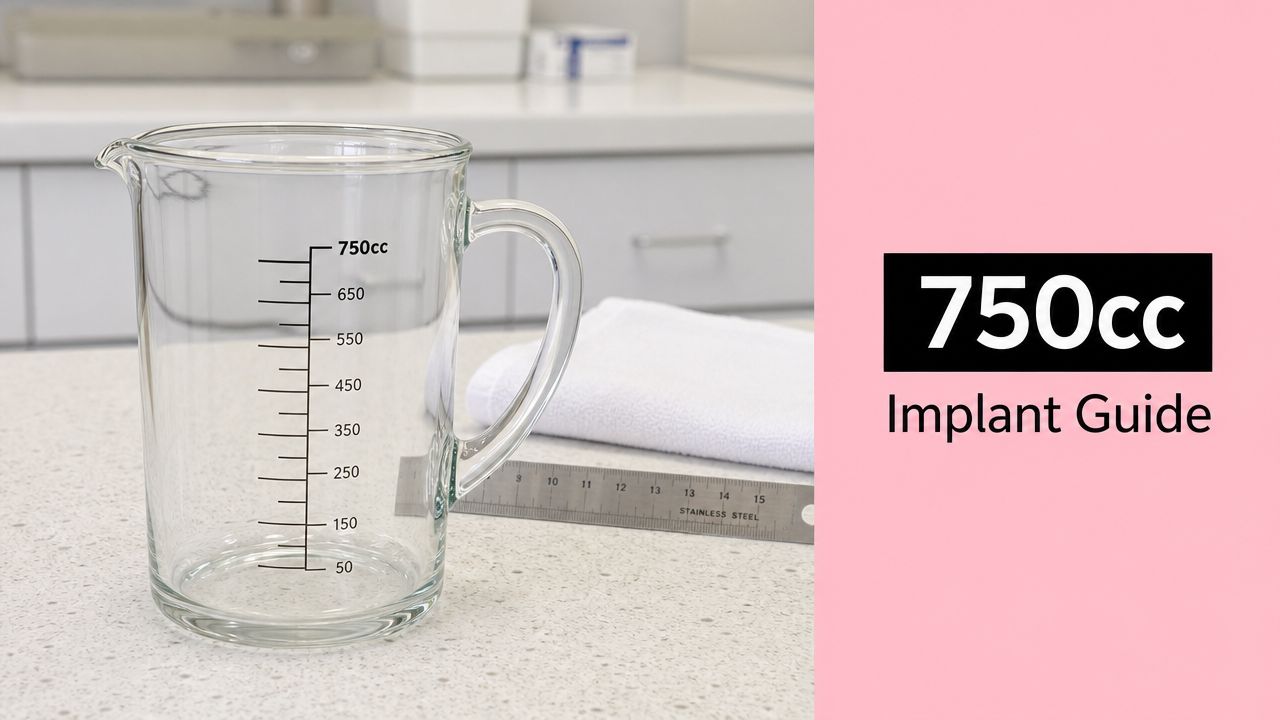
You may be staring at photos, sizing charts, and forum comments, trying to answer one simple question for your own body. How big is 750cc, really? And just as important, if you choose that size, will you still like the result years from now?
That's where many articles fall short. They show dramatic before-and-afters, but they don't spend enough time on what matters most in real life: how a very large implant fits your frame, how your tissues handle that weight over time, and how likely you are to need a lift or revision later.
If you've already looked at smaller sizes and feel drawn to something more noticeable, this is a reasonable place to pause and think carefully. A size like 750cc breast implants can create a bold change, but the best decision isn't about chasing a number. It's about choosing a result your body can support well, not just this year, but for the long haul. If you're comparing this range to slightly smaller options, it can also help to review 650 cc breast implants and see how quickly volume changes become more dramatic.
Patients who research 750cc breast implants are usually not looking for a subtle adjustment. They want fullness that's obvious in clothing, obvious in photos, and obvious to them when they look in the mirror. That goal is valid. But with a size this large, the central issue isn't only appearance. It's whether the appearance will hold up well as your skin, breast tissue, and support structures age.
That question matters because large implants ask more of the body. Your skin has to stretch. Your lower breast has to carry more load. Your chest dimensions have to accommodate not just the volume, but the width and projection of the implant. A result can look impressive early on and still become difficult to maintain if the tissues were pushed beyond what they can support comfortably.
What patients often need most is not a bigger implant, but a clearer picture of what “bigger” means on their own frame.
A careful consultation should slow the process down. It should address your goals, but it should also look ahead. If you're considering 750cc, the essential conversation isn't “Can this be placed?” It's “Will this choice still feel balanced, comfortable, and attractive later?”
The term cc stands for cubic centimeters, which is a measure of volume. In breast augmentation, surgeons use cc because bra cup sizes are inconsistent. A cup size changes between brands, band sizes, and body types. Volume is more precise.
With 750cc breast implants, the number tells you one important thing right away. This is not a middle-of-the-road implant. It is a large-volume implant choice.
One independent review notes that 750cc sits at the very upper end of commonly available implant volumes, with the largest standard saline implant at 775 cc and a silicone gel implant reaching 800 cc. The same review says implants in the 700+ cc range are commonly associated with an increase of 3+ cup sizes, which is why 750cc is generally considered a dramatic change rather than a modest one (breast implant statistics review).
That single fact clears up a lot of confusion. If you've been wondering whether 750cc is “kind of big” or “very big,” the answer is simple. It's very big by standard augmentation sizing.
Volume matters, but it doesn't predict your final look by itself. A 750cc implant may appear striking on one patient and merely proportionate on another, depending on height, chest width, existing breast tissue, and skin tone.
Here's a simple way to consider the matter:
If you want to understand how manufacturers and surgeons think about size ranges, a Mentor implant sizes chart can help translate the number into a more practical comparison.
Practical rule: 750cc is best understood as a large-volume category, not a guaranteed cup size.
That distinction protects patients from one of the most common misunderstandings. Two people can choose the same volume and end up with very different outcomes.
Volume is only the starting point. The shape you see after surgery comes from how that volume is distributed across the chest.
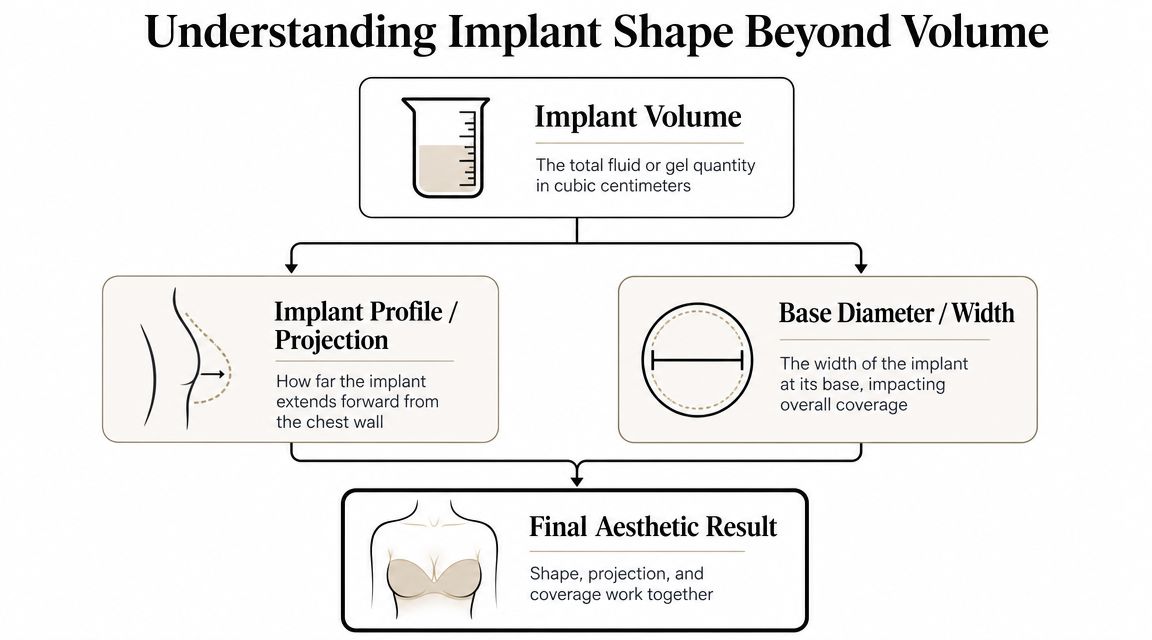
In breast augmentation, implant size is measured in cc, but surgeons also match that volume to base diameter, height, and projection so the implant fits the patient's chest wall and soft-tissue envelope. A 750cc implant has to be selected in relation to those anatomic measurements because volume alone does not predict final shape or fit (implant selection and anatomy overview).
That means your surgeon isn't just asking, “How big do you want to be?” They're asking a more useful question. “What implant can your chest support in a way that looks intentional and stable?”
A patient often assumes that 750cc is one look. It isn't.
A wider implant can distribute that volume across more of the chest, creating a broader appearance with less forward push. A narrower implant with more projection can create stronger upper fullness and more front-facing prominence. Both are 750cc. Neither will look the same.
This is why “I want 750” is not yet a surgical plan. The plan has to answer:
A good implant choice respects your anatomy. If the base diameter is too wide, the breasts can look overfilled at the sides. If the projection is too aggressive for the tissue envelope, the result may look unnaturally tight. If the tissue coverage is limited, the implant can become easier to feel or see.
Patients comparing filler options should also understand material tradeoffs. A helpful next read is silicone vs saline breast implants, because the shell fill and feel can influence how a large implant behaves on the body.
A surgeon's job is not to say yes to a number. It's to match a number to a frame.
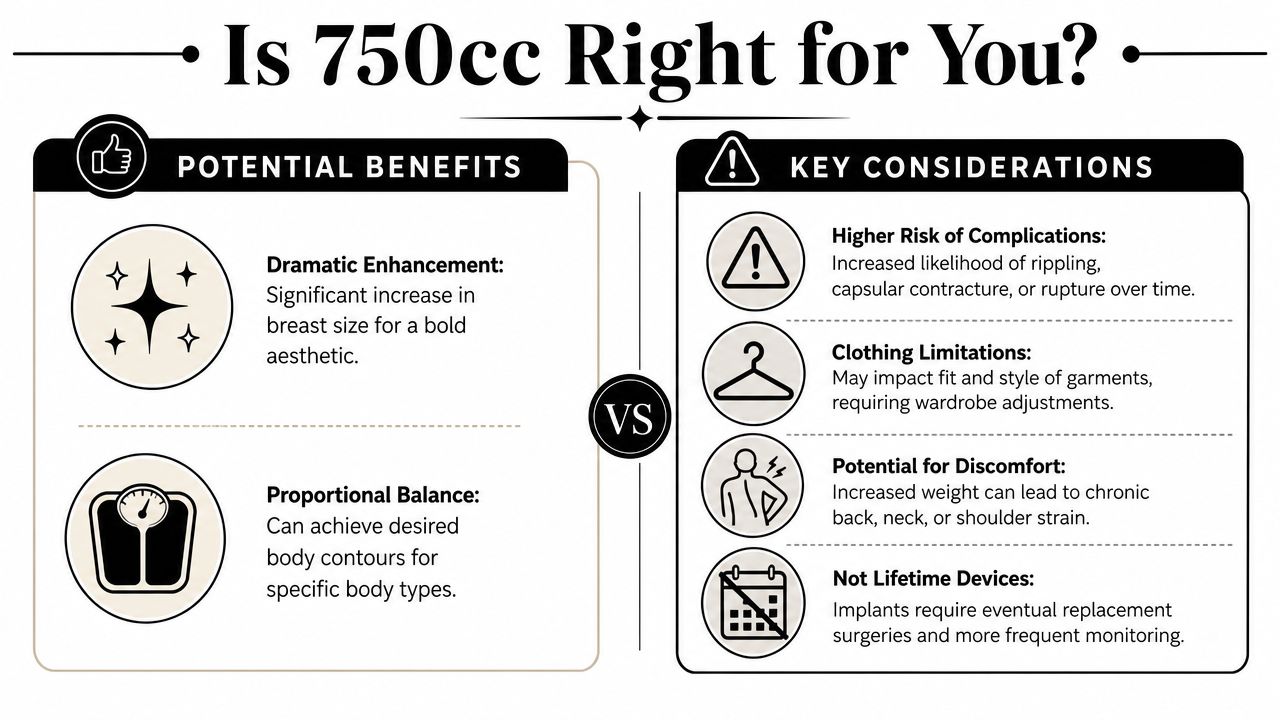
The better question isn't whether 750cc can be inserted. In many patients, it can. The better question is whether it's likely to remain attractive and supportable on your frame over time.
Consider two common scenarios.
One patient has a broader chest, stronger skin tone, some natural breast tissue, and mild existing looseness after pregnancy or weight change. On that frame, 750cc may look bold but still fit within the chest width reasonably well. She may still need added support planning, but the anatomy may at least give the implant somewhere to live.
Another patient is petite, with a narrower chest, thinner tissue, and tight skin. On that frame, 750cc may create an immediate dramatic effect, but the long-term question becomes harder. The tissues may stretch faster. The implant may sit too dominant for the breast footprint. The result may age into bottoming out, widening, or sagging that needs correction.
A key concern with very large volumes like 750cc is whether they are aesthetically sustainable on a patient's frame over time. The tradeoff between dramatic projection and long-term tissue tolerance is often underexplained, but it directly affects the risk of needing a future lift, mesh support, or revision surgery (long-term concerns in augmentation decisions).
This is the heart of the “Will this still look good in 10 years?” question.
The answer depends on several factors working together:
Skin elasticity
Firmer skin tends to hold shape better. Looser or thinner skin may stretch faster under a heavier implant.
Breast width
A wider chest can sometimes accommodate more volume without forcing the implant outside natural proportions.
Existing ptosis or sagging
If the breast already sits low, a large implant alone may worsen the mismatch between nipple position and breast volume. Some patients need a lift, not just more implant.
Native tissue thickness
Better soft-tissue coverage can hide edges and create a softer transition. Thin coverage can make a large implant look more artificial over time.
Patients often ask for the biggest implant they can get. A safer question is this: what size gives me the look I want without making future surgery more likely?
A consultation should become more cautious if your goals require the surgeon to ignore your basic anatomy. Warning signs include tissue that already looks strained, skin that seems thin, a breast base that's too narrow for the implant dimensions, or a plan that assumes a lift can be avoided when the breast really needs one.
Good candidacy is not about bravery. It's about tissue support.
Once a patient decides to pursue large implants, surgical planning becomes more important, not less. The larger the implant, the more every technical choice affects shape, support, and long-term behavior.
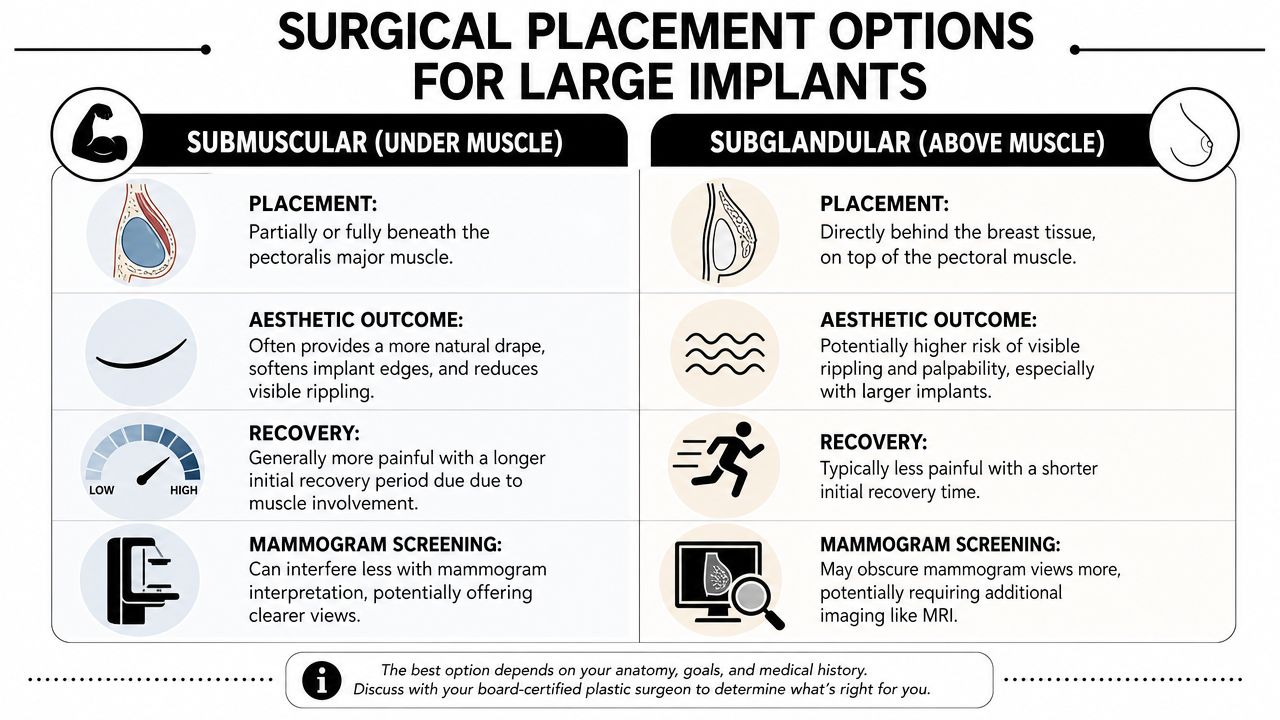
For many patients, the first major decision is placement.
| Placement | What it may offer | What to watch closely with large implants |
|---|---|---|
| Submuscular | More tissue coverage and a softer upper transition | Recovery may feel more demanding because the muscle is involved |
| Subglandular | Simpler pocket position and often less early muscle discomfort | Large implants may show edges or rippling more readily in thinner patients |
With 750cc breast implants, many surgeons lean toward approaches that improve coverage and support when anatomy allows it. That doesn't mean one position is correct for every patient. It means the margin for error is smaller when the implant is heavy and prominent.
Incision choice also matters. An inframammary incision often gives the surgeon direct visibility and control when placing a larger implant. Other incisions may still be appropriate in selected cases, but the larger the device, the more important controlled pocket creation becomes.
Patients often focus on pain, but recovery after large implant surgery is also about tissue adaptation. Your skin, lower breast, and internal pocket are all adjusting to a greater load.
You may notice:
That's one reason aftercare matters. Mobility, posture, scar management, and soft-tissue healing all affect how comfortable you feel during recovery. Some patients find practical value in reviewing scar tissue prevention tips as part of a broader post-op plan, especially when they're trying to understand how healing habits may influence comfort and long-term tissue behavior.
With a very large implant, a technically successful operation isn't just one that looks full on day one. It's one that preserves support as much as possible, respects tissue limits, and leaves room for the breast to age more gracefully.
That often means the best plan is not the biggest possible implant. It's the largest implant your anatomy can reasonably sustain.
A patient sits in consultation and asks a fair question: “I love the fuller look now, but will 750cc still look good in 10 years?” That is the right question. Large implants are not only a decision about volume today. They are a decision about how much weight your skin, breast tissue, and internal support will be carrying year after year.
The FDA states that breast implants are not lifetime devices, and that the chance of complications rises the longer they are in place (FDA breast implant risks and complications).
With a 750cc implant, the long-term question is usually less about whether you can heal from surgery and more about whether your tissues can support that size gracefully over time. Breasts age. Skin stretches. Ligaments relax. Weight changes, pregnancy, and gravity keep working long after the incisions have healed.
A useful comparison is a heavy shelf on a wall. It may look stable the day it is installed. If the wall support is borderline, the problem often shows up later, with sagging, shifting, or strain. Breast tissue behaves in a similar way with very large implants.
Potential concerns include:
None of this means 750cc implants are always a poor choice. It means the margin for error is smaller, and the long-term maintenance burden can be higher. Patients who are happiest years later usually understand that a dramatic result may also carry a higher chance of needing adjustment down the road.
At this size, good judgment matters as much as technical skill. A surgeon is not just placing an implant. He or she is evaluating the strength of your soft tissue, the width of your chest, the position of your nipple, the quality of your skin, and whether your anatomy can carry that load without looking overstretched later.
That is why revision experience matters. Any surgeon can show early after photos. The more revealing question is whether the surgeon regularly treats problems such as bottoming out, recurrent sagging, implant malposition, rippling, and patients who wish they had chosen a different size.
When you are evaluating a surgeon, look for:
Cape Cod Plastic Surgery offers breast augmentation consultations with Dr. Marc Fater, a board-certified plastic surgeon with over 30 years of experience and an on-site AAAASF-accredited surgical suite. In a case like 750cc, those details matter because the goal is not merely to create fullness. The goal is to create a result your body has a reasonable chance of carrying well over time.
A trustworthy surgeon does not just ask, “How big do you want to be?” A better question is, “What size can your body support and still look balanced years from now?”
If you've made it this far, you probably already understand the most important point. 750cc breast implants are not just a size choice. They are a long-term structural decision.
For the right patient, they can create the dramatic fullness she wants. For the wrong patient, they can start a cycle of tissue stretch, disappointment, and revision. The difference often comes down to anatomy, planning, and the willingness to think beyond the first few months after surgery.
That's why an in-person consultation matters. Your chest width, skin quality, breast position, tissue thickness, and lifestyle all affect whether 750cc is reasonable, borderline, or likely too much. Online photos can't answer that. A sizing chart can't answer that. Your body can.
If your real question is, “Will this still look good in 10 years?” you deserve a direct answer, not a sales pitch. A careful surgeon should talk openly about support, sagging risk, revision risk, and whether a lift or different size would serve you better.
If you're considering breast augmentation on Cape Cod and want a thoughtful discussion about whether 750cc implants fit your body and long-term goals, schedule a consultation with Cape Cod Plastic Surgery. Dr. Marc Fater and his team can evaluate your anatomy, review your options, and help you make a decision built around safety, proportion, and lasting results.
October 7, 2026
A Practical Guide to Healing After Breast Surgery

October 6, 2026
Your Safety Guide: What to Look for When Choosing a Plastic Surgeon
October 5, 2026
Why Our On-Site Accredited Facility Matters for Your Safety

Cape Cod Plastic Surgery offers expert cosmetic and reconstructive procedures in a safe, accredited setting. Led by Dr. Marc Fater, we combine advanced techniques with personalized care to help you look and feel your best.
Monday: 9:00 AM – 5:00 PM
Tuesday: 9:00 AM – 5:00 PM
Wednesday: 9:00 AM – 5:00 PM
Thursday: 9:00 AM – 5:00 PM
Friday: 9:00 AM – 5:00 PM