

September 9, 2026
How to Care for Surgical Incisions Properly
Expert Guide to Proper Surgical Incision Care
Jun 30, 2026

Gynecomastia surgery usually costs $4,800 to $15,000 in the United States, with a national average total cost of $8,825. That wide range is exactly why generic pricing advice frustrates people, because your final number depends heavily on the severity of your chest and the kind of surgery you need.
If you're reading this, you've probably already seen vague answers online. One site gives you a low number that sounds too good to be true. Another throws out a surgeon's fee and leaves out the operating room, anesthesia, garments, medications, and everything else that turns a quote into a real bill. That's how patients end up confused, and in some cases, badly underprepared.
The bigger problem is that most articles treat gynecomastia surgery cost like it's a flat-rate procedure. It isn't. A mild case and a severe case are not priced the same because they are not the same operation. A patient with puffy nipples and minimal excess tissue may need a relatively straightforward approach. A patient with dense gland, loose skin, and more extensive fullness may need a combined procedure with more operating time and more involved contouring.
That difference matters if you're budgeting carefully, comparing practices, or deciding whether now is the right time to move forward. If you want a clear overview of what the procedure itself involves before focusing on pricing, read this overview of what gynecomastia surgery is.
You call three offices about gynecomastia surgery and get three very different prices. One sounds low enough to feel tempting. One is vague. One is much higher than you expected. That does not mean anyone is being dishonest. It usually means you are comparing different operations, different fee structures, and different levels of care.
Start with the part patients miss most often. Gynecomastia is not one flat-rate procedure. The cost changes with the grade of the condition, the amount of gland that needs to be removed, the amount of fat that can be treated with liposuction, and whether loose skin has to be addressed. A mild puffy-nipple case is a simpler operation than a larger, heavier chest with skin excess. The budget should reflect that reality from day one.
That is why broad national pricing averages only help so much. They give you a rough frame of reference, but they do not tell you what your chest will require. If you want context on the procedure itself before you price it out, read this overview of gynecomastia surgery and how it is performed.
Patients on Cape Cod usually want one clean number early in the process. I get it. You want to know whether this is realistic for your budget before you invest time in consultations. The better question is more specific: what grade of gynecomastia do you have, and what surgical plan will correct it properly?
Your quote should match the work involved. Two men can both have gynecomastia and need very different operations.
That is where budgeting gets more accurate. A smaller case may need liposuction with limited gland excision. A more advanced case may need longer operating time, wider contouring, and skin tightening or skin removal. On Cape Cod, local pricing can also reflect private accredited facilities, surgeon experience, and a more personalized surgical experience than high-volume discount advertising in larger metro markets.
Before you decide one office is cheaper or more expensive, get clear answers to these questions:
On Cape Cod, I tell patients to be careful with internet comparisons. A stripped-down ad from another market may leave out pieces that matter, or it may reflect a simpler case than yours. Judge the quote by the grade of gynecomastia being treated, what is included, and whether the plan makes sense for your anatomy. That is how you avoid surprises and budget with confidence.
A gynecomastia surgery quote works a lot like buying a car. The base model isn't the drive-off price. You still have to account for the pieces that make the purchase real.
In surgery, the bill usually comes down to four buckets: the surgeon's fee, anesthesia, the facility, and post-operative items. The surgeon's fee is typically the largest portion. According to Dr. Delgado's breakdown of gynecomastia surgery pricing, the surgeon's fee typically accounts for 40 to 60% of the total cost, the national average surgeon's fee is $5,587, facility fees run $1,000 to $2,500, post-surgery items like compression garments run $200 to $500, and the all-inclusive cost averages $8,825.
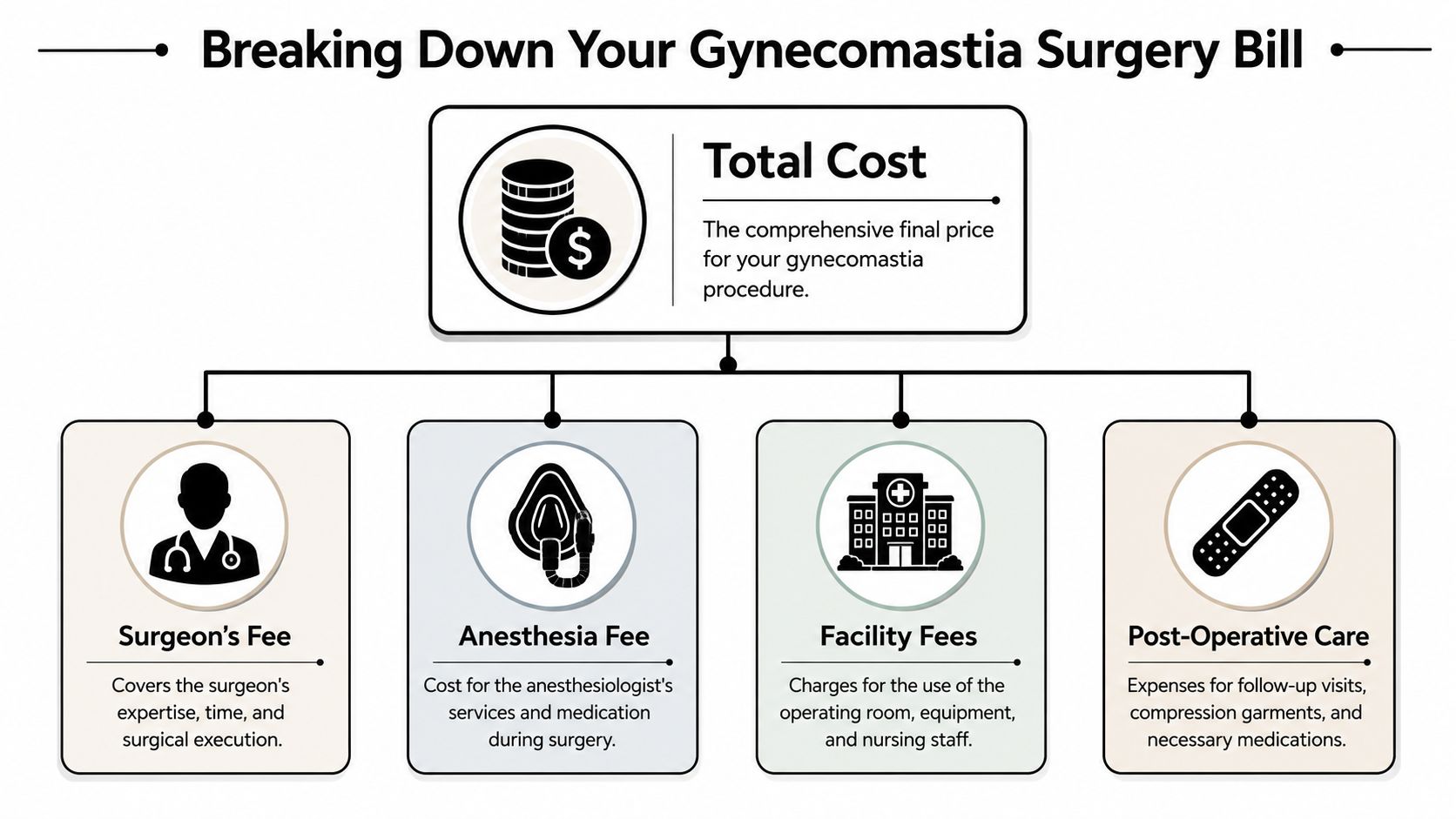
| Cost component | What you're paying for |
|---|---|
| Surgeon's fee | Surgical expertise, planning, technique, and the procedure itself |
| Anesthesia fee | The anesthesia professional's time, medications, and monitoring |
| Facility fee | The operating suite, equipment, supplies, and staff |
That structure matters because some practices advertise only the first line item. Patients see a surgeon's fee and assume that's the surgery cost. It isn't.
Surgeon's fee
This is the value of judgment and execution. You're paying for the assessment of your chest, the choice of technique, the contouring plan, and the skill to remove tissue cleanly while aiming for a natural masculine result.
Anesthesia fee
This covers the anesthesia provider and the medications used during surgery. GoodRx notes that anesthesia fees add $800 to $1,500, which is why a quote that leaves anesthesia out is incomplete.
Facility fee
This is the cost of the operating environment. It includes the surgical suite, sterile setup, equipment, recovery support, and staff. A proper facility is not where you want bargain-basement shortcuts.
Post-operative care
Compression garments, medications, and similar recovery items may seem small compared with the surgical fee, but they still matter and should be disclosed clearly.
A good quote should read like an itemized invoice, not a mystery number scribbled on a business card.
Ask this in plain language: "What is my total all-in quote, and what is not included?"
That one sentence saves patients from most financial surprises.
A Cape Cod patient with a small, puffy nipple concern should not budget the same way as a patient with heavy gland, loose skin, and a chest that needs reshaping. That is the budgeting mistake I see all the time.
The final number changes because the operation changes. Grade matters first. It affects how much tissue has to come out, whether liposuction alone is enough, whether gland excision is needed, and whether the skin can shrink on its own or has to be tightened surgically.
Mild gynecomastia is often a shorter, more straightforward correction. A moderate case usually calls for a combination approach because fat and dense gland tissue behave differently. A more advanced chest often requires extra contouring work and, in some cases, skin removal or tightening to avoid a deflated or uneven result.
That added work increases operating time and technical complexity. It also changes the recovery plan.
Use this framework:
This is the part many national average articles miss. A flat average can be misleading if your chest falls clearly into a mild or advanced category. If you are budgeting for surgery on Cape Cod, that distinction matters even more because local pricing reflects both case complexity and the standard of care patients expect in this market. If you want a broader sense of how cosmetic procedure pricing is structured, this guide to cosmetic surgery costs on Cape Cod gives helpful local context.
A short explainer can help if you'd like to hear a surgeon discuss the topic more visually:
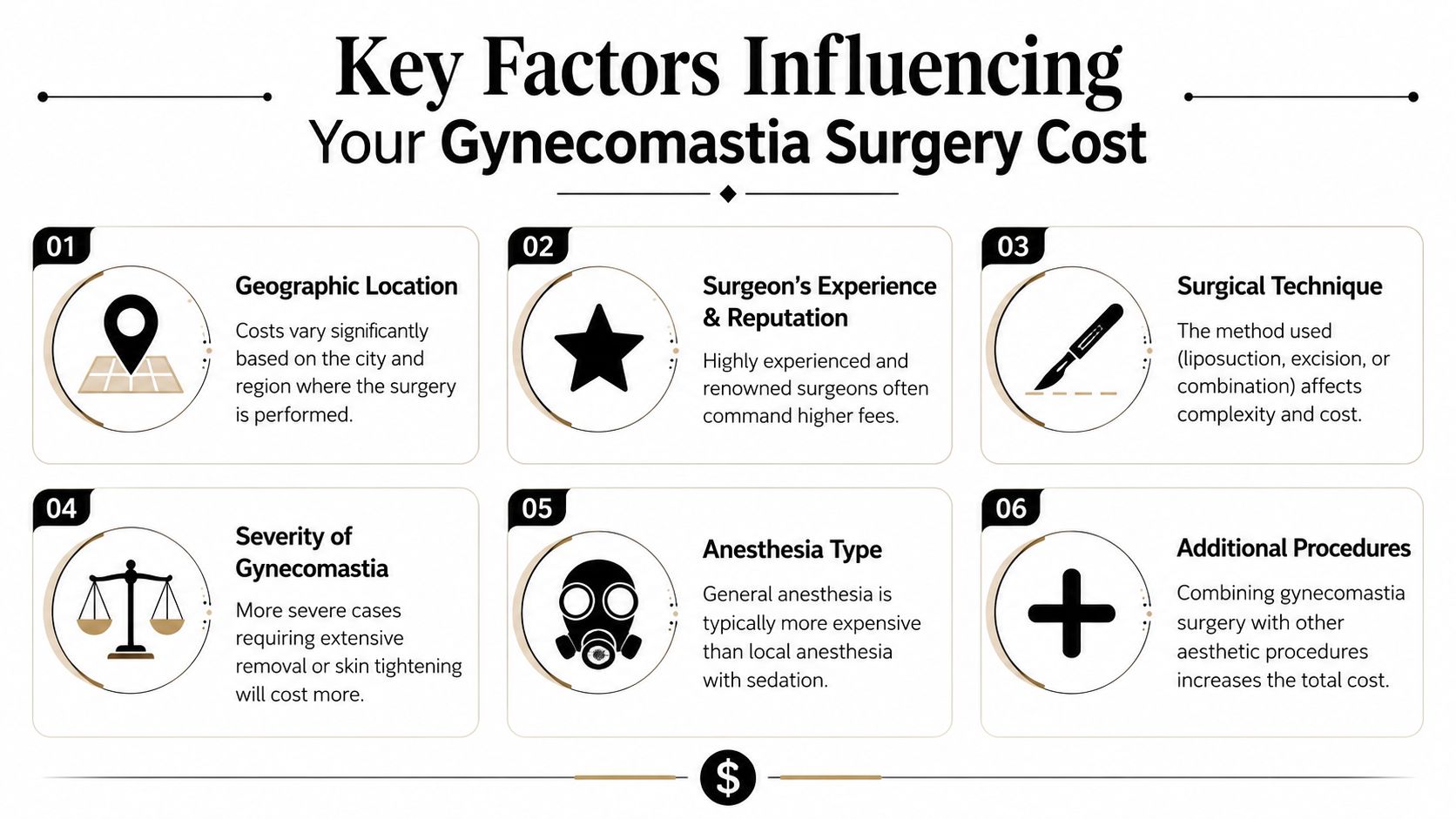
| Factor | Why it matters |
|---|---|
| Geographic location | Regional overhead, staffing, and facility costs affect pricing |
| Surgeon's experience | A surgeon who treats gynecomastia regularly often charges more for that judgment and consistency |
| Technique used | Liposuction alone costs differently than excision, contouring, or skin reduction |
| Additional procedures | Combining surgery increases total operating time and total fees |
A very low quote deserves scrutiny. Ask exactly what grade the surgeon believes you have, what technique is planned, and whether the proposed result matches your goal.
Cheap surgery can become expensive if the first operation leaves behind gland tissue, contour irregularities, or loose skin that should have been addressed the first time.
A patient calls after seeing one online quote for $5,000 and another for $14,000. He assumes one office is overpriced. Usually, the underlying issue is that the two quotes are not for the same operation.
Gynecomastia pricing changes sharply based on the grade being treated. A smaller grade with limited gland removal and liposuction is a very different surgery from a larger grade that needs wider excision, contouring, and skin management. If you budget from a flat national average alone, you can end up thousands of dollars off.
National ranges are broad for that reason. Some cases are straightforward. Others take more operating time, more surgical planning, and more follow-up. That spread matters more than the headline average.
Cape Cod is not a bargain market, and that is not a bad thing. Patients here usually want privacy, responsive staff, careful follow-up, and a surgical setting that feels organized and professional. Those expectations affect price.
Local quotes also reflect the type of case being treated. A Grade 1 or mild Grade 2 case may fall toward the lower end of a practice's range. A more advanced case, especially one with skin excess or a need for stronger chest reshaping, will move higher. That is the comparison that helps you plan.
If you want a wider local benchmark, this guide to cosmetic surgery costs on Cape Cod shows how regional overhead, facility standards, and service levels shape pricing across procedures.
A Chicago quote, a Dallas quote, and a Cape Cod quote can all be reasonable. They still may represent completely different surgeries.
Ask better questions:
That last point gets ignored too often. Practices handle financial responsibility in different ways, and patients should understand the paperwork before surgery. A plain-English explanation of medical billing noncoverage notices can help if you want to understand how offices document out-of-pocket costs.
Cheap quotes create problems. If gland tissue is left behind, contouring is incomplete, or loose skin is ignored, revision surgery can cost more than doing it properly the first time.
The smart way to budget is simple. Get quoted for your grade, make sure the quote is all-inclusive, and compare the plan, not just the price.
A man from Cape Cod comes in expecting a simple answer on cost. Then he learns his quote depends on two separate questions. Will insurance treat his case as medically necessary, and if not, how will he pay for the full surgical plan his chest grade requires? This is the financial fork in the road.
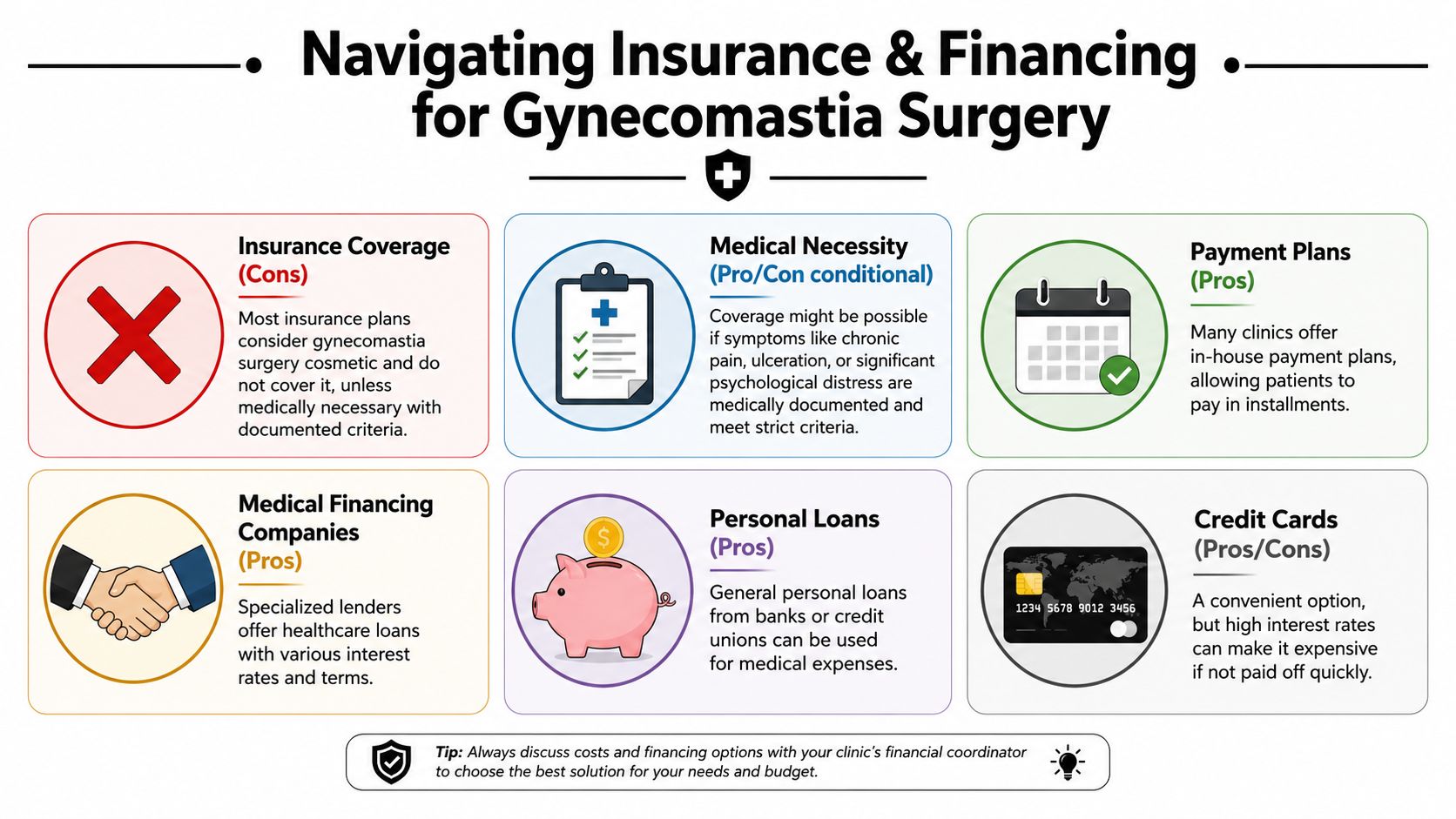
Most gynecomastia surgery is paid out of pocket. Say that upfront and plan from there. Insurance can help in a narrow group of cases, but you should treat coverage as a possibility to verify, not a budgeting strategy to count on.
Insurance may be considered if your surgeon documents a medical issue rather than a cosmetic concern alone. Every carrier has its own rules. Some want records showing persistent symptoms. Some want proof that the breast enlargement is not caused by a medication or another untreated condition. Some deny coverage unless conservative treatment has already failed.
Ask the office direct questions:
If your procedure is not covered, the paperwork still matters. A plain-English guide to medical billing noncoverage notices can help you understand how practices document patient financial responsibility before treatment.
The biggest mistake patients make is financing a teaser number. A grade 1 case treated with limited liposuction and excision is a different financial commitment from a grade 3 or 4 case that may need broader contouring and skin management. That difference matters everywhere, and it matters on Cape Cod too, where facility standards and seasonal operating costs can push the total higher than patients expect.
Use financing to cover the full quote, not just the deposit. Include the procedure, garments, prescriptions, time off work, and any follow-up costs the practice does not bundle into the fee.
Common payment paths include:
Medical financing companies
Many plastic surgery offices offer third-party financing designed for elective procedures. These applications are usually quick, but the interest rate and repayment period matter more than the monthly payment alone.
Practice-based payment options
Some offices allow staged payments before surgery. This can work well for patients who are planning ahead and want to avoid borrowing the entire amount.
Personal loans or credit cards
These are familiar options, but they can become expensive fast if the rate is high or the balance lingers.
If you want a practical breakdown of those choices, read this guide on how to finance cosmetic surgery.
This is my advice to every patient coordinator candidate and every patient. Build your budget around the highest realistic version of your plan, not the lowest advertised one.
If your chest grade suggests a more involved operation, finance accordingly. If insurance later helps, great. If your final quote comes in lower, even better. But if you budget for a mild case and your exam shows a more advanced grade, you will feel cornered at the exact moment you should be making a calm decision.
The consultation is where cost stops being theoretical and becomes useful.
Until a surgeon examines your chest, a firm quote is just guesswork. Photos can help. Online research can help. Neither replaces an in-person assessment of tissue type, skin quality, asymmetry, and the surgical approach needed to get a result that looks right.
A proper consultation should include:
That last point matters. A consultation isn't just a medical visit. It's the moment where good planning starts.

Patients who skip careful consultation often compare numbers instead of plans. That leads to bad decisions. One office may quote for liposuction alone. Another may quote for liposuction plus gland excision and contour correction. Those are not competing bids for the same operation.
The most expensive mistake isn't paying more for the right surgery. It's paying less for the wrong one and needing another procedure later.
Write these down and bring them with you:
That conversation gives you the only number that really matters. Your number.
A patient gets a quote that looks manageable, then starts adding up prescriptions, a compression garment, and pre-op testing. That is how a reasonable plan turns into a stressful surprise.
Ask for a written list of every expected expense tied to recovery. Common add-ons include garments, medications, lab work, and pathology if tissue is sent for review. On Cape Cod, where some patients coordinate surgery around seasonal work or travel off-Cape, missing these details creates budgeting problems fast.
Usually, yes.
Revision cases take more planning because the surgeon may be dealing with scar tissue, contour problems, leftover gland, or skin that did not retract well after the first operation. The bill often reflects that added complexity. This is one more reason grade matters so much. A patient with a mild grade who gets liposuction alone when gland excision was needed may spend less up front and much more later.
It can be. According to Bookimed's international gynecomastia surgery pricing overview, the average cost in Turkey is $3,100 and Mexico ranges from $2,750 to $4,250, with savings of 30 to 50% compared to the U.S. The same source also notes that lower pricing can come with different standards of care, follow-up challenges, and added risk.
My advice is simple. Do not compare airfare-plus-surgery against a local quote and assume you are comparing the same thing. Ask who manages a hematoma, contour issue, or wound problem after you return home. If you live on Cape Cod, convenience matters. So does having your follow-up care close enough that you can use it.
No. But it needs a close look.
A lower quote may be perfectly reasonable for a low-grade case that needs a smaller operation. It may also mean the plan leaves out gland excision, skin tightening, anesthesia, or facility fees. Price only makes sense once you know exactly what grade is being treated and exactly what operation is being proposed.
Use the same standards for every office.
The primary goal isn't to find the cheapest gynecomastia surgery cost. You want the correct operation for your anatomy, with clear pricing and no vague gaps in the plan.
September 9, 2026
Expert Guide to Proper Surgical Incision Care

Master dermal fillers aftercare with do's and don'ts, swelling tips, activity limits and warning signs to protect your results and heal smoothly.

September 8, 2026
Ensuring Safety: Why Your Surgeon's Credentials Matter Most

Cape Cod Plastic Surgery offers expert cosmetic and reconstructive procedures in a safe, accredited setting. Led by Dr. Marc Fater, we combine advanced techniques with personalized care to help you look and feel your best.
Monday: 9:00 AM – 5:00 PM
Tuesday: 9:00 AM – 5:00 PM
Wednesday: 9:00 AM – 5:00 PM
Thursday: 9:00 AM – 5:00 PM
Friday: 9:00 AM – 5:00 PM